Showing posts with label JP Morgan. Show all posts

Saturday, December 28, 2013

Get ready for your new landlords

You mean JP Morgan partnered up with Deutsche Bank who owns Blackstone. Ready for it??? Your new landlords with  be not the King of foreclosure anymore , but the next biggest fraud bank. This is pure bullshit! They are just passing these fraudulent notes back and forth , so you can never digg deep enough to find the truth. Now how about for once these two ponzi schemers tell the truth!


Blackstone Gets $252M Repo Financing


Blackstone Mortgage Trust Inc. has entered into a master repurchase agreement with JPMorgan Chase Bank which calls for advances up to 153 million pounds ($252 million) to purchase loans secured by English properties.
The agreement was disclosed on an 8-K filing obtained via DisclosureNet.com.
Advances are priced at Libor plus between 200 and 325 basis points depending on the attributes of the purchased assets. The maturity date is Dec. 20, 2016.
Blackstone is a commercial mortgage real estate investment trust headquartered in New York which purchases loans on properties located in the U.S and in Europe.


 YOU GOTTA LOVE THIS ONE. THEY CAUSE MILLIONS OF FRAUDULENT  FORECLOSURES AND NOW ARE YOUR NEW LANDLORDS. 

Blackstone has spent $7.5 billion on about 40,000 homes, the most of any firm after homes prices plunged as much as 35 percent from the 2006 peak. The New York-based firm has obtained $3.6 billion in credit lines from lenders led by Deutsche Bank. Christine Anderson, spokeswoman for New York-based Blackstone, declined to comment on the bond offering, which is also being arranged by Credit Suisse Group AG and JPMorgan Chase & Co. (JPM)
Renters in the U.S. occupy about 14 million single-family homes worth as much as $2.8 trillion, according to Goldman Sachs Group Inc. Demand for leased housing is increasing as fewer Americans are able to qualify for a mortgage after the financial crisis, which forced millions of homeowners into foreclosure.

 ALL THE THIEVES JOIN TOGETHER 
http://en.wikipedia.org/wiki/The_Blackstone_Group

Thursday, December 19, 2013

Well I warned you

 This is true. I paid off First Premier Bank CC in 2004, when owned by Washington Mutual. Recently I had letters arriving asking for settlements and people calling my family  telling them I could go to jail if I didn't pay. They updated it weekly on my credit report as well. I went to my VT AG who addressed this with them and guess what? They never responded .Chase and JP are selling these to recovery sites even if they were paid off.  

Chase and JP claim to own these and sell them and claim to own the notes and sell them and foreclose . Now , they are claiming they don't , and cry wolf cause they were caught and want to sue the FDIC.. ah NO ! You lied Chase and JP and its now time you face your karma! I warned you .


JP Morgan Sues FDIC for WAMU Cash Over Disputed Mortgage Bonds

by Neil Garfield
EDITOR'S NOTE: The dots are starting to get connected. Here JP Morgan who said they were the successor for everything that was WAMU turns out to be arguing that this didn't actually happen and that some money is still left in the WAMU "estate." The issue that is not raised is what else is in the WAMU estate? I content that there are numerous loans or claims to loans that were never transferred to anyone successfully and I think the FDIC and JPM both know that. Chase is trying to limit its exposure for bad bonds while at the same time claiming ownership or servicing rights for the underlying mortgages.
Which brings me to a central procedural point: if these cases are to be properly litigated such that the truth of the transaction(s) comes out, then it cannot be done on the rocket docket of foreclosures. It should be assigned to regular civil litigation or even better complex litigation because the issues cannot be addressed in the 5-10 minutes that are allowed on the rocket docket.
------------------------------------------------------------------
  • JPMorgan (JPM) has sued the Federal Deposit Insurance Corp. for a portion of the $2.7B remaining in the FDIC receivership that liquidated Washington Mutual following the sale of its branches and deposits to JPMorgan for $1.88B during the financial crisis in 2008.
  • The lawsuit is the latest development in the dispute between JPMorgan and the FDIC over who should assume Washington Mutual's legal liabilities, such as those related to the sale of problematic mortgage bonds.
  • Meanwhile, JPMorgan has been sued by the State of Mississippi for alleged misconduct while going after credit-card users for missed payments. The bank's sins include pursuing consumers for money they didn't owe, Mississippi said.
  • The state is the second to sue JPMorgan over the issue, the other being California, while 15 others are examining the matter. JPM is already in early settlement talks with 14 of them.

Tuesday, December 3, 2013

Wamu Breaking news

Who knows what will happen when all is said and done.. Just might be that Karma will hit many, namely Deutsche Bank and JP Morgan and Chase. One can only hope.


Bloomberg News
DEC 3, 2013 12:58pm ET
Ex-WaMu CEO Said to be Near Settlement in Bank Failure


Former Washington Mutual Inc. Chief Executive Officer Kerry Killinger and two other bank officials are in settlement talks with the Office of the Comptroller of the Currency, the last chapter in the government’s probe of the largest U.S. bank failure.

The regulator is weighing a settlement with Killinger, former chief operating officer Stephen Rotella and David Schneider, former head of the home-loan division, over claims they mismanaged the Seattle-based thrift, according to a person who was briefed and spoke on condition of anonymity because the talks aren’t public.

The person, who said the talks have entered the final stage, didn’t describe the terms being discussed. The details of a deal would need the approval of senior OCC officials.

Washington Mutual, which was the nation’s largest savings and loan and one of the largest subprime lenders, became a public symbol of the excesses of the housing bubble. The thrift and its subprime arm “engaged in a host of shoddy lending practices that contributed to a mortgage time bomb,” the Senate Permanent Subcommittee on Investigations said in a 2011 report.

The bank was seized by regulators in September 2008 after reporting that it faced $19 billion in losses from soured mortgages. JPMorgan Chase & Co. bought remnants of the thrift and has since struggled to unwind itself from liability for Washington Mutual’s faults.

In 2011, Killinger, Rotella and Schneider reached a $64 million settlement with the Federal Deposit Insurance Corp., which liquidated the bank. The FDIC sued the three executives for failing to tend to the thrift’s safety while they received more than $95 million in compensation from 2005 until its collapse. Most of their payments under the settlement were covered by Washington Mutual’s insurance policy.

The OCC’s separate investigation stems from the agency’s 2011 merger with the Office of Thrift Supervision, which had supervised Washington Mutual.

Daniel W. Turbow, a lawyer at Wilson Sonsini Goodrich & Rosati who has represented Killinger, declined to comment. Rotella, now CEO of New York-based StoneCastle Cash Management LLC, didn’t immediately respond to a request for comment. Schneider, who until this year was CEO of Vericrest Financial Inc., an Irving, Texas, mortgage servicer, didn’t return a message left at a phone number listed to his name in New Jersey.

Bryan Hubbard, an OCC spokesman, declined to comment on the talks.

A Justice Department investigation into Washington Mutual ended in August 2011 without charges filed.

The report from the Senate panel, which is led by Senator Carl Levin, a Michigan Democrat, found that Washington Mutual “produced hundreds of billions of dollars of poor quality loans that incurred early payment defaults, high rates of delinquency, and fraud.”

Killinger advised his bank’s board in June 2006 that the company should be “in position to grow its market share” in high-risk lending—including subprime loans—according to an internal memo published in the Senate investigation. The report said Killinger pushed a plan to “significantly curtail” low-margin, safer loans in a shift toward higher risk.

Two months earlier, Schneider had given a presentation suggesting the bank should almost double its subprime volume by 2008, according to the Senate report. Emails between Rotella and Killinger in 2005 showed Rotella also encouraging subprime and home equity loan growth, according to the report.

Killinger said in court filings in the FDIC lawsuit that examiners from the FDIC and OTS were stationed at the bank and were aware “in real time” of business decisions the FDIC later challenged. Killinger, Washington Mutual’s CEO for 18 years, told Levin’s panel in 2010 that his bank could have survived the crisis but U.S. officials denied Washington Mutual help offered to other financial firms.

The bank—in business for 119 years—had enjoyed a string of acquisitions and explosive growth in its final years, adopting a new advertising slogan in the months before its collapse: “Whoo hoo!” In U.S. history, the scale of its bankruptcy was eclipsed only by Lehman Brothers Holdings Inc.

JPMorgan, as part of its $13 billion settlement with the government last month, agreed it wouldn’t continue to press the FDIC to cover some of the losses from defective mortgage securities sold by Washington Mutual before it was acquired.

Monday, September 9, 2013

Chase Settles Suit Alleging Kickbacks on Force-Placed Insurance

Chase Settles Suit Alleging Kickbacks on Force-Placed Insurance


JPMorgan Chase has agreed to stop accepting commissions from the nation's top provider of force-placed insurance in an agreement that could loom large for other big banks alleged to have overbilled homeowners on insurance premiums.
Under a settlement filed Friday in U.S. District Court in Miami, Chase and insurance company Assurant would also make payments to up to 1.3 million mortgage holders nationwide who were allegedly overcharged during the last five years. The agreement would resolve a suit filed on behalf of homeowners that hold Chase mortgages.
The payments—equal to 12.5% of the insurance premium each affected homeowner was charged—could total as much as $300 million, according to a document filed by the plaintiffs' lawyers. In addition, plaintiffs' lawyers could get up to $20 million.
Potentially more important, though, are the changes Chase and Assurant agreed to make to their business arrangements, which could affect future settlements involving other big banks. Under the deal, Chase agreed not to take commissions—widely characterized as kickbacks—or to engage in certain reinsurance arrangements with Assurant for six years.
Force-placed insurance is a type of property insurance—intended to protect the mortgage investors' stake—that banks purchase when homeowners' policies lapse. Though banks buy the insurance, they typically pass along the cost to homeowners or to investors, including Fannie Mae and Freddie Mac.
For years, banks have been able to pad their profits by aligning with insurers that set insurance premiums extremely high and then used various methods to funnel much of the money back to the bank.
Chase spokeswoman Amy Bonitatibus said in an email Monday that the New York bank discontinued its reinsurance agreement earlier this year. "The settlement will have no expected impact on our financials," she stated.
The proposed settlement is subject to approval from a judge. An Assurant spokesman said in an email that the company is unable to comment on the agreement while the case is still pending.
A lawyer for the plaintiffs, Adam Moskowitz of Kozyak, Tropin & Throckmorton in Coral Gables, Fla., said that a confidentiality agreement prevents him from commenting on the settlement.
His firm has also filed suits involving force-placed insurance against Citigroup, Bank of America and HSBC. Moskowitz said that other defendants have contacted his firm about starting mediation talks similar to those involving Chase and Assurant.
"We are looking forward to working with all of the defendants to resolve all of these cases," Moskowitz said.
In May, Wells Fargo and the other giant in the force-placed insurance industry, QBE, agreed to settle a related suit. That settlement featured larger potential payouts to homeowners than the Chase-Assurant settlement does, but it did not include the same restrictions on future business arrangements.
Still, the reforms agreed to by Chase and Assurant do not go as far as an agreement that Assurant reached in May with New York authorities. For example, the settlement filed Friday does not set a permissible loss ratio as a way to reduce homeowners' premiums.
New York officials found that Assurant subsidiaries paid no more than 24.7% of its premiums in claims between 2006 and 2011, and its March settlement with the company established a 62% permissible loss ratio.
When the New York settlement was announced, Empire State officials stated that Chase had made approximately $600 million over the previous seven years by taking 75% of the profits from the business it sent to Assurant.
Unlike the New York settlement, the agreement filed Friday would be binding across the country, assuming the court approves it.

Saturday, August 17, 2013

Got some good reading herefor everyone

The enforcement actions were based on interagency examinations conducted in the fourth quarter of 2010. A summary of the findings of the interagency reviews is available in the Interagency Review of Foreclosure Policies and Practices, which was produced by the OCC, the Board of Governors of the Federal Reserve System, and the OTS.

Links to the OCC and former OTS Enforcement Actions (Issued April 2011):

Links to Enforcement Action Amendments for Servicers Entering the Independent Foreclosure Review Payment Agreement (Issued February 2013):

Just hit link in the blue 

Wednesday, August 14, 2013

Break-up-the-big-banks fever hits the states


Its time to wake up our State Legislatures, and demand that they stand with others to bring down to big to fail! We also need to tell them private hedge funds trying to pass the fraudulent mortgage notes these banks had, are also fraud!!

A JPMorgan Chase Bank is pictured. | AP Photo
So far, only Maine and South Dakota have approved a Glass-Steagall resolution. | AP Photo
Elizabeth Warren’s effort to break up Wall Street banks through a return to Depression-era laws may not have a lot of support in Congress, but it has a sympathetic audience in state capitals across the country.
Lawmakers in at least 18 states have introduced resolutions this year calling on Congress to split up banking giants by putting back in place a wall between commercial banking, taking deposits and making loans, and investment banking, the world of traders and deal-makers.


Five years after the 2008 financial crisis and three years after enactment of the 2010 Dodd-Frank law, these symbolic resolutions show there is still a significant amount of public anger toward big banks.
And if these proposals gain enough traction in state legislatures, a growing number of members of Congress could feel pressure to get behind this effort to reinstate the 1933 Glass-Steagall Act — a cause Warren championed as a candidate and has reinvigorated as a freshman Massachusetts senator.

“We on the state level have been looking for an Elizabeth Warren — someone to carry this banner for us,” said Illinois state Rep. Mary Flowers, a Democrat who is the lead sponsor on a resolution introduced in May that urges Congress to reinstate Glass-Steagall, which was repealed in 1999.
Maryland Democratic state Del. Aisha Braveboy, who co-sponsored a resolution in her state, said: “She is the inspiration.”
So far, only Maine and South Dakota have approved a Glass-Steagall resolution. The states where lawmakers are pressing the issue include Mississippi, Pennsylvania, Alabama and California.
This week, the National Conference of State Legislatures will vote on a Glass-Steagall resolution introduced by Delaware Republican state Sen. Catherine Cloutier at its legislative summit in Atlanta.

Large banks aren’t taking the issue lightly.
Take Delaware — corporate home to the credit card operations of several banks.
When a group of bipartisan state senators introduced a resolution in June calling for a return to Glass-Steagall, four lobbyists — including those working on behalf of JPMorgan Chase and Bank of America — showed up at a hearing to denounce the idea. The resolution was shelved.
“I can’t say I was really surprised by the pushback,” said state Sen. Bruce Ennis, a Democrat who is one of the resolution’s co-sponsors. “They don’t want to rock the boat.”
Delaware state Sen. Robert Venables, a Democrat and another co-sponsor, added: “I’m 80 years old and I remember the aftermath of the Great Depression — this was why it was put in. And then the Clinton administration repealed it.”
Not all state lawmakers pushing for a breakup of big banks cite Warren, a liberal who came to prominence because of her calls to get tough on Wall Street, as an inspiration. Several are conservatives with a tea partier’s dislike of Wall Street and the taxpayer bailouts that resulted from the financial crisis.
In South Dakota, state Rep. Stace Nelson — a self-described tea partier with a “mean libertarian” streak — and other state lawmakers urged Senate Banking Committee Chairman Tim Johnson (D-S.D.) last month to support Glass-Steagall after the state Legislature adopted the measure earlier this year.
“People are gravely concerned about what has happened on Wall Street with the bailouts and the government getting involved,” said Nelson, who has formed a 2014 Senate exploratory committee.

Read more: http://www.politico.com/story/2013/08/break-up-the-big-banks-fever-hits-the-states-95481.html#ixzz2byMu8N8o

Saturday, August 10, 2013

JP Morgan,Chase,Washington Mutual , Long Beach Mortgage What they have in common

No Jamie, your not responsible for anything that goes wrong. The housing collapse, the fraud committed with Washington Mutual  and Long Beach mortgages, YOU had in your possession, Your employees even stated , yes, in writing to the VT AG and the OCC and a lawyer, Yes, we own both loans, and sent copies of both the mortgage and the note and the HUD paperwork. A year later , suddenly, whoops, we don't own the first, but we do have the second, and were gonna write the second one off as paid and satisfied . So , how did you also have in hand BOTH a year earlier? How was it also, it showed up in a private hedge funds hands a year and a half later, when after 7 years only you were able to show proof of both notes? How many other people who had Washington Mutual  and Long Beach notes did you fraud this way?

You SIR need to go to jail with no pass. Instead of throwing your employees under the bus, how about being a man, and taking responsibility for your wrong doings for a change? I forgot, your no man, your a coward. Your karma will come ..its a matter of time. Your no different than Bernie Madoff .. except your fraud has gone global, and he paid for his crimes and you run from it.

Two former JPMorgan Chase employees are expected to be arrested for their role in the so-called "London Whale" scandal that lost the bank roughly $6.2 billion last year, The New York Times reports. The arrest of the employees, Javier Martin-Artajo and Julien Grout, will reportedly take place in London.
Not among those expected to be charged is the London Whale himself, one Bruno Iksil, who built up the massive positions in the derivatives market that eventually cost the bank billions, according to a Reuters report published Thursday. According to a later report, Iksil will have to play a key role in any arrests related to the scandal.
On Thursday, Reuters reported that JPMorgan, the largest bank in the country by assets, was close to a settlement with the Securities and Exchange Commission over the scandal in which the bank would admit fault, a relative rarity on Wall Street.
The Federal Bureau of Investigation and federal prosecutors are separately investigating whether company employees underrepresented the scandal's potential fallout to investors in a 2012 meeting, according to a separate New York Times report.
The company's chief executive officer, Jamie Dimon, early on described the scandal as a "tempest in a teapot," an opinion he later described as "dead wrong," according to the Wall Street Journal. But Dimon has maintained that he did not purposefully deceive anyone with his initial comments. "There was no hiding, there was no lying, there was no bullshitting, period," he said of the scandal In June.

Monday, August 5, 2013

Why you should change banks

 Lets not leave out US BANK corp.. they have had there hands in full swing on foreclosures , and supplying private hedge funds with cash to buy your homes, most illegally.


9 Reasons To Change Banks – Switch From Wall Street

Reason #1: People Who Change Banks Like It

change banks satisfaction
People who bank with local lenders are far more satisfied than those who bank on Wall Street. (source)


Reason #2: The Wall Street Banks Are Still Too Big to Fail

if the biggest banks were too big to fail aligned


Reason #3: The Wall Street Banks Are Still Too Big to Jail

HSBC drug laundering


Reason #4: The Wall Street Banks Are Too Big to Manage

sheila bair bull by the horns too big to manage
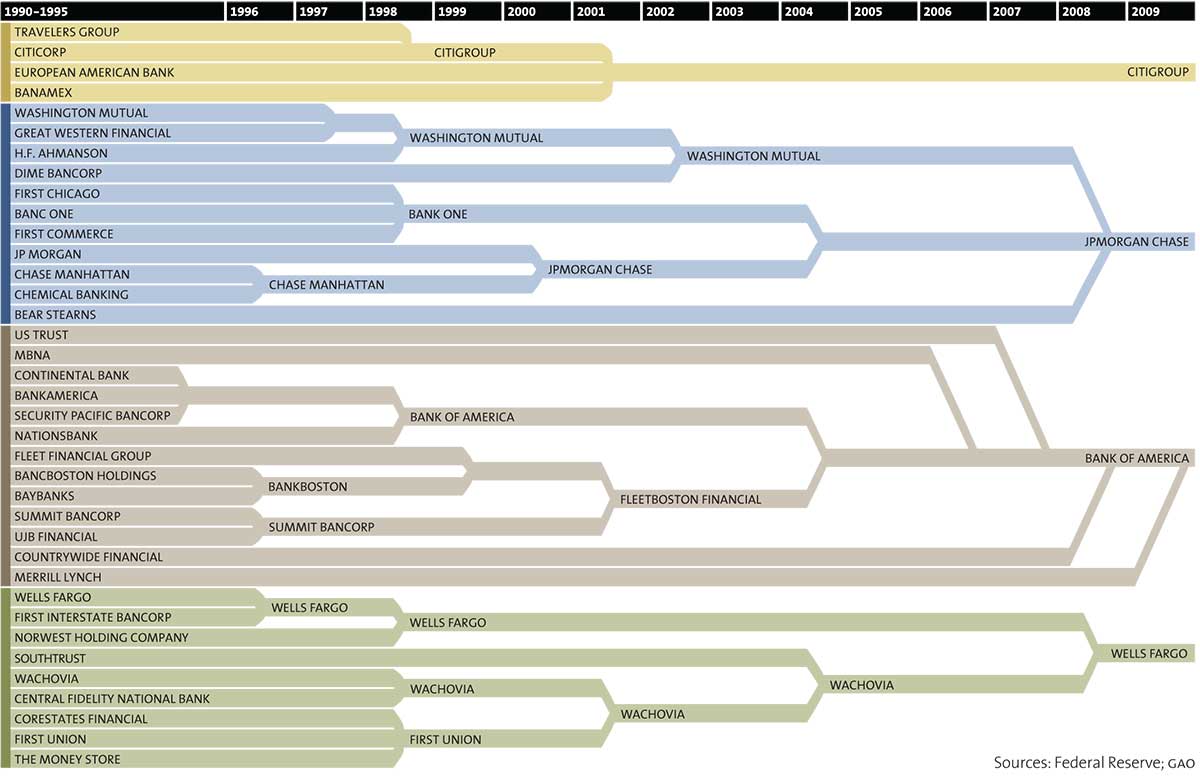
The megabanks have grown tremendously over the past two decades, making it harder for them to properly manage all their various international pieces.
bank concentration timeline
SOURCE


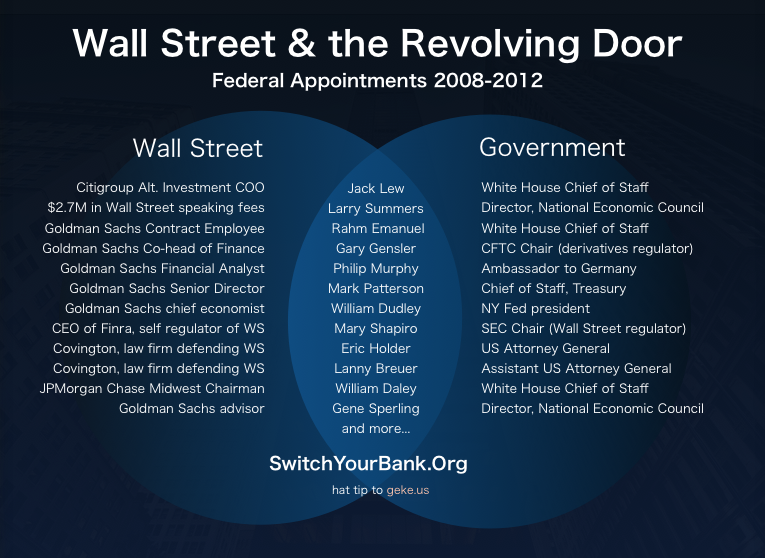
Reason #5: Wall Street Has Captured Washington

Wall Street revolving door


Reason #6: Wall Street Continues To Gamble With the Economy

Gambling on Wall Street lies behind boring, impenetrable names like credit default swaps, synthetic credit derivatives, and mortgage-back securities. All of these bets are types of derivatives. The financial crisis of 2008 occurred largely because these particular derivatives bets went bad. And yet the worldwide derivatives market continues to explode, from under $100 trillion in notional value in 2000 to over $700 trillion in 2011.
Worldwide Derivatives
SOURCE
What’s more, nearly half of the worldwide derivatives exposure is centered in the United States, and 95% of the total U.S. derivatives exposure comes from 5 megabanks.
wall street derivatives
SOURCE


Reason #7: Small Lenders Charge Less in Fees

wall street fees
Smaller lenders charge less in account fees, overdraft fees, and off-us ATM fees, as shown in a study from the PIRG Education Fund. According to the study, a substantive portion of small lenders belong to ATM networks that don’t charge anything if you use an ATM which doesn’t belong to your financial institution. That’s better than some megabanks offer.


Reason #8: Small Lenders Are Far More Likely to Offer Totally Free Checking

lower checking
Small financial institutions are more likely to offer totally free checking accounts. No loopholes or snags. Chart from the Institute of Local Self-Reliance.


Reason #9: Small Lenders Are Far Better For Your Community

If you want to support local job creation, one way to do it is to support local lenders.
bank local
Local lenders also make nearly 40% of small business loans, even though they only have 10% of total bank assets. (source)
bank local

Conclusion – Why Change Banks?

The problem with the megabanks is that they’re locked in a destructive cycle of being too big to manage, too big to fail, and too big to jail. They continue to have unpredictable, catastrophic losses. The losses lead inevitably to declarations of “too big to fail” (and bailouts). Being “too big to fail” means that the megabanks can’t be prosecuted without endangering the entire economy (or so they say), which makes the megabanks even bigger—and, again (back to the start!), too big to manage.
Therefore:
If you want to help end “too big to fail,” if you opposed the megabank bailouts, if you’re tired of megabanks getting away with crime, if you recognize that these institutions have become too big to manage, if you want to ensure that we never repeat the vast injustice at play in the 2008 crisis, then switch your bank.
You might be thinking, “Yes, okay, Wall Street makes the economy dangerous. But there are plenty of things that make the economy dangerous—more than I could ever effectively boycott.”
That’s why, even if you don’t think changing banks will make much difference for the fiscal health of the nation, you should still change banks for many of the personal advantages listed above. Either, way changing banks to a local lender is a good idea.

Friday, August 2, 2013

The courts are finally getting it! I hope VT listens.

n the other hand we should not assume that they have arrived nor that this decision will have pervasive effects throughout California or elsewhere in the United States or other countries.
J.P. Morgan did suffer a crushing defeat in this decision. And the borrower definitely receive the benefits of a judicial decision that will allow the borrower to sue for wrongful foreclosure including equitable and legal relief which in plain language means reversing the foreclosure and getting damages. Probably one of the most damaging conclusions by the appellate court is that an examination of whether the loan ever made it into the asset pool is proper in determining the proper party to initiate a foreclosure or to offer a credit bid at a foreclosure auction.  The court said that alleged transfers into the trust after the cutoff date are void under New York State law which is the law that governs the common-law trusts created by the banks as part of the fraudulent securitization scheme.
Before you give them a standing ovation remember that it is possible for additional documentation to be created, fabricated and forged showing that despite the apparent violation of the cutoff date, the trustee has accepted the loan into the trust. This will most likely be a lie. I don't think there is any entity acting as trustee of a trust that doesn't know that it is under intense scrutiny and doesn't want to be subject to liability that could amount to trillions of dollars advanced by investors with the purchase of bogus mortgage-backed bonds that were presumably managed by the trustee but in reality not managed at all  because the bonds were worthless. This gave the banks the opportunity to claim that they owned the bonds and therefore had an insurable interest which gave rise to the whole problem with AIG and AMBAC and other insurers or parties who had guaranteed the bond, the loan or any loss (credit default swaps).
The fact that the loan in this case was definitely securitized is also interesting. Of course Washington Mutual was stating to everyone that it was not involved in the securitization of mortgage loans when in fact nearly all of the loans originated became subject to claims of securitization. This case explains why I never say that the loan was securitized or that the loan was in any particular trust, to wit: I don't believe that a funded trust exists with the ability to purchase loans and therefore I don't believe the loans are in any of the asset pools. So when people ask me how they can prove which trust their loan is actually in, I reply that they are asking the wrong question.
What is being played out here in this case and hundreds of thousands of other cases is a representation by the foreclosing entity that the trust owns the loan when in fact it never owned the loan nor could it because the money that was advanced by investors was never deposited into the trust. We have the same banks representing to regulatory authorities and insurers that it is the bank and not the trust that owns the loan even though the bank merely made the loan using money advanced by investors who believed that they were buying mortgage-backed bonds. The truth is they were merely making a deposit into an account maintained by the investment bank. The resulting transactions do not qualify for exemption as securities or insurance under the 1998 law. Nor do they qualify for REMIC treatment under the Internal Revenue Code.
In other words if you take a close look and actually follow the path of the money and the path of the paper you will find that despite the pronouncements from the Department of Justice and other agencies, this is a simple fraud case using a Ponzi model. The hallmark of a Ponzi model is that it collapses as soon as the investors stop buying the bogus securities. If the government cares to do so it can freely prosecute the individuals and companies involved without any air of exemption under the 1998 law because none of the parties followed the securitization path presumed by the 1998 law. So we are back to this, to wit: a security is a security and subject to SEC regulations and insurance is an insurance contract subject to insurance regulators, and fraud is fraud subject to recovery of restitution, compensatory damages, punitive damages, treble damages etc.
You should remember when reading this decision that the appellate court was not ruling in favor of the borrower granting the substantive relief the borrower  was seeking. The appellate court merely reversed the trial court decision to dismiss the borrower's claims. That only means that the borrower now as an opportunity to prove the elements of quiet title, wrongful foreclosure, slander of title, cancellation of instruments and relief under California's version of unfair business practices. But the devil is in the details and proving the case requires aggressive discovery and aggressive preparation for trial. It is highly probable that the case will settle. The bank will probably be willing to pay almost any amount of money to avoid a judgment setting forth the elements of a wrongful foreclosure and how the bank violated the law.
The Bank will attempt to avoid any final order that undermines the value of loans that are subject to claims of securitization, because those loans supposedly support the value of the bogus mortgage-backed bonds sold to investors.  Any such final order would also undermine the balance sheet of J.P. Morgan and any other major bank carrying the mortgage bonds as assets on their balance sheet. If those assets are diminished, then the bank is not as well funded as it has been reporting. In fact, those assets might well vanish completely from the balance sheet of those banks, causing the banks to be seized by the FDIC and broken up into smaller pieces for regional and community banks to pick up. Hence this decision represents a risk factor that could eliminate the legal fiction created by smoke and mirrors from Wall Street banks, to wit: it is not the borrowers who are deadbeats, it is the banks who are broke and whose management has run off with billions and perhaps trillions of dollars that should be in the United States economy. The absence of that money lies at the root of our unemployment and low economic activity.
This Glaski case has many of the elements that we have been discussing for years. Fabricated documents, forgeries, perjury, false affidavits and no money trail to backup the story painted by the fabricated documents. And of course it has our old friend Washington Mutual Bank And the supposed take over by Chase Bank that never actually happened.
And it involves the issue of assignments and the fact that the assignment is not the transaction itself but only a report of a transaction. If the borrower proves that the transaction reported in the assignment or other instrument of conveyance never occurred, or if the borrower is successful in shifting the burden of proof to the bank to show that it did occur, the assignment will have no value whatsoever unless the transaction is present, to wit: that someone actually purchased the loan through the payment of money or other valuable consideration that was received by a party who actually owned the loan.
Thus even if Chase Bank were able to show that it entered into a transaction in which the loans were transferred (something we can find no evidence of which the FDIC receiver says never occurred) that would only be the equivalent of a quit claim deed, to wit: whoever received the consideration for the transfer of the loans was merely conveying any interest they had even if they had no interest at all. Hence the transactions by which Washington Mutual allegedly came to be the owner of the loan must be examined in the same way as the transaction between the Washington Mutual bankruptcy estate and chase bank.
You should also take note that the decision was published with the admonition that it is  "not to be published in the official reports."  this is further indication that the court is concerned about the far-reaching effects of the decision and essentially tells trial judges that they do not have to follow it. So for those who wish to point to this decision and say "game over" we are not there yet. But I do think that we passed the halfway point and we are probably in the fifth or sixth inning of a nine inning game. Translating that to time, I would estimate that it's going to take another three or four years to clean up this mess and that it might take several decades to clean up the title corruption that was created by the banks.

Friday, July 12, 2013

JPMorgan Chase Fires Back At Warren-McCain Plan To Reinstate Glass-Steagall


Shocking news: JPMorgan Chase is not exactly jazzed about some recent plans to regulate banks, including Elizabeth Warren and John McCain's bill to reinstate the Glass-Steagall law splitting investment and commercial banks.
Even more shocking: JPMorgan seems to think it will probably be able to water down or avoid these plans.
In a Friday conference call to discuss the bank's second-quarter profits, an analyst asked whether the Warren-McCain bill to reinstate the Depression-era Glass-Steagall law would hurt business at the biggest U.S. bank by assets. JPMorgan's chief financial officer, Marianne Lake, dismissed the whole idea.
"Glass-Steagall didn't have anything to do with the crisis," Lake said, "and our business model allowed us to be a port in the storm. Our customers like doing business with us in the model we have now, so ..." She trailed off, took a long pause, and then added: "We don't spend time thinking about that."
In another not-exactly-stunning development, JPMorgan CEO and Chairman Jamie Dimon grumbled just a bit about new rules proposed by U.S. regulators this week limiting how much risk big U.S. banks will be allowed to take on. Specifically, he grumbled about how those rules are stricter than proposed global rules, and how that gap could make U.S. banks less competitive.
"If you have a world where some businesses have to have two times as much capital as other companies, over time that can create a huge competitive disadvantage," Dimon said. "We have interest in a safe and sound system, but not for a hugely imbalanced competitive playing field."
But Dimon also suggested that regulators are aware of these discrepancies and are trying to "harmonize" their efforts -- and who doesn't love harmony, especially when it makes it easier for banks to get more leveraged and dangerous?
Similarly, Lake suggested there were "fundamental issues" with proposed new rules limiting banks' riskiness and forcing them to seek out more capital. She suggested that regulators seem to be willing to consider having mercy on the banks and loosening up some of those fetters.
What is ironic is that the new capital and leverage proposals don't seem to create all that much of a hardship for banks, at least not for JPMorgan -- as DealBreaker's Matt Levine points out, the bank admits that about the worst that might happen is that it will not be able to shovel cash out the door to shareholders quite as quickly as it had hoped. Not exactly the econopocalypse bank flaks are predicting.
Anyway, seeing regulators back down on these rules would hardly be shocking. We have already seen aggressive bank lobbyists water down, muddle and delay implementation of the Dodd-Frank financial reform law. JPMorgan alone spent $8 million last year lobbying on financial reform and other issues, according to the Center for Responsive Politics.
As for the Glass-Steagall revival, the consensus on Wall Street and in Washington is that it stands pretty much no chance of becoming law. JPMorgan argues that its own size and complexity is super-attractive to customers, and that argument will probably win the day. The competing argument -- that the country enjoyed decades of relative financial calm after the segregation of bank activities after the Great Depression, and that it fell into a financial crisis not long after the removal of those safeguards -- is not taken seriously.
For what it's worth, Former Rep. Barney Frank -- the Frank in Dodd-Frank -- basically agreed with JPMorgan's Lake about Glass-Steagall, telling CNBC on Friday that he didn't think reinstating the law was nearly as important to the safety of the financial system as reforming the trade of the credit derivatives that nearly helped bring down that system the last time. And of course JPMorgan is lobbying hard on that issue, too.