Showing posts with label Glass-Steagall. Show all posts

Monday, September 9, 2013

Ex-Citi CEO John Reed: We Need To Break Up The Big Banks

Ex-Citi CEO John Reed: We Need To Break Up The Big Banks


Sen. Elizabeth Warren (D-Mass.) has a friend in former Wall Street CEO John Reed.
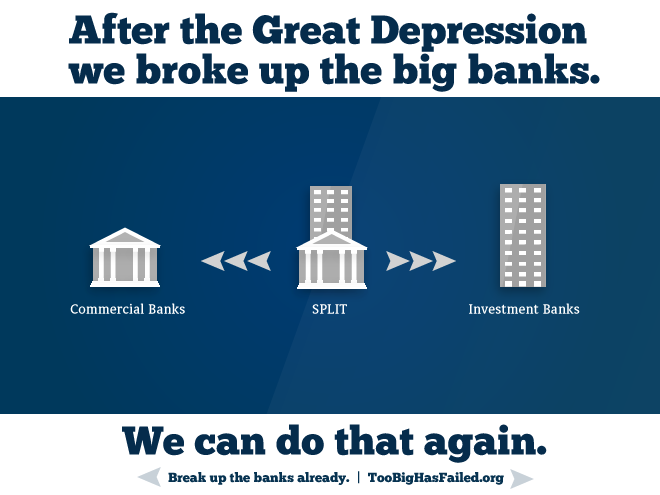
The former CEO of Citicorp, which merged with Travelers Insurance in 1998 to create the mega-bank Citigroup, told the Financial Times in an interview published Sunday that it's time to reinstate the Glass-Steagall Act. The act largely separated investment banking from commercial banking until its controversial repeal in 1999.
Reed, who played a critical role in the creation of Citigroup, now the nation's third biggest bank by assets, told the Senate Banking Committee in 2010 that he helped create "a monster" by combining Travelers and Citi.
Still today, he told the FT, bankers are being pushed to become more like high-risk traders and take bigger risks to get bigger payouts.
“These cultures [investment from commercial banking] don’t mix well and one tends to push out the other," Reed said. "It does result in institutions whose behavior isn’t necessarily productive for the economy."
Warren has Glass-Steagall on her radar as well, and proposed a bill earlier this year with Sen. John McCain (R-Ariz.) and others that aims to reinstate the division between investment and commercial banks. Some say the act's repeal helped create the conditions for banks to become "too big to fail" and require taxpayer bailouts.
Reed also argued his point in a 2009 letter to The New York Times, saying that separating commercial and investment banking activities “makes sense."

“Ah, if we could only clone her." Elizabeth Warren,

In a speech at an AFL-CIO convention on Sunday, Sen. Elizabeth Warren (D-Mass.) criticized the Supreme Court for being too right-wing and serving the interests of Big Business over the needs of Americans.
In voicing her support for the labor movement and promoting an agenda aimed at defending working families, Warren warned of conservative-leaning justices and a "corporate capture of the federal courts."
“You follow this pro-corporate trend to its logical conclusion, and sooner or later you’ll end up with a Supreme Court that functions as a wholly owned subsidiary of big business,” Warren said.
Warren said that Wall Street and major corporations are making it difficult for labor leaders to enact financial reform.
“The big banks and their army of lobbyists have fought every step of the way to delay, water down, block or strike down regulations,” Warren said. “When a new approach is proposed -– like my bill with John McCain, Angus King and Maria Cantwell to bring back Glass-Steagall -– you know what happens. They throw everything they’ve got against it."
“I believe that if people would be opposed to a particular trade agreement, then that trade agreement should not happen," she said.
Warren was citing a bipartisan bill aimed at separating lending and trading.
"Despite the progress we've made since 2008, the biggest banks continue to threaten the economy," Warren said in a written statement defending the bill. "The four biggest banks are now 30 percent larger than they were just five years ago, and they have continued to engage in dangerous, high-risk practices that could once again put our economy at risk."
After Warren concluded her speech, AFL-CIO President Richard Trumka praised the senator, saying, “Ah, if we could only clone her.”

Friday, August 23, 2013

Elizabeth Warren’s secret: The Salon interview


The senator tells Salon how one senator can wield tremendous power -- and (kind of) addresses those '16 rumors

Elizabeth Warren's secret: The Salon interviewMassachusetts Sen. Elizabeth Warren (Credit: Reuters/Eric Thayer)
It’s been well-documented that the 113th Congress specializes in getting nothing consequential done. While the nation’s supply of named post offices is apparently well-stocked, anything more critical has generally stalled out, with little hope to break the gridlock.
So let’s say you’re a high-profile freshman senator walking into this den of inertia, and you want to make your large following proud and advance your agenda, but you’re in no position to do that legislatively? How do you, Elizabeth Warren, find your way through this minefield, and even chalk up successes?
“It’s all about learning to use the new tools,” Warren told Salon in an interview this week. “In the Senate, there are more tools in the toolbox than are obvious.” Warren, now the senior senator from Massachusetts (Ed Markey, with a 37-year congressional career, is the junior member), has employed those more unconventional tools effectively, doing her part to both change the conversation around the financial industry inside and outside Washington, and change the sharpness of the regulatory response to financial misdeeds.
Warren sits on the Senate Banking Committee, which has marked up all of two bills so far this year (she played a role in both, passing an amendment to a national insurance licensing bill and working closely with the committee leadership on reforming the Federal Housing Administration). But she has really shone in oversight hearings, where she has gained a reputation for offering uncomfortable questions to regulatory officials about their lack of prosecuting criminal activity on Wall Street.  “Too big to fail has become too big for trial,” she said at a hearing in February. “How big do the biggest banks have to get before we consider breaking them up?” she asked Treasury Secretary Jack Lew in May. And she’s used the bully pulpit outside the hearing room, too, schooling CNBC anchors so badly on the history of financial regulation that the network forced the clip to be removed from YouTube.

advertisement

This creates a consequence for the regulators for lax enforcement. Nobody wants to end up on the business end of an Elizabeth Warren viral video, and the hope is that the prodding will spur the regulators into action, or at least keep them alert. “There’s a lot that banking regulators can do to make the system safer without Congress passing any new laws,” Warren told Salon. “But only if they do their jobs. It’s about accountability in both directions. The largest financial institutions should be held accountable, and so should the regulators.”
She added, “They are not there to serve the banks, they are there to serve the public. I’m reminded of that when we have public hearings. I try to ask questions that the public wants to hear.”
This extends beyond the occasional badgering of witnesses (“I beg your pardon,” said Warren when I termed it that way, though she misunderstood, as I have a great affection for badgering). In one of her first major actions, Warren opened an investigation into the Independent Foreclosure Review, which was supposed to review every foreclosure from 2009-2010 for errors, but ended up so botched (the banks picked their own reviewers) that regulators shut it down and gave wronged homeowners a seemingly random amount of cash compensation, typically around $300. Warren demanded information on how the aborted reviews were conducted, what they found and how regulators arrived at the final penalties. After a series of embarrassing hearings on the subject, last month Federal Reserve chairman Ben Bernanke promised the release of some details, though none have yet come out.
Other agencies have come to expect Warren’s queries. Just yesterday, she asked the Justice Department about why it settled with five large banks who submitted fraudulent mortgage insurance claims to the FHA for $225 million, when based on the number of claims made public in a government report, the damages could have been as high as $37 billion. That comes out to a settlement for 0.6 percent of potential damages.
Warren has had more luck with the Securities and Exchange Commission, which she previously criticized for generating settlements with giant financial institutions on securities fraud and other violations without making the guilty party admit wrongdoing. Corporations can’t stand this because they expose themselves to future litigation, could suffer reputational risk and even lose their banking licenses. But putting this price on misconduct could have a tremendous deterrent effect (in addition, fines in cases where the defendant admits wrongdoing are not tax deductible).
The Massachusetts senator used both hearings and a series of letters to new SEC chairwoman Mary Jo White to question the policy. This has borne fruit: White announced a new settlement policy that will require admissions of guilt in more cases. “I’m very optimistic about the direction Mary Jo White is taking the SEC,” Warren said. “She didn’t make a generalized ‘we’re going to get tough’ statement, she identified a class of cases in which the agency would take a different position, with harsher consequences for companies that don’t cooperate.”
“Commissioner White is showing some real spirit,” Warren added. “She has come in and made it clear that it’s a new day in town.”
Just this week, hedge fund manager Philip Falcone admitted wrongdoing in a settlement over improper use of funds at Harbinger Capital, the first individual to do so since White announced the new policy. While Falcone didn’t admit to liability on specific violations of law, Warren called it a “step in the right direction,” and an indication that “the SEC is a watchdog that’s starting to show some teeth.”
So while critics call Warren’s verbal jabs mere showboating, combined with her persistence they have had a tangible impact, both exposing some bank-friendly regulators and spurring others to better alternatives. “Those who criticize her for being all talk and no achievements don’t understand the Senate,” said Jeff Connaughton, a former chief of staff to Sen. Ted Kaufman who wrote an appreciation of Warren earlier this year. “I think she and others have made regulators think twice about how kid glove treatment of the banks will look in a harsh Senate spotlight.”
Warren has also done plenty of unsung work in her freshman year. She actually has the highest attendance at Banking Committee proceedings so far this year, making 27 out of 35 hearings and executive sessions, more than chairman Tim Johnson or ranking member Mike Crapo. And in hearings, she almost always stays from start to finish, learning from her fellow members’ questioning and often tailoring hers to cover a different subject area. “I learn a lot from those hearings,” Warren said. “Not everyone is engaged, but there’s a core of people really interested in the issues and really driving them.”
The freshman senator named her Banking Committee colleagues Sherrod Brown and Jeff Merkley as part of this core group. (She even had nice words to say for Republican Bob Corker, whom she has worked with on the future of Fannie Mae and Freddie Mac “since before I was a senator.”) Another reformer, Carl Levin, has made a habit of using his Permanent Subcommittee on Investigations to delve into issues of financial crimes, most recently with the “London Whale” trade by JPMorgan Chase. Levin’s report was instrumental in the criminal indictments of two ex-traders at the bank for hiding losses and lying to regulators and investors. “Progress on the London Whale and admit or deny has come because of three or four determined senators and despite two captured committees,” argued Jeff Connaughton.
The increased scrutiny has a cumulative effect. When one regulatory agency like the SEC changes its policy, it provokes other agencies to consider toughening theirs. When one senator points the way toward more provocative questioning of the broken regulatory response to a tsunami of financial crimes, other senators want in on the act. “She has elevated ‘the game’ of other senators,” said Bartlett Naylor of Public Citizen. “No longer can her peers survive a committee hearing on a one-minute staff briefing before asking a question written for them, if it might be at odds with one of her positions.”
Warren is hoping such momentum-building will play out in her first banking legislation, which would reinstate the Depression-era “Glass-Steagall” protections separating commercial banking (like taking deposits and making loans) from investment banking (like trading derivatives and other Wall Street casino gambling pursuits). Critics allege that the Glass-Steagall repeal had nothing to do with the financial crisis. But in a system where those duties are separated, Warren believes, regulators would have an easier time at their jobs. “They wouldn’t have to develop expertise in multiple lines of business,” she said. “The SEC can oversee the non-bank institutions, and bank regulators could focus on the safety of banks.” While all big legislation faces a long road in a divided Washington, Warren partnered with Republican John McCain, Democrat Maria Cantwell and Independent Angus King on the Glass-Steagall bill to raise its profile, using an outside-inside approach. “We’re two freshmen and two members not on the Banking Committee,” Warren said, “and we got together to make this a more urgent issue.”
Regardless of the eventual outcome of that bill, Warren has learned that a senator has power if he or she knows how to wield it. As for how else she can make an impact, Jeff Connaughton has a suggestion. “Run for president.”
I asked if she had any reaction to that kind of buzz. The senator had a pat response. “No!”
Read the full transcript of our conversation here.

Friday, July 26, 2013

WE THE PEOPLE DEMAND THE TRUTH!

NO MR. BERNANKE -NOT SOME OF THE INFORMATION NEEDS TO BE RELEASED- ALL OF IT NEEDS TO BE RELEASED. WE WERE THE VICTIMS AND PROTECTING TO BIG TO FAIL BANKS IS OVER. WE THE PEOPLE DEMAND THE TRUTH!


"The truth is that they stopped the review process and "Settled" because the regulators were under a mandate to protect the banks. They were finding far too many wrongful and illegal foreclosures. The investigator testified that the sampling they used was not random but rather designed to show how few foreclosures were illegal. But even that showed that at least 6500 homeowners had been illegally foreclosed and evicted. The banks and regulators were sitting on a time bomb so they swept it under the rug with "settlements" to cover up the widespread pandemic rush to illegal, wrongful foreclosures where strangers tot he transaction took title to property at a foreclosure sale by submitting a "Credit bid" in which they had absolutely no interest or authority."  ---- Neil F Garfield Livinglies.me
Not long ago, if someone told you that the government would review the foreclosure process, find that many people were foreclosed illegally and wrongfully --- perhaps up to 90% --- and then step in to protect the banks with a pennies on the dollar settlement WITHOUT TELLING THE FAMILIES THAT WERE WRONGFULLY FORECLOSED THAT IT HAD BEEN DETERMINED THAT THEY WERE ILLEGALLY AND WRONGFULLY FORECLOSED --- you might have said, it can't be true --- things are not that bad.
Besides, you might say, how could the foreclosures have been illegal and wrongful to the point that the banks would agree to pay any settlement, even if it was pennies on the dollar. After all, as Judges are want to say "You took the loan, you didn't pay, you lose your house."
But in open session sworn testimony before the Senate Committee on banking and finance, under questioning from Senator Warren (see recent post for the video) that is exactly what the investigator admitted. In fact, it gets worse --- they entered into the settlement to get this out of the way fast and sweep it under the rug.  And, the investigator admitted that they had not yet notified those whom the agency had already found had definitely been illegally and wrongfully foreclosed and evicted from their homes. Worse, the investigator admitted that no decision had been made when or if those families would be notified.
So here we have the government withholding information of civil and perhaps criminal wrongdoing, not informing the victims that they not only have a cause of action for damages, but that the proof is already in the hands of the regulatory agencies. And perhaps worse, this admission comes AFTER Bernanke assured Senator Warren that the victims would be notified.
So Judges, lawyers, borrowers and investors across the land and indeed across the world are still laboring under the misapprehension that when the dust settles the home will still be foreclosed. Not so.
If the real creditor has not stepped up to enforce the debt there can only be one reason --- they have already been paid. And if they have already been paid, then the balance due from the borrower to that creditor is zero. And if someone else paid it, the most they COULD have is an action in contribution or unjust enrichment against the borrower; but they don't have that right because they expressly waived it. Nonetheless, the Federal reserve is "buying" these mortgage bonds, supposedly backed by mortgage loans that we have now seen were paid or unenforceable at the rate of $85 Billion per month.
The presumption ought to be, based upon the filings of the regulatory agencies, the settlements and the sworn testimony before Congress, that the foreclosure is suspect and Judges should stop ramming these wrongful foreclosures down the throat of lawyers whose objections and arguments are dismissed without a thought. We don't have to wait for the evidence before we decide. The time to decide is now because the evidence IS in.
And even if you can't get the information from the regulatory agencies who claim the results to be confidential even though they admit what is in them, aggressive lawsuits against the pretender lenders should lead to huge awards to borrowers and their attorneys. What are you waiting for? Stop wasting time by delaying the cases so that the client gets another month of free rent and start being the aggressor in discovery, pleading and litigating.


Tuesday, July 16, 2013

7 Reasons To Support Glass-Steagall, and a List of Those Who Do

It's a proposition that has plenty of critics, many of whom say that Glass-Steagall wouldn't have prevented the last crisis .( namely people like banks who don't want here , heres why)  In response, we've listed three reasons (numbers 4, 5, and 6 below) showing that the repeal of Glass-Steagall did in fact play a role in the crisis and that people should therefore support restoring it. Here's the list:

1. It Will Break Up Chase, Bank of America, and Citi

By international accounting standards, these three banks are the biggest in world. They are also the prime examples of banks that have enormous combined commercial and investment enterprises. What this means is that these banks are increasingly unwieldy, and in the words of former FDIC chair Sheila Bair they're simply "too big to manage."

2. It Will Fracture Wall Street's Lobbying Power


photo from flickr
In a Bloomberg video and in an article in the Financial Times, University of Chicago economist Luigi Zingales argues that restoring Glass-Steagall will fracture Wall Street's lobbying power. He says, "Under the old regime, commercial banks, investment banks and insurance companies had different agendas, so their lobbying efforts tended to offset one another. But after the restrictions ended, the interests of all the major players were aligned." It's no wonder, then, that Wall Street's power in Washington has increased in recent years.

3. Glass-Steagall Is Simple

Separating commercial banking activity from investment banking activity is a simple way to keep banks smaller. This simplicity is reflected in the bill itself: The original Glass-Steagall Act was 37 pages, for instance, while the 2010 Dodd-Frank Act will potentially reach 30,000 pages of rules.
Of course, simplicity in itself isn't reason enough to support a bill, but it's a reason that shouldn't be overlooked. After all, the global economy gets exponentially more complex each year, and so it's imperative to compensate that complexity with simple regulations—not lots of red tape and loopholes. “The simpler a rule is," Luigi Zingales says, "the fewer provisions there are and the less it costs to enforce them. The simpler it is, the easier it is for voters to understand and voice their opinions accordingly. Finally, the simpler it is, the more difficult it is for someone with vested interests to get away with distorting some obscure facet.”
We need a few simple laws on Wall Street. Glass-Steagall is one such law.

4. It Would Have Prevented AIG's Major Role In the Financial Crisis


photo from flickr
In his testimony to the Financial Crisis Inquiry Commission, Former Superintendent Eric Dinallo argued that AIG wouldn't have been so laden with risk if they hadn't been able to function like a hedge fund. He says that the repeal of Glass-Steagall, "permitted AIG to operate an effectively unregulated hedge fund with grossly insufficient reserves to back up its promises. Had AIG Financial Products been a stand alone company, it is unlikely that its counterparties would have been willing to do business with it because its commitments would never have carried a triple-A credit rating."
Since AIG was at the heart of the bailouts, the repeal of Glass-Steagall played a major role in the financial crisis.

5. Citi Wouldn't Have Been Run By Someone Who Didn't Understand Commercial Banking

Vikram Pandit (pictured above) hadn't ever worked as a commercial banker before becoming CEO of Citi in 2007. As Sheila Bair once said, Pandit “wouldn’t have known how to underwrite a loan if his life depended on it.” His lack of experience with commercial banking was problematic during the crisis because Citi was the sickest of all banks that received bailout money—requiring $472.6 billion in cash and guarantees. Pandit would have never been in charge of such a large commercial banking enterprise if Glass-Steagall hadn't been repealed. Instead, he would have stuck with what he knew: investment banking.

6. Investment Banks Wouldn't Have Faced as Much Competitive Pressure During the 2000s


Lehman Brothers CEO Dick Fuld, saying he wanted to rip out the heart of people betting against him.
The man in the picture above is Dick Fuld, the CEO of Lehman Brothers, an investment bank that went bankrupt in the crisis. Fuld was insanely competitive, as we saw in A Colossal Failure of Common Sense as well as this internal video, where Fuld shows his disdain for people betting against Lehman by saying, "I want to reach in, rip out their heart, and eat it before they die." (Yikes.) Fuld desperately wanted to be a top dog on Wall Street, and the repeal of Glass-Steagall made that much, much more difficult because it created the sudden influx of big competition from commercial banks. Fuld's blindly competitive spirit led him to overextend Lehman and eventually go bankrupt.
Of course, the repeal of Glass-Steagall didn't in itself cause Fuld to overextend, but it's clear that Lehman and other investment banks like Bear Stearns wouldn't have faced nearly so much competitive pressure if commercial banks like Citi hadn't suddenly entered the investment banking scene after 1999.
This report from Public Citizen (pdf) reveals more about why "The absence of Glass-Steagall ... was intrinsic to Lehman’s collapse," showing that Lehman itself admitted they were feeling intense pressure in 2005 from the repeal of Glass-Steagall.

7. Plenty of Smart People Support Restoring Glass-Steagall

Here's a list of people in the video above who support Glass-Steagall:
0:07 -- Bill Moyers (PBS) and Matt Taibbi (Rolling Stone discuss how little has changed since 2008).
0:27 -- Robert Reich (fmr Labor Sec) explains why we need to break up the biggest banks
0:47 -- Sandy Weil (founder, Citi Bank) explains why he wants the banks to be broken up
1:04 -- Byron Dorgan gives the successful history of breaking up the banks.
1:32 -- James Rickards lists the folks who allowed the banks to get big again.
1:41 -- James Komansky (fmr CEO, Merril Lynch) regrets his decision to allow banks to get big again.
1:57 -- Luigi Zingales (economist, Univ. of Chicago) on the danger of consolidated banks.
2:13 -- Sheila Bair (fmr FDIC Chair) on why she would like to see the banks broken back up.
2:30 -- Joseph Stiglitz (Nobel laureate, Columbia economist) on why we don't have ordinary capitalism when banks are so big.
2:40 -- Nouriel Roubini (NYU economist) "if institutions are too big to fail, they are too big."
2:54 -- Simon Johnson (MIT economist)
3:18 -- Neil Barofsky (TARP inspector) explains exactly what needs to happen.
3:41 -- Elizabeth Warren
4:00 -- Bernie Sanders
4:17 -- Ted Kaufman
*You can see more from MIT economist Simon Johnson in his articles "Five Facts About the New Glass-Steagall," where he says that Glass-Steagall would be good for small banks, and in "Remember Citigroup," where he says that the repeal of Glass-Steagall was directly responsible for Citi's problems in the crisis. You can also see more from University of Chicago economist Luigi Zingales in his article "Why I Was Won Over By Glass-Steagall," where he explains why he was initially resistant to the law, and why he now supports it.
In addition to the sixteen people shown in the video above, here are some more quotes from others who want to restore the law:
Barry Ritholtz, chief executive of FusionIQ, an asset management and research firm: “For about 70 years, Glass-Steagall managed to keep the riskier, more damaging part of Wall Street away from what should be the boring, straightforward side of finance. It was the height of stupidity repealing Glass-Steagall.”
Arthur Levitt, former Wall Street regulator: “Clearly, I regret my support of doing away with Glass Steagall.”
John Reed, former Citi CEO: "As another older banker and one who has experienced both the pre- and post-Glass Steagall world, I would agree with Paul A. Volcker (and also Mervyn King, governor of the Bank of England) that some kind of separation between institutions that deal primarily in the capital markets and those involved in more traditional deposit-taking and working-capital finance makes sense. This, in conjunction with more demanding capital requirements, would go a long way toward building a more robust financial sector."
Thomas Hoenig, FDIC director: “When you mix commercial banking and high-risk broker-dealer activities, you increase the risk overall and as a result you invite new problems.”
Dean Baker, economist for the Center for Economic Policy and Research: "I think there are a lot of ways to make [the big banks] less powerful, less politically powerful, less economically powerful. Glass-Steagall, again I'd like to see that sort of separation."
Andrew Haldane, Executive director of the Bank of England, calls Glass-Steagall "perhaps the single most important piece of financial legislation of the 20th century."

Conclusion

Restoring Glass-Steagall won't guarantee prevention of future financial crises, just as it (alone) wouldn't have prevented the last one. However, restoring Glass-Steagall is a simple way to reduce the size of Wall Street banks, and its repeal certainly did play a part in the last crisis. Its for those reasons, as well as the others listed above, that the law should be restored.
We'll conclude with this passage from Simon Johnson's article "Remember Citigroup," which argues that the New Glass-Steagall law should be a complement to other propositions to fix banking. We strongly agree with this notion:
The point of the New Glass-Steagall Act is to complement other measures in place or under consideration, including much higher capital requirements (both in the Brown-Vitter proposed legislation and in the new regulatory cap on leverage now under consideration), the Volcker Rule, and efforts to bring greater transparency to derivatives.
These measures are not substitutes for each other – they are complements.  Each would be more effective if the others are also implemented properly.
Nothing can completely remove the risk of future financial crisis.  Anyone who promises this is offering up illusions and deception.
But, like it or not, public policy shapes incentives in the financial system.  We can have a safer financial system that works better for the broader economy – as we had after the reforms of the 1930s.  Or we can have a system in which a few relatively large firms are encouraged to follow the model of Citigroup and to become ever more careless and on a grander scale.
Also see our last post on the new Glass-Steagall Act.

Friday, July 12, 2013

JPMorgan Chase Fires Back At Warren-McCain Plan To Reinstate Glass-Steagall


Shocking news: JPMorgan Chase is not exactly jazzed about some recent plans to regulate banks, including Elizabeth Warren and John McCain's bill to reinstate the Glass-Steagall law splitting investment and commercial banks.
Even more shocking: JPMorgan seems to think it will probably be able to water down or avoid these plans.
In a Friday conference call to discuss the bank's second-quarter profits, an analyst asked whether the Warren-McCain bill to reinstate the Depression-era Glass-Steagall law would hurt business at the biggest U.S. bank by assets. JPMorgan's chief financial officer, Marianne Lake, dismissed the whole idea.
"Glass-Steagall didn't have anything to do with the crisis," Lake said, "and our business model allowed us to be a port in the storm. Our customers like doing business with us in the model we have now, so ..." She trailed off, took a long pause, and then added: "We don't spend time thinking about that."
In another not-exactly-stunning development, JPMorgan CEO and Chairman Jamie Dimon grumbled just a bit about new rules proposed by U.S. regulators this week limiting how much risk big U.S. banks will be allowed to take on. Specifically, he grumbled about how those rules are stricter than proposed global rules, and how that gap could make U.S. banks less competitive.
"If you have a world where some businesses have to have two times as much capital as other companies, over time that can create a huge competitive disadvantage," Dimon said. "We have interest in a safe and sound system, but not for a hugely imbalanced competitive playing field."
But Dimon also suggested that regulators are aware of these discrepancies and are trying to "harmonize" their efforts -- and who doesn't love harmony, especially when it makes it easier for banks to get more leveraged and dangerous?
Similarly, Lake suggested there were "fundamental issues" with proposed new rules limiting banks' riskiness and forcing them to seek out more capital. She suggested that regulators seem to be willing to consider having mercy on the banks and loosening up some of those fetters.
What is ironic is that the new capital and leverage proposals don't seem to create all that much of a hardship for banks, at least not for JPMorgan -- as DealBreaker's Matt Levine points out, the bank admits that about the worst that might happen is that it will not be able to shovel cash out the door to shareholders quite as quickly as it had hoped. Not exactly the econopocalypse bank flaks are predicting.
Anyway, seeing regulators back down on these rules would hardly be shocking. We have already seen aggressive bank lobbyists water down, muddle and delay implementation of the Dodd-Frank financial reform law. JPMorgan alone spent $8 million last year lobbying on financial reform and other issues, according to the Center for Responsive Politics.
As for the Glass-Steagall revival, the consensus on Wall Street and in Washington is that it stands pretty much no chance of becoming law. JPMorgan argues that its own size and complexity is super-attractive to customers, and that argument will probably win the day. The competing argument -- that the country enjoyed decades of relative financial calm after the segregation of bank activities after the Great Depression, and that it fell into a financial crisis not long after the removal of those safeguards -- is not taken seriously.
For what it's worth, Former Rep. Barney Frank -- the Frank in Dodd-Frank -- basically agreed with JPMorgan's Lake about Glass-Steagall, telling CNBC on Friday that he didn't think reinstating the law was nearly as important to the safety of the financial system as reforming the trade of the credit derivatives that nearly helped bring down that system the last time. And of course JPMorgan is lobbying hard on that issue, too.