Showing posts with label JPMorgan Chase. Show all posts

Tuesday, November 12, 2013

JPMorgan Chase - How low can you go?

Of all the low down dirty deals JP Morgan Chase has managed to incorporate over the years, this has to be the dirtiest. Instead of taking away from there own salaries ( I am sure Jamie could hold back on a few bonuses and a few others ) They decide to send people to the unemployment line.
I would suggest these employees, take a stand. If you know any truths about what this bank has done to screw people , especially ones who are losing there homes, step forward. They will throw you under the bus  in a heartbeat , but a homeowner will be grateful to you forever.

In a effort to support these employees ,, please boycott JP Morgan /Chase.


JPMorgan Chase to Reportedly Let 15,000-Plus Go by End of 2014

Layoffs_08_09_13
After celebrating their second-quarter earnings, JPMorgan Chase announced disappointing third-quarter stats, with losses of nearly half a billion.
“While we had strong underlying performance across the businesses, unfortunately, the quarter was marred by large legal expense. We continuously evaluate our legal reserves, but in this highly charged and unpredictable environment, with escalating demands and penalties from multiple government agencies, we thought it was prudent to significantly strengthen them,” said Chairman and CEO Jamie Dimon. “While we expect our litigation costs should abate and normalize over time, they may continue to be volatile over the next several quarters.”
Now, JPMorgan Chase has decided to move ahead with laying off 15,000-plus workers by the end of 2014. Operating a full year ahead of schedule, 4,000 jobs have been eliminated already, predominantly in the consumer business. Citing the increasing use of electronic services like mobile deposits, online accounts and more, one wonders if this is more of a smokescreen for the real issue here: the recovery of funds after devastating legal discourse.
As Forbes reported last month, not long after the release of JPMorgan’s earnings report, the two percent dip in earnings is due to the heavy legal costs associated with over a dozen different cases. The company admitted to setting aside $23 billion to cover its legal fees, however; that number could balloon out of control should more legal measures be weighed against the company.
As if potentially losing one’s job wasn’t enough, global regulators are reportedly monitoring the private chat room discussions between JPMorgan Chase employees and foreign correspondents, as well as other peers. Messages are being intercepted and used as evidence in building cases regarding the manipulation of interest rates. Bloomberg, via a source, reports that JPMorgan may encourage traders to use phones and e-mails rather than chat rooms to assist clients in large currency transactions.


Friday, October 11, 2013

Where does all the money go , you ask.


Big bank fines aren’t working

The penalties are greater than ever, but financial firms keep turning profits -- while the rest of us pay

Big bank fines aren't working 
Jamie Dimon, CEO of JPMorgan Chase & Co.(Credit: AP/Paul Sakuma)
This article originally appeared on Alternet.
AlterNet If somebody broke into your home and stole your belongings, you’d expect to see some serious consequences if they got caught. But when banks and financial firms rob, defraud and mismanage the money of Americans—and even cast them out of their own homes illegally—the worst that usually happens is a fine.
Since the recent financial crisis and housing collapse, some of Wall Street’s biggest banks have faced fines from regulators reaching into billion-dollar territory. In the latest news, JPMorgan Chase is looking at $11 billion in fines for pushing crap mortgage securities on unwary investors.
That sounds like a hefty amount of cash—it’s about the gross domestic product of Kenya, and tops that of Iceland and Bahrain. As journalist Pat Garafalo has noted, $11 billion is equal to what all the major banks paid together in 2012. The sum would be the largest single financial fine in history, if in fact it ever is paid (JPMorgan Chase is reported to be in negotiations that might reduce it).
So what happens to all that dough? Will it really change anything?
Let’s follow the money trail.
Who gets fined, and for what?
Investigators from the SEC, the U.S. Justice Department, a smorgasbord of state governments, and other regulatory agencies have been fining financial institutions for everything from concealing risky products, to illegally kicking soldiers out of their homes, to trying to scam bailout money.
The SEC has a list of firms whose activity “led to or arose from” the financial crisis on its website. It tells you what they have been charged with, what fines have been sought and what has been paid. The list is pretty long. Here’s just a small sample of the 161 entities and individuals charged for a grand total of $2.73 billion collected so far in settlements:
  • Goldman Sachs: Charged with conning investors on a financial product tied to subprime mortgages as the U.S. housing market started tanking. Goldman agreed to pay a record penalty in $550 million settlement and reform its business practices. A jury found former Goldman Sachs vice-president Fabrice Tourre liable for fraud.


  • Citigroup: The SEC charged the company and two executives with misleading investors about exposure to subprime mortgage assets. Citigroup paid a $75 million penalty to settle charges, and the executives also paid penalties.
  • Bank of America: Charged with misleading investors about billions of dollars in bonuses being paid to Merrill Lynch executives at the time of its acquisition of the firm, and failing to disclose ginormous losses that Merrill sustained. BofA paid $150 million to settle charges.
Now, keep in mind that so far we’re only talking about the SEC, which deals with various kinds of market scammers like inside traders, accounting fraudsters, and crooks who dupe investors.
If you start going through all the various agencies and the frauds they deal with, you may feel as if you’ve plunged into the 9 Circles of Financial Hell.
The U.S. Commodity Futures Trading Commission has its own list of enforcement actions, which covers hustlers who screw around with futures and option markets. Then there’s the Consumer Financial Protection Bureau, which deals with jerks who rip off consumers with products like credit cards and criminals who take kickbacks that raise prices on things like mortgage payments.  Over at the Department of Justice, they watch out for your price-fixers, your rate-riggers, and your money launderers. The Office of the Comptroller of the Currency handles swindlers of the sort who steal your financial info and make up phony investment programs, along with debt collectors. And so on.
There’s a good bit of overlap between regulators, and when there’s a big scam afoot, several agencies will often file suit against the same company.
Where does the money go?
That’s the billion-dollar question. Regulators love to brag about all the money they extract from financial transgressors, which comes in the form of various fines and “disgorgements” (returns of wrongful profits) to settle charges.
But does the money go to victims? Does it end up in the Treasury? Do regulators use it to fund more investigations? Buy snazzy new furniture for the office? The answers are not always easy to come by.
Let’s take a look at JPMorgan. This year alone, the megabank has paid $3.68 billion to settle various criminal probes into stuff ranging from manipulating electricity markets to ripping off credit card customers. A big fish was the “London Whale” debacle in which over $7 billion vanished due to risky derivatives bets.For its failed risk management and unsafe practices related to that Moby Dick of a f*ck up, JPMorgan is settling for $920 million. Out of that particular amount, $200 million will go to the SEC, and another $200 million to the Federal Reserve Board. The Office of the Comptroller of the Currency will receive $300 million, while the British regulator will get $220 million.
And we still haven’t gotten to the $11 billion whopper JPMorgan may have to pay out to end mortgage-bond investigations by federal and state authorities. That lump sum would presumably take care of all of the charges and would reportedly include $4 billion for relief for people who lost their houses and so on. The rest would go to pay various penalties. Where that $7 billion or so ultimately goes depends on what agency you’re talking about, and the particulars of the case.
I contacted the Department of Justice to find out how it handled fines, and no one returned my messages. (Perhaps during the shutdown, justice has been put on hold—or maybe that already happened when Attorney General Eric Holder admitted that banks had gotten too big to jail.) In any case, a former DOJ officer, Billy Jacobson, has gone on record as saying that the fines don’t pay for coffee and donuts for investigators. Instead, the money has to go the U.S. Treasury. Restitution for victims is rare, and constitutes a trivial amount of what the DOJ brings in. In 2011 the DOJ took in $2 billion in judgments and settlements, and only $116 million went to restitution.
At the SEC, I got hold of a spokesperson who tersely informed me that money collected from fines does not ever come back to the agency, but rather goes into the Treasury’s general fund. Anything else would violate the agencies’ statutes.
The Sarbanes-Oxley Act of 2002 also directed the SEC to create something called the Fair Fund, which in some cases, distributes monies collected from fines and disgorgements to investors. So if you invested in a company like, say, Enron, you might end up seeing some of your money returned, though rarely all of it, and the process can take years. If you happen to own stock in a company or owned a mutual fund that has been charged by the SEC, you can check the SEC website to see if there’s a settlement fund. Only a small portion of what’s in the Fair Fund has been returned to investors, so don’t hold your breath.
Some have complained that money from fines goes back to the regulatory agencies to launch further investigations, which creates a parasitic relationship between regulators and those they pursue. Barry Ritholtz of the Big Picture was recently quoted in Yahoo Finance on this point: “Only a portion of the settlements collected go to the actual victims,” stated Ritholtz. “For the most part the money is used to fund more investigations.” When I asked him for particulars, Ritholtz first told me to “Google it” but when I pressed him, he sent me the SEC’s 156-page financial report from 2012. When I read over this bloated document, it seemed to contradict Ritholtz’s statement. Perhaps he sees something in 156 pages that I don’t —alas, he did not respond to further inquiries.
I continued my quest to follow the money by calling up the Consumer Financial Protection Bureau. The folks at the CFPB were the most helpful so far, and explained that when the bureau collects civil penalties, it drops them into something called the Civil Penalty Fund, which was established by the Dodd Frank legislation in 2010. The bureau will use the money in the Civil Penalty Fund to provide some compensation to victims, an amount which depends on various factors such as how much the victim has gotten from other sources.  When the CFPB can’t find the victim or determines, for whatever reason, that it’s not “practicable” to pay them, the money goes to “consumer education” and “financial literacy programs.” That last bit is a little vague.
In the end, we seem to have a large chunk of money from fines and penalties going to the U.S. Treasury, which, if you’re a deficit hawk, ought to cheer you. But the amount going to victims, though on the rise, still appears to be inadequate.
Case in point: 10 megabanks, including Citi, JPMorgan Chase, and Bank of America, will have to fork over $3.3 billion in direct payments to customers who were in foreclosure during 2009 and 2010. That adds up to about $125,000 for each person who was foreclosed on even though they were up to date with their mortgage payments. Does that amount really cover the horrific cost of being kicked out of your home, losing equity, and all the other costs and inconveniences that go along with such a cataclysmic disruption? Some victims are saying no, it doesn’t, by a long shot.
Who pays the fines?
Technically, the banks or financial entities charged pay the fines. Much has been made of an aspect of corporate tax law that allows companies to write off disgorgements when they pay Uncle Sam. The Washington Post reports that the law lets the companies off the hook for millions of dollars in tax payments. Some bloggers have leapt to the idea that a big bank can write off fines, but that is not true at all, because fines are not the same thing as disgorgements.
Here’s how disgorgement works: If you’re a crook and you get your money from illegal activity you then pay taxes on, what you’ve really done is inflated your income and assets to the government because that money actually didn’t belong to you in the first place. If disgorgement happens, then you have to hand over the money you made from your shady activity. From a technical accounting perspective, you shouldn’t be taxed on the money because it was never yours, and the taxes you paid must be returned. This obviously doesn’t sit well in the gut for many folks, but instead of arguing this particular point, perhaps what we should really be doing is insisting that the fines should be much bigger—because right now, they aren’t big enough to hurt.
The banks are very clever about things like fines, and in some cases, they actually have ways of making you pay for them. When HSBC got hit with a giant money-laundering fine, customers got letters soon after noting certain “changes.” HSBC, for no reason it cared to explain, would be taking longer to deposit monies into accounts. What the bank was really doing was increasing the “float,” or soaking up interest on the money in between the time you deposit a check into your account and the moment it shows up there. Was there any link between the money-laundering fine and what happened to your account? Makes you wonder. It did not make the Federal Reserve wonder, though.
What if you decided to go after a bank yourself for harmful activity? Alexander Eichler at the Huffington Post has pointed out that there’s some very interesting fine print on fines buried way down in the terms-and-conditions agreements you have to sign when you open a bank account with big names like HSBC, TD Bank, and PNC Bank. Basically, if there’s any legal disputes over your account, and the bank has to fork over any fees, like attorney fees and so on, you get to pay them. In other words, if you sue your bank over a credit card dispute, you may have to pay for the bank’s losses, even if you win.
Here’s HSBC’s clause: “You agree to be liable to the bank for any losses, costs or expenses the bank incurs as a result of any dispute involving your account. You authorize the bank to deduct any such losses, costs or expenses from your account without prior notice to you.” The LA Times reports that though the practice is on shaky legal ground, what it’s really intended to do is scare consumers out of taking a bank to court.
Such is the peculiar reality in our banks-gone-wild universe.
In fact, taxpayers are paying for big banks to make all those heady profits and enabling their bad behavior through our subsidies. The megabanks can borrow money at a lower rate because creditors assume the government, on behalf of taxpayers, will come to the rescue in an emergency. Ironically, this subsidy only encourages them to engage in more risky behavior, for which we all end up paying.
What’s the goal of the fines, anyway?
Good question. Nobody really seems to know. In theory, disgorgements are a remedy for misdeeds, whereas fines are a punishment. But the punishment in many cases does not fit the crimes, which have wreaked havoc on the entire economy and caused job losses, vanished savings and pensions, and lost homes for millions of blameless people. Fines may sometimes force a company out of business, but most of time, those paying the big bucks barely bat an eye.
In case you hadn’t noticed, bank profits are up.
Despite JPMorgan’s potential $11 billion hit, the company stock has barely registered the fine. Maybe that’s because the fine, though large, would only amount to about two quarters worth of profits. Or because no one really believes a sum like that will ever be paid.
In any event, banks like settlements because they save a lot of hassle. Settling matters outside of the court system means that they usually don’t have to admit wrongdoing, they save money on legal fees, and they avoid juries, which may be in the mood to get a lot tougher on them than your friendly neighborhood regulator. This is true not just for banks, but all across the corporate sector. Big Pharma has gotten hit with big fines, too, for things like fraudulent marketing practicies. Hasn’t slowed them down a bit.
I spoke to banking expert Walker Todd of the American Institute for Economic Research, and he noted that though there has been a movement to get banks to at least admit wrongdoing when they settle, these admissions typically fall short of owning up to criminal guilt. When firms admit to criminal guilt, then they are open to lawsuits, and if they end up in court, they can’t deny what they’ve already admitted as facts.
Until they are truly forced to admit their crimes, or have to pay penalties that exceed their profits, banks have little to fear.
Are fines just the cost of doing business?
The Obama administration has not been very eager to pursue full-blown court cases with corporations or send executives to jail. When criminal charges ensue, they often involve lower-level employees who take the hit while the company and the big honchos go unscathed. The fines are paid and everybody goes back to business as usual.
The New York Times noted in an editorial that in the case of UBS, which was involved in the LIBOR rate-rigging scandal, a subsidiary got hit with a $100 million fine and two former traders of various criminal acts could wind up in jail. Sounds good—until you realize, as the Times observes, that a “subsidiary’s plea on a single criminal charge appears to shield the parent company and the prosecution of two traders appears to shield their managers.”
In other words, crush the small fry and let the big fish go.
What is clear is that fines, even the biggest ones, do little to deter criminal activity. Big banks appear to be simply calculating fines into their business models: fines, after all, don’t exceed profits, and in this scenario, what do you think the incentive is for banks to cease their fraudulent and criminal activity? If you answered, “none whatsoever,” you are likely correct.
Bank fines are simply baked into financial business. Until fines are much, much bigger and perpetrators at the top face the possibility of prosecution, the crime spree will go on.

Monday, September 30, 2013

JPMorgan Audit Director Laban Jackson: 'We Actually Are Guilty'

Sorry just isn't enough.

jpmorgan guilty


CHICAGO (Reuters) - The head of JPMorgan Chase & Co's audit committee acknowledged on Thursday that the bank had made mistakes and said it has tried to learn from them.
"We've got these things that we actually are guilty of and we've got to fix them," said Laban Jackson, the head of the audit committee of JPMorgan's board of directors.
"It's embarrassing for the board," he added. Jackson spoke at a conference at a downtown Chicago hotel on Thursday.
The remarks could underscore the bank's eagerness to resolve the raft of regulatory investigations it now faces. Earlier on Thursday, JPMorgan Chief Executive Jamie Dimon met with U.S. Attorney General Eric Holder in Washington to discuss a settlement to end investigations into its sales of shoddy mortgage securities leading up to the financial crisis.
In Chicago, Jackson spoke publicly with Anne Sheehan, chair of the Council of Institutional Investors, which sponsored the event.
Jackson did not discuss in detail the bank's settlement talks with regulators.
But he did offer a picture of some board decision making and vowed that it would try to become more open with investors. When Sheehan, as moderator, suggested that many directors would not share the same goal, Jackson replied, "That's got to change, and you guys have to drive it."
Asked what he learned from JPMorgan's troubles, Jackson said that while few boards or managers could stop malfeasance, JPMorgan made sure its response to problems like the so-called "London whale" trading losses were correct, such as by bringing in law firms to investigate its actions.
Jackson quoted JPMorgan's top director, former Exxon Mobil CEO Lee Raymond, as saying: "our job is to get the respect back in the market."
Jackson received a polite reception from attendees at the conference, which included hundreds of officials from state pension funds, endowments and other institutions.
Several said, however, they wished the directors had taken a harder line. "I think he was very light on the board's self-evaluation," said Dieter Waizenegger, executive director of CtW Investment Group, an adviser to union pension funds. CtW previously had opposed Jackson's re-election to the board.
Jackson noted that after problems emerged, JPMorgan had clawed back millions of dollars from executives, demoted some and fired others to send a strong message the bank's rules and culture had to be respected.
"I don't know what else we could have done because we're not allowed to shoot people," Jackson said. "That's what happened. I'm sorry to all you shareholders."

Sunday, September 15, 2013

What you don't know may shock you


Five years ago today, Lehman Brothers went bankrupt.

Instantly and inevitably, the house of cards otherwise known as Wall Street collapsed.

But after getting bailed out by the American taxpayers, Wall Street is doing just fine.

The people of Main Street? Not so much.

Here are some numbers to think about this Sunday morning.

  • Amount the crash cost the U.S. economy: $22 trillion
  • How much everyone would get if that $22 trillion were divided equally among the U.S. populace: $69,478.88
  • Assets of the four biggest banks in America — JPMorgan Chase, Bank of America, Citigroup and Wachovia/Wells Fargo — when they were “too big to fail” in 2008: $6.4 trillion
  • Assets of those four banks today: $7.8 trillion
  • Of the 63 former Lehman Brothers employees identified by a bankruptcy examiner as being aware of an accounting scheme Lehman used to mask its true finances, number who are employed in senior financial services positions today: 47
  • Number of the 25 banks responsible for the bulk of risky subprime loans leading up to the crash that are back in the mortgage business: 25
  • Chances that an American voter thinks that regulating financial products and services is “important” or “very important”: 9 in 10
  • Chances that an American knows the Earth orbits the sun: 8 in 10
  • Amount spent in 2012 by Wall Street and other finance industry behemoths on lobbying to roll back, water down and weasel out of the Dodd-Frank Wall Street Reform and Consumer Protection Act: $487 million
  • Number of registered financial industry lobbyists in 2012: 2,429
  • Number of lawsuits filed as of April of this year by Eugene Scalia, son of U.S. Supreme Court Justice Antonin Scalia, to hold up implementation of Dodd-Frank rules on legal technicalities: 7
  • Rank of finance industry among all corporate election spending by sector in 2011 and 2012: 1
  • Amount the industry gave to political candidates in 2011 and 2012: $664 million
  • In 2012, rate at which revenues of JPMorgan Chase, the largest bank in the U.S., matched Public Citizen’s operating expenses for the entire year: Every 80 minutes
Undeniably, these numbers are shocking, infuriating, damning.

Thursday, August 15, 2013

Your mortgage documents are fake!

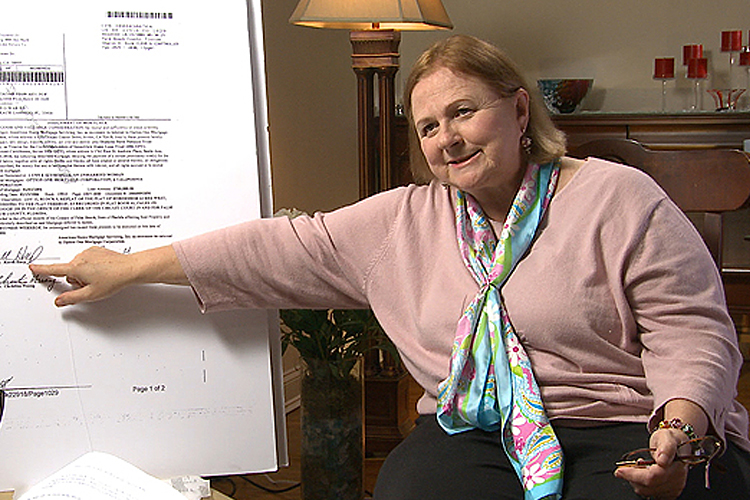
Your mortgage documents are fake!Lynn Szymoniak (Credit: CBS News/60 MInutes)
If you know about foreclosure fraud, the mass fabrication of mortgage documents in state courts by banks attempting to foreclose on homeowners, you may have one nagging question: Why did banks have to resort to this illegal scheme? Was it just cheaper to mock up the documents than to provide the real ones? Did banks figure they simply had enough power over regulators, politicians and the courts to get away with it? (They were probably right about that one.)
A newly unsealed lawsuit, which banks settled in 2012 for $95 million, actually offers a different reason, providing a key answer to one of the persistent riddles of the financial crisis and its aftermath. The lawsuit states that banks resorted to fake documents because they could not legally establish true ownership of the loans when trying to foreclose.
This reality, which banks did not contest but instead settled out of court, means that tens of millions of mortgages in America still lack a legitimate chain of ownership, with implications far into the future. And if Congress, supported by the Obama administration, goes back to the same housing finance system, with the same corrupt private entities who broke the nation’s private property system back in business packaging mortgages, then shame on all of us.
The 2011 lawsuit was filed in U.S. District Court in both North and South Carolina, by a white-collar fraud specialist named Lynn Szymoniak, on behalf of the federal government, 17 states and three cities. Twenty-eight banks, mortgage servicers and document processing companies are named in the lawsuit, including mega-banks like JPMorgan Chase, Wells Fargo, Citi and Bank of America.
Szymoniak, who fell into foreclosure herself in 2009, researched her own mortgage documents and found massive fraud (for example, one document claimed that Deutsche Bank, listed as the owner of her mortgage, acquired ownership in October 2008, four months after they first filed for foreclosure). She eventually examined tens of thousands of documents, enough to piece together the entire scheme.
A mortgage has two parts: the promissory note (the IOU from the borrower to the lender) and the mortgage, which creates the lien on the home in case of default. During the housing bubble, banks bought loans from originators, and then (in a process known as securitization) enacted a series of transactions that would eventually pool thousands of mortgages into bonds, sold all over the world to public pension funds, state and municipal governments and other investors. A trustee would pool the loans and sell the securities to investors, and the investors would get an annual percentage yield on their money.

advertisement

In order for the securitization to work, banks purchasing the mortgages had to physically convey the promissory note and the mortgage into the trust. The note had to be endorsed (the way an individual would endorse a check), and handed over to a document custodian for the trust, with a “mortgage assignment” confirming the transfer of ownership. And this had to be done before a 90-day cutoff date, with no grace period beyond that.
Georgetown Law professor Adam Levitin spelled this out in testimony before Congress in 2010: “If mortgages were not properly transferred in the securitization process, then mortgage-backed securities would in fact not be backed by any mortgages whatsoever.”
The lawsuit alleges that these notes, as well as the mortgage assignments, were “never delivered to the mortgage-backed securities trusts,” and that the trustees lied to the SEC and investors about this. As a result, the trusts could not establish ownership of the loan when they went to foreclose, forcing the production of a stream of false documents, signed by “robo-signers,” employees using a bevy of corporate titles for companies that never employed them, to sign documents about which they had little or no knowledge.
Many documents were forged (the suit provides evidence of the signature of one robo-signer, Linda Green, written eight different ways), some were signed by “officers” of companies that went bankrupt years earlier, and dozens of assignments listed as the owner of the loan “Bogus Assignee for Intervening Assignments,” clearly a template that was never changed. One defendant in the case, Lender Processing Services, created masses of false documents on behalf of the banks, often using fake corporate officer titles and forged signatures. This was all done to establish standing to foreclose in courts, which the banks otherwise could not.
Szymoniak stated in her lawsuit that, “Defendants used fraudulent mortgage assignments to conceal that over 1400 MBS trusts, each with mortgages valued at over $1 billion, are missing critical documents,” meaning that at least $1.4 trillion in mortgage-backed securities are, in fact, non-mortgage-backed securities. Because of the strict laws governing of these kinds of securitizations, there’s no way to make the assignments after the fact. Activists have a name for this: “securitization FAIL.”
One smoking gun piece of evidence in the lawsuit concerns a mortgage assignment dated Feb. 9, 2009, after the foreclosure of the mortgage in question was completed. According to the suit, “A typewritten note on the right hand side of the document states:  ‘This Assignment of Mortgage was inadvertently not recorded prior to the Final Judgment of Foreclosure… but is now being recorded to clear title.’”
This admission confirms that the mortgage assignment was not made before the closing date of the trust, invalidating ownership. The suit further argued that “the act of fabricating the assignments is evidence that the MBS Trust did not own the notes and/or the mortgage liens for some assets claimed to be in the pool.”
The federal government, states and cities joined the lawsuit under 25 counts of the federal False Claims Act and state-based versions of the law. All of them bought mortgage-backed securities from banks that never conveyed the mortgages or notes to the trusts. The plaintiffs argued that, considering that trustees and servicers had to spend lots of money forging and fabricating documents to establish ownership, they were materially harmed by the subsequent impaired value of the securities. Also, these investors (which includes the Treasury Department and the Federal Reserve) paid for the transfer of mortgages to the trusts, yet they were never actually transferred.
Finally, the lawsuit argues that the federal government was harmed by “payments made on mortgage guarantees to Defendants lacking valid notes and assignments of mortgages who were not entitled to demand or receive said payments.”
Despite Szymoniak seeking a trial by jury, the government intervened in the case, and settled part of it at the beginning of 2012, extracting $95 million from the five biggest banks in the suit (Wells Fargo, Bank of America, JPMorgan Chase, Citi and GMAC/Ally Bank). Szymoniak herself was awarded $18 million. But the underlying evidence was never revealed until the case was unsealed last Thursday.
Now that it’s unsealed, Szymoniak, as the named plaintiff, can go forward and prove the case. Along with her legal team (which includes the law firm of Grant & Eisenhoffer, which has recovered more money under the False Claims Act than any firm in the country), Szymoniak can pursue discovery and go to trial against the rest of the named defendants, including HSBC, the Bank of New York Mellon, Deutsche Bank and US Bank.
The expenses of the case, previously borne by the government, now are borne by Szymoniak and her team, but the percentages of recovery funds are also higher. “I’m really glad I was part of collecting this money for the government, and I’m looking forward to going through discovery and collecting the rest of it,” Szymoniak told Salon.
It’s good that the case remains active, because the $95 million settlement was a pittance compared to the enormity of the crime. By the end of 2009, private mortgage-backed securities trusts held one-third of all residential mortgages in the U.S. That means that tens of millions of home mortgages worth trillions of dollars have no legitimate underlying owner that can establish the right to foreclose. This hasn’t stopped banks from foreclosing anyway with false documents, and they are often successful, a testament to the breakdown of law in the judicial system. But to this day, the resulting chaos in disentangling ownership harms homeowners trying to sell these properties, as well as those trying to purchase them. And it renders some properties impossible to sell.
To this day, banks foreclose on borrowers using fraudulent mortgage assignments, a legacy of failing to prosecute this conduct and instead letting banks pay a fine to settle it. This disappoints Szymoniak, who told Salon the owner of these loans is now essentially “whoever lies the most convincingly and whoever gets the benefit of doubt from the judge.” Szymoniak used her share of the settlement to start the Housing Justice Foundation, a non-profit that attempts to raise awareness of the continuing corruption of the nation’s courts and land title system.
Most of official Washington, including President Obama, wants to wind down mortgage giants Fannie Mae and Freddie Mac, and return to a system where private lenders create securitization trusts, packaging pools of loans and selling them to investors. Government would provide a limited guarantee to investors against catastrophic losses, but the private banks would make the securities, to generate more capital for home loans and expand homeownership.
That’s despite the evidence we now have that, the last time banks tried this, they ignored the law, failed to convey the mortgages and notes to the trusts, and ripped off investors trying to cover their tracks, to say nothing of how they violated the due process rights of homeowners and stole their homes with fake documents.
The very same banks that created this criminal enterprise and legal quagmire would be in control again. Why should we view this in any way as a sound public policy, instead of a ticking time bomb that could once again throw the private property system, a bulwark of capitalism and indeed civilization itself, into utter disarray? As Lynn Szymoniak puts it, “The President’s calling for private equity to return. Why would we return to this?”
Update: This story previously suggested that banks settled this lawsuit with the federal government for $1 billion. That number is actually the total for a number of whistle-blower lawsuits that were folded into a larger National Mortgage Settlement. This specific lawsuit settled for $95 million. The post above has been changed to reflect this fact.

Wednesday, August 7, 2013

Subprime Execs From 2008 Are Alive and Well

Well here's news, the crooks who destroyed America, are alive and well and working on walls street, for none other than the KINGS of thieves -JPMorgan Chase, Goldman Sachs, Bank of America,and Deutsche Bank.


Subprime Execs From 2008 Are Alive and Well at Wall Street's Big Banks

Friday, 02 Aug 2013 07:54 AM
By John Morgan
Share:
Some of the subprime mortgage executives from Bear Stearns, the now-extinct investment bank that was among the first dominos to fall in the U.S. financial meltdown, have parleyed their expertise into top jobs at the most powerful banks on Wall Street, according to The Center for Public Integrity.

Bears Stearns failed in 2008 under the weight of billions of dollars in mortgage-backed securities that its customers and creditors concluded were not worth what the bank maintained.

Today those executives hold senior roles at JPMorgan Chase, Goldman Sachs, Bank of America and Deutsche Bank.


"The fact they were able to emerge unscathed from a financial crisis that wiped out $19.2 trillion of household wealth in the U.S. and as many as 8.8 million jobs has become part of the legacy of the financial meltdown," The Center for Public Integrity stated.

Four of the executives — Thomas Marano, Jeffrey Verschleiser, Michael Neirenberg and Jeffrey Mayer — have been accused of making false statements to federal regulators in a lawsuit by the Federal Housing Finance Agency (FHFA), the news organization said. All four denied the allegations in their response.

Two other of Bear Stearns' mortgage division leaders, Mary Haggery and Baron Silverstein, were not named in the FHFA lawsuit.

Separately, AMBAC Assurance Corp., which went bankrupt after guaranteeing some of Bear Stearns' mortgage bonds, accused the firm of fraud in a lawsuit that described alleged actions by all six executives.

"How is it that we could say that we learned something from the last crisis when we still have the same people running our companies for the future?" asked Jordan Thomas, a former attorney for the Securities and Exchange Commission who now runs the whistleblower practice at a private New York law firm.

Marano has earned more than $29 million in the past four years as head of Residential Capital LLC, the mortgage subsidiary of the former General Motors Acceptance Corp., which obtained a huge federal bailout, The Center reported. Residential Capital itself filed for bankruptcy last year.

Verschleiser jumped to Goldman Sachs in 2008 as a managing director and was promoted to global head of mortgage trading last year, according to the news agency.

Nierenberg and Silverstein now work together at Bank of America's divisions that issue mortgage-backed securities and collateralized debt obligations — two instruments that figured prominently in the financial crisis.

Meanwhile, Haggerty works in an executive role at JPMorgan and Mayer has a senior role at Deutsche Bank.

The news service concluded that as of today, there have been "few meaningful prosecutions or regulatory actions against any individuals who were in positions of power during the financial crisis."

On Wednesday, a federal jury in New York found former Goldman Sachs trader Fabrice Tourre liable for misleading investors in a crisis-era deal that cost them $1 billion, The Wall Street Journal reported.

Tourre was a mid-level figure at Goldman, and not regarded one of Wall Street leaders who helped play a prominent role in the 2008 meltdown.


Tuesday, July 30, 2013

Here we go again!!

US files civil charges against former MF Global CEO Jon Corzine

By Gabriel Black
20 July 2013 
 
Last month, the US Commodity Futures Trading Commission (CFTC) filed a civil lawsuit against Jon Corzine, the ex-chief of MF Global, for “failing to properly supervise” employees who used nearly a billion dollars from customers’ accounts to cover the firm’s bad debts.

Corzine personifies the politically incestuous relationship between Wall Street and the Democratic Party. A former CEO of Goldman Sachs, he went from Wall Street to Washington, using millions of dollars of his own fortune to win election as US senator from New Jersey in 2000 and repeating the process to become governor of New Jersey in 2006.
A major fundraiser for Barack Obama’s election campaign in 2008, Corzine was defeated in his bid for a second term as New Jersey governor by right-wing Republican Chris Christie due largely to Corzine’s attacks on state employees. He moved on to become CEO of Wall Street brokerage firm MF Global in 2010.
Under Corzine, MF Global lost billions of dollars betting on European government bonds. By October 2011, the firm was unraveling and it filed for Chapter 11 bankruptcy protection on October 31. It quickly emerged that some $1 billion in clients’ money was missing, widely believed to have been stolen by MF Global management to meet demands from the firm’s Wall Street creditors.
The $41 billion bankruptcy of MF Global was the eighth largest in US history and the biggest Wall Street collapse since the 2008 implosion of Lehman Brothers.
The CFTC civil suit against Corzine was filed in federal court in New York. The complaint also lists the assistant treasurer of the firm, Edith O’Brien, as a defendant.
MF Global and its parent firm have both made settlements with the CFTC. If O’Brien or Corzine are found guilty, they will rescind pay and incur fines.
In keeping with the policy of the Obama administration of refusing to criminally prosecute banks and top bank executives involved in defrauding investors, clients and the general public, Corzine faces no criminal charges.
After a ten-month investigation, the Justice Department last year dropped a criminal probe of MF Global and Corzine, declaring there was not enough evidence to indict the banker/politician. In the civil suit filed last month, moreover, Corzine is not being charged with misappropriating customers’ money, but only failing to properly supervise subordinates such as the firm’s treasurer, Edith O’Brien.
There is a stark disconnect between the descriptions of MF Global wrongdoing and the role of Corzine in the lawsuit filed by CFTC enforcement chief David Meister and the kid gloves treatment the CFTC is giving the former CEO. The suit seems, moreover, to undermine the Justice Department’s claim to have insufficient evidence to prosecute Corzine.
According to Meister, “thousands of customers were harmed, and customer fund protection laws were violated on a scale never previously seen in the US futures markets.” The suit states further: “Corzine bears responsibility for MF Global’s unlawful acts … He [Corzine] held and exercised direct or indirect control over MF Global … and either did not act in good faith or knowingly induced these violations.”
The suit cites telephone calls and other communications that point to Corzine’s direct role in misappropriating customer funds.
In a phone call just four days before the firm collapsed, Corzine told an employee “to strategize how they could use customer segregated funds to induce [JPMorgan Chase] to clear MF Global’s trades more quickly.” The employee objected, “but that’s cash seg for clients—it has nothing to do with greasing our wheels for Chase to move.” To which Corzine replied: “I understand, but you put it in a tri-party, and then once the securities have started moving, then you move it back to the um… this is the same thing we did last night, they left it in the tri-party, the seg money.”
At another point, the suit cites the treasurer of the company as saying, “We have to tell Jon enough is enough. We need to take the keys away from him.”
The lawsuit is expected to last several years. Corzine maintains that he is completely innocent and will contest it.
Should he lose, Corzine will be barred from certain types of financial trading and fined a small portion of his fortune. He is currently considering starting a new hedge fund.
 

Friday, July 12, 2013

JPMorgan Chase Fires Back At Warren-McCain Plan To Reinstate Glass-Steagall


Shocking news: JPMorgan Chase is not exactly jazzed about some recent plans to regulate banks, including Elizabeth Warren and John McCain's bill to reinstate the Glass-Steagall law splitting investment and commercial banks.
Even more shocking: JPMorgan seems to think it will probably be able to water down or avoid these plans.
In a Friday conference call to discuss the bank's second-quarter profits, an analyst asked whether the Warren-McCain bill to reinstate the Depression-era Glass-Steagall law would hurt business at the biggest U.S. bank by assets. JPMorgan's chief financial officer, Marianne Lake, dismissed the whole idea.
"Glass-Steagall didn't have anything to do with the crisis," Lake said, "and our business model allowed us to be a port in the storm. Our customers like doing business with us in the model we have now, so ..." She trailed off, took a long pause, and then added: "We don't spend time thinking about that."
In another not-exactly-stunning development, JPMorgan CEO and Chairman Jamie Dimon grumbled just a bit about new rules proposed by U.S. regulators this week limiting how much risk big U.S. banks will be allowed to take on. Specifically, he grumbled about how those rules are stricter than proposed global rules, and how that gap could make U.S. banks less competitive.
"If you have a world where some businesses have to have two times as much capital as other companies, over time that can create a huge competitive disadvantage," Dimon said. "We have interest in a safe and sound system, but not for a hugely imbalanced competitive playing field."
But Dimon also suggested that regulators are aware of these discrepancies and are trying to "harmonize" their efforts -- and who doesn't love harmony, especially when it makes it easier for banks to get more leveraged and dangerous?
Similarly, Lake suggested there were "fundamental issues" with proposed new rules limiting banks' riskiness and forcing them to seek out more capital. She suggested that regulators seem to be willing to consider having mercy on the banks and loosening up some of those fetters.
What is ironic is that the new capital and leverage proposals don't seem to create all that much of a hardship for banks, at least not for JPMorgan -- as DealBreaker's Matt Levine points out, the bank admits that about the worst that might happen is that it will not be able to shovel cash out the door to shareholders quite as quickly as it had hoped. Not exactly the econopocalypse bank flaks are predicting.
Anyway, seeing regulators back down on these rules would hardly be shocking. We have already seen aggressive bank lobbyists water down, muddle and delay implementation of the Dodd-Frank financial reform law. JPMorgan alone spent $8 million last year lobbying on financial reform and other issues, according to the Center for Responsive Politics.
As for the Glass-Steagall revival, the consensus on Wall Street and in Washington is that it stands pretty much no chance of becoming law. JPMorgan argues that its own size and complexity is super-attractive to customers, and that argument will probably win the day. The competing argument -- that the country enjoyed decades of relative financial calm after the segregation of bank activities after the Great Depression, and that it fell into a financial crisis not long after the removal of those safeguards -- is not taken seriously.
For what it's worth, Former Rep. Barney Frank -- the Frank in Dodd-Frank -- basically agreed with JPMorgan's Lake about Glass-Steagall, telling CNBC on Friday that he didn't think reinstating the law was nearly as important to the safety of the financial system as reforming the trade of the credit derivatives that nearly helped bring down that system the last time. And of course JPMorgan is lobbying hard on that issue, too.

Thursday, May 30, 2013

The Biggest Price-Fixing Scandal Ever

Everything Is Rigged:
The Biggest Price-Fixing Scandal Ever

The Illuminati were amateurs. The second huge financial scandal of the year reveals the real international conspiracy: There's no price the big banks can't fix

Conspiracy theorists of the world, believers in the hidden hands of the Rothschilds and the Masons and the Illuminati, we skeptics owe you an apology. You were right. The players may be a little different, but your basic premise is correct: The world is a rigged game. We found this out in recent months, when a series of related corruption stories spilled out of the financial sector, suggesting the world's largest banks may be fixing the prices of, well, just about everything. You may have heard of the Libor scandal, in which at least three – and perhaps as many as 16 – of the name-brand too-big-to-fail banks have been manipulating global interest rates, in the process messing around with the prices of upward of $500 trillion (that's trillion, with a "t") worth of financial instruments. When that sprawling con burst into public view last year, it was easily the biggest financial scandal in history – MIT professor Andrew Lo even said it "dwarfs by orders of magnitude any financial scam in the history of markets."
That was bad enough, but now Libor may have a twin brother. Word has leaked out that the London-based firm ICAP, the world's largest broker of interest-rate swaps, is being investigated by American authorities for behavior that sounds eerily reminiscent of the Libor mess. Regulators are looking into whether or not a small group of brokers at ICAP may have worked with up to 15 of the world's largest banks to manipulate ISDAfix, a benchmark number used around the world to calculate the prices of interest-rate swaps.
Interest-rate swaps are a tool used by big cities, major corporations and sovereign governments to manage their debt, and the scale of their use is almost unimaginably massive. It's about a $379 trillion market, meaning that any manipulation would affect a pile of assets about 100 times the size of the United States federal budget.
It should surprise no one that among the players implicated in this scheme to fix the prices of interest-rate swaps are the same megabanks – including Barclays, UBS, Bank of America, JPMorgan Chase and the Royal Bank of Scotland – that serve on the Libor panel that sets global interest rates. In fact, in recent years many of these banks have already paid multimillion-dollar settlements for anti-competitive manipulation of one form or another (in addition to Libor, some were caught up in an anti-competitive scheme, detailed in Rolling Stone last year, to rig municipal-debt service auctions). Though the jumble of financial acronyms sounds like gibberish to the layperson, the fact that there may now be price-fixing scandals involving both Libor and ISDAfix suggests a single, giant mushrooming conspiracy of collusion and price-fixing hovering under the ostensibly competitive veneer of Wall Street culture.
The Scam Wall Street Learned From the Mafia
Why? Because Libor already affects the prices of interest-rate swaps, making this a manipulation-on-manipulation situation. If the allegations prove to be right, that will mean that swap customers have been paying for two different layers of price-fixing corruption. If you can imagine paying 20 bucks for a crappy PB&J because some evil cabal of agribusiness companies colluded to fix the prices of both peanuts and peanut butter, you come close to grasping the lunacy of financial markets where both interest rates and interest-rate swaps are being manipulated at the same time, often by the same banks.
"It's a double conspiracy," says an amazed Michael Greenberger, a former director of the trading and markets division at the Commodity Futures Trading Commission and now a professor at the University of Maryland. "It's the height of criminality."
The bad news didn't stop with swaps and interest rates. In March, it also came out that two regulators – the CFTC here in the U.S. and the Madrid-based International Organization of Securities Commissions – were spurred by the Libor revelations to investigate the possibility of collusive manipulation of gold and silver prices. "Given the clubby manipulation efforts we saw in Libor benchmarks, I assume other benchmarks – many other benchmarks – are legit areas of inquiry," CFTC Commissioner Bart Chilton said.
But the biggest shock came out of a federal courtroom at the end of March – though if you follow these matters closely, it may not have been so shocking at all – when a landmark class-action civil lawsuit against the banks for Libor-related offenses was dismissed. In that case, a federal judge accepted the banker-defendants' incredible argument: If cities and towns and other investors lost money because of Libor manipulation, that was their own fault for ever thinking the banks were competing in the first place.
"A farce," was one antitrust lawyer's response to the eyebrow-raising dismissal.
"Incredible," says Sylvia Sokol, an attorney for Constantine Cannon, a firm that specializes in antitrust cases.
All of these stories collectively pointed to the same thing: These banks, which already possess enormous power just by virtue of their financial holdings – in the United States, the top six banks, many of them the same names you see on the Libor and ISDAfix panels, own assets equivalent to 60 percent of the nation's GDP – are beginning to realize the awesome possibilities for increased profit and political might that would come with colluding instead of competing. Moreover, it's increasingly clear that both the criminal justice system and the civil courts may be impotent to stop them, even when they do get caught working together to game the system.
If true, that would leave us living in an era of undisguised, real-world conspiracy, in which the prices of currencies, commodities like gold and silver, even interest rates and the value of money itself, can be and may already have been dictated from above. And those who are doing it can get away with it. Forget the Illuminati – this is the real thing, and it's no secret. You can stare right at it, anytime you want.


The banks found a loophole, a basic flaw in the machine. Across the financial system, there are places where prices or official indices are set based upon unverified data sent in by private banks and financial companies. In other words, we gave the players with incentives to game the system institutional roles in the economic infrastructure.
Libor, which measures the prices banks charge one another to borrow money, is a perfect example, not only of this basic flaw in the price-setting system but of the weakness in the regulatory framework supposedly policing it. Couple a voluntary reporting scheme with too-big-to-fail status and a revolving-door legal system, and what you get is unstoppable corruption.
Every morning, 18 of the world's biggest banks submit data to an office in London about how much they believe they would have to pay to borrow from other banks. The 18 banks together are called the "Libor panel," and when all of these data from all 18 panelist banks are collected, the numbers are averaged out. What emerges, every morning at 11:30 London time, are the daily Libor figures.
Banks submit numbers about borrowing in 10 different currencies across 15 different time periods, e.g., loans as short as one day and as long as one year. This mountain of bank-submitted data is used every day to create benchmark rates that affect the prices of everything from credit cards to mortgages to currencies to commercial loans (both short- and long-term) to swaps.
Gangster Bankers Broke Every Law in the Book
Dating back perhaps as far as the early Nineties, traders and others inside these banks were sometimes calling up the company geeks responsible for submitting the daily Libor numbers (the "Libor submitters") and asking them to fudge the numbers. Usually, the gimmick was the trader had made a bet on something – a swap, currencies, something – and he wanted the Libor submitter to make the numbers look lower (or, occasionally, higher) to help his bet pay off.
Famously, one Barclays trader monkeyed with Libor submissions in exchange for a bottle of Bollinger champagne, but in some cases, it was even lamer than that. This is from an exchange between a trader and a Libor submitter at the Royal Bank of Scotland:
SWISS FRANC TRADER: can u put 6m swiss libor in low pls?...
PRIMARY SUBMITTER: Whats it worth
SWSISS FRANC TRADER: ive got some sushi rolls from yesterday?...
PRIMARY SUBMITTER: ok low 6m, just for u
SWISS FRANC TRADER: wooooooohooooooo. . . thatd be awesome
Screwing around with world interest rates that affect billions of people in exchange for day-old sushi – it's hard to imagine an image that better captures the moral insanity of the modern financial-services sector.
Hundreds of similar exchanges were uncovered when regulators like Britain's Financial Services Authority and the U.S. Justice Department started burrowing into the befouled entrails of Libor. The documentary evidence of anti-competitive manipulation they found was so overwhelming that, to read it, one almost becomes embarrassed for the banks. "It's just amazing how Libor fixing can make you that much money," chirped one yen trader. "Pure manipulation going on," wrote another.
Yet despite so many instances of at least attempted manipulation, the banks mostly skated. Barclays got off with a relatively minor fine in the $450 million range, UBS was stuck with $1.5 billion in penalties, and RBS was forced to give up $615 million. Apart from a few low-level flunkies overseas, no individual involved in this scam that impacted nearly everyone in the industrialized world was even threatened with criminal prosecution.
Two of America's top law-enforcement officials, Attorney General Eric Holder and former Justice Department Criminal Division chief Lanny Breuer, confessed that it's dangerous to prosecute offending banks because they are simply too big. Making arrests, they say, might lead to "collateral consequences" in the economy.
The relatively small sums of money extracted in these settlements did not go toward reparations for the cities, towns and other victims who lost money due to Libor manipulation. Instead, it flowed mindlessly into government coffers. So it was left to towns and cities like Baltimore (which lost money due to fluctuations in their municipal investments caused by Libor movements), pensions like the New Britain, Connecticut, Firefighters' and Police Benefit Fund, and other foundations – and even individuals (billionaire real-estate developer Sheldon Solow, who filed his own suit in February, claims that his company lost $450 million because of Libor manipulation) – to sue the banks for damages.
One of the biggest Libor suits was proceeding on schedule when, early in March, an army of superstar lawyers working on behalf of the banks descended upon federal judge Naomi Buchwald in the Southern District of New York to argue an extraordinary motion to dismiss. The banks' legal dream team drew from heavyweight Beltway-connected firms like Boies Schiller (you remember David Boies represented Al Gore), Davis Polk (home of top ex-regulators like former SEC enforcement chief Linda Thomsen) and Covington & Burling, the onetime private-practice home of both Holder and Breuer.
The presence of Covington & Burling in the suit – representing, of all companies, Citigroup, the former employer of current Treasury Secretary Jack Lew – was particularly galling. Right as the Libor case was being dismissed, the firm had hired none other than Lanny Breuer, the same Lanny Breuer who, just a few months before, was the assistant attorney general who had balked at criminally prosecuting UBS over Libor because, he said, "Our goal here is not to destroy a major financial institution."
In any case, this all-star squad of white-shoe lawyers came before Buchwald and made the mother of all audacious arguments. Robert Wise of Davis Polk, representing Bank of America, told Buchwald that the banks could not possibly be guilty of anti- competitive collusion because nobody ever said that the creation of Libor was competitive. "It is essential to our argument that this is not a competitive process," he said. "The banks do not compete with one another in the submission of Libor."

If you squint incredibly hard and look at the issue through a mirror, maybe while standing on your head, you can sort of see what Wise is saying. In a very theoretical, technical sense, the actual process by which banks submit Libor data – 18 geeks sending numbers to the British Bankers' Association offices in London once every morning – is not competitive per se.
But these numbers are supposed to reflect interbank-loan prices derived in a real, competitive market. Saying the Libor submission process is not competitive is sort of like pointing out that bank robbers obeyed the speed limit on the way to the heist. It's the silliest kind of legal sophistry.
But Wise eventually outdid even that argument, essentially saying that while the banks may have lied to or cheated their customers, they weren't guilty of the particular crime of antitrust collusion. This is like the old joke about the lawyer who gets up in court and claims his client had to be innocent, because his client was committing a crime in a different state at the time of the offense.
"The plaintiffs, I believe, are confusing a claim of being perhaps deceived," he said, "with a claim for harm to competition."
Judge Buchwald swallowed this lunatic argument whole and dismissed most of the case. Libor, she said, was a "cooperative endeavor" that was "never intended to be competitive." Her decision "does not reflect the reality of this business, where all of these banks were acting as competitors throughout the process," said the antitrust lawyer Sokol. Buchwald made this ruling despite the fact that both the U.S. and British governments had already settled with three banks for billions of dollars for improper manipulation, manipulation that these companies admitted to in their settlements.
Michael Hausfeld of Hausfeld LLP, one of the lead lawyers for the plaintiffs in this Libor suit, declined to comment specifically on the dismissal. But he did talk about the significance of the Libor case and other manipulation cases now in the pipeline.
"It's now evident that there is a ubiquitous culture among the banks to collude and cheat their customers as many times as they can in as many forms as they can conceive," he said. "And that's not just surmising. This is just based upon what they've been caught at."
Greenberger says the lack of serious consequences for the Libor scandal has only made other kinds of manipulation more inevitable. "There's no therapy like sending those who are used to wearing Gucci shoes to jail," he says. "But when the attorney general says, 'I don't want to indict people,' it's the Wild West. There's no law."
The problem is, a number of markets feature the same infrastructural weakness that failed in the Libor mess. In the case of interest-rate swaps and the ISDAfix benchmark, the system is very similar to Libor, although the investigation into these markets reportedly focuses on some different types of improprieties.
Though interest-rate swaps are not widely understood outside the finance world, the root concept actually isn't that hard. If you can imagine taking out a variable-rate mortgage and then paying a bank to make your loan payments fixed, you've got the basic idea of an interest-rate swap.
In practice, it might be a country like Greece or a regional government like Jefferson County, Alabama, that borrows money at a variable rate of interest, then later goes to a bank to "swap" that loan to a more predictable fixed rate. In its simplest form, the customer in a swap deal is usually paying a premium for the safety and security of fixed interest rates, while the firm selling the swap is usually betting that it knows more about future movements in interest rates than its customers.
Prices for interest-rate swaps are often based on ISDAfix, which, like Libor, is yet another of these privately calculated benchmarks. ISDAfix's U.S. dollar rates are published every day, at 11:30 a.m. and 3:30 p.m., after a gang of the same usual-suspect megabanks (Bank of America, RBS, Deutsche, JPMorgan Chase, Barclays, etc.) submits information about bids and offers for swaps.
And here's what we know so far: The CFTC has sent subpoenas to ICAP and to as many as 15 of those member banks, and plans to interview about a dozen ICAP employees from the company's office in Jersey City, New Jersey. Moreover, the International Swaps and Derivatives Association, or ISDA, which works together with ICAP (for U.S. dollar transactions) and Thomson Reuters to compute the ISDAfix benchmark, has hired the consulting firm Oliver Wyman to review the process by which ISDAfix is calculated. Oliver Wyman is the same company that the British Bankers' Association hired to review the Libor submission process after that scandal broke last year. The upshot of all of this is that it looks very much like ISDAfix could be Libor all over again.
"It's obviously reminiscent of the Libor manipulation issue," Darrell Duffie, a finance professor at Stanford University, told reporters. "People may have been naive that simply reporting these rates was enough to avoid manipulation."
And just like in Libor, the potential losers in an interest-rate-swap manipulation scandal would be the same sad-sack collection of cities, towns, companies and other nonbank entities that have no way of knowing if they're paying the real price for swaps or a price being manipulated by bank insiders for profit. Moreover, ISDAfix is not only used to calculate prices for interest-rate swaps, it's also used to set values for about $550 billion worth of bonds tied to commercial real estate, and also affects the payouts on some state-pension annuities.
So although it's not quite as widespread as Libor, ISDAfix is sufficiently power-jammed into the world financial infrastructure that any manipulation of the rate would be catastrophic – and a huge class of victims that could include everyone from state pensioners to big cities to wealthy investors in structured notes would have no idea they were being robbed.
"How is some municipality in Cleveland or wherever going to know if it's getting ripped off?" asks Michael Masters of Masters Capital Management, a fund manager who has long been an advocate of greater transparency in the derivatives world. "The answer is, they won't know."
Worse still, the CFTC investigation apparently isn't limited to possible manipulation of swap prices by monkeying around with ISDAfix. According to reports, the commission is also looking at whether or not employees at ICAP may have intentionally delayed publication of swap prices, which in theory could give someone (bankers, cough, cough) a chance to trade ahead of the information.
Swap prices are published when ICAP employees manually enter the data on a computer screen called "19901." Some 6,000 customers subscribe to a service that allows them to access the data appearing on the 19901 screen.
The key here is that unlike a more transparent, regulated market like the New York Stock Exchange, where the results of stock trades are computed more or less instantly and everyone in theory can immediately see the impact of trading on the prices of stocks, in the swap market the whole world is dependent upon a handful of brokers quickly and honestly entering data about trades by hand into a computer terminal.
Any delay in entering price data would provide the banks involved in the transactions with a rare opportunity to trade ahead of the information. One way to imagine it would be to picture a racetrack where a giant curtain is pulled over the track as the horses come down the stretch – and the gallery is only told two minutes later which horse actually won. Anyone on the right side of the curtain could make a lot of smart bets before the audience saw the results of the race.

At ICAP, the interest-rate swap desk, and the 19901 screen, were reportedly controlled by a small group of 20 or so brokers, some of whom were making millions of dollars. These brokers made so much money for themselves the unit was nicknamed "Treasure Island."
Already, there are some reports that brokers of Treasure Island did create such intentional delays. Bloomberg interviewed a former broker who claims that he watched ICAP brokers delay the reporting of swap prices. "That allows dealers to tell the brokers to delay putting trades into the system instead of in real time," Bloomberg wrote, noting the former broker had "witnessed such activity firsthand." An ICAP spokesman has no comment on the story, though the company has released a statement saying that it is "cooperating" with the CFTC's inquiry and that it "maintains policies that prohibit" the improper behavior alleged in news reports.
The idea that prices in a $379 trillion market could be dependent on a desk of about 20 guys in New Jersey should tell you a lot about the absurdity of our financial infrastructure. The whole thing, in fact, has a darkly comic element to it. "It's almost hilarious in the irony," says David Frenk, director of research for Better Markets, a financial-reform advocacy group, "that they called it ISDAfix."
After scandals involving libor and, perhaps, ISDAfix, the question that should have everyone freaked out is this: What other markets out there carry the same potential for manipulation? The answer to that question is far from reassuring, because the potential is almost everywhere. From gold to gas to swaps to interest rates, prices all over the world are dependent upon little private cabals of cigar-chomping insiders we're forced to trust.
"In all the over-the-counter markets, you don't really have pricing except by a bunch of guys getting together," Masters notes glumly.
That includes the markets for gold (where prices are set by five banks in a Libor-ish teleconferencing process that, ironically, was created in part by N M Rothschild & Sons) and silver (whose price is set by just three banks), as well as benchmark rates in numerous other commodities – jet fuel, diesel, electric power, coal, you name it. The problem in each of these markets is the same: We all have to rely upon the honesty of companies like Barclays (already caught and fined $453 million for rigging Libor) or JPMorgan Chase (paid a $228 million settlement for rigging municipal-bond auctions) or UBS (fined a collective $1.66 billion for both muni-bond rigging and Libor manipulation) to faithfully report the real prices of things like interest rates, swaps, currencies and commodities.
All of these benchmarks based on voluntary reporting are now being looked at by regulators around the world, and God knows what they'll find. The European Federation of Financial Services Users wrote in an official EU survey last summer that all of these systems are ripe targets for manipulation. "In general," it wrote, "those markets which are based on non-attested, voluntary submission of data from agents whose benefits depend on such benchmarks are especially vulnerable of market abuse and distortion."
Translation: When prices are set by companies that can profit by manipulating them, we're fucked.
"You name it," says Frenk. "Any of these benchmarks is a possibility for corruption."
The only reason this problem has not received the attention it deserves is because the scale of it is so enormous that ordinary people simply cannot see it. It's not just stealing by reaching a hand into your pocket and taking out money, but stealing in which banks can hit a few keystrokes and magically make whatever's in your pocket worth less. This is corruption at the molecular level of the economy, Space Age stealing – and it's only just coming into view.