Showing posts with label Wall Street. Show all posts

Sunday, September 15, 2013

Personally I want to hear Bartiromo’s response

Personally I want to hear Bartiromo’s response, and I am sure the rest of America would as well , don't you?

Barney Frank Leaves Wall Street Defenders Speechless: Why Are Bankers ‘Paying Themselves So Much Money?’

By Alan Pyke on September 15, 2013 at 1:23 pm
Barney FrankAs his fellow panelists sought to sidestep criticisms of the financial industry on the five-year anniversary of the bank failure that kicked the financial crisis and Great Recession into full swing, former congressman Barney Frank asked a simple question that brought Wall Street’s defenders up short. “To your question about those poor beleaguered bankers who have been forced to do so much,” Frank said, “why are they paying themselves so much money? Where did these enormous salaries come from if they were in fact in such serious trouble?”
Frank was responding to CNBC host Maria Bartiromo’s call to “get beyond the conversation of is Wall Street evil, are the bankers evil and causing pain” and instead look to economic growth as a cure-all for the vast inequality in income and wealth that has been exacerbated since the end of the recession. (Nevermind that the deregulation of the financial sector is a primary driver of inequality in the U.S.) His question produced several seconds of silence as Bartiromo and former Treasury Secretary Hank Paulson laughed nervously and looked to Meet The Press host David Gregory for help. As Bartiromo seemed about to respond to Frank, Gregory stepped in to change the subject.
Watch the exchange below:
BARTIROMO: We need to get beyond the conversation of is Wall Street evil? Are the bankers evil and causing pain? And toward the conversation of, how do you create sustainable economic growth? That will answer the issue of inequality. Because with growth comes jobs.
[...]
BARNEY FRANK: I do want to add one thing, though, to your question about those poor beleaguered bankers who have been forced to do so much to keep from not being able to pay their debts they can’t lend money. if they really are running businesses that are so stressed that they can’t do their basic work, why are they paying themselves so much money? Where did these enormous salaries come from if they were in fact in such serious trouble?
BARTIROMO: (laughing) Thank you for giving me that one. Okay.
GREGORY (Host): But your point is to get beyond — to get beyond some of the resentment of the bankers and get to a place where we actually have more hiring going on, more investment going on and washington plays a more constructive role beyond whether it was the bailout of the banks which changed our politics.
It would have been interesting to hear Bartiromo’s response had Gregory not intervened to prevent anyone answering Frank’s question. Wall Street executive pay seems difficult to defend five years on from the crisis. It isn’t just that banker bonuses and bank profits have returned to or even surpassed pre-crisis highs. It’s that a third of the highest-paid executives of the past 20 years have been failures or frauds. It’s that companies routinely manipulate performance-based compensation schemes to effectively guarantee executive payouts. It’s that taxpayers subsidize payments in the form of stock, which also give executives incentive to the sorts of fraud and risk-taking that created the financial crisis.
The financial reform law that Frank co-authored with then-Sen. Chris Dodd (D-CT) included rules meant to change executive compensation. Those changes have yet to materialize. Five years on from the Lehman Brothers bankruptcy, former Lehman chief Dick Fuld is far from the only former executive to have retained hundreds of millions of dollars in pay and bonuses for their work that contributed to the crisis. Efforts to change the culture of the financial industry appear to have failed, as traders still report a high willingness to break the rules for personal gain.

What you don't know may shock you


Five years ago today, Lehman Brothers went bankrupt.

Instantly and inevitably, the house of cards otherwise known as Wall Street collapsed.

But after getting bailed out by the American taxpayers, Wall Street is doing just fine.

The people of Main Street? Not so much.

Here are some numbers to think about this Sunday morning.

  • Amount the crash cost the U.S. economy: $22 trillion
  • How much everyone would get if that $22 trillion were divided equally among the U.S. populace: $69,478.88
  • Assets of the four biggest banks in America — JPMorgan Chase, Bank of America, Citigroup and Wachovia/Wells Fargo — when they were “too big to fail” in 2008: $6.4 trillion
  • Assets of those four banks today: $7.8 trillion
  • Of the 63 former Lehman Brothers employees identified by a bankruptcy examiner as being aware of an accounting scheme Lehman used to mask its true finances, number who are employed in senior financial services positions today: 47
  • Number of the 25 banks responsible for the bulk of risky subprime loans leading up to the crash that are back in the mortgage business: 25
  • Chances that an American voter thinks that regulating financial products and services is “important” or “very important”: 9 in 10
  • Chances that an American knows the Earth orbits the sun: 8 in 10
  • Amount spent in 2012 by Wall Street and other finance industry behemoths on lobbying to roll back, water down and weasel out of the Dodd-Frank Wall Street Reform and Consumer Protection Act: $487 million
  • Number of registered financial industry lobbyists in 2012: 2,429
  • Number of lawsuits filed as of April of this year by Eugene Scalia, son of U.S. Supreme Court Justice Antonin Scalia, to hold up implementation of Dodd-Frank rules on legal technicalities: 7
  • Rank of finance industry among all corporate election spending by sector in 2011 and 2012: 1
  • Amount the industry gave to political candidates in 2011 and 2012: $664 million
  • In 2012, rate at which revenues of JPMorgan Chase, the largest bank in the U.S., matched Public Citizen’s operating expenses for the entire year: Every 80 minutes
Undeniably, these numbers are shocking, infuriating, damning.

Thursday, August 22, 2013

Several Big Banks Forge Mortgage Documents

Several Big Banks Forge Mortgage Documents, New Unsealed Documents Show

Last year, some Wall Street banks settled in a fraud lawsuit for $95 million, filed by Florida resident and white-collar fraud specialist, Lynn Szymoniak. The lawsuit named 28 “banks, mortgage servicers and document processing companies,” and was filed in federal courts in North and South Carolina.
The scam consisted of the banks drawing up fake mortgage documents “because they could not legally establish true ownership of the loans when trying to foreclose.”
The lawsuit, recently unsealed, exposes some nasty secrets about the way in which banks handled the lawsuit and what that handling means. David Dayen with Salon, reported because the banks settled, rather than fought the suit, there are “tens of millions of mortgages in America [that] still lack a legitimate chain of ownership.” These tens of millions have been estimated to equal up to trillions of dollars. And because the mortgage documents are forgeries, there is no “underlying owner” that can rightfully foreclose on these mortgages.
What the banks were doing is sending off securities that were not mortgage-backed. They were essentially empty securities. As Syzmoniak points out, the “Defendants used fraudulent mortgage assignments to conceal that over 1400 MBS trusts, . . are missing critical documents.” The banks would push out these non-mortgage backed securities and eventually created over $1.4 trillion of worthless mortgages and securities.
A crucial piece of evidence in the lawsuit was that, in 2009, one “Assignment of Mortgage was inadvertently not recorded prior to the Final Judgement of Foreclosure.” This makes the underlying ownership of the mortgage invalid because that finding proved that the “mortgage assignment was not made before the closing date of the trust.”
Because these documents were faked, mortgages “were materially harmed by the subsequent impaired value of the securities.” The banks committed fraud to the most severe degree. They created $1.4 trillion in non-mortgage-backed securities, but they were able to settle by only paying a fraction of the amount they defrauded. And they even lied to the Securities and Exchange Commission about the valuelessness of the mortgages. No one was put in handcuffs, no one was convicted.
Despite the five largest banks settling, Szymoniak can still bring other banks like HSBC, Bank of New York Mellon, and Deutsche Bank to trial to seek retribution of their crimes.

Monday, August 5, 2013

7 Reasons To Support Glass-Steagall, & a List of Those Who Do

7 Reasons To Support Glass-Steagall, & a List of Those Who Do

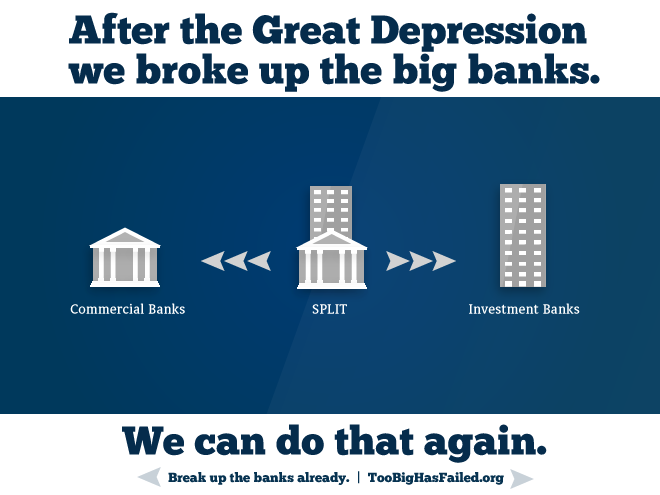
In our last post we talked about a new proposal to restore the Glass-Steagall Act of 1933, an act that separated commercial banking from investment banking.
It’s a proposition that has plenty of critics, many of whom say that Glass-Steagall wouldn’t have prevented the last crisis (see here, here, and here). In response, we’ve listed three reasons (numbers 4, 5, and 6 below) showing that the repeal of Glass-Steagall did in fact play a role in the crisis and that people should therefore support restoring it. Here’s the list:

1. It Will Break Up Chase, Bank of America, and Citi

reasons to support glass-steagall
By international accounting standards, these three banks are the biggest in world. They are also the prime examples of banks that have enormous combined commercial and investment enterprises. What this means is that these banks are increasingly unwieldy, and in the words of former FDIC chair Sheila Bair they’re simply “too big to manage.”

2. It Will Fracture Wall Street’s Lobbying Power

reasons to support glass-steagall
photo from flickr
In a Bloomberg video and in an article in the Financial Times, University of Chicago economist Luigi Zingales argues that restoring Glass-Steagall will fracture Wall Street’s lobbying power. He says, “Under the old regime, commercial banks, investment banks and insurance companies had different agendas, so their lobbying efforts tended to offset one another. But after the restrictions ended, the interests of all the major players were aligned.” It’s no wonder, then, that Wall Street’s power in Washington has increased in recent years.

3. Glass-Steagall Is Simple

reasons to support glass-steagall
Separating commercial banking activity from investment banking activity is a simple way to keep banks smaller. This simplicity is reflected in the bill itself: The original Glass-Steagall Act was 37 pages, for instance, while the 2010 Dodd-Frank Act will potentially reach 30,000 pages of rules.
Of course, simplicity in itself isn’t reason enough to support a bill, but it’s a reason that shouldn’t be overlooked. After all, the global economy gets exponentially more complex each year, and so it’s imperative to compensate that complexity with simple regulations—not lots of red tape and loopholes. “The simpler a rule is,” Luigi Zingales says, “the fewer provisions there are and the less it costs to enforce them. The simpler it is, the easier it is for voters to understand and voice their opinions accordingly. Finally, the simpler it is, the more difficult it is for someone with vested interests to get away with distorting some obscure facet.”
We need a few simple laws on Wall Street. Glass-Steagall is one such law.

4. It Would Have Prevented AIG’s Major Role In the Financial Crisis

reasons to support glass-steagall
photo from flickr
In his testimony to the Financial Crisis Inquiry Commission, Former Superintendent Eric Dinallo argued that AIG wouldn’t have been so laden with risk if they hadn’t been able to function like a hedge fund. He says that the repeal of Glass-Steagall, “permitted AIG to operate an effectively unregulated hedge fund with grossly insufficient reserves to back up its promises. Had AIG Financial Products been a stand alone company, it is unlikely that its counterparties would have been willing to do business with it because its commitments would never have carried a triple-A credit rating.”
Since AIG was at the heart of the bailouts, the repeal of Glass-Steagall played a major role in the financial crisis.

5. Citi Wouldn’t Have Been Run By Someone Who Didn’t Understand Commercial Banking

reasons to support glass-steagall
Vikram Pandit (pictured above) hadn’t ever worked as a commercial banker before becoming CEO of Citi in 2007. As Sheila Bair once said, Pandit “wouldn’t have known how to underwrite a loan if his life depended on it.” His lack of experience with commercial banking was problematic during the crisis because Citi was the sickest of all banks that received bailout money—requiring $472.6 billion in cash and guarantees. Pandit would have never been in charge of such a large commercial banking enterprise if Glass-Steagall hadn’t been repealed. Instead, he would have stuck with what he knew: investment banking.

6. Investment Banks Wouldn’t Have Faced as Much Competitive Pressure During the 2000s

reasons to support glass-steagall
Lehman Brothers CEO Dick Fuld, saying he wanted to rip out the heart of people betting against him.
The man in the picture above is Dick Fuld, the CEO of Lehman Brothers, an investment bank that went bankrupt in the crisis. Fuld was insanely competitive, as we saw in A Colossal Failure of Common Sense as well as this internal video, where Fuld shows his disdain for people betting against Lehman by saying, “I want to reach in, rip out their heart, and eat it before they die.” (Yikes.) Fuld desperately wanted to be a top dog on Wall Street, and the repeal of Glass-Steagall made that much, much more difficult because it created the sudden influx of big competition from commercial banks. Fuld’s blindly competitive spirit led him to overextend Lehman and eventually go bankrupt.
Of course, the repeal of Glass-Steagall didn’t in itself cause Fuld to overextend, but it’s clear that Lehman and other investment banks like Bear Stearns wouldn’t have faced nearly so much competitive pressure if commercial banks like Citi hadn’t suddenly entered the investment banking scene after 1999.
This report from Public Citizen (pdf) reveals more about why “The absence of Glass-Steagall … was intrinsic to Lehman’s collapse,” showing that Lehman itself admitted they were feeling intense pressure in 2005 from the repeal of Glass-Steagall.

7. Plenty of Smart People Support Restoring Glass-Steagall


Here’s a list of people in the video above who support Glass-Steagall:
0:07 – Bill Moyers (PBS) and Matt Taibbi (Rolling Stone discuss how little has changed since 2008).
0:27 – Robert Reich (fmr Labor Sec) explains why we need to break up the biggest banks
0:47 – Sandy Weill (CEO, Citigroup) explains why he wants the banks to be broken up
1:04 – Byron Dorgan gives the successful history of breaking up the banks.
1:32 – James Rickards lists the folks who allowed the banks to get big again.
1:41 – James Komansky (fmr CEO, Merril Lynch) regrets his decision to allow banks to get big again.
1:57 – Luigi Zingales (economist, Univ. of Chicago) on the danger of consolidated banks.
2:13 – Sheila Bair (fmr FDIC Chair) on why she would like to see the banks broken back up.
2:30 – Joseph Stiglitz (Nobel laureate, Columbia economist) on why we don’t have ordinary capitalism when banks are so big.
2:40 – Nouriel Roubini (NYU economist) “if institutions are too big to fail, they are too big.”
2:54 – Simon Johnson (MIT economist)
3:18 – Neil Barofsky (TARP inspector) explains exactly what needs to happen.
3:41 – Elizabeth Warren
4:00 – Bernie Sanders
4:17 – Ted Kaufman
*You can see more from MIT economist Simon Johnson in his articles “Five Facts About the New Glass-Steagall,” where he says that Glass-Steagall would be good for small banks, and in “Remember Citigroup,” where he says that the repeal of Glass-Steagall was directly responsible for Citi’s problems in the crisis. You can also see more from University of Chicago economist Luigi Zingales in his article “Why I Was Won Over By Glass-Steagall,” where he explains why he was initially resistant to the law, and why he now supports it.
In addition to the sixteen people shown in the video above, here are some more quotes from others who want to restore the law:
Barry Ritholtz, chief executive of FusionIQ, an asset management and research firm: “For about 70 years, Glass-Steagall managed to keep the riskier, more damaging part of Wall Street away from what should be the boring, straightforward side of finance. It was the height of stupidity repealing Glass-Steagall.”
Arthur Levitt, former Wall Street regulator: “Clearly, I regret my support of doing away with Glass Steagall.”
John Reed, former Citi CEO: “As another older banker and one who has experienced both the pre- and post-Glass Steagall world, I would agree with Paul A. Volcker (and also Mervyn King, governor of the Bank of England) that some kind of separation between institutions that deal primarily in the capital markets and those involved in more traditional deposit-taking and working-capital finance makes sense. This, in conjunction with more demanding capital requirements, would go a long way toward building a more robust financial sector.”
Thomas Hoenig, FDIC director: “When you mix commercial banking and high-risk broker-dealer activities, you increase the risk overall and as a result you invite new problems.”
Dean Baker, economist for the Center for Economic Policy and Research: “I think there are a lot of ways to make [the big banks] less powerful, less politically powerful, less economically powerful. Glass-Steagall, again I’d like to see that sort of separation.”
Andrew Haldane, Executive director of the Bank of England, calls Glass-Steagall “perhaps the single most important piece of financial legislation of the 20th century.”

Conclusion

Restoring Glass-Steagall won’t guarantee prevention of future financial crises, just as it (alone) wouldn’t have prevented the last one. However, restoring Glass-Steagall is a simple way to reduce the size of Wall Street banks, and its repeal certainly did play a part in the last crisis. Its for those reasons, as well as the others listed above, that the law should be restored.
We’ll conclude with this passage from Simon Johnson’s article “Remember Citigroup,” which argues that the New Glass-Steagall law should be a complement to other propositions to fix banking. We strongly agree with this notion:
The point of the New Glass-Steagall Act is to complement other measures in place or under consideration, including much higher capital requirements (both in the Brown-Vitter proposed legislation and in the new regulatory cap on leverage now under consideration), the Volcker Rule, and efforts to bring greater transparency to derivatives.
These measures are not substitutes for each other – they are complements.  Each would be more effective if the others are also implemented properly.
Nothing can completely remove the risk of future financial crisis.  Anyone who promises this is offering up illusions and deception.
But, like it or not, public policy shapes incentives in the financial system.  We can have a safer financial system that works better for the broader economy – as we had after the reforms of the 1930s.  Or we can have a system in which a few relatively large firms are encouraged to follow the model of Citigroup and to become ever more careless and on a grander scale.
Also see our last post on the new Glass-Steagall Act.

Elizabeth Warren Introduces 21st Century Glass-Steagall Act

Elizabeth Warren Glass-Steagall
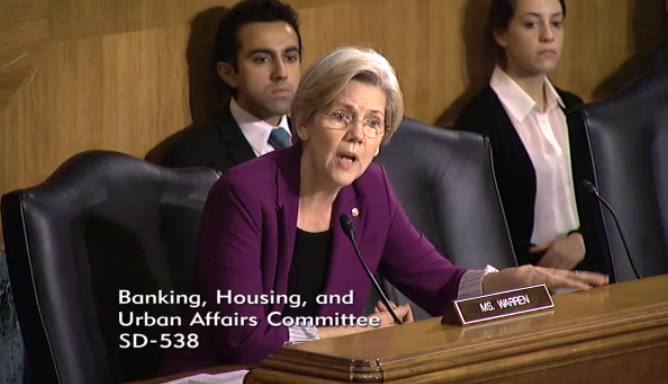
At today’s Senate Banking Committee hearing, Elizabeth Warren introduced the 21st Century Glass-Steagall Act of 2013, co-sponsored by Senators McCain, Cantwell, and King. This new bill mirrors the original 1933 Glass-Steagall Act, which separated traditional banking activity (like checking and lending) from the riskier activity investment banking (like derivatives).
The original law was repealed in 1999 by the Gramm-Leach-Bliley Act, though Glass-Steagall had been eroding for years leading up to that point. Gramm-Leach-Bliley, along with several laws passed during that era, allowed the big banks to transform into megabanks, creating “too big to fail.”
To illustrate, the chart below shows that from 1935 to 1990 the three biggest banks averaged around 10% of total bank assets, but by 2009 they suddenly had over 40%.
rise of too big to fail concentration of banks glass-steagall
This new bill from Senator Warren will reverse this trend and make the banks smaller. After all, the three biggest banks (Chase, Bank of America, and Citi) are all bloated conglomerate banks that have enormous traditional and investment subsidiaries, so these banks wouldn’t be able to continue as they’re currently instituted under the new Glass-Steagall Act. Instead these megabanks would be broken up into much smaller firms.
What’s more, the new Glass-Steagall Act will make it so banks cannot gamble with derivatives using depositor’s money, as they do today. Currently, depositors at banks like Chase, Bank of America, or Citi implicitly use their money to help these banks make amplified bets that have the potential to cause another global meltdown. Reintroducing Glass-Steagall will make it so depositor’s money cannot be used for the derivatives market. This would be a major step toward restoring sanity to Wall Street.
For more on why it’s important to restore Glass-Steagall, see this compilation video that shows expert after expert calling to restore it:

Perhaps one of the best quotes from the video is from University of Chicago economist Luigi Zingales who says the strength of Glass-Steagall was its simplicity. The new bill from Warren shares that strength. It’s a mere 30 pages (compare that to the 30,000 pages of rules that will come out of Dodd-Frank).
You can read the full text of the bill here, or glance at the fact sheet (thanks to @peteshroeder for pointing us to the documents via Twitter).

Tuesday, July 30, 2013

Here we go again!!

US files civil charges against former MF Global CEO Jon Corzine

By Gabriel Black
20 July 2013 
 
Last month, the US Commodity Futures Trading Commission (CFTC) filed a civil lawsuit against Jon Corzine, the ex-chief of MF Global, for “failing to properly supervise” employees who used nearly a billion dollars from customers’ accounts to cover the firm’s bad debts.

Corzine personifies the politically incestuous relationship between Wall Street and the Democratic Party. A former CEO of Goldman Sachs, he went from Wall Street to Washington, using millions of dollars of his own fortune to win election as US senator from New Jersey in 2000 and repeating the process to become governor of New Jersey in 2006.
A major fundraiser for Barack Obama’s election campaign in 2008, Corzine was defeated in his bid for a second term as New Jersey governor by right-wing Republican Chris Christie due largely to Corzine’s attacks on state employees. He moved on to become CEO of Wall Street brokerage firm MF Global in 2010.
Under Corzine, MF Global lost billions of dollars betting on European government bonds. By October 2011, the firm was unraveling and it filed for Chapter 11 bankruptcy protection on October 31. It quickly emerged that some $1 billion in clients’ money was missing, widely believed to have been stolen by MF Global management to meet demands from the firm’s Wall Street creditors.
The $41 billion bankruptcy of MF Global was the eighth largest in US history and the biggest Wall Street collapse since the 2008 implosion of Lehman Brothers.
The CFTC civil suit against Corzine was filed in federal court in New York. The complaint also lists the assistant treasurer of the firm, Edith O’Brien, as a defendant.
MF Global and its parent firm have both made settlements with the CFTC. If O’Brien or Corzine are found guilty, they will rescind pay and incur fines.
In keeping with the policy of the Obama administration of refusing to criminally prosecute banks and top bank executives involved in defrauding investors, clients and the general public, Corzine faces no criminal charges.
After a ten-month investigation, the Justice Department last year dropped a criminal probe of MF Global and Corzine, declaring there was not enough evidence to indict the banker/politician. In the civil suit filed last month, moreover, Corzine is not being charged with misappropriating customers’ money, but only failing to properly supervise subordinates such as the firm’s treasurer, Edith O’Brien.
There is a stark disconnect between the descriptions of MF Global wrongdoing and the role of Corzine in the lawsuit filed by CFTC enforcement chief David Meister and the kid gloves treatment the CFTC is giving the former CEO. The suit seems, moreover, to undermine the Justice Department’s claim to have insufficient evidence to prosecute Corzine.
According to Meister, “thousands of customers were harmed, and customer fund protection laws were violated on a scale never previously seen in the US futures markets.” The suit states further: “Corzine bears responsibility for MF Global’s unlawful acts … He [Corzine] held and exercised direct or indirect control over MF Global … and either did not act in good faith or knowingly induced these violations.”
The suit cites telephone calls and other communications that point to Corzine’s direct role in misappropriating customer funds.
In a phone call just four days before the firm collapsed, Corzine told an employee “to strategize how they could use customer segregated funds to induce [JPMorgan Chase] to clear MF Global’s trades more quickly.” The employee objected, “but that’s cash seg for clients—it has nothing to do with greasing our wheels for Chase to move.” To which Corzine replied: “I understand, but you put it in a tri-party, and then once the securities have started moving, then you move it back to the um… this is the same thing we did last night, they left it in the tri-party, the seg money.”
At another point, the suit cites the treasurer of the company as saying, “We have to tell Jon enough is enough. We need to take the keys away from him.”
The lawsuit is expected to last several years. Corzine maintains that he is completely innocent and will contest it.
Should he lose, Corzine will be barred from certain types of financial trading and fined a small portion of his fortune. He is currently considering starting a new hedge fund.
 

Monday, July 29, 2013

Friday, July 26, 2013

Will we ever know the truth?

FIRST RULE: DO NOT TRUST THE GOVERNMENT
SECOND RULE: DO NOT TRUST THE BANKS THAT OWN THE GOVERNMENT
THIRD RULE: THE BANKS KICK DOWN ANY DOORS THEY CARE TO
FOURTH RULE: REMEMBER THE FIRST AND SECOND AND THIRD RULES
It’s long past time that Americans wake up and start paying very close attention to what has happened, and what continues to happen every single day in this country.
“Our” government has become totally, completely and entirely captive of the banks and institutions that have gutted this country and which have sucked the life’s earnings and life blood out of every single man, woman, child and unborn child of this formerly free nation called the United States of Amerika.
Don’t buy into the bullshit anymore that the two co-conspirators were working together for the good of the American people, they have all been conspiring to make insanely rich all those at the very top of the pyramid–by gutting the wealth and stealing blind from every Amerikan.
And if you dare to challenge them. If you dare to speak out, they do come back swinging….they come at you with the low and pathetic punches of cowards and bullies.
Because I dare to stand up and say the banks should not kick down the doors of my neighbors, that makes me a very real target.
And to all of you, you formerly free Amerikans who are now brothers and sisters in arms, living in a most dangerous nation, you must wake up and see what is happening all around you.
It’s not nearly enough that they gutted this nation and robbed us blind and sent the world heading straight into the abyss in 2008….that was just the start.   They continued to lie, cheat and steal from all Amerikans, and now take full reign to batter down the doors of any Amerikan they choose here in 2012.
What do you think?   Will they just back off…become civilized…respectful of our rights as Amerikans?   Will they just stop kicking down doors, drilling out locks, inspecting or winterizing property? Or will they simply become even more emboldened, more militant, more out of control?
But enough about that because, after all, no one at all cares about how the Amerikan on the street suffers.   Your story is not told in the millions of court cases pending all across this nation.   For the story, the real story, to be told, that story must be represented by entire rosters of the highest priced attorneys in the world.   Not just a squad of them, not just a gang of them, but an entire team.   Just look at all their names on all the pleadings that are attached here….the Masters of The Legal Universe…Gangs of Lawyers, Squads of Lawyers, Teams of Lawyers.
I know the whole WAMU/FDIC/JPMorgan deal is a dirty mess filled with nothing but garbage and more pain for all Amerikans.   I know, when I keep digging deeper and deeper into this evil mess, it will eventually be revealed that American taxpayers are on the hook for all of this…for amounts far greater than what has been previously disclosed.   Somewhere, buried in places they don’t want people like me talking about, they’ve cut additional Sweetheart Deals that serve their interests….at least in the short run.
Kick me. Bully me. Slap me around.   Thank you sir, may I please, please, please have another….it only strengthens my resolve.
But enough about all that….read through some of the details that have got me all fired up here tonight:
Let’s start first with an internal email:
Let’s say there is a contract between the thrift and the Parent and that is included
in the Books and Records (not something like ” accrued for on the books of the
Failed Bank,” which probably would fix the problem) of the thrift at the time of
closing. Any liability under that contract is then arguably a liability reflected in
the Books and Records. Therefore one would most likely conclude that liabilities
under that contract are assumed under 2.1. . . . In a normal P&A between
commercial parties this is not something a buyer would ever assume and it really
doesn’t make sense (nor frankly is it fair) here.
Then let’s get more into a massive lawsuit that pits Deutsche Bank against WAMU, the FDIC and JPMorgan Chase.   In the lawsuit, teams of lawyers, gangs of lawyers, platoons of lawyers are all arguing over one thing….allegations of widespread fraud and misrepresentation…and exactly who should pay for all the wrongdoing……
Washington Mutual Bank was the largest bank failure in history. AC ¶ 10. In April,
2010, the U.S. Senate Subcommittee on Investigations initiated an investigation into ” some of
the causes and consequences of the financial crisis,” focusing squarely on WaMu’s origination
and securitization of mortgage loans ” as a case study in the role of high risk loans in the U.S.
financial crisis.” Shulman Dec. Ex. A (Wall Street and the Financial Crisis: Hearing before the
Permanent Subcomm. On Investigations, April 13, 2010, Hearing Ex. 1a); AC ¶ 65.
The Senate Subcommittee found that ” WaMu selected and securitized loans that it had
identified as likely to go delinquent, without disclosing its analysis to investors who bought the
securities,” and that WaMu ” securitized loans tainted by fraudulent information, without
notifying purchasers of the fraud that was discovered.” AC ¶ 69. The Senate Subcommittee
report, associated hearings and related documents (collectively, the ” Senate Record”) reflect a
pattern of non-compliance by WaMu with the Representations and Warranties.
On September 25, 2008, the Office of Thrift Supervision closed Washington Mutual
Bank and named the FDIC as Receiver. Shortly thereafter, the FDIC, in its corporate and
receivership capacities, and JPMC entered into a PAA to transfer substantially all of the assets
and liabilities of Washington Mutual Bank from the FDIC to JPMC.
The PAA described the assets purchased by JPMC as:
3.1 Assets Purchased by Assuming Bank. Subject to Sections 3.5, 3.6 and 4.8,
the Assuming Bank hereby purchases from the Receiver, and the Receiver hereby
sells, assigns, transfers, conveys, and delivers to the Assuming Bank, all right,
title, and interest of the Receiver in and to all of the assets (real, personal and
mixed, wherever located and however acquired) including all subsidiaries, joint
ventures, partnerships, and any and all other business combinations or
arrangements, whether active, inactive, dissolved or terminated, of the Failed
Bank whether or not reflected on the books of the Failed Bank as of Bank
Closing. Assets are purchased hereunder by the Assuming Bank subject to all
liabilities for indebtedness collateralized by Liens affecting such Assets to the
extent provided in Section 2.1. The subsidiaries, joint ventures, partnerships, and
any and all other business combinations or arrangements, whether active, inactive,
dissolved or terminated being purchased by the Assuming Bank includes, but is
not limited to, the entities listed on Schedule 3.1a. Notwithstanding Section 4.8,
the Assuming Bank specifically purchases all mortgage servicing rights and
obligations of the Failed Bank.
Under this transaction, the Purchase and Assumption (Whole Bank), the Potential
Acquirer whose Bid is accepted by the Corporation assumes the Assumed
Deposits of the Bank and all other liabilities but specifically excluding the
preferred stock, non-asset related defensive litigation, subordinated debt and
senior debt, and purchases all of the assets of the Bank, excluding those assets
identified as excluded assets in the Legal Documents and subject to the provisions
thereof.
The FDIC complains that the Trustee indiscriminately uses the term ” WaMu” to refer to
the FDIC and JPMC. However, when the FDIC is appointed receiver it ” steps into the shoes” of
the failed institution, which means that it assumes all of the rights and obligations of the defunct
bank. See O’Melveny & Meyers v. FDIC, 512 U.S. 79, 86-87 (1994). The FDIC succeeds to
only the same interests held by the failed institution, nothing more or less. See, e.g., Waterview
Mgmt., 105 F.3d at 701. WaMu had ongoing obligations and liabilities under the Governing
Documents, and ” by operation of law” the FDIC assumed all of those obligations and liabilities.
See 1821(d)(2)(A); see also AC ¶ 93. The FDIC had the option, within a reasonable time, to
repudiate the Governing Documents and pay damages. See 12 U.S.C. § § 1821(e)(1)-(3).34
In this case, however, it is indisputable that the FDIC chose not to repudiate the Governing
Documents. See, e.g., AC ¶ ¶ 14-17, 96. If the FDIC had repudiated the Governing Documents,
it could not have sold the related assets to JPMC as it now claims. If and to the extent that the
Court determines that the PAA did not transfer all of the obligations and liabilities under the  Governing Documents to JPMC without limitation, then the FDIC remains liable for those
breaches.
If the FDIC did not repudiate and retained WaMu’s obligations and liabilities under the
Governing Documents, it is not only liable for WaMu’s breaches, but it is also responsible for
any breaches of the Governing Documents that arose after it became receiver. FIRREA does not
authorize the FDIC to breach contracts. See, e.g., Waterview Mgmt., 105 F.3d at 701; Sharpe,
126 F.3d at 1155. The FDIC discovered and/or had notice of WaMu’s breaches and, during its
brief capacity as WaMu’s successor-in-interest, owed Notice Obligations to the Trustee for those
breaches. See AC ¶ ¶ ¶ 49, 75, 95. Further, even if JPMC now possesses the records, the FDIC
is still liable, as successor to WaMu, for failing to perform the Notice Obligations or honor the
Trustee’s Access Rights or to require and cause JPMC, as the FDIC’s successor, to do so. See
AC ¶ 98. Finally, the FDIC must fulfill WaMu’s Repurchase Obligations under the Governing
Documents, including any such obligations that arose on its watch.
DEUTSCHE BANK V. JPMORGAN CHASE, WAMU, FDIC
And especially here….
KIM V JPMC-1

Thursday, July 25, 2013

Deutsche Bank its a matter of time before I find proof

YOUR KARMA WILL COME DEUTSCHE BANK

How “Revolving Doors” Protect Wall Street’s Fraudsters

2 | By Shah Gilani
A funny thing happened on Robert Khuzami’s way to a $5-million-a-year job.
By funny I mean sickening; by sickening I mean a travesty of a mockery of a sham; by a travesty of a mockery of a sham I mean how the operatives at the SEC sometimes operate.
Robert Khuzami, the recently former head of enforcement at the Securities and Exchange Commission, just signed with powerhouse law firm Kirkland & Ellis, one of the nation’s biggest corporate firms, for a deal that guarantees him $5 million a year for at least the next two years.
After that, who knows? He might work his way up to join the top slot prestidigitators, I mean professionals, at the firm, who are paid about $8 million a year.
Good for him. He’s smart, aggressive, and knows how the games are played. He’s a playa.
Not at the SEC, of course. There, as the top dog biting the behinds of Wall Street miscreants, the good-looking enforcement chief did a bang-up job chasing down inside traders like Raj Rajaratnam and Rajat Gupta.
And to his credit, he bit the bicycle wheels of the fast-moving Goldman Sachs, slowing them down enough to pay a $550 million fine in 2010 for misleading investors on a collateralized debt obligation (CDO) deal called Abacus.
You may know that round two of that fight – over whether or not Goldman’s man, the Fabulous Fab Tourre, who put one part of Abacus together (there were several deals under the Abacus name), did so with the help of hedge fund honcho John Paulson to guarantee the product would fail and Paulson would reap a windfall – is now on trial.
Here’s what you probably don’t know…
Goldman wasn’t the only one doing this.
Another huge purveyor of built-to-blow-up CDO deals put together with the help of John Paulson was Deutsche Bank.
Here’s something else you probably didn’t know.
While Deutsche Bank was looked at, two years after Goldman was fined in July 2010, for doing exactly what Goldman did – only the name of their cherry bombs came under the START label – nothing ever came of the look through.
I searched and searched, but I couldn’t find anything through the SEC’s looking glass about them looking into Deutsche for duplicating the fraud that Goldman never admitted nor denied perpetuating.
In 2012 the German magazine Der Spiegel broke the story that the SEC was looking at Deutsche’s dealings on the slippery slopes of slicing and dicing synthetic CDOs into potable H-bombs. But there’s no après-ski happy ending, or any ending at all that I could find. Not even on the SEC’s website (here), where a host of dispositions on the same subject are listed.
Want to know why?
Well, here’s something you probably don’t know.
At the time Deutsche Bank’s darling derivatives do-gooders were putting together the firm’s planned obsolesce CDO deals, Robert Khuzami was, get this, the Deutsche Bank’s General Counsel for the Americas and Global Head of Litigation and Regulatory Investigations (starting in 2002).
Isn’t that interesting?
Khuzami stayed at the bank until 2009, interestingly enough, just until all the you-know-what was hitting the fan. His boss at Deutsche, Richard H. Walker, who had met Khuzami at Cadwalader, Wickersham & Taft when Walker was a partner there, later recommended him for the enforcement job at the SEC – a job Walker once held himself.
Nothing ever came of the SEC, under deputy dog Khuzami, looking at Deutsche’s CDO tripwires. But they probably could have extracted hundreds of millions of dollars from them, as they did Goldman.
How do I figure that? Because just a few months ago, in March 2013, Deutsche Bank reached a $17.5 million settlement with Massachusetts regulators who said the firm’s employees didn’t disclose conflicts of interest tied to collateralized debt obligations before the financial crisis. (Details of that settlement here.)
The travesty of a mockery of a sham is that “revolving doors” like this are all over Washington. And as Khuzami’s kabuki theatrics prove, a wink is as good as a nod to a blind horse.
Shah

FOR THOSE OF YOU WHO DEUTSCHE BANK FRAUDED ( HALF THE COUNTRY) HERES A LINK TO READ AS WELL.

 http://www.sec.state.ma.us/sct/current/sctdb/db_consent.pdf


SAC Capital hit with criminal charges

steven cohen sac capital SAC has earned a reputation for being one of the world's most profitable hedge funds.
NEW YORK (CNNMoney)

In a move that could deal a death blow to one of the country's largest hedge funds, federal prosecutors announced criminal insider trading charges Thursday against SAC Capital, the firm run by billionaire investor Steven Cohen.

The indictment charges that the hedge fund was guilty of both "unlawful conduct by individual employees and an institutional indifference to that unlawful conduct."
The government alleges a pattern of insider trading that was "substantial, pervasive and on a scale without known precedent in the hedge fund industry."
SAC Capital did not immediately reply to CNNMoney's requests for comment.
The indictment charges that the insider trading started in 1999. and that the firm hired research analysts and money managers specifically because they possessed insider information. It says the insider trading resulted in "hundreds of millions" of dollars of illegal profits and "avoided losses" for the hedge fund.
The indictment follows a wide-ranging investigation that has already implicated more than half-a-dozen current or former SAC employees.
Cohen himself has not been charged criminally, though the Securities and Exchange Commission announced civil charges against him last week, accusing him of failing to supervise employees who engaged in insider trading.
Investigators have been circling Cohen and SAC for years. The firm agreed in March to pay the SEC roughly $615 million in connection with alleged insider trading by employees including two portfolio managers, Mathew Martoma and Michael Steinberg.
Martoma and Steinberg have already been charged criminally and are awaiting trial. Both have pleaded not guilty.
Martoma is accused of selling and shorting shares of the pharmaceutical companies Elan (ELN) and Wyeth based on inside information from drug trials that had not been publicized. The trades allegedly allowed SAC to generate profits and avoid losses worth $276 million in total.
Steinberg is accused of insider trading in Dell (DELL, Fortune 500) and Nvidia (NVDA) stock. An analyst who reported to Steinberg, Jon Horvath, has already pleaded guilty and is cooperating with prosecutors.
Related: Wall Street sheriff says no one too big to indict
Investors have been fleeing SAC in droves over the past few months as the firm's legal troubles have mounted.
The indictment of the firm makes matters worse. The Justice Department could permanently shutter SAC, which reportedly employs about 1,000 people, with a conviction in the case.
The SEC, meanwhile, is seeking to bar Cohen for managing investor funds. He could also be barred from the financial services industry.
Even if the firm is closed and Cohen himself faces sanctions, he could still manage the massive personal fortune he has invested with SAC, said Jacob Frenkel, a former federal prosecutor and SEC lawyer. As of May, Cohen accounted for $7 billion out of the roughly $15 billion managed by SAC, according to Bloomberg.
Nonetheless, the criminal charges against SAC represent a significant step.
Prosecutors have generally been reluctant to indict companies since accounting firm Arthur Andersen essentially collapsed a decade ago -- taking down nearly 28,000 jobs -- after being convicted in connection with the Enron scandal, said Michael Clark, a defense lawyer and former federal prosecutor. The conviction was later overturned by the Supreme Court.
Subsidiaries of global banks Royal Bank of Scotland (RBS) and UBS (UBS) have pleaded guilty in the past few months to criminal charges in connection with the Libor rate-rigging scandal, though those pleas didn't affect the firms' ability to operate in the United States.

Hey Investors listening yet? Dump the hedge funds!! 

Monday, July 22, 2013

The clock is ticking.. karma is coming!!

Jacob Lew, the Treasury secretary, has told Wall Street to accept the rules in the Dodd-Frank financial law or face tougher ones.Saul Loeb/Agence France-Presse — Getty ImagesJacob Lew, the Treasury secretary, has told Wall Street to accept the rules in the Dodd-Frank financial law or face tougher ones.
The nation’s six largest banks reported $23 billion in profits in the second quarter, but they could end up victims of their own success.
In recent weeks, the Treasury Department, senior regulators and members of Congress have stepped up efforts intended to make the largest banks safer. The banks have warned that more regulation could undermine their ability to compete and curtail the amount of money they have to lend, but the strong earnings that came out over the last week could undercut their argument.

Article Tools

  • Facebook
  • Save
  • Twitter
  • E-mail
  • Google+
  • Print
  • Share

Related Links

The most pressing concern for banks is a relatively tough new rule that regulators proposed last week that could force banks to build up more capital, the financial buffer they maintain to absorb losses. But the banks did not demonstrate any difficulty in meeting the proposed rules, and the banks now appear to have fewer allies in Washington than at any time since the financial crisis.
This was highlighted on Wednesday when the Treasury secretary, Jacob J. Lew, effectively issued an ultimatum to Wall Street, calling for the swift adoption of rules introduced through the Dodd-Frank financial overhaul law, which Congress passed in 2010. Mr. Lew also said that he might be open to stricter measures if enough had not been done to remove the threat that big banks can pose to the wider economy.
“If we get to the end of this year, and cannot, with an honest, straight face, say that we’ve ended ‘too big to fail,’ we’re going to have to look at other options because the policy of Dodd-Frank and the policy of the administration is to end ‘too big to fail,’ ” Mr. Lew said.
“This is maybe the strongest admission I’ve heard from the administration that we must act further to end ‘too big to fail,’ ” Senator David Vitter, Republican of Louisiana, said in a statement. Along with Senator Sherrod Brown, Democrat of Ohio, Senator Vitter introduced a bill earlier this year that would sharply increase capital levels at the biggest banks. In Congress on Thursday, Ben S. Bernanke, the Federal Reserve chairman, echoed Mr. Lew’s remarks. He said that if the measures already planned did not remove the risks posed by large banks, “additional steps would be appropriate.”
Still, some analysts remain skeptical that the Fed and the Treasury would really lend their weight to the sort of aggressive measures some lawmakers are contemplating. The recent comments may be an attempt to gain some political benefit from looking tough on the banks. And the remarks may be aimed at reducing any momentum that the more draconian pieces of bank legislation are gaining in the Senate.
“I wonder how much of this is a serious policy change and how much is positioning by the administration to take on a more populist mode going into 2014,” Nolan McCarty, a professor of politics and public affairs at Princeton University, said. “It’s a little bit surprising that, three years after Dodd-Frank and five years after the financial crisis, people are concerned not enough has been done.”
Still, the stronger words from government officials could shift the balance of power away from the banking industry.
“I sense a sea change in this,” Sheila C. Bair, a former chairwoman of the Federal Deposit Insurance Corporation, a primary bank regulator, said. “It’s not moving with the banks, it’s moving against them.”
The resurgence in bank profits appears to have been an important factor in persuading regulators to do more. The earnings revival did not take place just at the banks that emerged from the crisis in a position of relative strength, like JPMorgan Chase and Wells Fargo. This week, both Bank of America and Citigroup, which faltered badly after the financial crisis, reported healthy profits. The stocks of both banks have nearly doubled over the last 12 months, highlighting that investors’ faith in the behemoths is also returning.
“The regulators are doing this because they can,” Michael Mayo, a banking analyst at CLSA, said. “And they can at this time of relative stability.”
The six largest banks now dominate the industry, accounting for more than half the sector’s assets. Since the crisis, this has helped them make profit from mortgages and credit card loans, as well as Wall Street activities, like trading securities and underwriting deals. Their second-quarter profits were up 40 percent compared with those in the period a year earlier. Over the last 12 months, their combined profits were more than $70 billion. Over that period, Morgan Stanley, Goldman Sachs and JPMorgan’s investment bank, all big presences on Wall Street, paid compensation of $41 billion.
Regulations planned or put in place in the crisis may also have helped banks by making them more resilient to shocks. The banks have less risky assets on their balance sheets, which helped them get through the recent rout in the bond market without big losses.
“You had major dislocations in currencies, commodities and interest rates and so far the industry has passed with flying colors,” Mr. Mayo said.
Still, Mr. Mayo and others question how healthy the banks are. While profits are up, and trading profits are buoyant, the pace of lending is not picking up. “Loans are down year to date. That’s the issue at the moment,” he said. “This is not the stuff robust recoveries are made of.”
The industry contends that, with economic growth still relatively weak, more regulation of banks would be wrong.
“You have to be cautious about what layering on additional things can do to our prospects for economic growth, job creation and credit availability, in light of this economic fragility,” said Robert S. Nichols, president of the Financial Services Forum, an industry group that represents large banks. “We have to have more robust growth to get Americans back to work.”
While banks have made big profits under stiffer rules since the crisis, some analysts warn that adding more to the overhaul could really start to hurt.
“We’ve reached a point now where we have a balance,” John R. Dearie, who oversees policy at the Financial Services Forum, said. “We have a fortress balance sheet banking system. Our concern is that we don’t overdo it.”
Still, some banking experts think the banks are bluffing when they say more regulation could hamper lending. “They can’t see that it is in their long-term interests to have a credible regulatory process,” Ms. Bair said.

WHAT IS THE EFFECT OF SETTLEMENTS, BUY-BACKS AND FEDERAL RESERVE BUYOUTS?

BUYOUTS?
We hear these stories of settlements, purchases by the Fed, buybacks --- but what they are buying and which mortgages are affected is never disclosed. Meanwhile the marketplace and the judicial system are functioning as though none of this activity was happening.
First of all it is never clear exactly what is being purchased. It does not appear as though the mortgages themselves have been purchased ---  although that appears to be the claim when Fannie and Freddie are involved. If it is the mortgage bond that is being purchased or settled we don't know whether all of the mortgage bonds issued by a particular alleged "asset pool" were purchased by the Federal Reserve or if they were the subject of a settlement with investors or regulatory authorities. We don't know if the asset pool still exists. We don't know how the money was applied and whether the bond receivable account was satisfied as to the asset pool or the investors.
 But we do know that each mortgage bond purports to convey an indivisible interest in the loans claimed by the asset pool, regardless of whether the loan actually made it into the pool or not. And we know that while the settlements are mostly proportional settlements in which less than 100 cents on the dollar was paid, the Federal Reserve is paying 100 cents on the dollar when the bond is sold. And to add to the complexity, we don't know the terms of the settlement and whether the banks that are claiming to sell these worthless bonds to the Federal Reserve acquired any evidence of title to the bonds.
In the marketplace, banks are accepting payoffs on mortgages they sold. Then they are executing satisfactions of mortgages they don't own --- and never did own. And in court they are filing Foreclosures on the same mortgages and submitting credit bids on mortgages in which they lack ownership of any type of account receivable in which they fulfill the requirements of a definition of creditor who can submit a credit bid instead of cash. So the deed is issued on foreclosure without any sale having occurred because the property went to the credit bidder. And then the right to redeem  is further corrupted because nobody has bothered to require the production of documents showing the true balance of the receivable account (if there is one) after adjustments for receipt of loss mitigation payments.
 
 
I know of many of these junk bonds with no paperwork or land-titles, yet, dumb ass investors still buy.. you all deserve to lose your asses!

Wednesday, July 17, 2013

Now this is BULLSHIT

First they lie and cheat and steal homes illegally and now , they want a free pass to do it all again? BULLSHIT! This needs to end, bankers need jail time, and maybe its time that ALL the people who were foreclosed on by these banks, get their homes free. Its time the people  start fighting back. No more free rides for bankers !!!!! JAIL THEM!This congress must be changed in 2014- or nothing will ever change.


New House Bill Wipes Mortgage Fraud Clean For Banksters

susanne_posel_news_ Foreclosure-Image-10.4.10Susanne Posel
Occupy Corporatism
July 17, 2013


The House Financial Services Committee (HFSC), headed by chair Jeb Hensarling, has approved proposed bill entitled, “Protecting American Taxpayers and Homeowners Act” (PATH) that is being sold to the American public as a way “to create a sustainable housing finance system.”
Hensarling explained : “Our plan helps taxpayers and homeowners. It gives power and control back to consumers. Under the current broken system, unaccountable Washington elites have more of a say over who gets a mortgage than your local bank. The current system is a government monopoly run by the same types of Washington bureaucrats who run the IRS. America can do better. Americans deserve better.”
Buried in PATH is the creation of the National Mortgage Data Repository (NMDR) which is the brainchild of the Federal Housing Finance Agency (FHFA) and the Consumer Financial Protection Bureau (CFPB).
The NMDR would be “the first comprehensive repository of detailed mortgage loan information. The database will primarily be used to support the agencies’ policymaking and research efforts and to help regulators better understand emerging mortgage and housing market trends.”
Richard Corday, director of the CFPB asserts that “in order to understand what is going on in the mortgage marketplace and develop appropriate consumer protections, we must have the best facts and data. This database will be a valuable tool for regulators and researchers and we look forward to partnering with FHFA on this important work.”
The NMDB would be utilized in conjunction with agencies to:
• Monitor the relative health of mortgage markets and consumers.
• Provide new insight on consumer decision making.
• Monitor new and emerging products in the mortgage market.
• View both first and second lien mortgages for a given borrower.
• Understand the impact of consumers’ debt burden.
The problem that justifies the NMDB is the Mortgage Electronic Registration Systems (MERS) that is a database that was incorporated in 1995 and privately held.
MERS board of directors is filled with vested interest from technocrats such as:
• Freddie Mac
• Wells Fargo
• Citigroup
• JP Morgan & Chase Co
• Fannie Mae
• Bank of America
Those financially invested in MERS include:
• Bank of America
• Citigroup
• HSBC
• Sun Trust
• Wells Fargo
• Fannie Mae
• Freddie Mac
Hensarling took a ski-trip last April and met with powerful members of the financial Elite who have also made campaign contributions to him through the SuperPAC Jobs, Economy and Budget (JEB) Fund just before PATH was announced by the HFSC.
The “weekend getaway” was attended by:
• A representative from the American Securitization Forum (ASF)
• Len Wolfson, lobbyist for the Mortgage Bankers Association (MBA)
• VISA
• And other members of the retail industry and finance corporations
Those who have contributed to the JEB Fund around the time of the ski-trip weekend are:
• Capital One
• Credit Suisse
• PricewaterhouseCoopers
• MasterCard
• UBS
• US Bank
• National Association of Federal Credit Unions
• Koch Industries
• Cash America International
• CheckSmart Financial
• Regions Financial
• JP Morgan & Chase Co
Considering the implications of PATH for the banksters, it may be that those technocrats who contributed to the JEB Fund would be the first to take advantage of the bill should it pass through to become a law.
Supporting PATH, the American Bankers Association (ABA) released a statement saying: “We commend Chairman Hensarling for this thoughtful measure to begin the essential work of reforming our nation’s housing finance system and protecting taxpayers, which includes reforming Fannie Mae and Freddie Mac and refocusing the Federal Housing Administration.”
The ABA went on to say: “We strongly support provisions of the Chairman’s bill that would delay implementation of pending mortgage rules, including Qualified Mortgage, and provide some important and needed changes to that rule. More time is needed to ensure that banks can comply with these complex new rules to avoid unintended effects on credit availability. Clarifications to the rules are also necessary, both those still to be proposed by regulators and others included in this legislation.”
The NMDR would wipe the slate clean with regard to the mortgage fraud that has become apparent with cases being filed in courts all across the nation. Homeowners and attorneys have realized that with the use of MERS, the banks have been able to robosign their way into mortgage debt that was foreclosable.
However, MERS has proven to be a bit of a thorn for the banksters when it comes to proving they hold title to the property they are in the process of seizing. In fact, it appears that the financial Elite did not consider the clogging of the courts and losing their right to foreclose on home based on the lack of evidence that they hold title of the property because of MERS.
Instead, the technocrats have devised a way to take the homes from ALL homeowners regardless of whether or not they have previously won during foreclosure litigation, are in the process of litigation and would file a complaint with the courts at a future date.
One of the outcomes of PATH would be the right of the technocrats to stop current legal standing of the homeowners in court with regard to foreclosure litigation.
Without this provision, the homeowner cannot sue to stop the foreclosure, nor can new complaints be filed with the courts.
But one of the biggest advantages of PATH would be for the technocrats to reopen foreclosure litigation that was ruled on in favor of the homeowner.
Just as with criminal law, the right of protection from being retried for a “crime” is protected under Jeopardy clause.
The civil version of the Jeopardy clause works much the same of the criminal counterpart. Jeopardy can terminate “in four instances: after acquittal; after dismissal; after a mistrial; and on appeal after conviction.”
What this means for PATH and the NMDR is that a homeowner who previously won a suit against the bank and kept their home, would now be under threat of having the case reopened under the new evidence argument.
The bank could simply open a new case in light of PATH that would empower them bring this law in as evidence (should the law be passed). This would also allow the banks to circumvent the Ex Post Facto clause .
By using PATH as the reason to bring old litigation to new light, this scheme would serve to give the banks a way to acquire those properties anyway.
It is a three-fold win for the technocrats thanks to Henserling and the HFSC.
• Future foreclosure litigation is halted because of lack of legal standing for the homeowner
• Current foreclosure litigation would be halted because of lack of legal standing for the homeowner
• Past litigation could be reopened and tried in court for the purpose of taking the property from the homeowner and possibly suing for damages and interests incurred by the original suit

Friday, July 12, 2013

The Dominoes are falling

S&P Fraud Case Proceeds in WesCorp, Eastern Financial Failures


A federal judge has rejected Standard & Poor’s bid to dismiss a Justice Department suit claiming the Wall Street ratings agency intentionally ignored its own standards rating risky investments sold to WesCorp FCU and Eastern Financial Florida CU, and others, moving the landmark case closer to trial.
In a 19-page ruling issued by the U.S. District Court for the Southern District of California on July 8, Judge David Carter said the Justice Department has sufficiently pleaded an intent to defraud investors who were fooled by their ratings, including WesCorp, the one-time $34 billion corporate, and Eastern Financial, a $2.4 billion Miami credit union, both of which were taken over by NCUA in 2009. “Any dispute over the veracity of these claims, or contested facts, are properly challenged at a later stage of litigation,” wrote Judge Carter.
In its suit filed in January, the Justice Department claimed that S&P knew the alleged scheme to defraud by issuers of the collateralized debt obligations, or CDOs, would result in the rating agency earning lucrative fees from investors who were fooled by their ratings. S&P, according to the Justice Department, knew, the costs of those fees “were passed through to the investors who purchased CDO tranches.” They allege the motive for doing so was “to maintain and increase its share of the market for credit ratings of RMBS and CDOs and the high fees and profits those ratings generated.”
CDOs are mortgage-backed securities constructed of other mortgage-backed securities.
S&P, in its motion to dismiss the civil fraud charges, called the Justice Department’s allegations a “stretch” that were based on loosely connected charges with little specificity. “Each of the representations identified by the government is the type of vague, generalized statement that court after court—in this District, this Circuit and elsewhere across the country—has held to be non-actionable in a federal fraud case such as this,” argued the S&P lawyers, who said S&P ratings are not hard and fast but “predictions about how securities might perform in the future”
WesCorp lost almost all of its $609 million investment in CDOs, making up the brunt of its $1.2 billion of losses in 2009. Projected losses on the corporate credit union failure are as much as $7 billion.
Eastern Financial was taken over by NCUA after it lost 99% of its $150 million investments in CDOs. Space Coast CU, which acquired the remnants of the failure, is suing several Wall Street banks over the sale of the CDOs. The Space Coast CU suits cite some of the same deals included in the Justice Department suit.
WesCorp and Eastern Financial were the only two credit unions authorized by regulators to purchase CDOs.
The Justice Department alleges that S&P falsely represented that its ratings were objective, independent, and uninfluenced by S&P’s relationships with investment banks when, in actuality, S&P’s desire for increased revenue and market share led it to favor the interests of these banks over investors, thereby giving unwarranted ratings to certain securities.
Other buyers of the CDOs cited in the Justice Department suit were Citibank, M&T Bank, Bank of America and First Midwest Bank, but the majority of the deals cited in the suit involved either WesCorp or Eastern Financial.
The government sued S&P under the 1989 Financial Institutions Reform, Recovery and Enforcement Act, passed after the savings and loan.


Thursday, June 20, 2013

Remember Penny Mac is also know as Country Wide

Remember Penny Mac is also know as Countrywide, the same creeps and thieves, who took homes and bet against them and defrauded the country is at it still, except now their a private hedge fund, which makes them even more dangerous. Why would the SEC and the FDIC, and the US Government allow these thieves to keep going? Anybody got answers? If you ask the government, all you will get is a run around.. same with the SEC.


HUSTLE: A PLAN TO DESTROY HOMEOWNERS AND DEFRAUD INVESTORS: The U.S. Government in its complaint filed against Bank of America details the specific ways in which Countrywide was operating when loans were originated.
"Countrywide rolled out a new streamlined loan origination model is called the "hustle."
In order to increase the speed at which it originated and sold loans to the GSES,  countrywide eliminated every significant checkpoint on loan quality and compensated its employees solely based on the volume of loans originated, leading to rampant instances of fraud and other serious lung defects all while countrywide was informing the GSES that it had tightened its underwriting guidelines."
Countrywide eliminated underwriter review even from many high risk loans. In lieu of underwriter review, countrywide assigned critical underwriting tasks to loan processors who were previously considered unqualified even to answer borrower questions. At the same time, countrywide or eliminated previously mandatory checklists that provided instructions on how to perform these underwriting tasks. Under the Hustle, such instructions on proper underwriting were considered nothing more than unnecessary forms that would slow the swim lane down.
Countrywide also eliminated the position of compliance specialist, an individual previously responsible for conducting a final, independent check on alone to ensure that all conditions on the loans approval were satisfied prior to funding.
The Hustle began in full force in approximately August 2007.
Countrywide also concealed the quality control reports on Hustle loans demonstrating that instances of fraud and other material defects (i.e. defects making the loans in eligible for investors sell) were legion. Countrywide's own quality control reports identified material defect rate of nearly 40% in certain months, rates that were nearly 10 times the industry-standard defect rate of approximately 4%.

  The complaint above is from the United States Atty. for the Southern District of New York gives us a clear picture of the processing of loans without any underwriting standards at Countrywide and other aggregators across the country. The complaint is not authority, but it is a guide for what you can allege and what you can ask about in discovery.
It is time to ask the nuclear question, to wit: in light of the revelations that are already in the public domain with dozens of whistleblowers, is it not reasonable to assume that the aggregators not only knew about fabricated, forged and inaccurate loan applications, but actually intended that result. I ask that question because of the number of attempted prosecutions of people for mortgage fraud, when mortgage fraud was exactly what Countrywide wanted.  They clearly wanted the highest possible volume of loans approved under circumstances where it can only be assumed that they wanted those loans to fail, in order to be paid by insurers, counterparties on credit default swaps, the federal government in bailouts and now the Federal Reserve which appears to be  buying $85 billion in worthless mortgage bonds from the financial industry every month.
  Thus Wall Street collected money from the investors (and took a share of that and put it in their pocket), collected money from borrowers (and took a share of that and put it in their pocket), collected money from insurers which went only into their pockets, collected money from the proceeds of credit default swaps which went only into their pockets,  collected money from the government in the bank bailouts, collected money from the government sponsored entities who guarantee the loans, and are collecting money from the Federal Reserve who are buying worthless mortgage bonds which have little or no interest in any secured loan, residential or otherwise. On top of all of that Wall Street has taken the homes of more than 5 million families and is expected to take the homes of another 5 million families ---  supposedly to cover the "loss"  on mortgage bonds they never owned and mortgage loans they never owned.
And then you have the real question, to wit: why would banks create a scheme that originated loans, most of which were destined to fail in one fashion or another? And the answer is unavoidable and incontestable: they did it because that was the way they could make the most money.
And then the second real question, to wit: why would banks want foreclosures but not want the property?  And the related question is why would they want a foreclosure under circumstances where a modification would produce far greater proceeds to mitigate the loss on a loan that a foreclosure? And the related question to that is why would the largest bank in the world adopt a policy of fraud in order to guide people into foreclosure deceiving them into thinking that they were getting a modification? And the final question related to all of that is why with the modification not become permanent after the borrower has done everything correctly during the trial period?  The answer is extremely simple: the foreclosure process is the largest cover-up in history for the largest economic crime in history; it provides cover for all of the defects, multiple payments that were already received and never disclosed, and the diversion of money and property from investors and homeowners.


 So why are these investors trusting them again is my question.. they don't like money??