Showing posts with label hedge funds. Show all posts

Tuesday, July 30, 2013

Collateral Damage: QE3 and the Shadow Banking System

The federal reserve gets the money from foreclosure fraud and the banks , plus the SEC who gets the money which goes to the Federal Reserve, all off OUR backs and the fraud perpetrated on US . Its the people who should of gotten this money back, its us it happen to! It's because of US you have that money!  Now their using money to fund hedge funds shadow banking off these same mortgages , they claimed were fraud! Where is our Justice? Give us our notes and homes back!
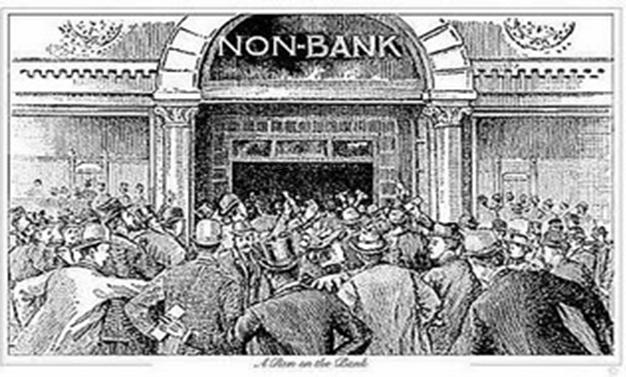
Shadow Banking

Collateral Damage: QE3 and the Shadow Banking System

Guest post by Ellen Brown, http://www.WebofDebt.com.
Rather than expanding the money supply, quantitative easing (QE) has actually caused it to shrink by sucking up the collateral needed by the shadow banking system to create credit. The “failure” of QE has prompted the Bank for International Settlements to urge the Fed to shirk its mandate to pursue full employment, but the sort of QE that could fulfill that mandate has not yet been tried.
Ben Bernanke’s May 29th speech signaling the beginning of the end of QE3 provoked a “taper tantrum” that wiped about $3 trillion from global equity markets – this from the mere suggestion that the Fed would moderate its pace of asset purchases, and that if the economy continues to improve, it might stop QE3 altogether by mid-2014. The Fed is currently buying $85 billion in US Treasuries and mortgage-backed securities per month.
The Fed Chairman then went into damage control mode, assuring investors that the central bank would “continue to implement highly accommodative monetary policy” (meaning interest rates would not change) and that tapering was contingent on conditions that look unlikely this year. The only thing now likely to be tapered in 2013 is the Fed’s growth forecast.
It is a neoliberal maxim that “the market is always right,” but as former World Bank chief economist Joseph Stiglitz demonstrated, the maxim only holds when the market has perfect information. The market may be misinformed about QE, what it achieves, and what harm it can do. Getting more purchasing power into the economy could work; but QE as currently practiced may be having the opposite effect.
Unintended Consequences
The popular perception is that QE stimulates the economy by increasing bank reserves, which increase the money supply through a multiplier effect.  But as shown earlier here, QE is just an asset swap – assets for cash reserves that never leave bank balance sheets. As University of Chicago Professor John Cochrane put it in a May 23rd blog:
QE is just a huge open market operation. The Fed buys Treasury securities and issues bank reserves instead. Why does this do anything? Why isn’t this like trading some red M&Ms for some green M&Ms and expecting it to affect your weight? . . .
[W]e have $3 trillion or so [in] bank reserves. Bank reserves can only be used by banks, so they don’t do much good for the rest of us. While the reserves may not do much for the economy, the Treasuries they remove from it are in high demand.
Cochrane discusses a May 23rd Wall Street Journal article by Andy Kessler titled “The Fed Squeezes the Shadow-Banking System,” in which Kessler argued that QE3 has backfired. Rather than stimulating the economy by expanding the money supply, it has contracted the money supply by removing the collateral needed by the shadow banking system. The shadow system creates about half the credit available to the economy but remains unregulated because it does not involve traditional bank deposits. It includes hedge funds, money market funds, structured investment vehicles, investment banks, and even commercial banks, to the extent that they engage in non-deposit-based credit creation.
Kessler wrote:
[T]he Federal Reserve’s policy—to stimulate lending and the economy by buying Treasurys—is creating a shortage of safe collateral, the very thing needed to create credit in the shadow banking system for the private economy. The quantitative easing policy appears self-defeating, perversely keeping economic growth slower and jobs scarcer.
That explains what he calls the great economic paradox of our time:
Despite the Federal Reserve’s vast, 4½-year program of quantitative easing, the economy is still weak, with unemployment still high and labor-force participation down. And with all the money pumped into the economy, why is there no runaway inflation? . . .
The explanation lies in the distortion that Federal Reserve policy has inflicted on something most Americans have never heard of: “repos,” or repurchase agreements, which are part of the equally mysterious but vital “shadow banking system.”
The way money and credit are created in the economy has changed over the past 30 years. Throw away your textbook.
Fractional Reserve Lending Without the Reserves
The post-textbook form of money creation to which Kessler refers was explained in a July 2012 article by IMF researcher Manmohan Singh titled “The (Other) Deleveraging: What Economists Need to Know About the Modern Money Creation Process.” He wrote:
In the simple textbook view, savers deposit their money with banks and banks make loans to investors . . . . The textbook view, however, is no longer a sufficient description of the credit creation process. A great deal of credit is created through so-called “collateral chains.”
We start from two principles: credit creation is money creation, and short-term credit is generally extended by private agents against collateral. Money creation and collateral are thus joined at the hip, so to speak. In the traditional money creation process, collateral consists of central bank reserves; in the modern private money creation process, collateral is in the eye of the beholder.
Like the reserves in conventional fractional reserve lending, collateral can be re-used (or rehypothecated) several times over. Singh gives the example of a US Treasury bond used by a hedge fund to get financing from Goldman Sachs. The same collateral is used by Goldman to pay Credit Suisse on a derivative position. Then Credit Suisse passes the US Treasury bond to a money market fund that will hold it for a short time or until maturity.
Singh states that at the end of 2007, about $3.4 trillion in “primary source” collateral was turned into about $10 trillion in pledged collateral – a multiplier of about three. By comparison, the US M2 money supply (the credit-money created by banks via fractional reserve lending) was only about $7 trillion in 2007.  Thus credit-creation-via-collateral-chains is a major source of credit in today’s financial system.
Exiting Without Panicking the Markets
The shadow banking system is controversial. It funds derivatives and other speculative ventures that may harm the real, producing economy or put it at greater risk. But the shadow system is also a source of credit for many businesses that would otherwise be priced out of the credit market, and for such things as credit cards that we have come to rely on. And whether we approve of the shadow system or not, depriving it of collateral could create mayhem in the markets. According to the Treasury Borrowing Advisory Committee of the Securities and Financial Markets Association, the shadow system could be short as much as $11.2 trillion in collateral under stressed market conditions. That means that if every collateral claimant tried to grab its collateral in a Lehman-like run, the whole fragile Ponzi scheme could collapse.
That alone is reason for the Fed to prevent “taper tantrums” and keep the market pacified. But the Fed is under pressure from the Swiss-based Bank for International Settlements, which has been admonishing central banks to back off from their asset-buying ventures.
An Excuse to Abandon the Fed’s Mandate of Full Employment?
 The BIS said in its annual report in June:
Six years have passed since the eruption of the global financial crisis, yet robust, self-sustaining, well balanced growth still eludes the global economy. . . .
Central banks cannot do more without compounding the risks they have already created. . . . [They must] encourage needed adjustments rather than retard them with near-zero interest rates and purchases of ever-larger quantities of government securities. . . .
Delivering further extraordinary monetary stimulus is becoming increasingly perilous, as the balance between its benefits and costs is shifting.
Monetary stimulus alone cannot provide the answer because the roots of the problem are not monetary. Hence, central banks must manage a return to their stabilization role, allowing others to do the hard but essential work of adjustment.
For “adjustment,” read “structural adjustment” – imposing austerity measures on the people in order to balance federal budgets and pay off national debts. The Fed has a dual mandate to achieve full employment and price stability. QE was supposed to encourage employment by getting money into the economy, stimulating demand and productivity. But that approach is now to be abandoned, because “the roots of the problem are not monetary.”
So concludes the BIS, but the failure may not be in the theory but the execution of QE. Businesses still need demand before they can hire, which means they need customers with money to spend. QE has not gotten new money into the real economy but has trapped it on bank balance sheets. A true Bernanke-style helicopter drop, raining money down on the people, has not yet been tried.
How Monetary Policy Could Stimulate Employment
The Fed could avoid collateral damage to the shadow banking system without curtailing its quantitative easing program by taking the novel approach of directing its QE fire hose into the real market.
One possibility would be to buy up $1 trillion in student debt and refinance it at 0.75%, the interest rate the Fed gives to banks. A proposal along those lines is Elizabeth Warren’s student loan bill, which has received a groundswell of support including from many colleges and universities.
Another alternative might be to make loans to state and local governments at 0.75%, something that might have prevented the recent bankruptcy of Detroit, once the nation’s fourth-largest city. Yet another alternative might be to pour QE money into an infrastructure bank that funds New Deal-style rebuilding.
The Federal Reserve Act might have to be modified, but what Congress has wrought it can change.  The possibilities are limited only by the imaginations and courage of our congressional representatives.

Monday, July 29, 2013

Unidentified Lenders Account For Growing Share of Jumbo MBS

CAN WE ALL SAY HEDGE FUNDS - THAT ARE FUNDED BY THE BANKS TO HIDE THE FRAUD OF 2004-2008!

Small lenders have accounted for a growing share of contributions to non-agency jumbo mortgage-backed securities. Some deals have included more than 70 lenders, with most of the lenders contributing less than 5 percent of the volume of mortgages included in a security.
While the lenders’ individual contributions to a particular jumbo MBS are small, they add up to significant market share, particularly when issuers don’t identify the lenders in prospectus documents filed with the Securities and Exchange Commission or in reports published by the rating services.
Through two quarters in 2013, unidentified lenders accounted for 35.3 percent of the collateral backing the $8.29 billion in non-agency jumbo MBS issued during that period, according to a new ranking and analysis by Inside Nonconforming Markets. That was nearly double the amount of loans coming from First Republic Bank, which was the top contributor to jumbo MBS in the first half of 2013.
And while a few identified lenders increased their share of contributions to non-agency jumbo MBS in the second quarter of 2013 compared with the previous quarter, the volume of originations from unidentified lenders increased by 46.8 percent during that time.


DEUTSCHE BANK/DB STRUCTURED PRODUCTS
JPM/CHASE
CITI
USBANK CORP
WELLS FARO
GOLDMAN
BOA

 
ARE ALL  FUNDING THESE HEDGE FUNDS TO HIDE THE FRAUD OF THESE MORTGAGES FROM 2004- 2008 , AND SUDDENLY THEY COME UP WITH THE PAPERWORK FOR THE COURTS, BUT THE HEDGE FUNDS FAIL TO TELL THE INVESTORS OR THE COURTS THE DOCUMENTS ARE FRAUDULENT AND ARE ON LOAN ONLY FOR THE COURT HEARINGS AND ARE RETURNED BACK TO THE BANKS.

PENNY MAC ( OLD COUNTRYWIDE BOYS)
ROOSEVELT MORTGAGE
RUSHMORE
ARCHBAY HOLDINGS LLC 
ARCHBAY CAPITOL /ALSO KNOWN AS YORK CAPITOL

THE LIST IS ENDLESS BUT THESE ARE ALOT OF THE MAIN PLAYERS IN THE FRAUD UPON THE COURTS.

Junk mortgages under the microscope

Ita time the sec and the feds take another look at junk bonds with hedge funds

A close-up of one deal shows how subprime mortgages went bad, says Fortune's Allan Sloan.


(Fortune Magazine) -- It's getting hard to wrap your brain around subprime mortgages, Wall Street's fancy name for junk home loans. There's so much subprime stuff floating around - more than $1.5 trillion of loans, maybe $200 billion of losses, thousands of families facing foreclosure, umpteen politicians yapping - that it's like the federal budget: It's just too big to be understandable.
So let's reduce this macro story to human scale. Meet GSAMP Trust 2006-S3, a $494 million drop in the junk-mortgage bucket, part of the more than half-a-trillion dollars of mortgage-backed securities issued last year. We found this issue by asking mortgage mavens to pick the worst deal they knew of that had been floated by a top-tier firm - and this one's pretty bad.
foreclosure.03.jpg
So many homes are up for sale that prices are falling, and holders of mortgage-backed securities are getting hurt.
newspaper_headlines.03.jpg


It was sold by Goldman Sachs (Charts, Fortune 500) - GSAMP originally stood for Goldman Sachs Alternative Mortgage Products but now has become a name itself, like AT&T and 3M.
This issue, which is backed by ultra-risky second-mortgage loans, contains all the elements that facilitated the housing bubble and bust. It's got speculators searching for quick gains in hot housing markets; it's got loans that seem to have been made with little or no serious analysis by lenders; and finally, it's got Wall Street, which churned out mortgage "product" because buyers wanted it. As they say on the Street, "When the ducks quack, feed them."
Alas, almost everyone involved in this duck-feeding deal has had a foul experience. Less than 18 months after the issue was floated, a sixth of the borrowers had already defaulted on their loans. Investors who paid face value for these securities - they were looking for slightly more interest than they'd get on equivalent bonds - have suffered heavy losses.
That's because their securities have either defaulted (for a 100% loss) or been downgraded by credit-rating agencies, which has depressed the securities' market prices. (Check out one of these jewels on a Bloomberg machine, and the price chart looks like something falling off a cliff.)
Even Goldman may have lost money on GSAMP - but being Goldman, the firm has more than covered its losses by betting successfully that the price of junk mortgages would drop. Of course, Goldman knew a lot about this market: GSAMP was just one of 83 mortgage-backed issues totaling $44.5 billion that Goldman sold last year.
Now let's take it from the top.
In the spring of 2006, Goldman assembled 8,274 second-mortgage loans originated by Fremont Investment & Loan, Long Beach Mortgage Co., and assorted other players. More than a third of the loans were in California, then a hot market. It was a run-of-the-mill deal, one of the 916 residential mortgage-backed issues totaling $592 billion that were sold last year.
The average equity that the second-mortgage borrowers had in their homes was 0.71%. (No, that's not a misprint - the average loan-to-value of the issue's borrowers was 99.29%.)
It gets even hinkier. Some 58% of the loans were no-documentation or low-documentation. This means that although 98% of the borrowers said they were occupying the homes they were borrowing on - "owner-occupied" loans are considered less risky than loans to speculators - no one knows if that was true. And no one knows whether borrowers' incomes or assets bore any serious relationship to what they told the mortgage lenders.
You can see why borrowers lined up for the loans, even though they carried high interest rates. If you took out one of these second mortgages and a typical 80% first mortgage, you got to buy a house with essentially none of your own money at risk. If house prices rose, you'd have a profit. If house prices fell and you couldn't make your mortgage payments, you'd get to walk away with nothing (or almost nothing) out of pocket. It was go-go finance, very 21st century.
Goldman acquired these second-mortgage loans and put them together as GSAMP Trust 2006-S3. To transform them into securities it could sell to investors, it divided them into tranches - which is French for "slices," in case you're interested.
There are trillions of dollars of mortgage-backed securities in the world for the same reason that Tyson Foods offers you chicken pieces rather than insisting you buy an entire bird. Tyson can slice a chicken into breasts, legs, thighs, giblets - and Lord knows what else - and get more for the pieces than it gets for a whole chicken. Customers are happy, because they get only the pieces they want.
Similarly, Wall Street carves mortgages into tranches because it can get more for the pieces than it would get for whole mortgages. Mortgages have maturities that are unpredictable, and they require all that messy maintenance like collecting the monthly payments, making sure real estate taxes are paid, chasing slow-pay and no-pay borrowers, and sending out annual statements of interest and taxes paid. Securities are simpler to deal with and can be customized.
Someone wants a safe, relatively low-interest, short-term security? Fine, we'll give him a nice AAA-rated slice that gets repaid quickly and is very unlikely to default. Someone wants a risky piece with a potentially very rich yield, an indefinite maturity, and no credit rating at all? One unrated X tranche coming right up. Interested in legs, thighs, giblets, the heart? The butcher - excuse us, the investment banker - gives customers what they want.
In this case, Goldman sliced the $494 million of second mortgages into 13 separate tranches. The $336 million of top tranches - named cleverly A-1, A-2, and A-3 - carried the lowest interest rates and the least risk. The $123 million of intermediate tranches - M (for mezzanine) 1 through 7 - are next in line to get paid and carry progressively higher interest rates.
Finally, Goldman sold two non-investment-grade tranches. The first, B-1 ($13 million), went to the Luxembourg-based UBS (Charts) Absolute Return fund, which is aimed at non-U.S. investors and thus spread GSAMP's problems beyond our borders. The second, B-2 ($8 million), went to the Morgan Keegan Select High Income fund. (Like most of this article, this information is based on our reading of various public filings; UBS and Morgan Keegan both declined to comment.)
Goldman wouldn't say, but it appears to have kept the 13th piece, the X tranche, which had a face value of $14 million (and would have been worth much more had things gone as projected), as its fee for putting the deal together. Goldman may have had money at risk in some of the other tranches, but there's no way to know without Goldman's cooperation, which wasn't forthcoming.
How is a buyer of securities like these supposed to know how safe they are? There are two options. The first is to do what we did: Read the 315-page prospectus, related documents, and other public records with a jaundiced eye and try to see how things can go wrong.
The second is to rely on the underwriter and the credit-rating agencies - Moody's and Standard & Poor's. That, of course, is what nearly everyone does.
In any event, it's impossible for investors to conduct an independent analysis of the borrowers' credit quality even if they choose to invest the time, money, and effort to do so. That's because Goldman, like other assemblers of mortgage-backed deals, doesn't tell investors who the borrowers are.
One Goldman filing lists more than 1,000 pages of individual loans - but they're by code number and zip code, not name and address.
Even though the individual loans in GSAMP looked like financial toxic waste, 68% of the issue, or $336 million, was rated AAA by both agencies - as secure as U.S. Treasury bonds. Another $123 million, 25% of the issue, was rated investment grade, at levels from AA to BBB--.
Thus, a total of 93% was rated investment grade. That's despite the fact that this issue is backed by second mortgages of dubious quality on homes in which the borrowers (most of whose income and financial assertions weren't vetted by anyone) had less than 1% equity and on which GSAMP couldn't effectively foreclose.
It's all in the math
How does toxic waste get distilled into spring water? Watch. It's all in the math - and the assumptions about how borrowers will behave.
These loans, which are fixed-rate, carried an average interest rate of 10.51%. After paying the people who collected the payments and handled all the other paperwork, the GSAMP Trust had ten percentage points left. However, the interest on the securities that GSAMP issued ran to only about 7%. (We say "about" because some of the tranches are floating-rate rather than fixed-rate.)
The difference between GSAMP's interest income and interest expense was projected at 2.85% a year. That spread was supposed to provide a cushion to offset defaults by borrowers. In addition, the aforementioned X piece didn't get fixed monthly payments and thus provided another bit of protection for the 12 tranches ranked above it.
Remember that we're dealing with securities, not actual loans. Thus losses aren't shared equally by all of GSAMP's investors. Any loan losses would first hit the X tranche. Then, if X were wiped out, the losses would work their way up the food chain tranche by tranche: B-2, B-1, M-7, and so on.
The $241 million A-1 tranche, 60% of which has already been repaid, was designed to be supersafe and quick-paying. It gets first dibs on principal paydowns from regular monthly payments, refinancings, and borrowers paying off their loans because they're selling their homes. Then, after A-1 is paid in full, it's the turn of A-2 and A-3, and so on down the line.
Moody's projected in a public analysis of the issue that less than 10% of the loans would ultimately default. S&P, which gave the securities the same ratings that Moody's did, almost certainly reached a similar conclusion but hasn't filed a public analysis and wouldn't share its numbers with us. As long as housing prices kept rising, it all looked copacetic.
Goldman peddled the securities in late April 2006. In a matter of months the mathematical models used to assemble and market this issue - and the models that Moody's and S&P used to rate it - proved to be horribly flawed. That's because the models were based on recent performances of junk-mortgage borrowers, who hadn't defaulted much until last year thanks to the housing bubble.
The fallout
Through the end of 2005, if you couldn't make your mortgage payments, you could generally get out from under by selling the house at a profit or refinancing it. But in 2006 we hit an inflection point. House prices began stagnating or falling in many markets. Instead of HPA - industry shorthand for house-price appreciation - we had HPD: house-price depreciation.
Interest rates on mortgages stopped falling. Way too late, as usual, regulators and lenders began imposing higher credit standards. If you had borrowed 99%-plus of the purchase price (as the average GSAMP borrower did) and couldn't make your payments, couldn't refinance, and couldn't sell at a profit, it was over. Lights out.
As a second-mortgage holder, GSAMP couldn't foreclose on deadbeats unless the first-mortgage holder also foreclosed. That's because to foreclose on a second mortgage, you have to repay the first mortgage in full, and there was no money set aside to do that. So if a borrower decided to keep on paying the first mortgage but not the second, the holder of the second would get bagged.
If the holder of the first mortgage foreclosed, there was likely to be little or nothing left for GSAMP, the second-mortgage holder. Indeed, the monthly reports issued by Deutsche Bank (Charts), the issue's trustee, indicate that GSAMP has recovered almost nothing on its foreclosed loans.
By February 2007, Moody's and S&P began downgrading the issue. Both agencies dropped the top-rated tranches all the way to BBB from their original AAA, depressing the securities' market price substantially.
In March, less than a year after the issue was sold, GSAMP began defaulting on its obligations. By the end of September, 18% of the loans had defaulted, according to Deutsche Bank.
As a result, the X tranche, both B tranches, and the four bottom M tranches have been wiped out, and M-3 is being chewed up like a frame house with termites. At this point, there's no way to know whether any of the A tranches will ultimately be impaired.
"[In hindsight,] I think we would not have rated it" had Moody's realized what was going on in the junk-mortgage market, says Nicolas Weill, the firm's chief credit officer for structured finance. Low credit scores and high loan-to-value ratios were taken into account in Moody's original analysis, of course, but the firm now thinks there were things it didn't know about.
Weill doesn't lay blame on any particular party, although in a Sept. 25 special report posted on Moody's website, he called for "additional third-party oversight that reviews the accuracy of the information provided by borrowers, appraisers, and brokers to originators" when it comes to junk issues. Or, as he calls them, "non-prime."
S&P, by contrast, says that it considers both its original rating and subsequent downward revisions correct. "We used the best information available at the time," says Vickie Tillman, S&P's chief rating officer.
If you read documents that Goldman filed with the SEC in connection with this offering, you discover that they warn about pretty much everything we've discussed so far and some things we haven't: the impact of falling house prices, the difficulty of foreclosing, the possible changes in credit ratings, the fact that more than half the mortgages were in California, Florida, and New York, all of which were overheated markets.
It's all disclosed. In capital letters. So no buyer - and this is aimed at sophisticated investors - can say he wasn't warned.
Goldman said it made money in the third quarter by shorting an index of mortgage-backed securities. That prompted Fortune to ask the firm to explain to us how it had managed to come out ahead while so many of its mortgage-backed customers were getting stomped.
Goldman's profits came from hedging the mortgage securities it keeps in inventory in order to make trading markets. It said in a recent SEC filing, "Although we recognized significant losses on our non-prime mortgage loans and securities, those losses were more than offset by gains on short mortgage positions."
As we interpret this - the firm declined to elaborate - Goldman made more on its hedges than it lost on its inventory because junk mortgages fell even more sharply than Goldman thought they would.
What is there to take away from our course in Junk Mortgages 101? Two things. First, you have to pay at least some attention to all those "risk factors" that issuers forever warn you about - especially when you're dealing with a whole new thing like junk mortgages issued en masse instead of by specialists.
Second, when you rely on the underwriter and the rating agencies to do all your homework for you, you don't have safety. You have only the illusion of safety.

Thursday, July 25, 2013

SAC Capital hit with criminal charges

steven cohen sac capital SAC has earned a reputation for being one of the world's most profitable hedge funds.
NEW YORK (CNNMoney)

In a move that could deal a death blow to one of the country's largest hedge funds, federal prosecutors announced criminal insider trading charges Thursday against SAC Capital, the firm run by billionaire investor Steven Cohen.

The indictment charges that the hedge fund was guilty of both "unlawful conduct by individual employees and an institutional indifference to that unlawful conduct."
The government alleges a pattern of insider trading that was "substantial, pervasive and on a scale without known precedent in the hedge fund industry."
SAC Capital did not immediately reply to CNNMoney's requests for comment.
The indictment charges that the insider trading started in 1999. and that the firm hired research analysts and money managers specifically because they possessed insider information. It says the insider trading resulted in "hundreds of millions" of dollars of illegal profits and "avoided losses" for the hedge fund.
The indictment follows a wide-ranging investigation that has already implicated more than half-a-dozen current or former SAC employees.
Cohen himself has not been charged criminally, though the Securities and Exchange Commission announced civil charges against him last week, accusing him of failing to supervise employees who engaged in insider trading.
Investigators have been circling Cohen and SAC for years. The firm agreed in March to pay the SEC roughly $615 million in connection with alleged insider trading by employees including two portfolio managers, Mathew Martoma and Michael Steinberg.
Martoma and Steinberg have already been charged criminally and are awaiting trial. Both have pleaded not guilty.
Martoma is accused of selling and shorting shares of the pharmaceutical companies Elan (ELN) and Wyeth based on inside information from drug trials that had not been publicized. The trades allegedly allowed SAC to generate profits and avoid losses worth $276 million in total.
Steinberg is accused of insider trading in Dell (DELL, Fortune 500) and Nvidia (NVDA) stock. An analyst who reported to Steinberg, Jon Horvath, has already pleaded guilty and is cooperating with prosecutors.
Related: Wall Street sheriff says no one too big to indict
Investors have been fleeing SAC in droves over the past few months as the firm's legal troubles have mounted.
The indictment of the firm makes matters worse. The Justice Department could permanently shutter SAC, which reportedly employs about 1,000 people, with a conviction in the case.
The SEC, meanwhile, is seeking to bar Cohen for managing investor funds. He could also be barred from the financial services industry.
Even if the firm is closed and Cohen himself faces sanctions, he could still manage the massive personal fortune he has invested with SAC, said Jacob Frenkel, a former federal prosecutor and SEC lawyer. As of May, Cohen accounted for $7 billion out of the roughly $15 billion managed by SAC, according to Bloomberg.
Nonetheless, the criminal charges against SAC represent a significant step.
Prosecutors have generally been reluctant to indict companies since accounting firm Arthur Andersen essentially collapsed a decade ago -- taking down nearly 28,000 jobs -- after being convicted in connection with the Enron scandal, said Michael Clark, a defense lawyer and former federal prosecutor. The conviction was later overturned by the Supreme Court.
Subsidiaries of global banks Royal Bank of Scotland (RBS) and UBS (UBS) have pleaded guilty in the past few months to criminal charges in connection with the Libor rate-rigging scandal, though those pleas didn't affect the firms' ability to operate in the United States.

Hey Investors listening yet? Dump the hedge funds!! 

Wednesday, July 17, 2013

Ben Bernanke: Fed’s Bond Purchases Aren’t on a Preset Course

OK investors are you paying attention to me yet? The quick buck on the bond buying is over. Dump them hedge fund bonds on foreclosure notes NOW!!


Federal Reserve chairman Ben Bernanke said the central bank’s asset purchases “are by no means on a preset course” as he sought to tamp down an increase in borrowing costs that threatens to slow the economic expansion.
“We’re going to be responding to the data,” Bernanke said today to the House Financial Services Committee. “If the data are stronger than we expect, we’ll move more quickly” to reduce purchases. If data “don’t meet the kinds of expectations we have about where the economy’s going, then we would delay that process or potentially increase purchases for a time.”
Stocks and Treasuries rallied on optimism that the Fed is prepared to delay an exit from its quantitative easing program should the four-year expansion show signs of faltering. Fed officials are trying to reverse an increase in Treasury yields since June 19, when Bernanke outlined the possible timing for a reduction in the $85 billion monthly pace of bond purchases.
“Clearly what happened in the markets after June was well beyond what they intended, and they’re trying to pull it back,” said Julia Coronado, chief economist for North America at BNP Paribas SA in New York and a former Fed board staff economist. “He has chosen to emphasize the conditionality of the baseline tapering forecast on data—and not just employment data but growth, inflation and importantly, financial conditions.”
The yield on the 10-year Treasury note fell to 2.48% at 12:30 p.m. in New York from 2.55% before the testimony. The Standard & Poor’s 500 Index rose 0.3% to 1,681.61.
The 10-year yield rose as high as 2.74% this month from 1.93% on May 21, the day before Bernanke said the FOMC may trim its bond buying in its “next few meetings” if officials see signs of sustained improvement in the labor market.
In prepared remarks, Bernanke said the Fed could keep buying bonds for longer if “financial conditions—which have tightened recently—were judged to be insufficiently accommodative to allow us to attain our mandated objectives.”
Responding to a question, he said the policy makers have succeeded in reducing market volatility that has greeted the Fed’s discussion of tapering.
“I think markets are beginning to understand our message, and the volatility has obviously moderated,” he said.
Policy makers have tried to assure investors that the Fed will hold down the benchmark interest rate after ending bond buying. Bernanke, in an appearance in Cambridge, Massachusetts, on July 11, said “highly accommodative monetary policy for the foreseeable future is what’s needed in the U.S. economy,” a message he repeated today.
The Fed chairman described labor markets as “far from satisfactory, as the unemployment rate remains well above its longer-run normal level, and rates of underemployment and long-term unemployment are still much too high.”
While risks to the economy have diminished since late last year, Bernanke said, the slow pace of the recovery means that it remains “vulnerable to unanticipated shocks, including the possibility that global economic growth may be slower than currently anticipated.”
In addition, “the risks remain that tight federal fiscal policy will restrain economic growth over the next few quarters by more than we currently expect, or that the debate concerning other fiscal policy issues, such as the status of the debt ceiling, will evolve in a way that could hamper the recovery.”
“This testimony is the relatively dovish Bernanke,” Mohamed El-Erian, chief executive officer of Pacific Investment Management Co., said in an interview on Bloomberg Television’s “In the Loop” with Betty Liu. “The underlying economy is still quite fragile.”
Bernanke also discussed dangers posed by an inflation rate that has remained below the Fed’s 2% goal.
Some sources of declining inflation “are likely to be transitory” and expectations for future price increases “have generally remained stable,” he said in his prepared remarks. At the same time, “very low inflation poses risks to economic performance—for example, by raising the real cost of capital investment—and increases the risk of outright deflation.”
The FOMC said in a June 19 statement that keeping the federal funds rate between zero and 0.25% “will be appropriate at least as long” as unemployment remains above 6.5% and the forecast for inflation in one to two years doesn’t exceed 2.5%.
Fed officials estimate the 6.5% unemployment threshold could be reached by the end of next year. That outlook is based on estimated growth of 3% to 3.5% for the economy in 2014, according to the committee’s June central tendency estimates, which are higher than the 2.9% estimate of private forecasters in a Bloomberg survey.
After that meeting, Bernanke said the FOMC may begin tapering bond purchases “later this year” and halt the program around mid-2014 if the economy performs in line with the Fed’s forecasts.
The chairman again took pains today to explain that the unemployment rate isn’t the only measure of labor market health.
“For example, if a substantial part of the reductions in measured unemployment were judged to reflect cyclical declines in labor force participation rather than gains in employment, the committee would be unlikely to view a decline in unemployment to 6.5% as a sufficient reason to raise its target for the federal funds rate,” he said. Increases in the benchmark lending rate “are likely to be gradual” when they happen, he said.
Bernanke, seeking to help unemployed Americans find work, has orchestrated the most aggressive easing in the central bank’s 100-year history, expanding its balance sheet to $3.5 trillion from $869 billion since August 2007 and keeping the main interest rate close to zero since December 2008.
Today, Bernanke claimed credit for fueling a rebound in sales of autos and homes, two industries that are driving the economic expansion. Fed asset purchases have also helped propel this year’s 17.5% surge in the S&P 500 Index of stocks.

Sunday, July 14, 2013

YOUR DUES ARE ABOUT DUE

NO WINNERS HERE ONLY WHINERS.. WHY YOU ASK?? LOOK BELOW


Wall Street banks are helping companies sell record amounts of junk bonds as strong demand lifts prices and lowers yields. The problem for investors who buy now is that they stand to suffer losses if interest rates rise, as is widely predicted.

Graphic by Bloomberg Businessweek; Data: Compiled by Bloomberg

Wednesday, July 10, 2013

Investors I warned you

 Investors I warned you..you did not listen , and now  you lose again and it will continue to happen till you pull out.I also warned you about Roosevelt Mortgage - US bank Trustee- done in Dec- 2012- Feb 2013 - these bonds are full of fraud.


Foreclosure documentation issues trap investors

Friday, June 28, 2013

Don't Call It A Housing Recovery Yet

Former FDIC Chair: Don't Call It A Housing Recovery Yet


Most economists say the . But one banking expert who grappled with the colossal housing bust during the Great Recession says it's too soon to celebrate.
Despite a recent upturn in sales and prices, "the housing market is still very weak," said Sheila Bair, who headed the Federal Deposit Insurance Corp. from 2006 to 2011. Bair, speaking at a Washington "economic summit" organized by The Atlantic magazine, warned homeowners that "we need more experience and data to know if it's really turned around."
Bair said lenders may be sitting on huge numbers of foreclosed upon houses that have been held back from the market. As housing prices start to perk up, that hidden inventory may come flooding into the market - and pushing prices back down, she said.
Moreover, millions of homeowners are "under water," i.e., they still owe more on mortgages than they could get by selling their homes. As soon as they can sell at prices high enough to pay off old loans, they'll put their properties on the market— and again drive down prices, she said.
And there could be another worry: prices for all sorts of assets may already be too high now because interest rates have been held too low for too long by the Federal Reserve, she said.
The Fed policy makers have had good intentions, but their low-interest-rate efforts have not revived the economy.
"We are not getting new lending and new jobs out of this," Bair said. However, we do have "the risk of asset bubbles developing... well, they've already developed," she said.

Shadow banking is back and is now Hedge Funds

As banks abandon debt trading, hedge funds that bet on bonds and loans are pulling in money from investors and hiring traders. Debt-focused hedge funds drew $41.4 billion from pension plans, wealthy individuals, and other investors in 2012, the most since 2007, according to data from Hedge Fund Research. They managed a total of $639.7 billion as of March 31, HFR data show, surpassing stock-trading hedge funds, with $638.7 billion.
Regulators are demanding that banks curb proprietary trading—betting with their own money—and hold more capital to back riskier investments. That’s allowed hedge funds to expand in businesses the banks are leaving, including distressed-debt trading and fixed-income arbitrage, a strategy that seeks to exploit short-term price differentials. “Hedge funds are playing in asset classes where they previously hadn’t played,” says Jason Rosiak, head of portfolio management at Pacific Asset Management.

Hedge funds specializing in debt trading are still minnows compared with Wall Street’s largest houses. BlueCrest Capital Management, Pine River Capital Management, and Millennium Management, three of the fastest-growing funds, have combined assets of about $67.6 billion, according to people with knowledge of the matter who asked not to be identified because the information is private. JPMorgan Chase’s (JPM) corporate and investment bank had an average of $413.4 billion in assets designated for trading in the first quarter.
Still, the hedge funds are growing rapidly, luring bankers from JPMorgan, Deutsche Bank (DB), Barclays (BCS), Bank of America (BAC), and others. BlueCrest doubled its New York staff in the two years through December, while Pine River increased its global workforce by a third in 2012. Millennium expanded its staff by 32 percent, to 1,250 people, last year. James Staley, the JPMorgan executive who was once seen as a candidate to run the company, quit in January to join $13.6 billion hedge fund firm BlueMountain Capital Management. “There’s a continuous brain drain on Wall Street,” says Rosiak.
One reason for banks’ retreat is the 2010 Dodd-Frank Act’s Volcker Rule, which seeks to curb proprietary trading. While the Volcker Rule hasn’t taken effect because regulators are still working out the details, some banks have closed proprietary trading desks.
Hedge funds, which are considered part of the less regulated “shadow-banking” system, are not subject to the rule. The idea behind regulators’ push to move debt trading from banks to hedge funds is to transfer the risk “into relatively small repositories that will be relatively insignificant if they fail,” says Roy Smith, a finance professor at New York University’s Stern School of Business. “The regulatory posture in the U.S. and in Europe is unequivocal. They want to transfer risk to the shadow-banking system.”
Yet moving risk to hedge funds does not make it go away. In 1998 hedge fund Long-Term Capital Management lost more than $4 billion after a debt default by Russia, mostly as a result of a fixed-income arbitrage strategy. The Federal Reserve was so concerned about the impact that it arranged a bailout paid for by banks. “If the hedge fund firms fail,” says Smith, “the real question is, to what degree will the market suffer from it?”

Tuesday, May 28, 2013

AG Eric Holder pay attention!


Despite the pronouncements by Eric Holder, the chief law enforcement officer of the United States, and the obvious reticence of the Securities and Exchange Commission, the vast majority of securities attorneys believe that the banks were (a) trading on inside information and (b) committing securities fraud when they funded and then traded on mortgages that were too toxic to ever succeed.
The first, trading on inside information, is regularly prosecuted by the justice department and the SEC. It is why Martha Stewart went to jail in rather flimsy evidence. The catch, justice and the SEC say is that this only applies to securities and the 1998 act signed into law by Clinton makes mortgage bonds and hedges on mortgage bonds NOT securities. It also makes the insurance paid on the mortgage bonds NOT insurance. This is despite the fact that the instruments meet every definition of securities and both the insurance contracts and credit default swaps appear to meet every definition of insurance. But the law passed by Congress in 1998 says otherwise, so how can we prosecute?
The second, securities fraud meets the same obstacle they say because they can't accuse anyone of committing fraud in the issuance or trading of securities when the law says there were no securities.
So goes the spin coming from Wall Street and as long as law enforcement in each state and the DOJ keeps listening to Wall Street and their lawyers, they will keep arriving at the same mistaken conclusion.
If Wall Street had in fact followed the plan of securitization set forth in their prospectuses and pooling and servicing agreements, assignment and assumption agreements and various other instruments that were created to build the infrastructure of securitization of debt --- including but not limited to mortgages, credit cards, auto loans, student loans etc. --- then Wall Street would be right and the justice department and the SEC might be stuck in the mud created by the 1998 law. But that isn't what happened and therefore the premise behind the apparent immunity of Wall Street Banks and bankers is actually an illusion.
Starting with the issuance of the mortgage bonds, most of them were issued before any mortgage was originated or acquired by anyone. In fact, the list attached to the prospectus for the mortgage bonds said so --- stating that the spreadsheet or list attached was by example only, that these mortgages do not exist but would be soon be replaced with real mortgages acquired pursuant to the enabling documents for the creation of the REMIC "trust." But that is not what happened either.
In no way did the Banks follow the terms of the prospectus, PSA, assignment and assumption agreements or anything else. Instead what they really did was create the illusion of a securitization scheme that covered up the reality of a PONZI scheme, the hallmark of which is that it collapses when investors stop buying the bogus securities and more investors want their money out than those wishing to put money into the scheme. There was no reason for the entire system to collapse other than the fact that Wall Street planned and bet on the collapse, thus making money coming and going and draining the lifeblood of capital worldwide out of economies and marketplaces that depended upon the continued flow of capital.
The creation of the REMIC "trust" was a sham. It was never formalized, never funded and never acquired any mortgages. hence any "exempt" securities issued by it were not the kind intended by the Act signed into law in 1998. It was not a mortgage-backed security, or credit backed security, it was an illusion designed to defraud anyone who invested in them. The purpose of issuing the mortgage bonds was not to fund and acquire mortgages but rather to steal as much money out of the flow as possible while covering their tracks with some of the money ending up on the closing table for newly originated or previously originated bundles of mortgages that were to be acquired. That isn't what happened either.
Wall Street bankers put the money from investors into their own private piggy bank and then funded and acquired mortgages with only part of the money while they made false "proprietary trades" in the "mortgage bonds" that made it look like they were trading geniuses making money hand over fist while the rest of the world saw their wealth decline by as much as 60%-70%. The funding for debt came not from the unfunded REMIC "trusts" but from the investment banker who was merely an intermediary depository institution which unlawfully was playing with investor money. The actual instruments upon which Wall Street relies to justify its actions is the prospectus, the PSA, and the Master Servicing agreement --- each of which was used to sell the investors on letting go of their money in exchange for the promises and conditions contained in the exotic agreements containing numerous conflicting clauses.
Thus the conclusion is that since the mortgage bonds were issued by an unfunded and probably nonexistent entity, the investors had "bought" an interest in an incoherent series of agreements that together constituted a security or, in the alternative, that there was no security and the investors were simply duped into parting with their money which is fraud, pure and simple.
I would say that investors acquired certain passive rights to the instruments used, with the exception of the bogus mortgage bonds that were usually worthless pieces of paper or entries on a log. In my opinion the issuance of the prospectus was the issuance of a security. The issuance of the PSA was the issuance of a security, And the issuance of the other agreements in the illusory securitization chain may also have been the issuance of a security. If cows can be securities, then written instruments that were used to secure passive investments are certainly securities. The exemption for mortgage bonds doesn't apply because neither the mortgage bond nor the REMIC "trust" were ever funded or used --- except in furtherance of their fraud when they claimed losses due to mortgage defaults and obtained federal bailouts, insurance and proceeds of credit default swaps.
The loan closings, like the funding of the "investments" was similarly diverted away from the investor and toward the intermediaries so that they could trade on the appearance of ownership of the loans in the form of selling bundles of loans that were not even close to being properly described in the paperwork --- although the paperwork often looked as though it was all proper.
The trading, hedging and insuring of investments that were not only destined by actually planned to fail was trading on inside information. The Banks knew very well that the triple A rating of the mortgage bonds was a sham because the mortgage bonds were worthless. What they were really trading in was the ownership of the loans which they knew were falsely represented on the note and mortgage. They thus converted the issuance of the promissory note signed by the borrower into a security under flase pretenses because the payee on the note and the secured party on the mortgage never completed the transaction, to wit: they never funded the loan and they made sure that the terms of repayment on the promissory note did not match up with the terms of repayment set forth in the prospectus, which was the real security.
Knowing from the start that they had the power (through the powers conferred on the Master Servicer) to pull the rug out from under the "investments" they traded with a vengeance hedging and selling as many times as they could based upon the same alleged loans that were in fact funded directly by and therefor owned by the investors directly (because the REMIC was ignored and so was the source of funding at the alleged loan closing).
Being the sole source of the real information on the legality, quality and quantity of these nonexistent investments in mortgage bonds, the Wall Street banks, their management, and their affiliates were committing both violation of the insider trading rule and the securities fraud rule ( as well as various other common law and statutory prohibitions and crimes relating to deceptive practices in the sale of securities). By definition and applying the facts rather than the spin, the Banks a have committed numerous crimes and the bankers should be held accountable. Let's not forget that by this time in the S&L scandal more than 800 people were sent to jail despite various attempts to mitigate the severity of their trespass and trampling on the rights of investors and depositors.
Failure to prosecute, while the statute of limitations is running out, is taking the rule of law and turning it on its head. The Obama administration has an obligation to hold these people accountable not only because violations of law should be prosecuted but to provide some deterrence from a recurrence or even escalation of the illegal practices foisted upon institutions, taxpayers and consumers around the world. Ample evidence exists that the Banks, emboldened by the lack of prosecutions, have re-started their engines and are indeed in the process of doing it again.
Think about it, where would a company get the money to have a multimedia advertising campaign blanketing areas of the the Country when the return on investment, according to them is only 2.5%? Between marketing, advertising, processing, and administrative costs, pus a reserve for defaults, they are either running a going out of business strategy or there is something else at work.
And if the transactions were legitimate why do the numbers of foreclosures drop like stones in those states that require proof of payment, proof of loss, and proof of ownership? why have we not seen a single canceled check or wire transfer receipt that corroborates the spin from Wall Street? Where is the real money in this scheme?
FROM OTHER MEDIA SOURCES ----
Foreclosure Victims Protesting Wall Street Impunity Outside DOJ Arrested, Tasered
http://www.truth-out.org/news/item/16527-victims-of-foreclosure-arrested-tasered-protesting-wall-street-impunity-outside-doj
Watch out. The mortgage securities market is at it again.
http://money.cnn.com/2013/05/23/news/economy/mortgage-backed-securities.pr.fortune/
West Sacramento homeowner uses new state law to stop foreclosure
http://www.sacbee.com/2013/05/23/5441875/west-sacramento-homeowner-uses.html
The Foreclosure Fraud Prevention Act: A.G. Schneiderman Commends Assembly for Passing Foreclosure Relief Bills
http://4closurefraud.org/2013/05/23/the-foreclosure-fraud-prevention-act-a-g-schneiderman-commends-assembly-for-passing-foreclosure-relief-bills/
Where did the California foreclosures go? Level of foreclosures sales dramatically down. Foreclosure legislation and bank processing. Subsidizing investor purchases via HAFA.
http://www.doctorhousingbubble.com/california-foreclosure-process-hafa-program-subsidize-investor-purchases/
Wasted wealth – The ongoing foreclosure crisis that never had to happen - The Hill's Congress Blog
http://thehill.com/blogs/congress-blog/economy-a-budget/301415-wasted-wealth--the-ongoing-foreclosure-crisis-that-never-had-to-happen


ITS COMING AND IT WILL BE WORST THE NEXT TIME AROUND, ALREADY HEDGE FUNDS AND BONDS ARE BUYING UP HOMES TO CONTROL THE MARKET, AND WHEN THIS WAS FAILS, WE WILL BE IN REAL BAD SHAPE. DON'T FOOL YOURSELVES IT IS COMING, SO PREPARE YOURSELVES NOW. 


CREDIT FOR THIS STORY GOES TO NEIL GARFIELD .