Showing posts with label investors. Show all posts

Tuesday, November 12, 2013

Are these investors totally stupid or just that greedy?


This gets me way down deep. First this trash bank **Deutsche Bank ** The mighty **King of foreclosures ** wipes out most of the country with robo signed papers and fraudulent paperwork, than take the homes, ( because they can't sell them the titles are junk) and turns around and RENTS them out! Nothing is done to them, nobody takes notice **HELLO US GOVERNMENT ARE YOU LISTENING?? ** NOT ONLY DID THEY MAKE MONEY OFF THE INSURANCE OF THESE HOMES FORECLOSING, BUT THEY NOW RAKE IN YET MORE PROFIT, OFF THE BACKS OF US TAXPAYERS WHO YES, DEAR CITIZENS WE BAILED OUT!

This bank screwed over how many investors?? How in God name are you stupid people  investing your money with them again? When our elected officials finally wake up, you will lose again, see they will investigate these homes and will find, they were illegal foreclosures , and DON'T  come crying again, you deserve to lose your asses.

I wonder how many pigs and bets are being placed on these?? They know they are playing on thin ice and the clock is ticking before their found out again.


NOV 12, 2013 1:47pm ET

DB Pricing Shows Appetite for REO-to-Rent Securitization


Deutsche Bank priced the inaugural single family rental transaction, the $479 million Invitation Homes 2013-SFR1 single family rental securitization transaction 5 basis points to 35 basis points tighter than initial guidance, a person familiar with the deal confirmed.
Invitation Homes, a Blackstone portfolio company, manages the nation's largest portfolio of single family homes being rented. The company has $7.5 billion of investments in the single-family home rental market.
The transaction had six sequential floating rate tranches. The classes were rated by Moody's Investors Service, Kroll Bond Ratings and Morningstar.
The Aaa/AAA/AAA, class A notes structured with a weighted average life of 4.9 years priced at 115 basis points over the one-month Libor, around 5 basis points tighter than initial price talk.
The Aa2/AA/AA, class B notes structured with a weighted average life of 5.1 years, priced at 135 basis points over the one-month Libor, at least 15 basis points tighter than price talk.
The A2/A/A, class C notes, structured with a weighted average life of 5.1 years priced at 185 basis points over the one-month Libor, also 15 basis points tighter than price talk.
Lower down the credit curve, the class D, E and F notes all priced around 35 basis points tighter than initial price talk. The Baa2/BBB/BBB+, class D note structured with a weighted average life of 5.1 years priced at 215 basis points over the one-month Libor.
The BBB-/BBB-, class E notes structured with a weighted average life of 5.1 years priced at 265 basis points over the one-month Libor.
KBRA rated the class F notes BB which were structured with a weighted average life of 5.1 years and priced at 365 basis points over the one-month Libor.

JP Morgan /Chase Bank run?

Are we looking at a new Bank run about to happen? Investors take notice, time to bail!

JPMorgan Fund Sparks Biggest High-Grade Bond Outflow Since June

Nov 01, 2013 4:02 pm ET
Nov. 1 (Bloomberg) -- JPMorgan Chase & Co.’s Core Bond Fund reported a $2.3 billion withdrawal this week that spurred the biggest weekly outflow from U.S. investment-grade debt funds since June.
The fund’s net assets dropped 9.2 percent to $22.38 billion on Oct. 28, according to data compiled by Bloomberg. Investment- grade funds reported a $2.67 billion outflow during the past week, with most of it coming from one fund, Bank of America Corp. credit strategists Hans Mikkelsen and Yuriy Shchuchinov said in an Oct. 31 report, citing data from EPFR Global.
The withdrawal reported “was likely a one-off event and no signal of a broader rotation out of high-grade bond funds,” the analysts wrote.
Investment-grade bonds in the U.S. gained 1.5 percent in October as speculation mounted that the Federal Reserve will maintain its $85 billion of monthly asset purchases through March. Companies have sold $991.4 billion of the debt so far this year, on pace for the most ever, from $945.4 billion during the same period last year, Bloomberg data show.
The JPMorgan Core Bond Fund was started on Dec. 31, 1983, and focuses on investment-grade notes with medium-term maturities, according to the data. It had 25 percent of its assets in corporate bonds and 55.8 percent in mortgage debt as of Aug. 31, Bloomberg data show.
Gregory Roth, a spokesman for J.P. Morgan Asset Management, declined to comment on the nature of the outflow.
--With assistance from Matthew Kelly in Princeton, New Jersey. Editors: Shannon D. Harrington, Richard Bravo

Friday, November 1, 2013

With a deal like who could loseyou ask, EVERYONE!

Anything that Deutsche Bank and Goldman sponsor, or are underwriters for.. ( here's a hint.. Blackstone is owned by Deutsche Bank)  only means disaster for anyone who sinks money into these two fraudsters. So, here's some advice by someone who has dealt with  Deutsche Bank, Don't invest in there messes! Also, boycott the Hilton!

Blackstone's Hilton looks to launch IPO week of December 2: sources


11:15:00 BST
An exterior shot of the Hilton Midtown in New York June 7, 2013. REUTERS/Andrew Kelly
Thu Oct 31, 2013 7:52pm GMT
(Reuters) - Hotel operator Hilton Worldwide Inc, owned by private equity firm Blackstone Group LP (BX.N), is aiming to launch its initial public offering the week of December 2, two people familiar with the matter said on Thursday.
The people cautioned that the timing of the float could change depending upon a regulatory review which is still in process. They asked not to be identified because the timing of the IPO is still confidential.
Blackstone declined to comment, while a Hilton representative did not immediately respond to a request for comment.
Blackstone took Hilton private in 2007 in a $26.7 billion deal, which was one of the largest leveraged buyouts that preceded the 2008 global financial crisis. In September, Hilton filed for an IPO to raise $1.25 billion.
Blackstone is hoping the stock market will value Hilton at around $30 billion, sources previously told Reuters.
Founded in 1919 by Conrad Hilton, the hotel operator's brands include such high-end names as Conrad and Waldorf Astoria. Hilton has 4,041 hotels, or 665,667 rooms under its umbrella, located in 90 countries. The company itself owns or leases 157 hotels, including the Waldorf Astoria in New York and the Hilton Hawaiian Village.
The IPO comes as Blackstone looks to exit several real estate investments. This week, shopping center unit Brixmor Property Group Inc (BRX.N) raised $825 million in an IPO.
Blackstone in July filed to take another hotel chain, Extended Stay America Inc, public, and the company said on Thursday it could be valued at as much as $4.2 billion.
It is also looking to sell or take public hotel chain La Quinta, potentially valuing it at up to $4.5 billion.
Deutsche Bank (DBKGn.DE), Goldman Sachs (GS.N), BofA Merrill Lynch and Morgan Stanley (MS.N) are the lead underwriters on the Hilton offering.

Thursday, September 19, 2013

Tell the SEC NO, not this time.. I did

Contact the SEC now and tell them no more slaps on the hands. 


SEC Addresses: Headquarters and Regional Offices

The Securities and Exchange Commission has twelve offices across the country:

SEC Headquarters
100 F Street, NE
Washington, DC 20549
(202) 942-8088
contact form: https://tts.sec.gov/oiea/QuestionsAndComments.html
see also: Electronic Mailboxes at the Commission
Directions for Hand Deliveries & Pick-ups
Atlanta Regional Office
Rhea Kemble Dignam, Regional Director
950 East Paces Ferry, N.E.
Ste 900
Atlanta, GA 30326-1382
(404) 842-7600
e-mail: atlanta@sec.gov
State jurisdiction: Georgia, North Carolina, South Carolina, Tennessee, Alabama
Boston Regional Office
John Dugan, Acting Regional Director
33 Arch Street, 23rd Floor
Boston, MA 02110-1424
(617) 573-8900
e-mail:
boston@sec.gov
State jurisdiction: Connecticut, Maine, Massachusetts, New Hampshire, Vermont, Rhode Island
Chicago Regional Office
Tim Warren, Acting Regional Director
175 W. Jackson Boulevard
Suite 900
Chicago, IL 60604
(312) 353-7390
e-mail: chicago@sec.gov
State jurisdiction: Illinois, Indiana, Iowa, Kentucky, Michigan, Minnesota, Missouri, Ohio, Wisconsin
Denver Regional Office
Julie Lutz and Kevin Goodman, Acting Co-Regional Directors
1801 California Street, Suite 1500
Denver, CO 80202-2656
(303) 844-1000
e-mail: denver@sec.gov
State jurisdiction: Colorado, Kansas, Nebraska, New Mexico, North Dakota, South Dakota, Wyoming
Fort Worth Regional Office
David Woodcock, Regional Director
Burnett Plaza, Suite 1900
801 Cherry Street, Unit 18
Fort Worth, TX 76102
(817) 978-3821
e-mail: dfw@sec.gov
State jurisdiction: Texas, Oklahoma, Arkansas, Kansas (except for the exam program which is administered by the Denver Regional Office)
Los Angeles Regional Office
Michele Wein Layne, Regional Director
5670 Wilshire Boulevard, 11th Floor
Los Angeles, CA 90036-3648
(323) 965-3998
e-mail: losangeles@sec.gov
State jurisdiction: Arizona, Hawaii, Guam, Nevada, Southern California (zip codes 93599 and below, except for 93200-93299)
Miami Regional Office
Eric I. Bustillo, Regional Director
801 Brickell Ave., Suite 1800
Miami, FL 33131
(305) 982-6300
e-mail: miami@sec.gov
State jurisdiction: Florida, Mississippi, Louisiana, U.S. Virgin Islands, Puerto Rico
New York Regional Office
Andrew Calamari, Regional Director
Brookfield Place
200 Vesey Street, Suite 400
New York, NY 10281-1022
e-mail: newyork@sec.gov
State jurisdiction: New York, New Jersey
Philadelphia Regional Office
Daniel M. Hawke, Regional Director
The Mellon Independence Center
701 Market Street
Philadelphia, PA 19106-1532
(215) 597-3100
e-mail: philadelphia@sec.gov
State jurisdiction: Delaware, Maryland, Pennsylvania, Virginia, West Virginia, District of Columbia
Salt Lake Regional Office
Kenneth D. Israel, Jr., Regional Director
15 W. South Temple Street
Suite 1800
Salt Lake City, UT 84101
(801) 524-5796
e-mail: saltlake@sec.gov
State jurisdiction: Utah
San Francisco Regional Office
Michael S. Dicke, Co-Acting Regional Director
Kristin A. Snyder, Co-Acting Regional Director
44 Montgomery Street, Suite 2800
San Francisco, CA 94104
(415) 705-2500
e-mail: sanfrancisco@sec.gov
State jurisdiction: Washington, Oregon, Alaska, Montana, Idaho, Northern California (zip codes 93600 and up plus 93200-93299)
 
NO! This is letting them get away with it again. Its like them telling me they were the owner of my Long Beach Washington Mutual mortgage and a year later saying they made a mistake and  didn't own it and using the same damn excuses. NO, this needs to stop. I lost my home because of this abuse.. and I canbet  thousands more.
Let it stop now and this time  charges filed, for once work for the people and the investors, and not just let them off the hook.


You are subscribed to Press Releases from the Securities Exchange Commission. A new press release is now available.
09/19/2013 07:00 AM EDT

The Securities and Exchange Commission today charged JPMorgan Chase & Co. with misstating financial results and lacking effective internal controls to detect and prevent its traders from fraudulently overvaluing investments to conceal hundreds of millions of dollars in trading losses.
The SEC previously charged two former JPMorgan traders with committing fraud to hide the massive losses in one of the trading portfolios in the firm’s chief investment office (CIO).  The SEC’s subsequent action against JPMorgan faults its internal controls for failing to ensure that the traders were properly valuing the portfolio, and its senior management for failing to inform the firm’s audit committee about the severe breakdowns in CIO’s internal controls.
JPMorgan has agreed to settle the SEC’s charges by paying a $200 million penalty, admitting the facts underlying the SEC’s charges, and publicly acknowledging that it violated the federal securities laws.
“JPMorgan failed to keep watch over its traders as they overvalued a very complex portfolio to hide massive losses,” said George S. Canellos, Co-Director of the SEC’s Division of Enforcement.  “While grappling with how to fix its internal control breakdowns, JPMorgan’s senior management broke a cardinal rule of corporate governance and deprived its board of critical information it needed to fully assess the company’s problems and determine whether accurate and reliable information was being disclosed to investors and regulators.”
As part of a coordinated global settlement, three other agencies also announced settlements with JPMorgan today: the U.K. Financial Conduct Authority, the Federal Reserve, and the Office of the Comptroller of the Currency.  JPMorgan will pay a total of approximately $920 million in penalties in these actions by the SEC and the other agencies.
According to the SEC’s order instituting a settled administrative proceeding against JPMorgan, the Sarbanes-Oxley Act of 2002 established important requirements for public companies and their management regarding corporate governance and disclosure.  Public companies such as JPMorgan are required to create and maintain internal controls that provide investors with reasonable assurances that their financial statements are reliable, and ensure that senior management shares important information with key internal decision makers such as the board of directors.  JPMorgan failed to adhere to these requirements, and consequently misstated its financial results in public filings for the first quarter of 2012.
According to the SEC’s order, in late April 2012 after the portfolio began to significantly decline in value, JPMorgan commissioned several internal reviews to assess, among other matters, the effectiveness of the CIO’s internal controls.  From these reviews, senior management learned that the valuation control group within the CIO – whose function was to detect and prevent trader mismarking – was woefully ineffective and insufficiently independent from the traders it was supposed to police.  As JPMorgan senior management learned additional troubling facts about the state of affairs in the CIO, they failed to timely escalate and share that information with the firm’s audit committee.
Among the facts that JPMorgan has admitted in settling the SEC’s enforcement action:
  • The trading losses occurred against a backdrop of woefully deficient accounting controls in the CIO, including spreadsheet miscalculations that caused large valuation errors and the use of subjective valuation techniques that made it easier for the traders to mismark the CIO portfolio.
  • JPMorgan senior management personally rewrote the CIO’s valuation control policies before the firm filed with the SEC its first quarter report for 2012 in order to address the many deficiencies in existing policies.
  • By late April 2012, JPMorgan senior management knew that the firm’s Investment Banking unit used far more conservative prices when valuing the same kind of derivatives held in the CIO portfolio, and that applying the Investment Bank valuations would have led to approximately $750 million in additional losses for the CIO in the first quarter of 2012. 
  • External counterparties who traded with CIO had valued certain positions in the CIO book at $500 million less than the CIO traders did, precipitating large collateral calls against JPMorgan.
  • As a result of the findings of certain internal reviews of the CIO, some executives expressed reservations about signing sub-certifications supporting the CEO and CFO certifications required under the Sarbanes-Oxley Act.
  • Senior management failed to adequately update the audit committee on these and other important facts concerning the CIO before the firm filed its first quarter report for 2012.
  • Deprived of access to these facts, the audit committee was hindered in its ability to discharge its obligations to oversee management on behalf of shareholders and to ensure the accuracy of the firm’s financial statements.
The SEC’s order requires JPMorgan to cease and desist from causing any violations and any future violations of Sections 13(a), 13(b)(2)(A), and 13(b)(2)(B) of the Securities Exchange Act of 1934 and Rules 13a-11, 13a-13, and 13a-15.  The order also requires JPMorgan to pay a $200 million penalty that may be distributed to harmed investors in a Fair Fund distribution.
The SEC’s investigation, which is continuing, has been conducted by Michael Osnato, Steven Rawlings, Peter Altenbach, Joshua Brodsky, Joseph Boryshansky, Daniel Michael, Kapil Agrawal, Eli Bass, Sharon Bryant, Daniel Nigro, and Christopher Mele.  The SEC appreciates the coordination of the U.K. Financial Conduct Authority, Federal Reserve, and Office of the Comptroller of the Currency as well as the assistance of the U.S. Attorney’s Office for the Southern District of New York, Federal Bureau of Investigation, Commodity Futures Trading Commission, and Public Company Accounting Oversight Board.

Wednesday, September 18, 2013

Looking for answers

Hi everyone,
This is a long shot , but hoping someone will know . I am looking for employees of Dana Capital , mostly a man named Joe. He would of worked for them in 2004. I want to know if he knows if my note was securitized . I am sure he will.

Dana Capital Group
Category: Mortgage Brokers 
8001 Irvine Center Drive
Irvine, CA 92618

I am also looking for investors for this security

Roosevelt Mortgage ( bought the loans from Archbay Mortgage LLC 2010B) This would be in Jan- Feb of this year. The actual sale was Dec.29. 2012.
Rushmore - Servicer
US Bank Corp - Trustee 

Inside this security is a loan , stating its worth 180,000.00 , this is NOT true, the house is worth 116,000.00. Their are 3 liens on this house, one is a US FEDERAL Lien for 201,000.00, Plus 32,000.00 Tax lien ( not for the house) and a 19,000.00 lien for Beneficial. 

Their is also , questions concerning the actual ownership of this loan. It was originally with Long Beach Mortgage in 2004- 2010. According to land records. However DB Structured Products claimed to of bought it in Sept 2006, but their is no assignment, no land records , nothing they proved to of bought it. In 2010 Deutsche Bank sold it to Archbay holdings LLC 2010B, with a robo signed document, yet, never showed how they were able to sell it, when no land records showed they owned it . ( title now no good) Than in 2011 Chase  claims to own it, ( received by Washington Mutual) Archbay and Deutsche Bank lawyers also have a robo signed assignment signed 6 years after the fact , stating it came from Chase, which Chase has also denied in doing, and was to be sent back to a M.E. Wilderman at Orion Financial group. ( 2nd title defect) Archbay never showed how they were able to buy it, also , why would they request an emerg assignment from Chase , if they in fact had all the required paperwork to buy it? Why robo signed? Why an incomplete assignment? Why if Chase did this , they state they didn't?  Now it was sold to Roosevelt mortgage Dec 29, 2012. 

I want to buy the house and pay in cash . Or I go to federal court and everyone loses. This house has been in foreclosure since May 2006, my only fault was taking on this loan when I didn't have to , and all I wanted was to know who owned it to pay for it. I never asked for a free ride , every work out was walked away from , not by me.

Please contact me , if you can help in this matter.


Monday, September 9, 2013

Left with nothing.

This man owed $134 in property taxes. The District sold the lien to an investor who foreclosed on his $197,000 house and sold it. He and many other homeowners like him were

Left with nothing.

Published on September 8, 2013
On the day Bennie Coleman lost his house, the day armed U.S. marshals came to his door and ordered him off the property, he slumped in a folding chair across the street and watched the vestiges of his 76 years hauled to the curb.
Movers carted out his easy chair, his clothes, his television. Next came the things that were closest to his heart: his Marine Corps medals and photographs of his dead wife, Martha. The duplex in Northeast Washington that Coleman bought with cash two decades earlier was emptied and shuttered. By sundown, he had nowhere to go.
All because he didn’t pay a $134 property tax bill.
HOMES FOR THE TAKING:
LIENS, LOSS AND PROFITEERS — Part 1 of 3

Part 2 — Suspicious bids go unnoticed in D.C.
Coming Tuesday: Part 3 — District tax officials have made hundreds of mistakes in recent years by declaring property owners delinquent even after they paid their taxes, forcing them to fight for their homes. Coming Tuesday.
Live Q&A: Join the reporters at noon ET on Sept. 10 for a chat about the series. Submit questions here.
The retired Marine sergeant lost his house on that summer day two years ago through a tax lien sale — an obscure program run by D.C. government that enlists private investors to help the city recover unpaid taxes.
For decades, the District placed liens on properties when homeowners failed to pay their bills, then sold those liens at public auctions to mom-and-pop investors who drew a profit by charging owners interest on top of the tax debt until the money was repaid.
But under the watch of local leaders, the program has morphed into a predatory system of debt collection for well-financed, out-of-town companies that turned $500 delinquencies into $5,000 debts — then foreclosed on homes when families couldn’t pay, a Washington Post investigation found.
As the housing market soared, the investors scooped up liens in every corner of the city, then started charging homeowners thousands in legal fees and other costs that far exceeded their original tax bills, with rates for attorneys reaching $450 an hour.

How you could lose your home

Property owners in the District risk losing their homes over relatively small amounts in unpaid property taxes. Here’s a look at the process:

If you don't pay your taxes, the District sells a lien for the tax debt to an investor, usually a company. The investor gets a lien.
$2,500
The typical lien amount, just a fraction of the property's value
13,000
Tax liens the District has sold from 2005 to 2012

Note: The District no longer sells tax liens on houses for delinquent tax bills under $1,000. Lien amounts include property taxes, penalties and interest. The District doesn’t track legal fees charged to homeowners. The estimates of legal fees is besed on a Post study of more than 200 cases. The foreclosure and court cases are through mid-2013.

Source: Data from D.C. Office of Tax and Revenue and D.C. Superior Court
Families have been forced to borrow or strike payment plans to save their homes.
Others weren’t as lucky. Tax lien purchasers have foreclosed on nearly 200 houses since 2005 and are now pressing to take 1,200 more, many owned free and clear by families for generations.
Investors also took storefronts, parking lots and vacant land — about 500 properties in all, or an average of one a week. In dozens of cases, the liens were less than $500.
Coleman, struggling with dementia, was among those who lost a home. His debt had snowballed to $4,999 — 37 times the original tax bill. Not only did he lose his $197,000 house, but he also was stripped of the equity because tax lien purchasers are entitled to everything, trumping even mortgage companies.
“This is destroying lives,” said Christopher Leinberger, a distinguished scholar and research professor of urban real estate at George Washington University.
Officials at the D.C. Office of Tax and Revenue said that without tax sales, property owners wouldn’t feel compelled to pay their bills.
“The tax sale is the last resort. It’s also the first resort — it’s the only way in the statute to collect debt,” said deputy chief financial officer Stephen Cordi.
But the District, a hotbed for the tax lien industry, has done little to shield its most vulnerable homeowners from unscrupulous operators.
Foreclosures have upended families in some of the city’s most distressed neighborhoods. Houses were taken from a housekeeper, a department store clerk, a seamstress and even the estates of dead people. The hardest hit: elderly homeowners, who were often sick or dying when tax lien purchasers seized their houses.
One 65-year-old flower shop owner lost his Northwest Washington home of 40 years after a company from Florida paid his back taxes — $1,025 — and then took the house through foreclosure while he was in hospice, dying of cancer. A 95-year-old church choir leader lost her family home to a Maryland investor over a tax debt of $44.79 while she was struggling with Alzheimer’s in a nursing home.
Other cities and states took steps to curb abuses, such as capping the fees, safeguarding houses owned by the elderly or scrapping tax sales altogether and instead collecting the money themselves.
“Where is the justice? They’re taking people’s lives,” said Beverly Smalls, whose elderly aunt lost her home in Northeast Washington. “It’s just not right.”
In a 10-month investigation, The Post chronicled years of breakdowns and abuses in a program that puts at risk one of the most fundamental possessions in American life.
  • Of the nearly 200 homeowners who lost their properties in recent years, one in three had liens of less than $1,000.
  • More than half of the foreclosures were in the city’s two poorest wards, 7 and 8, where dozens of owners were forced to leave their homes just months before purchasers sold them. One foreclosed on a brick house near the Maryland border with a $287 lien and sold it less than eight weeks later for $129,000.
  • More than 40 houses were taken by companies whose representatives were caught breaking laws in other states to win liens.
  • Instead of stepping in, the D.C. tax office created more problems by selling nearly 1,900 liens by mistake in the past six years — even after owners paid their taxes — forcing unsuspecting families into legal battles that have lasted for years. One 64-year-old woman spent two years fighting to save her home in Northwest after the tax office erroneously charged her $8.61 in interest.


Under a D.C. program, owners have lost homes over debts as low as $44
Stephen Cordi, with the D.C. tax office. Click on the image to view the gallery. (Lois Raimondo / The Washington Post)
Every Wednesday, homeowners plead their cases at D.C. Superior Court, where they are pitted against industry lawyers who have filed for more than 7,000 foreclosure cases in the past eight years alone. Families pace the hallways waiting for their names to be called in last-ditch efforts to rescue their homes.
“This is highway robbery,” said Brenda Adjetey, who showed up in court last week to protect her home in Southeast Washington after her $1,100 tax bill nearly quadrupled because of legal fees charged by the investor.
Tax lien purchasers defend the industry, saying that most people who buy liens are local investors just trying to earn interest — not take homes — and that the law gives owners six months to repay their debts before a foreclosure case can be filed.
“This is an opportunity to make some money, but it is also an opportunity for the city to get paid and to help its citizens,” said Richard Cockerill, a veteran bidder from Virginia.
In a written statement, the tax office added, “Property owners are given multiple opportunities to pay both before and after the tax sale.”
Officials also said the tax office has made improvements to the program in recent years, including additional warnings to homeowners before liens are sold, and the office recently stopped selling liens on houses for less than $1,000.
But officials acknowledge that limit was set to manage the caseload and is not a permanent policy change.
At a public hearing this past October, housing advocates presented a list of reforms to the D.C. Council, including capping the fees charged by purchasers and offering payment plans to struggling homeowners. But the changes were never made.
“That’s a failure on the part of government,” said Stephen Fuller, director of the Center for Regional Analysis at George Mason University. “This has punitive consequences. People have been damaged.”

Outsiders come to buy liens

Thomas McRae ran a flower shop on the first floor in this house on Sherman Avenue NW. But a tax lien investor from Florida foreclosed while McRae was under hospice care.
Liens are generally sold the year after a homeowner fails to pay a tax bill, for the same amount as the debt. Homeowners receive several warnings before their liens are put up at annual auctions.
Once a lien is sold, owners have six months to repay the investor with interest. If that does not happen, the investor can move to foreclose.
For years, the auctions came and went with little fanfare, drawing local investors who would plunk down a few hundred dollars to buy up liens in neighborhoods they knew well. Most were looking to earn the interest, and if there was a foreclosure, it was handled by the tax office.
But the work overwhelmed the agency, and in 2001, city leaders made a critical change: They told investors to head directly to court to file a foreclosure case.
The move empowered investors to start charging legal fees and court costs — a game changer that allowed them to turn minor delinquencies into insurmountable debts.
Companies from Florida, Illinois, Maryland and New York came to town, prepared to spend millions.
In 2007, more than 150 purchasers spent five days competing for 2,000 liens, first on properties downtown near the Capitol, then Georgetown, followed by Dupont Circle, Chinatown and finally the neighborhoods near the Anacostia River, long stricken by poverty.

Tuesday, August 20, 2013

JPMorgan hit by U.S. bribery probe


How did the banks get away with it? Bribery takes many forms. It doesn't need to be a direct payment, but merely something of value to the regulator or law enforcement officer. In this case it is the hiring of children of banking regulators in China. There is no reason why we should think that couldn't happen here. It did. The revolving door of regulators, law enforcement and the banks has long been known.
Even if it isn't a bribe, the bank is hiring people and then designating them for important positions in government regulation. Jamie Dimon sits on the Board at the New York Federal Reserve. Being immersed in the bank culture, the people involved come to believe the myths repeated every day. It becomes part of their culture.
The reason why the decisions on banking have been so chaotic is that there is a direct conflict between the real world and the illusions created by the banks. Put another way, the difference is between truth and fiction.
The fact remains that practically no mortgage can be satisfied or released because the ownership is completely deranged. The correction can only come from the courts when they realize and learn that the origination of the loan was a sham transaction, not just a table funded loan, and that the intent was fraud on the investors and homeowners (who were also "investors"). The scheme unraveled precisely in concert with investors ceasing to buy the "mortgage bonds" issued by entities in "street name." That is the red flag that alerts authorities that the securitization chain was in fact a fraudulent PONZI scheme. The issuers were designated asset pools that had nothing in them, and in most cases were not funded, directly or indirectly. So the mortgage bonds were worthless.
And now that the facts are being slowly revealed, the depth of malfeasance by the banks is being recognized for what it is --- but the government is sticking with its policy of "no prosecution." Until the government steps up to the mike and says outright that the scheme was a fraudulent scheme in which the borrowers were used as pawn to steal money from investors, most people are not going to believe it. Until respectable economists and legal scholars step up and say that the loan transaction described in the note never existed and was a strawman transaction that should have been revealed to the borrower, this tragedy will stop.
Study the Assignment and Assumption Agreements executed before the first loan application was ever accepted for review. Track the money from strangers showing up at closing as though it was the money of the designated payee on the note and mortgage. The rest will be easy. But until regulators see the public as their boss instead of the banks, don't expect any help from outside the courtroom.

UNFORTUNATELY  THE HELP FROM INSIDE THE COURTS ARE LIMITED AS WELL.

Thursday, July 25, 2013

SAC Capital hit with criminal charges

steven cohen sac capital SAC has earned a reputation for being one of the world's most profitable hedge funds.
NEW YORK (CNNMoney)

In a move that could deal a death blow to one of the country's largest hedge funds, federal prosecutors announced criminal insider trading charges Thursday against SAC Capital, the firm run by billionaire investor Steven Cohen.

The indictment charges that the hedge fund was guilty of both "unlawful conduct by individual employees and an institutional indifference to that unlawful conduct."
The government alleges a pattern of insider trading that was "substantial, pervasive and on a scale without known precedent in the hedge fund industry."
SAC Capital did not immediately reply to CNNMoney's requests for comment.
The indictment charges that the insider trading started in 1999. and that the firm hired research analysts and money managers specifically because they possessed insider information. It says the insider trading resulted in "hundreds of millions" of dollars of illegal profits and "avoided losses" for the hedge fund.
The indictment follows a wide-ranging investigation that has already implicated more than half-a-dozen current or former SAC employees.
Cohen himself has not been charged criminally, though the Securities and Exchange Commission announced civil charges against him last week, accusing him of failing to supervise employees who engaged in insider trading.
Investigators have been circling Cohen and SAC for years. The firm agreed in March to pay the SEC roughly $615 million in connection with alleged insider trading by employees including two portfolio managers, Mathew Martoma and Michael Steinberg.
Martoma and Steinberg have already been charged criminally and are awaiting trial. Both have pleaded not guilty.
Martoma is accused of selling and shorting shares of the pharmaceutical companies Elan (ELN) and Wyeth based on inside information from drug trials that had not been publicized. The trades allegedly allowed SAC to generate profits and avoid losses worth $276 million in total.
Steinberg is accused of insider trading in Dell (DELL, Fortune 500) and Nvidia (NVDA) stock. An analyst who reported to Steinberg, Jon Horvath, has already pleaded guilty and is cooperating with prosecutors.
Related: Wall Street sheriff says no one too big to indict
Investors have been fleeing SAC in droves over the past few months as the firm's legal troubles have mounted.
The indictment of the firm makes matters worse. The Justice Department could permanently shutter SAC, which reportedly employs about 1,000 people, with a conviction in the case.
The SEC, meanwhile, is seeking to bar Cohen for managing investor funds. He could also be barred from the financial services industry.
Even if the firm is closed and Cohen himself faces sanctions, he could still manage the massive personal fortune he has invested with SAC, said Jacob Frenkel, a former federal prosecutor and SEC lawyer. As of May, Cohen accounted for $7 billion out of the roughly $15 billion managed by SAC, according to Bloomberg.
Nonetheless, the criminal charges against SAC represent a significant step.
Prosecutors have generally been reluctant to indict companies since accounting firm Arthur Andersen essentially collapsed a decade ago -- taking down nearly 28,000 jobs -- after being convicted in connection with the Enron scandal, said Michael Clark, a defense lawyer and former federal prosecutor. The conviction was later overturned by the Supreme Court.
Subsidiaries of global banks Royal Bank of Scotland (RBS) and UBS (UBS) have pleaded guilty in the past few months to criminal charges in connection with the Libor rate-rigging scandal, though those pleas didn't affect the firms' ability to operate in the United States.

Hey Investors listening yet? Dump the hedge funds!! 

Monday, July 22, 2013

Lies of the Banks Coming Back to Haunt Them


by Neil Garfield
Now that Federal Reserve is nearly done buying the worthless mortgage bonds, the banks have shown that they are in fact making money hand over fist and the government is feeling less fearful about toppling the financial system with financial regulation.
Based upon my interview with a highly placed well-informed source who prefers to remain anonymous, it appears as though the playing field and the goal posts have been moved.
The starting point is the sale of worthless mortgage bonds to investors under false pretenses. It isn’t just that the underwriting standards that were to be applied to the mortgages were not followed; the problem is really that the money from the investors was never deposited into an account that was legally or even apparently owned by the investors or the asset pool shares that they thought they were buying.
The banks were claiming the investment shares (mortgage-backed securities) to be their own despite the clear money trail and paper trail showing that at no time were the investors informed that they were lending their money or their right to the mortgage loans to the banks and their co-venturers.
Then the banks claimed losses on those investment shares and collected from insurance, credit default swaps, other hedge products, and the taxpayers.
Then the banks claimed insolvency that threatened the entire financial system despite having received money from investors, part of which was never invested in anything related to mortgages or mortgage bonds. The threat of insolvency and the threat to the entire financial system was taken seriously by people in government that should have known better and perhaps did know better.
Then it was decided that the Federal Reserve would cure the insolvency issue by purchasing the worthless mortgage bonds at full value. They purchased it from the banks who it no time actually owned close bonds nor did the banks own any of the loans that supposedly “backed” the mortgage-backed bonds.
Then it was revealed that the banks were making a lot of money while the rest of the economy went into a nosedive. Any economist who is questioned on this subject will respond that it is very unlikely for intermediaries who act as conduits for transactions to make money when economic activity is on the decline.
If they are reporting profits it is from fictitious transactions. In this case fictitious transactions are “trading profits.” In reality the banks are feeding part of their ill-gotten gains back into the bank, and claiming it as profits. When the chips were down and the banks had to show that they were strong enough to exist at their mega size, they came up with the capital without any problem.
Now that they came up with the capital and the profits, they have demonstrated that the extra restrictions that regulators want to put on the banks will neither damage the bank’s profitability nor threaten the financial system.
But the Banks know that their ability to come up with money all stems from the fact that they lied to everyone and stole trillions of dollars and that it did not come from ordinary banking activities. SO they are currently in a bed they made for themselves: they don’t want the restrictions to be too restrictive because it might have a negative effect on their legal earnings, but they have proven the opposite with their illegal earnings --- which is precisely what the regulators were waiting for.
Hence the banks are stuck with whatever regulations are put on banks --- especially those who claim ownership over transactions in which they acted only as intermediaries --- or they must say that the regulations would be harmful because the truth is they didn’t really make the money that they reported as net income.
This doesn’t come as news to the Federal Reserve who knows that it is purchasing worthless bonds. But the Federal Reserve cannot say that the bonds are worthless because it would then be seen as quantitative easing which is inflationary. The whole reason the money supply was expanded so much without inflation going wild is that the Federal Reserve was merely “buying bonds” and not just giving out money. But the bonds were completely worthless. So the truth is that the Federal Reserve was and still is giving out money in quantitative easing.
This chain of events served to undercut the middle class portion of the economy completely, denuding them of jobs, houses and even prospects, creating blighted neighborhoods, declining tax revenues for municipalities and this bankruptcies like the City of Detroit. If the law was applied as it is applied to everyone except the big banks, then they would be charged with mortgage fraud, securities fraud (because the exemption does not apply if you don't follow the rules of issuance of a mortgage bond) and compensatory damages would be due to the following people with percentages of the total money advanced for each $1 of mortgage:
  1. Investors: 125%
  2. Insurers: 85%
  3. Credit default swaps: 400%
  4. Miscellaneous hedge products: 25%
  5. Borrowers: 15% (100% of the payments and down payment)
  6. Taxpayers: 5%
  7. Federal reserve: 100%
Thus the situation was likened by my source to an old joke about lawyers, the punch line of which is that the dog screws everyone in the room and runs away with the steak.But the real problem is that by participating in this deceptive scheme, the Federal Reserve, put the burden of the loss on homeowners whose mortgages were paid in whole or in part by the financial sector including the Federal Reserve.
It isn’t just that the ownership of the loan has become completely convoluted; the real issue is money, to wit: the credit transaction with borrower has been long since extinguished by these devices used by the banks and the Federal Reserve, and vehicles like the Maiden Lane entities.
The amount of money owed on those mortgages is in reality far less than the the amount demanded by the banks --- which means that modification is possible for nearly every loan, whether delinquent or not, because the principal has already been reduced by payment. THIS IS WHY I SAY FOLLOW THE MONEY TRAIL BEFORE YOU FOLLOW THE PAPER TRAIL. THE PAPER TRAIL IS ONLY RELEVANT IF IT MATCHES THE MONEY TRAIL. OTHERWISE IT IS IRRELEVANT.
In the marketplace where loans are being refinanced and where mortgages are being foreclosed, these facts are carefully kept out of the mainstream conversation. But more and more judges are starting to ask questions because the behavior of the banks is just not consistent with a creditor who wants their money.
They seem to want the foreclosure judgment or sale but they are not so interested in the property. AND THAT is because the foreclosure puts the seal of approval from the state on a bunch of lies that were proffered to the courts and to the recording offices. It is the foreclosure judgment and sale that starts the clock ticking on wrongful foreclosures. Once time has run out on those actions, the banks are home free and the Federal Reserve, the unwitting or witting accomplice goes on their merry way while more than ten million families lose their homes, jobs and prospects.
If the Courts start finding that the mortgages are invalid, that their enforcement is defective or impossible, and that the debt is in doubt because there is no proof of the account receivable and the loss must belong to SOMEBODY, the current plan collapses. As I stated in 2007 based upon my own direct knowledge and the knowledge of industry sources who were active in the bundling, selling and trading activity associated with mortgage loans, the entire crisis would have been averted if the banks were held to account because the accounts due from the borrowers had been reduced without their knowing it just as the account due to the investors had been reduced without them knowing it.
This brings us back to what seems like a quaint solution now. I said we should forget blame and just let bring everyone to the table and share the losses and risks. People get to stay in their homes, the investors get a return on their investment, the banks earn fees, and companies like AIG won't be in danger of toppling. But then, the catastrophic shift in wealth inequality would also never have happened. And the super rich would have been revealed, if they were bankers, as common thieves with keys to the vault.

Sunday, July 14, 2013

YOUR DUES ARE ABOUT DUE

NO WINNERS HERE ONLY WHINERS.. WHY YOU ASK?? LOOK BELOW


Wall Street banks are helping companies sell record amounts of junk bonds as strong demand lifts prices and lowers yields. The problem for investors who buy now is that they stand to suffer losses if interest rates rise, as is widely predicted.

Graphic by Bloomberg Businessweek; Data: Compiled by Bloomberg

Wednesday, July 10, 2013

The storm is coming

17 Signs That Most Americans Will Be Wiped Out By The Coming Economic Collapse


The vast majority of Americans are going to be absolutely blindsided by what is coming.  They don't understand how our financial system works, they don't understand how vulnerable it is, and most of them blindly trust that our leaders know exactly what they are doing and that they will be able to fix our problems.  As a result, most Americans are simply not prepared for the massive storm that is heading our way.  Most American families are living paycheck to paycheck, most of them are not storing up emergency food and supplies, and only a very small percentage of them are buying gold and silver for investment purposes.   They seem to have forgotten what happened back in 2008. 
When the financial markets crashed, millions of Americans lost their jobs.  Because most of them were living on the financial edge, millions of them also lost their homes.  Unfortunately, most Americans seem convinced that it will not happen again.  Right now we seem to be living in a "hope bubble" and people have become very complacent.  For a while there, being a "prepper" was very trendy, but now concern about a coming economic crisis seems to have subsided.  What a tragic mistake.  As I pointed out yesterday, our entire financial system is a giant Ponzi scheme, and there are already signs that our financial markets are about to implode once again
Those that have not made any preparations for what is coming are going to regret it bitterly.  The following are 17 signs that most Americans will be wiped out by the coming economic collapse...
#1 According to a survey that was just released, 76 percent of all Americans are living paycheck to paycheck.  But most Americans are acting as if their jobs will always be there.  But the truth is that mass layoffs can occur at any time.  In fact, it just happened at one of the largest law firms in New York City.
#2 27 percent of all Americans do not have even a single penny saved up.
#3 46 percent of all Americans have $800 or less saved up.
#4 Less than one out of every four Americans has enough money stored away to cover six months of expenses.
#5 Wages continue to fall even as the cost of living continues to go up.  Today, the average income for the bottom 90 percent of all income earners in America is just $31,244.  An increasing percentage of American families are just trying to find a way to survive from month to month.
#6 62 percent of all middle class Americans say that they have had to reduce household spending over the past year.
#7 Small business is becoming an endangered species in America.  In fact, only about 7 percent of all non-farm workers in the United States are self-employed at this point.  That means that the vast majority of Americans are depending on someone else to provide them with an income.  But what is going to happen as those jobs disappear?
#8 In 1989, the debt to income ratio of the average American family was about 58 percent.  Today it is up to 154 percent.
#9 Today, a higher percentage of Americans are dependent on the government than ever before.  In fact, according to the U.S. Census Bureau 49 percent of all Americans live in a home that gets direct monetary benefits from the federal government.  So what is going to happen when the government handout gravy train comes to an end?
#10 Back in the 1970s, about one out of every 50 Americans was on food stamps.  Today, about one out of every 6.5 Americans is on food stamps.
#11 It is estimated that less than 10 percent of the U.S. population owns any gold or silver for investment purposes.
#12 It has been estimated that there are approximately 3 million "preppers" in the United States.  But that means that almost everyone else is not prepping.
#13 44 percent of all Americans do not have first-aid kits in their homes.
#14 48 percent of all Americans do not have any emergency supplies stored up.
#15 53 percent of all Americans do not have a 3 day supply of nonperishable food and water in their homes.
#16 One survey asked Americans how long they thought they would survive if the electrical grid went down for an extended period of time.  Incredibly, 21 percent said that they would survive for less than a week, an additional 28 percent said that they would survive for less than two weeks, and nearly 75 percent said that they would be dead before the two month mark.
#17 According to a survey conducted by the Adelphi University Center for Health Innovation, 55 percent of Americans believe that the government will come to their rescue when disaster strikes.
Just because you are living a comfortable middle class lifestyle today does not mean that it will always be that way.
If you doubt this, take a look at what is going on in Greece.  Many formerly middle class parents in Greece have become so impoverished that they are actually dumping their children at orphanages so that they won't starve...
Scores of children have been put in orphanages and care homes for economic reasons; one charity said 80 of the 100 children in its residential centres were there because their families can no longer provide for them.
Ten percent of Greek children are said to be at risk of hunger. Teachers talk of cancelling PE lessons because children are underfed and of seeing pupils pick through bins for food.
If the U.S. economy crashes and you lose your job, how will you and your family survive?
Will you and your family end up homeless and totally dependent on the government for your survival?
Get prepared while there is still time.  If you do not know how to get prepared, my article entitled "25 Things That You Should Do To Get Prepared For The Coming Economic Collapse" has some basic tips, and there are dozens of excellent websites out there that teach people advanced prepping techniques for free.
So there is no excuse.  You can trust that Ben Bernanke and Barack Obama have everything under control, but as for me and my family we are going to prepare for the giant economic storm that is coming.
I hope that you will be getting prepared too.


Saturday, June 29, 2013

USB Investors - heres your heads up


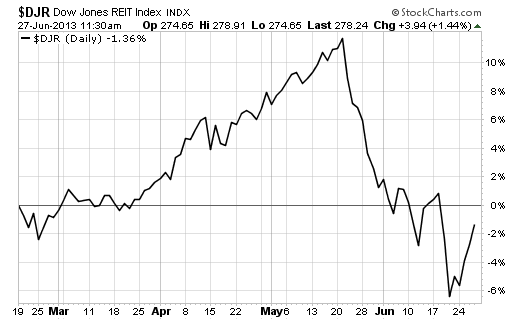
Real estate investment trusts (REITs) could soon turn from income investor darling to toxic portfolio sludge. It's already started: While the S&P 500 fell a few percentage points over the past month, REITs tumbled over 12% -- as measured by the Dow Jones REIT index (which covers over 90% of all publicly traded REITs):
(click to enlarge)
Worse still, if you back out dividends (which have been substantial), REITs have underperformed the broad stock market since mid-2010. Why the underperformance? For the past five-plus years, REITs enjoyed the double-edged sword of Fed policy. Low borrowing costs (of essentially zero percent) made it incredibly easy for these leveraged firms to borrow low and lend high.
But since rates can't go lower than zero, there's limited upside for REITs. Investors have kept one foot near the exit in anticipation of an inevitable rate hike when the Fed stopped (or hinted at stopping as we recently witnessed). That's because when rates rise, REITs will take it hard in the shorts.
First, profits will fall. That's because the "spread" between what they can borrow for and what they can lend for will narrow. When you can borrow at 0% and lend at 5%, you can leverage a billion dollar portfolio into hundreds of millions in profits. But what happens if rates jump to just 1%? That shrinks their profitability by one-fifth. If rates rise high enough, current loan repayment levels won't be high enough to secure new borrowing -- and REITs won't be able to secure a nickel of financing from anyone.
Companies like Annaly (NLY), considered to be one of the biggest and best run REITs, could see their current 12.3% dividend drop from double digits to zero -- and the stock will crater even further than it already has. When your business model is based on periodically refinancing long-term debt and pocketing the difference between borrowing costs and lending profits, you can expect huge gains when rates are super-low -- like they are right now.
But every REIT investor should be intimately aware of the other side of the sword. When (not if) rates rise, REITs will have a hard time. We currently own two REITs in our portfolio, but we're keeping a close eye on borrowing rates and, like every other REIT owner, we have one foot near the exit at all times. We'll let you know when things go from bad to worse for REITs.
Disclosure: None.

But here I will help you out.

The Roosevelt management trade  Dec 29th.2012, where they bought Archbay Holdings llc 2010B,  and than securitized it as a T-1 with USB as Trustee , is fraud. The houses were in foreclosure, titles are junk, Paperwork for them is fraud by Orion Financial Group, not the actual banks who owned them, and I know of one that has liens on them for 4 times the houses worth and 2 are Federal Liens as well . The actual worth of the house at the last appraisal in 2012 was 119.000.00 but their telling you 180,000.00 , the liens are well over 400,000.00 . Now don't you think you should be doing some checking yourselves? This is facts not fiction here and your being brought down that old 2005-2008 road. Remember I warned you.