Showing posts with label FDIC. Show all posts

Thursday, December 19, 2013

Well I warned you

 This is true. I paid off First Premier Bank CC in 2004, when owned by Washington Mutual. Recently I had letters arriving asking for settlements and people calling my family  telling them I could go to jail if I didn't pay. They updated it weekly on my credit report as well. I went to my VT AG who addressed this with them and guess what? They never responded .Chase and JP are selling these to recovery sites even if they were paid off.  

Chase and JP claim to own these and sell them and claim to own the notes and sell them and foreclose . Now , they are claiming they don't , and cry wolf cause they were caught and want to sue the FDIC.. ah NO ! You lied Chase and JP and its now time you face your karma! I warned you .


JP Morgan Sues FDIC for WAMU Cash Over Disputed Mortgage Bonds

by Neil Garfield
EDITOR'S NOTE: The dots are starting to get connected. Here JP Morgan who said they were the successor for everything that was WAMU turns out to be arguing that this didn't actually happen and that some money is still left in the WAMU "estate." The issue that is not raised is what else is in the WAMU estate? I content that there are numerous loans or claims to loans that were never transferred to anyone successfully and I think the FDIC and JPM both know that. Chase is trying to limit its exposure for bad bonds while at the same time claiming ownership or servicing rights for the underlying mortgages.
Which brings me to a central procedural point: if these cases are to be properly litigated such that the truth of the transaction(s) comes out, then it cannot be done on the rocket docket of foreclosures. It should be assigned to regular civil litigation or even better complex litigation because the issues cannot be addressed in the 5-10 minutes that are allowed on the rocket docket.
------------------------------------------------------------------
  • JPMorgan (JPM) has sued the Federal Deposit Insurance Corp. for a portion of the $2.7B remaining in the FDIC receivership that liquidated Washington Mutual following the sale of its branches and deposits to JPMorgan for $1.88B during the financial crisis in 2008.
  • The lawsuit is the latest development in the dispute between JPMorgan and the FDIC over who should assume Washington Mutual's legal liabilities, such as those related to the sale of problematic mortgage bonds.
  • Meanwhile, JPMorgan has been sued by the State of Mississippi for alleged misconduct while going after credit-card users for missed payments. The bank's sins include pursuing consumers for money they didn't owe, Mississippi said.
  • The state is the second to sue JPMorgan over the issue, the other being California, while 15 others are examining the matter. JPM is already in early settlement talks with 14 of them.

Tuesday, November 26, 2013

Wamu, Chase and the decision that can change lives

Sadly I have said this all along.


It is obvious that documents were produced for Shack to issue these rulings. The affidavits to which he refers should be obtained in their entirety. There is lots to take away from this decision, but most important, is that Chase never acquired the loans from WAMU. The loans originated or acquired by WAMU were already sold to investors, trusts and Fannie or Freddie. The issue with Fannie and Freddie of course is that they were merely fronting for "private label" securitizations hiding behind the veil of the GSE's who were mere guarantors and not lenders. I'd like to see any agreement and transactional documents showing the alleged purchase by Fannie, but it is presumed in the Shack Order and Findings.
It is also obvious that the finding that Chase was not the owner of the debt at any time came from an admission from both a Fannie Mae representative in an affidavit from an alleged Fannie Mae representative. We should direct discovery in Chase cases to that person in Fannie Mae who says they acquired the subject debt and that Chase merely received the servicing rights in the Chase-WAMU merger.
Note that Fannie Mae is considered by Shack to have acted in bad faith, and that Fannie was less than forthcoming in its description of itself stating that they might be the owner or they might be the trustee (pursuant to the Master Trustee Agreement published in 2007) for a securitized trust. Note also that Fannie at no time was chartered as a lender. Thus it could not originate any loans and never did so. The vagueness with which Fannie Mae addresses the issue of ownership shows that the hiding and non-disclosure in bankruptcy courts and state courts continues across the country.
The admission from Fannie that they "might" be the Master trustee for allegedly securitized assets (debts arising out of fictitious transactions on paper that looked like mortgage loans) is both alarming and encouraging. The rush to foreclosure is partially explained by this chaotic pile of fraudulent paper trails.
When you take into account the non stop servicer advances, you can see what the parties are hiding --- that the real creditor on those debts, has been paid all the interest they were expecting, that the principal is being paid in settlements with pennies on the dollar, and that the default alleged in notices from servicers and informing the borrower of the right to reinstate were defective, to wit: that the amount stated as required to cure the alleged default was and remains incorrect. The amount should have been reduced by third party payments including but not limited to the servicer advances which were not loans, and thus could only be characterized as PAYMENT, which is the ultimate defense against a lawsuit or any enforcement mechanism designed to collect a debt.
The dirty little secret is that they diverted title and money from the investors and converted what could have been a secured loan into an unsecured loan. The advances and payments by third parties satisfied the debt that arose when the borrower took the loan. They in turn MIGHT have claims for contribution or unjust enrichment but they are most certainly not protected by a pledge of collateral either as mortgage or assignment of rents or anything else.
Note that it could not have acquired loans except with money from what were represented as securitized trusts with Fannie as master Trustee. Therefore there are no circumstances under which Fannie or Freddie could be owners of the the debt with rights to enforce except upon the only event in which money is paid by Fannie for the loan --- a guarantee payment AFTER FORECLOSURE) that is the only transaction permitted under its charter. This point was missed by Shack or ignored by him, because he had bigger fish to fry --- the lawyers for Chase itself with a copy of the order to be served upon Jamie Dimon, the head of Chase.
The fact is that with the WAMU bankruptcy, seizure by OTS and appointment of FDIC, there were no assignments, agreements of sale or even a permission slip under which Chase could or did acquire loans from WAMU. But that didn't stop Chase from claiming exactly that in tens of thousands of foreclosures.
In cases where Chase is allegedly at the root of title through the merger with WAMU, it would be appropriate to site to the Shack case, get the case documents, get a Title and Securitization report (see http://www.livingliesstore.com) and lawyers should look into a motion for summary judgment, or a motion for involuntary dismissal with prejudice. Even where Chase might allege that it is filing the foreclosure as a representative of Fannie or Freddie, the basis for that allegation needs to be in their pleading or it is not an ULTIMATE fact upon which relief could be granted. Discovery should be aimed at getting the documents upon which Chase allegedly relies in showing that it has the authority to represent Fannie --- and don't stop there. The truth is that nearly all the so-called Fannie and Freddie loans were veils for the private label securitization in which the money was diverted from the trust, as was the title, leaving Fannie and Freddie as well as the investors and the buyers holding nothing.
In cases where the statute of limitations has already run, the dismissal of the foreclosure action, is barred in most cases from ever being brought again by anyone. But the dismissal against Chase should be with prejudice in all events because it isn't the creditor and therefore does not satisfy the statutory requirements in Florida, and I presume all other states, to submit a credit bid at auction in lieu of cash.
The Judges are beginning to understand that by applying basic contract law, they can clear their dockets. It is up to us to help them. The offer of a loan was met with acceptance by the borrower but the loan never occurred. The transfers also had offer and acceptance but again no money because the investors' money was used (outside the trust) directly to fund the origination or acquisition of the loan. This was part of a larger scheme to defraud to investors whose money was to have been deposited into the trust and then used to fund origination or acquisition of the he loans within 90 days (the cutoff).
The investment bank fraudulently induced (see complaints filed by investors, insurers, government guarantee entities etc.) the investors to give them money for an investment into a controlled trust when in fact they diverted the money for their own purposes, taking outsized fees for themselves as the toxic loans materialized to "support" the alleged investment into loans. That is the "mismanagement" part of investors' allegations --- diversion of money into a PONZI scheme.
The investment bank fraudulently diverted title to the loans to strawman entities or were --- sometimes even by name (see American Brokers Conduit) --- mere conduits for undisclosed third party lenders. The argument that the parties managed to hide this from the borrower long enough for the statute of limitations to run out on TILA claims is an affront to the court system and to the statutory scheme enacted by Congress to protect borrowers from predatory lenders and "steal" deals where huge fees were taken, rather than earned, without disclosure to the Borrower.
So the first element of fraud alleged by investors is diversion of the the money. The second is diversion of the paperwork that would have protected the investors at least to some extent. In this scheme title to the loan papers was intentionally diverted from the owners of the the debt, thus rendering the so-called mortgage documents unenforceable --- all alleged by investors, insurers and other co-obligors who have discovered to their chagrin that each of them paid the investment bank 100 cents on the the dollar on each loan multiple times.
And yet borrowers continue to seek modifications, which means they are not looking for free houses. Even knowing they are dealing with criminals the borrowers are willing to start paying these thieves if the terms can be adjusted to give them the benefit of the bargain that was intended at origination of the purchase money mortgage or refinancing or second mortgage or HELOC.
That leaves the servicers and their lawyers being the only ones who want Foreclosures because they want a free house and/or they want the foreclosure to recapture Servicer advances to the creditors --- advances that vastly reduce the amount owed and which cure the alleged borrower default. That has now become a foreclosure folly in which the servicers and their lawyers are the only parties who want it. The investors don't care because they are getting settlements for the fraud of the investment banks for creating unenforceable loan documents (that are frequently enforced anyway because of judicial ignorance) and diversion of investor money.
In the end, the "clean hands" that Shack talks about are clearly absent from both Servicer and government sponsored entities and as judge Shack states in his decision, wrongdoers should not be permitted to profitf or their wrongdoing. If that means a windfall to the borrower, so be it. It can be likened to the old usury laws and the current usury laws where the principal of the debt is wiped out and the fraudster is hit with a judgment for three times the principal, three times the interest or both.

Thursday, November 14, 2013

ALERT: COMMUNITY BANKS AND CREDIT UNIONS AT GRAVE RISK

Well this warning didn't take long.. When are you people gonna learn. ANYTHING that has Deutsche Bank attached to it , is a loss before it starts. Call your banks and Credit Unions and tell them no deals with Black Rock  IE: Deutsche Bank!!

Investors, hear my warning, you will lose in the end. Last warning.


BlackRock with ETF push to smaller banks


  • The roughly 7K regional and community banks in the U.S. have securities portfolios totaling $1.5T, the majority of which is in MBS, putting them at a particularly high interest rate risk, and on the screens of regulators who would like to see banks diversify their holdings.
  • "This is going to be a multiple-year trend and dialogue," says BlackRock's (BLK) Jared Murphy who is overseeing the iSharesBonds ETFs campaign.
  • The funds come with an expense ratio of 0.1% and the holdings are designed to limit interest rate risk. BlackRock scored its first big sale in Q3 when a west coast regional invested $100M in one of the funds.
  • At issue are years of bank habits - when they want to reduce mortgage exposure, they typically turn to Treasurys. For more credit exposure, they habitually turn to municipal bonds. "Community bankers feel like they're going to be the last in the food chain to know if there are any problems with a corporate issuer," says a community bank consultant.


ALERT: COMMUNITY BANKS AND CREDIT UNIONS AT GRAVE RISK HOLDING $1.5 TRILLION IN MBS

by Neil Garfield
I've talked about this before. It is why we offer a Risk Analysis Report to Community Banks and Credit Unions. The report analyzes the potential risk of holding MBS instruments in lieu of Treasury Bonds. And it provides guidance to the bank on making new loans on property where there is a history of assignments, transfers and other indicia of claims of securitization.
The risks include but are not limited to
  1. MBS Instrument issued by New York common law trust that was never funded, and has no assets or expectation of same.
  2. MBS Instrument was issued by NY common law trust on a tranche that appeared safe but was tied by CDS to the most toxic tranche.
  3. Insurance paid to investment bank instead of investors
  4. Credit default swap proceeds paid to investment banks instead of investors
  5. Guarantees paid to investment banks after they have drained all value through excessive fees charged against the investor and the borrowers on loans.
  6. Tier 2 Yield Spread Premiums of as much as 50% of the investment amount.
  7. Intentional low underwriting standards to produce high nominal interest to justify the Tier 2 yield spread premium.
  8. Funding direct from investor funds while creating notes and mortgages that named other parties than the investors or the "trust."
  9. Forcing foreclosure as the only option on people who could pay far more than the proceeds of foreclosure.
  10. Turning down modifications or settlements on the basis that the investor rejected it when in fact the investor knew nothing about it. This could result in actions against an investor that is charged with violations of federal law.
  11. Making loans on property with a history of "securitization" and realizing later that the intended mortgage lien was junior to other off record transactions in which previous satisfactions of mortgage or even foreclosure sales could be invalidated.
The problem, as these small financial institutions are just beginning to realize, is that the MBS instruments that were supposedly so safe, are not safe and may not be worth anything at all --- especially if the trust that issued them was never funded by the investment bank who did the underwriting and sales of the MBS to relatively unsophisticated community banks and credit unions. In a word, these small institutions were sitting ducks and probably, knowing Wall Street the way I do, were lured into the most toxic of the "bonds."
Unless these small banks get ahead of the curve they face intervention by the FDIC or other regulatory agencies because some part of their assets and required reserves might vanish. These small institutions, unlike the big ones that caused the problem, don't have agreements with the Federal government to prop them up regardless of whether the bonds were real or worthless.
Most of the small banks and credit unions are carrying these assets at cost, which is to say 100 cents on the dollar when in fact it is doubtful they are worth even half that amount. The question is whether the bank or credit union is at risk and what they can do about it. There are several claims mechanisms that can employed for the the bank that funds itself facing a write-off of catastrophic or damaging proportions.
The plain fact is that nearly everyone in government and law enforcement considers what happens to small banks to be "collateral damage," unworthy of any effort to assist these institutions even though the government was complicit in the fraud that has resulted in jury verdicts, settlements, fines and sanctions totaling into the hundreds of billions of dollars.
This is a ticking time bomb for many institutions that put their money into higher yielding MBS instruments believing they were about as safe as US Treasury bonds. They were wrong but because of any fault of anyone at the bank. They were lied to by experts who covered their lies with false promises of insurance, hedges and guarantees.
Those small institutions who have opted to take the bank public, may face even worse problems with the SEC and shareholders if they don't report properly on the balance sheet as it is effected by the downgrade of MBS securities. The problem is that most auditing firms are not familiar with the actual facts behind these securities and are likely a this point to disclaim any responsibility for the accounting that produces the financial statements of the bank.
I have seen this play out before. The big investment banks are going to throw the small institutions under the bus and call it unavoidable damage that isn't their problem. despite the hard-headed insistence on autonomy and devotion to customer service at each bank, considerable thought should be given to banding together into associations that are not controlled by regional banks are are part of the problem and will most likely block any solution. Traditional community bank associations and traditional credit unions might not be the best place to go if you are looking to a real solution.
Community Banks and Credit Unions MUST protect themselves and make claims as fast as possible to stay ahead of the curve. They must be proactive in getting a credible report that will stand up in court, if necessary, and make claims for the balance. Current suits by investors are producing large returns for the lawyers and poor returns to the investors. Our entire team stands ready to assist small institutions achieve parity and restitution.
FOR MORE INFORMATION OR TO SCHEDULE CONSULTATIONS BETWEEN NEIL GARFIELD AND THE BANK OFFICERS (WITH THE BANK'S LAWYER) ON THE LINE, EXECUTIVES FOR SMALL COMMUNITY BANKS AND CREDIT UNIONS SHOULD CALL OUR TALLAHASSEE NUMBER 850-765-1236 or OUR WEST COAST NUMBER AT 520-405-1688.
BLK | Thu, Nov 14
BlackRock with ETF push to smaller banks • The roughly 7K regional and community banks in the U.S. have securities portfolios totaling $1.5T, the majority of which is in MBS, putting them at a particularly high interest rate risk, and on the screens of regulators who would like to see banks diversify their holdings. • "This is going to be a multiple-year trend and dialogue," says BlackRock's (BLK) Jared Murphy who is overseeing the iSharesBonds ETFs campaign. • The funds come with an expense ratio of 0.1% and the holdings are designed to limit interest rate risk. BlackRock scored its first big sale in Q3 when a west coast regional invested $100M in one of the funds. • At issue are years of bank habits - when they want to reduce mortgage exposure, they typically turn to Treasurys. For more credit exposure, they habitually turn to municipal bonds. "Community bankers feel like they're going to be the last in the food chain to know if there are any problems with a corporate issuer," says a community bank consultant.


Friday, September 13, 2013

What We Haven't Learned From the Crisis

Our old theory of what to do was wrong, and we don’t have a new one.

Lehman Brothers former Chairman and CEO Richard Fuld is sworn in before testifying to the Financial Crisis Inquiry Commission about the roots and causes of the 2008 financial and banking meltdown in U.S. and worldwide markets.
Former Lehman Brothers CEO Richard Fuld is sworn in before testifying Sept. 1, 2010, to the Financial Crisis Inquiry Commission about the causes of the 2008 financial and banking meltdown. We don't know much more now than we did then, or in 2008.
Photo by Chip Somodevilla/Getty Images
This weekend marks the fifth anniversary of Lehman Brothers’ final, chaotic descent into bankruptcy. The investment bank wasn’t the first American financial institution to drown in bad bets on mortgage-backed securities. But unlike those that had come before, Lehman wasn’t covered by the FDIC and its resolution process. And despite the scrambling efforts of the Treasury Department and Federal Reserve, there was no way to quasi-save it through the kind of shotgun marriage that was deployed to sell Bear Stearns to JPMorgan Chase. Lehman was going down, and all officials could do was wait to see what happened next.
What happened next, of course, was a full-scale financial panic—one that the Fed and the Treasury spent the next year fighting under two presidents. They wanted, desperately, to avoid the collapse of the American banking system. And contrary to loud and fashionable lines of criticism then and now, they overwhelmingly did it not out of corruption or fealty to Wall Street but out of sincere belief that ending financial panic would be critical to helping real people and the real economy. To their credit, they succeeded at stemming the disaster much better than their contemporaneous critics allowed.
But they don’t like to admit to a plain truth that’s obvious to most everyone else: that ending the financial crisis and healing the banking system turned out to be much less important than we believed at the time.
Advertisement
One of the most infamous documents of the Obama era is a January 2009 projection attributed to Jared Bernstein and Christina Romer making the case for the president’s stimulus plan. They forecast that with the president’s plan in place, unemployment would peak in the third quarter of 2009 at 8 percent and then fall to about 5 percent by the second quarter of 2013.
Oops.
The really striking thing about the paper isn’t what they say about the stimulus. It’s what they say about a world of no stimulus. In this world unemployment peaks at 9 percent in the middle of 2010. After that it falls quite rapidly to about 5.5 percent in early 2013 and then precisely matches the no-stimulus scenario by the end of this year. Which is to say they believed then what policymakers at all levels believed—that there was simply no way to have a grinding years-long period of seemingly endless slow growth and mass unemployment. A harder recessionary fall would mean a sharper snapback. Cushioning the blow was sensible and humane, but the actual difference would be short-lived.
And yet experts knew that, at least in an academic sense, prolonged slumps were possible. That’s what happened during the Great Depression of the 1930s. Ben Bernanke summed up the conventional wisdom on this point in 2002, in his
tribute speech on Milton Friedman’s 90th birthday—back when Bernanke was a Fed governor but not yet running the show. “Regarding the Great Depression,” Bernanke said, addressing himself directly to Friedman, “you’re right, we did it. We’re very sorry. But thanks to you, we won’t do it again.”
The embedded meaning here: The Depression occurred because the Federal Reserve of the time had allowed widespread bank failures to sharply reduce the amount of money circulating in the country. This shortage of currency led to falling prices, which became a vicious cycle. With prices headed downward, everyone wanted to defer business investments and major purchases as far into the future as possible. That only increased the excess demand for money and intensified the cycle of deflation. The lesson was clear—at all costs, prevent a spiral of bank failures, currency shortage, and falling prices. Get that done, and the system will return to equilibrium.
By this standard, the powers that be have performed quite well. Leading measures of financial system stress spiked during the crisis but rapidly returned to normal. Banks have failed, but the banking system is alive. Ordinary households and businesses have no trouble finding someplace safe to put their money, and creditworthy borrowers can get loans. There’s been no cycle of deflation.
Yet the self-correcting economy we were promised hasn’t materialized. The unemployment rate remains high, even as the share of the population looking for a job keeps shrinking. And there’s no real mystery as to why the labor market has remained sick. Despite the hype about robots and jobless recoveries, employment growth has been about as weak as you’d expect given weak overall GDP growth. This is the deepest and most frightening lesson of the financial crisis—the automatic bounce-back mechanism doesn’t actually exist. The need for some extra boost—whether from fiscal stimulus, or monetary policy aimed at deliberately increasing inflation—is deeper and more profound than the Obama administration realized at the time.
Putting the measures in place for that extra boost would be an extremely difficult political lift. But the emergency measures that saved the banking system in the fall and winter of 2008–2009 were a tough lift too. They got done because policy elites regarded them as necessary. Today, those at the helm at the time defend that judgment, but add the qualification that what was necessary was “not sufficient.” Yet the insufficiency of the banking rescue ought to raise the question of whether it really was necessary. The bailouts of financial institutions were supposed to put the country on a self-correcting long-term path, even in the absence of other pro-growth measures. If they don’t do that, then the billions spent on TARP are like any other kind of fiscal stimulus spending—just a form targeted at a segment of society that’s unusually undeserving of public assistance. 
Bailout fatigue is rampant, but there’s absolutely no consensus on what we should do when faced with the next major economic downturn. Five years ago Bernanke and others at least had the excuse that they thought they knew what to do. Today we know that bank-centered theory of depression prevention was wrong, but haven’t embraced a new one. The continued imperfections in America’s financial regulations are scary. But the lack of a plan for what to do next time those flaws come to light—that’s much scarier.

Monday, August 5, 2013

7 Reasons To Support Glass-Steagall, & a List of Those Who Do

7 Reasons To Support Glass-Steagall, & a List of Those Who Do

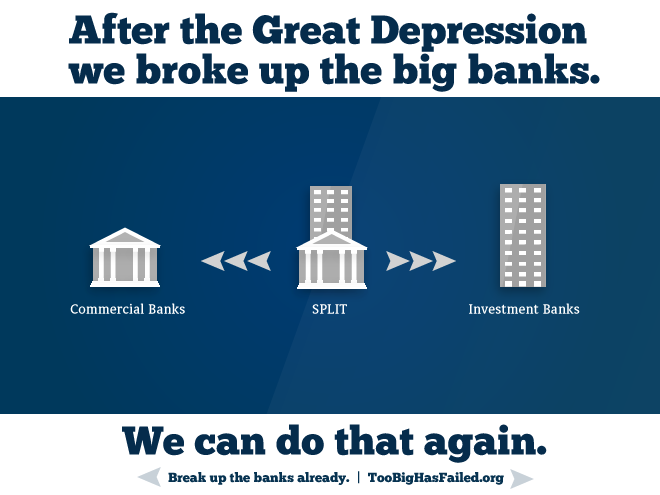
In our last post we talked about a new proposal to restore the Glass-Steagall Act of 1933, an act that separated commercial banking from investment banking.
It’s a proposition that has plenty of critics, many of whom say that Glass-Steagall wouldn’t have prevented the last crisis (see here, here, and here). In response, we’ve listed three reasons (numbers 4, 5, and 6 below) showing that the repeal of Glass-Steagall did in fact play a role in the crisis and that people should therefore support restoring it. Here’s the list:

1. It Will Break Up Chase, Bank of America, and Citi

reasons to support glass-steagall
By international accounting standards, these three banks are the biggest in world. They are also the prime examples of banks that have enormous combined commercial and investment enterprises. What this means is that these banks are increasingly unwieldy, and in the words of former FDIC chair Sheila Bair they’re simply “too big to manage.”

2. It Will Fracture Wall Street’s Lobbying Power

reasons to support glass-steagall
photo from flickr
In a Bloomberg video and in an article in the Financial Times, University of Chicago economist Luigi Zingales argues that restoring Glass-Steagall will fracture Wall Street’s lobbying power. He says, “Under the old regime, commercial banks, investment banks and insurance companies had different agendas, so their lobbying efforts tended to offset one another. But after the restrictions ended, the interests of all the major players were aligned.” It’s no wonder, then, that Wall Street’s power in Washington has increased in recent years.

3. Glass-Steagall Is Simple

reasons to support glass-steagall
Separating commercial banking activity from investment banking activity is a simple way to keep banks smaller. This simplicity is reflected in the bill itself: The original Glass-Steagall Act was 37 pages, for instance, while the 2010 Dodd-Frank Act will potentially reach 30,000 pages of rules.
Of course, simplicity in itself isn’t reason enough to support a bill, but it’s a reason that shouldn’t be overlooked. After all, the global economy gets exponentially more complex each year, and so it’s imperative to compensate that complexity with simple regulations—not lots of red tape and loopholes. “The simpler a rule is,” Luigi Zingales says, “the fewer provisions there are and the less it costs to enforce them. The simpler it is, the easier it is for voters to understand and voice their opinions accordingly. Finally, the simpler it is, the more difficult it is for someone with vested interests to get away with distorting some obscure facet.”
We need a few simple laws on Wall Street. Glass-Steagall is one such law.

4. It Would Have Prevented AIG’s Major Role In the Financial Crisis

reasons to support glass-steagall
photo from flickr
In his testimony to the Financial Crisis Inquiry Commission, Former Superintendent Eric Dinallo argued that AIG wouldn’t have been so laden with risk if they hadn’t been able to function like a hedge fund. He says that the repeal of Glass-Steagall, “permitted AIG to operate an effectively unregulated hedge fund with grossly insufficient reserves to back up its promises. Had AIG Financial Products been a stand alone company, it is unlikely that its counterparties would have been willing to do business with it because its commitments would never have carried a triple-A credit rating.”
Since AIG was at the heart of the bailouts, the repeal of Glass-Steagall played a major role in the financial crisis.

5. Citi Wouldn’t Have Been Run By Someone Who Didn’t Understand Commercial Banking

reasons to support glass-steagall
Vikram Pandit (pictured above) hadn’t ever worked as a commercial banker before becoming CEO of Citi in 2007. As Sheila Bair once said, Pandit “wouldn’t have known how to underwrite a loan if his life depended on it.” His lack of experience with commercial banking was problematic during the crisis because Citi was the sickest of all banks that received bailout money—requiring $472.6 billion in cash and guarantees. Pandit would have never been in charge of such a large commercial banking enterprise if Glass-Steagall hadn’t been repealed. Instead, he would have stuck with what he knew: investment banking.

6. Investment Banks Wouldn’t Have Faced as Much Competitive Pressure During the 2000s

reasons to support glass-steagall
Lehman Brothers CEO Dick Fuld, saying he wanted to rip out the heart of people betting against him.
The man in the picture above is Dick Fuld, the CEO of Lehman Brothers, an investment bank that went bankrupt in the crisis. Fuld was insanely competitive, as we saw in A Colossal Failure of Common Sense as well as this internal video, where Fuld shows his disdain for people betting against Lehman by saying, “I want to reach in, rip out their heart, and eat it before they die.” (Yikes.) Fuld desperately wanted to be a top dog on Wall Street, and the repeal of Glass-Steagall made that much, much more difficult because it created the sudden influx of big competition from commercial banks. Fuld’s blindly competitive spirit led him to overextend Lehman and eventually go bankrupt.
Of course, the repeal of Glass-Steagall didn’t in itself cause Fuld to overextend, but it’s clear that Lehman and other investment banks like Bear Stearns wouldn’t have faced nearly so much competitive pressure if commercial banks like Citi hadn’t suddenly entered the investment banking scene after 1999.
This report from Public Citizen (pdf) reveals more about why “The absence of Glass-Steagall … was intrinsic to Lehman’s collapse,” showing that Lehman itself admitted they were feeling intense pressure in 2005 from the repeal of Glass-Steagall.

7. Plenty of Smart People Support Restoring Glass-Steagall


Here’s a list of people in the video above who support Glass-Steagall:
0:07 – Bill Moyers (PBS) and Matt Taibbi (Rolling Stone discuss how little has changed since 2008).
0:27 – Robert Reich (fmr Labor Sec) explains why we need to break up the biggest banks
0:47 – Sandy Weill (CEO, Citigroup) explains why he wants the banks to be broken up
1:04 – Byron Dorgan gives the successful history of breaking up the banks.
1:32 – James Rickards lists the folks who allowed the banks to get big again.
1:41 – James Komansky (fmr CEO, Merril Lynch) regrets his decision to allow banks to get big again.
1:57 – Luigi Zingales (economist, Univ. of Chicago) on the danger of consolidated banks.
2:13 – Sheila Bair (fmr FDIC Chair) on why she would like to see the banks broken back up.
2:30 – Joseph Stiglitz (Nobel laureate, Columbia economist) on why we don’t have ordinary capitalism when banks are so big.
2:40 – Nouriel Roubini (NYU economist) “if institutions are too big to fail, they are too big.”
2:54 – Simon Johnson (MIT economist)
3:18 – Neil Barofsky (TARP inspector) explains exactly what needs to happen.
3:41 – Elizabeth Warren
4:00 – Bernie Sanders
4:17 – Ted Kaufman
*You can see more from MIT economist Simon Johnson in his articles “Five Facts About the New Glass-Steagall,” where he says that Glass-Steagall would be good for small banks, and in “Remember Citigroup,” where he says that the repeal of Glass-Steagall was directly responsible for Citi’s problems in the crisis. You can also see more from University of Chicago economist Luigi Zingales in his article “Why I Was Won Over By Glass-Steagall,” where he explains why he was initially resistant to the law, and why he now supports it.
In addition to the sixteen people shown in the video above, here are some more quotes from others who want to restore the law:
Barry Ritholtz, chief executive of FusionIQ, an asset management and research firm: “For about 70 years, Glass-Steagall managed to keep the riskier, more damaging part of Wall Street away from what should be the boring, straightforward side of finance. It was the height of stupidity repealing Glass-Steagall.”
Arthur Levitt, former Wall Street regulator: “Clearly, I regret my support of doing away with Glass Steagall.”
John Reed, former Citi CEO: “As another older banker and one who has experienced both the pre- and post-Glass Steagall world, I would agree with Paul A. Volcker (and also Mervyn King, governor of the Bank of England) that some kind of separation between institutions that deal primarily in the capital markets and those involved in more traditional deposit-taking and working-capital finance makes sense. This, in conjunction with more demanding capital requirements, would go a long way toward building a more robust financial sector.”
Thomas Hoenig, FDIC director: “When you mix commercial banking and high-risk broker-dealer activities, you increase the risk overall and as a result you invite new problems.”
Dean Baker, economist for the Center for Economic Policy and Research: “I think there are a lot of ways to make [the big banks] less powerful, less politically powerful, less economically powerful. Glass-Steagall, again I’d like to see that sort of separation.”
Andrew Haldane, Executive director of the Bank of England, calls Glass-Steagall “perhaps the single most important piece of financial legislation of the 20th century.”

Conclusion

Restoring Glass-Steagall won’t guarantee prevention of future financial crises, just as it (alone) wouldn’t have prevented the last one. However, restoring Glass-Steagall is a simple way to reduce the size of Wall Street banks, and its repeal certainly did play a part in the last crisis. Its for those reasons, as well as the others listed above, that the law should be restored.
We’ll conclude with this passage from Simon Johnson’s article “Remember Citigroup,” which argues that the New Glass-Steagall law should be a complement to other propositions to fix banking. We strongly agree with this notion:
The point of the New Glass-Steagall Act is to complement other measures in place or under consideration, including much higher capital requirements (both in the Brown-Vitter proposed legislation and in the new regulatory cap on leverage now under consideration), the Volcker Rule, and efforts to bring greater transparency to derivatives.
These measures are not substitutes for each other – they are complements.  Each would be more effective if the others are also implemented properly.
Nothing can completely remove the risk of future financial crisis.  Anyone who promises this is offering up illusions and deception.
But, like it or not, public policy shapes incentives in the financial system.  We can have a safer financial system that works better for the broader economy – as we had after the reforms of the 1930s.  Or we can have a system in which a few relatively large firms are encouraged to follow the model of Citigroup and to become ever more careless and on a grander scale.
Also see our last post on the new Glass-Steagall Act.

Elizabeth Warren Introduces 21st Century Glass-Steagall Act

Elizabeth Warren Glass-Steagall
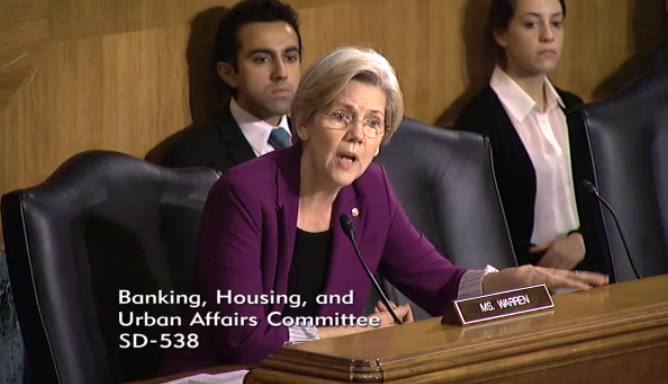
At today’s Senate Banking Committee hearing, Elizabeth Warren introduced the 21st Century Glass-Steagall Act of 2013, co-sponsored by Senators McCain, Cantwell, and King. This new bill mirrors the original 1933 Glass-Steagall Act, which separated traditional banking activity (like checking and lending) from the riskier activity investment banking (like derivatives).
The original law was repealed in 1999 by the Gramm-Leach-Bliley Act, though Glass-Steagall had been eroding for years leading up to that point. Gramm-Leach-Bliley, along with several laws passed during that era, allowed the big banks to transform into megabanks, creating “too big to fail.”
To illustrate, the chart below shows that from 1935 to 1990 the three biggest banks averaged around 10% of total bank assets, but by 2009 they suddenly had over 40%.
rise of too big to fail concentration of banks glass-steagall
This new bill from Senator Warren will reverse this trend and make the banks smaller. After all, the three biggest banks (Chase, Bank of America, and Citi) are all bloated conglomerate banks that have enormous traditional and investment subsidiaries, so these banks wouldn’t be able to continue as they’re currently instituted under the new Glass-Steagall Act. Instead these megabanks would be broken up into much smaller firms.
What’s more, the new Glass-Steagall Act will make it so banks cannot gamble with derivatives using depositor’s money, as they do today. Currently, depositors at banks like Chase, Bank of America, or Citi implicitly use their money to help these banks make amplified bets that have the potential to cause another global meltdown. Reintroducing Glass-Steagall will make it so depositor’s money cannot be used for the derivatives market. This would be a major step toward restoring sanity to Wall Street.
For more on why it’s important to restore Glass-Steagall, see this compilation video that shows expert after expert calling to restore it:

Perhaps one of the best quotes from the video is from University of Chicago economist Luigi Zingales who says the strength of Glass-Steagall was its simplicity. The new bill from Warren shares that strength. It’s a mere 30 pages (compare that to the 30,000 pages of rules that will come out of Dodd-Frank).
You can read the full text of the bill here, or glance at the fact sheet (thanks to @peteshroeder for pointing us to the documents via Twitter).

Wednesday, July 31, 2013

Another great post by Neil Garfield

Perils of Pooling: OneWest

by Neil Garfield
Apparently my article yesterday hit a nerve. NO I wasn't saying that the only problems were with BofA and Chase. OneWest is another example. Keep in mind that the sole source of information to regulators and the courts are the ONLY people who understand mergers and acquisitions. So it is a little like one of those TV shows where the only way they can get an arrest and conviction is for the perpetrator or suspect to confess. In this case, they "confess" all kinds of things to gain credibility and then lead the agencies and judicial system down a rabbit hole which is now a well trodden path. So many people have gone down that hole that most people that is the way to get to the truth. It isn't. It is part of a carefully constructed series of complex conflicting lies designed carefully by some very smart lawyers who understand not just the law but the way the law works. The latter is how they are getting away with it.
Back to OneWest, which we have detailed in the past.
OneWest was created almost literally overnight (actually over a weekend) by some highly placed players from Wall Street. There is an 80% loss sharing arrangement with the FDIC and yes, there appears to be some grey area about ownership of the loans because of that loss sharing agreement. But the evidence of a transaction in which the loans were actually purchased by a brand new entity that was essentially unfunded is completely absent. And that is because OneWest and Deutsch take the position that the loans were securitized despite IndyMac's assurances to the contrary. The only loans in which OneWest appears to be a player are those in which the loan was subject to (false) claims of securitization. No money went to the trustee, no money went to the trust, no assets went into the pool because the REMIC asset pool lacked the funding to purchase any assets.
Add to that a few facts. Deutsch is usually the "trustee"of the REMIC asset pool, but Reynaldo Reyes says he has nothing to do. He has no trust accounts and makes no decisions and performs no actions. Sound familiar. I have him on tape and his deposition has already been taken and publicized on the internet by others. Reyes says the whole arrangement is "counter-intuitive" (a very creative way of saying it is a lie). It is up to the servicer (OneWest) to decide what loans are subject to modification, mediation or even reinstatement. It is up to the servicer as to when to foreclose. And the servicer here is OneWest while the Master Servicer appears to be the investment banking arm of Deutsch, although I do not have that confirmed.
The way Reyes speaks about it the whole thing ALMOST makes sense. That is, until you start thinking about it. If Deutsch Bank has an extensive trust subsidiary, which it does, then why is a VP of asset management in control of the trust operations of the REMIC asset pools. Answer: because there are no funded trusts and there are no asset pools with assets. Hence any statement by OneWest that it is the owner of the loan is untrue as is the allegation that Deutsch is the trustee because all trustee duties have been delegated to the servicer. That leaves the investor with an empty box for an asset pool and no trustee or manager or even an agent to to actually know what is going on or who is monitoring their money and investments.
Note that like BOfA using Red Oak Merger Corp., there is the creation of a fictional entity that was not used by the name of, no kidding, "Holdco." This is to shield OneWest from certain liabilities as a lender. Legally it doesn't work that way but practically it generally does work that way because judges listen to bank lawyers to tell them what all this means. That is like asking a 1st degree murder defendant to explain to the jury the meaning of reasonable doubt.
Now be careful here because there is a "loan sale" agreement referenced in the package posted by the FDIC. But it refers to an exhibit F. There is no exhibit F and like the ambiguous agreements with the FDIC in Countrywide and Washington mutual, there are words there, but they don't really say anything. Suffice it to say that despite some fabricated documents to the contrary, there is no evidence I have seen that any loan  receivable was transferred to or from a REMIC asset pool, Indy-mac, or Hold-co.
These people were not stupid and they are not idiots. And their lawyers are pretty smart too. They know that with the presumption of a funded loan in existence, the banks could pretty much get away with saying anything they wanted about the ownership, the identity of the creditor and the ability to make a credit bid at the auction of a property that should never have been foreclosed in the first instance --- and certainly not by these people.
But if you dig just a little deeper you will see that the banks are represented to the regulatory authorities that they own the bonds (not true because the bonds were created and issued to specific investors who bought them); thus they include the bonds as significant items on their balance sheet which allows them to be called mega banks or too big to fail when in fact they have a tiny fraction of the reserve requirements of the Federal Reserve which follows the Basel accords.
Then when you turn your head and peak into courtrooms you find the same banks claiming ownership of the loan receivable, which was created when the funding occurred at the "closing" of the loan. They know they are taking inconsistent positions but most judges lack the sophistication to pinpoint the inconsistency. And that is how 5 million people lost their homes.
On the one hand the banks are claiming there was no fraud in the issuance of mortgage backed bonds by a REMIC asset pool formed as a trust. In fact, they say the loans were transferred into the REMIC asset pool. Which means that ownership of the mortgage bonds is ownership of the loans --- at least that is what the paperwork shows that was used to sell pension funds on buying these worthless bogus bonds. Then they turn around and come to court as the "holder" and get a foreclosure sale in which the bank submits the credit bid and buys the property without spending one dime. What they have done is, in lay terms, offered the debt to pay for the property. But the debt, according to the same people is owned by the investors or the REMIC trust, not the banks.
Then they turn to the insurers and counterparties on credit default swaps, and the Federal reserve that is buying these bonds and they say that the banks own the bonds, have an insurable interest, and should receive the proceeds of payments instead of the investors who actually put up the money. And then they say in court that the account receivable is unpaid, there is a default, and therefore the home should be foreclosed. What they have done is create a chaotic complex of lies and turn it into an illusion that changes colors and density depending upon whom the banks are talking with.
There is no default on the account receivable if the account was paid, regardless of who paid it --- as long as it was really paid to either the owner of the loan receivable or the authorized agent of the owner (i.e., the investor/lender). And so it is paid. And if paid, there can be no action on the note because the loan receivable has been satisfied. There can be no action on the mortgage because it was never a perfected lien and because the loan receivable was extinguished by PAYMENT. You can't use the mortgage to enforce the note which is evidence for enforcement of a debt when the debt no longer exists.
Judges are confused. The borrower must owe money to someone so why not simply enter judgment and let the creditors sort it out amongst themselves. The answer is because that is not the rule of law and if a creditor has a claim against the borrower it should be brought by that creditor not some stranger to the transaction whose actions are stripping the real creditor of lien rights and collection rights over the debt. What the courts are doing, by analogy, is saying that you must have killed someone when you fired that gun so we will dispense with evidence and a jury and proceed to sentencing. We will let the people in the crowd decide who is the victim who can bring a wrongful death action against you even if we don't even know when the gun was fired and who pulled the trigger. In the meanwhile you are sentenced to death or life in prison under our rocket docket for murders of unknown persons.

Tuesday, July 30, 2013

The never ending lie


Perils of Pooling

by Neil Garfield

We hold these truths to be self evident: that Chase never acquired any loans from Washington Mutual and that Bank of America never required any loans from Countrywide.  A review of the merger documents approved by the FDIC reveals that neither Chase nor Bank of America wanted to assume any liabilities in connection with the lending operations of Washington Mutual or Countrywide, or Long Beach Mortgage ,respectively. The loans were expressly left out of the agreement which is available for everyone to see on the FDIC website in the reading room.
With the exception of a few instances in which the court pointed out that Chase only acquired servicing rights and that Bank of America may not have acquired any rights, judges have been rubber-stamping foreclosures initiated by Bank of America (or entities controlled by Bank of America like Recontrust) under the assumption that Bank of America must be the owner of the Countrywide mortgages. The same is true  for judges who have been rubber-stamping foreclosures initiated by Chase under the assumption that Chase must be the owner of the Washington Mutual mortgages,and  Long Beach Mortgage. After all, if they don't own the mortgages then who does? The answer is that in nearly all cases either BofA nor Countrywide and neither Chase nor WAMU, nor Long Beach Mortgage, owned the loans and their financial statements prove it.
Not only have the judges been rubber-stamping the foreclosures and participating in a scheme that is correcting our title records nationwide, the entry of judgment against the borrower and for Bank of America or for Chase completes the theft of the investors money that was used for exorbitant fees, profits and bonuses and then finally for the funding of the origination or acquisition of loans. The fact that the REMIC trust was ignored in both form and content has also been the subject of the defective rulings from the bench.  Not only have the courts ruled against the borrowers and for the banks, they have even ruled against the presentation of evidence that would have shown that the investors were being stripped of their expected lien rights and then stripped again on their expected return of principal and interest, and then barred by collateral estoppel from ever bringing it up.
Since most of the foreclosures have emanated from Bank of America and Chase it is a fair assumption that most of the foreclosure sales were void because no valid bid was received in exchange for the deed. The property is still owned by the original homeowner In any case where a credit bid was submitted by Bank of America or Chase on any loan in which either Countrywide Mortgage or Washington Mutual,or Long Beach Mortgage was involved. I might add that the Federal Reserve in New York is completely aware of these facts and is steadfastly refusing to reveal the truth to the public or even to the homeowners whose homes were illegally and wrongfully foreclosed by Bank of America and Chase for a loan where both Bank of America and Chase and their chain of affiliates had been paid multiple times on a loan receivable account owned by the source of the funds, to wit: the investors who thought they were buying mortgage bonds from a funded legally organized REMIC trust.
CAVEAT:  The courts are mainly concerned with finality. In many states there may be a statute of limitations to challenge a void deed from an auction sale. Check with an attorney who is licensed in the jurisdiction in which your property is located before you take any action or make any decision.
It seems crazy to think that someone could apply for a loan and get the benefits of funding without ever being required to pay it back to the lender.  But that is exactly what is happening as a result of defective court decisions.  The lender consists of a group of investors including pension funds that are now underfunded as a result of the civil and possibly criminal theft of funds by Bank of America and Chase or the investment firms acquired by them.
Homeowners are being forced to pay Bank of America and Chase rather than the investors who actually advanced the funds. Bank of America and Chase actively interfere and Stonewall whenever a borrower or an investor seeks to peek under the hood to see what is in the box. There is nothing in the box. The deal was always between the investors and homeowners. The bank's lied. They pretended that they were the lenders when in fact there were only the intermediaries. The result was that all the payments received from borrowers, government, the federal reserve, insurers, guarantors, co-obligors, and counterparties on credit  default swaps went to the accounts of Bank of America and Chase rather than to the investors.
 By holding back the money, Bank of America and Chase, just like other banks created the illusion of a default and since they had created the illusion of ownership of the default they took the money instead of handing it over to the investors. You read the lawsuits that have been filed by  investors against the investment banks that sold them worthless mortgage bonds issued by an empty asset pool you will see that they allege affirmatively that the notes and mortgages are unenforceable.
That makes it unanimous! Both the lender and the borrower agree that the documentation is defective and unenforceable. Both the lender and the borrower agree that the lender should get paid.  And both the lender and the borrower agree that the lender is entitled to be paid only once for the money advanced by the lender.  And both the lender and the borrower agree that the banks are holding trillions of dollars in money that should have been used to pay off the account receivable owned by the investors.
With the lender paid off or where the account receivable has been reduced by payments to the banks who were acting as agents of the investors but breaching their duties to the investors, the amount payable by the homeowner as a borrower would be correspondingly reduced or eliminated. In fact, under the requirements of the federal truth in lending act, the overpayment is due to the borrower for failure to disclose the true facts of the transaction. In fact, under federal law, treble damages, legal interest, attorneys fees and costs probably also apply.

Saturday, July 27, 2013

JPM: The Washington Mutual Story


by Josh Rosner - March 13th, 2013, 8:00am


inShare5

Josh Rosner (@JoshRosner) is co-author of the New York Times Bestseller “Reckless Endangerment” and Managing Director at independent research consultancy Graham Fisher & Co. He advises regulators, policy-makers and institutional investors on banking and financial services (a more complete bio appears at the end of this column).
This is part 2 of 5; Yesterday evening, we published the Introduction. We will be releasing a different part each evening and morning culminating in the release of Rosner’s complete report on Friday morning. On that date, the Senate Permanent Subcommittee on Investigations will release their final report on JPM’s CIO Group (aka the London Whale).
~~~
We will address under-appreciated but material fundamental issues in a forthcoming report. Consistent with the purpose of this report we felt it important to consider outstanding internal control, headline and other extraordinary items that could materially impact JPM’s profitability and potentially highlight further breakdowns in controls.
Washington Mutual: a Story of Opacity and Impunity

Perhaps no other example illustrates JPMorgan’s scorched-earth legal approach better than the disputes over the estate of Washington Mutual (WaMu), which the firm acquired from the FDIC in September 2008. JPMorgan portrays its purchase of WaMu during the depths of the financial crisis as a patriotic act performed by a well-run bank. Its public statements and regulatory filings tell a different tale.
In August 2009, Deutsche Bank, as trustee for about $92 billion of notional WaMu securitizations, filed suit against the FDIC demanding the repurchase of billions of dollars of mortgages that they argued violated representations and warranties in the pooling agreement. The FDIC moved to dismiss the complaint, arguing that JPMorgan had assumed the liabilities in the WaMu purchase. Consequently, Deutsche Bank amended its complaint to add JPMorgan[i]. JPMorgan is protected by a broad gag order that has sealed away, from public view, any internal communications on Washington Mutual. We have had to rely on public information and information provided as a result of freedom of information requests.
After several years of agreeing with the FDIC’s position and acknowledging that it acquired the mortgage liabilities of Washington Mutual[ii], JPMorgan appears to have changed its mind when it realized the enormity the industry’s mortgage putback risks[iii]. JPMorgan is now boldly demanding indemnification from the FDIC Insurance Fund.
JPMorgan, which in the aftermath of the financial crisis, accepted more than $391 billion of government emergency program support[iv], is seeking to shift losses on over $190 billion of Washington Mutual-related mortgage securities onto the FDIC – claiming that for a mere $1.9 billion it bought nearly all of the positive value of WaMu and was able to stick the public with essentially all of the ongoing losses. If the firm fails in these efforts it could be stuck with settlement costs on claims of between $3 and $5 billion. Unfortunately, a continued lack of clarity about the firm’s reserves coupled with recent plaintiff-friendly court rulings that may increase putback settlement costs make it difficult to assess whether JPMorgan is adequately reserved.
Since it began to deny its obligation, JPMorgan has repeatedly tried getting the FDIC to agree that it has approval to settle and then send the FDIC the bill.  The arrogance, impunity and extent to which lengths JPM’s lawyers go in attempts to saddle the FDIC with its own losses are amazing. In a strongly worded letter of response to JPM’s repeated attempts to fool the FDIC into stating or implying it accepted consent, the FDIC strongly states that it has not consented to any actions or inactions by JPM and that “insomuch as these assertions may have become boilerplate language in correspondence from this firm, please consider this letter to be the FDIC’s standing rebuttal” [v]. Still, recent press reports suggest that JPMorgan and Deutsche Bank are engaged in settlement talks and that JPM’s strategy may be to settle with the Deutsche Bank (Trustee) investors, indemnify those investors and have them file a claim against the FDIC for indemnification.
Even beyond losses on the $92 billion of original principal balance for which Deutsche Bank is trustee, there are losses associated with another $100 billion of WaMu mortgage securities over which either JPMorgan or the FDIC will ultimately be required to settle.
The Acquisition

In early 2008, JPMorgan began to do due diligence on Washington Mutual with an eye to acquiring the troubled but still solvent firm, but because of the potential for big losses at WaMu, JPMorgan CEO Jamie Dimon chose not to move forward with an acquisition[vi]. Three months later, WaMu was bankrupt. As the FDIC began to plan for the closing and sale of WaMu, it offered bidders five possible transaction structures[vii], each with different levels of acquired liabilities.
On September 23 and 24, 2008, the FDIC negotiated over JPMorgan’s bid, which was for the acquisition of all of WaMu’s assets and liabilities except for the preferred stock, subordinated debt and senior debt of the bank[viii]. The deal structure that JPMorgan chose also required that the winning bid come at the least cost to the FDIC.

During the talks, JPMorgan sent an e-mail[ix] to the FDIC expressing concerns and seeking clarity about the “liabilities assumed by the assuming bank”[x] and expressed concern over the broadness of the provision[xi]. In a Q&A document released during the initial invitation to bid process, the FDIC made it clear that the obligations associated with mortgage securitizations would pass to the buyer[xii], their position did not change and JPMorgan did not receive the desired changes to the standard indemnification to protect itself against the liabilities associated with Washington Mutual’s mortgage securitizations. It couldn’t have been clearer that JPMorgan understood the liabilities it was accepting.
The FDIC did make limited changes to the standard bidding form, indemnifying the bank for up to $500 million for damages brought by Washington Mutual or third parties.[xiii] The agency also agreed to provide JPMorgan indemnification against mortgage-borrower (but not investor) claims[xiv], a frequent cause for concern in the fall of 2008.
On September 25, 2008, the FDIC announced that JPMorgan acquired the banking operations of Washington Mutual at no cost to the FDIC’s insurance fund [xv].  In an SEC filing that evening, JPMorgan said it “acquired all deposits, assets and certain liabilities of Washington Mutual’s banking operations from the Federal Deposit Insurance Corporation (FDIC), effective immediately. Excluded from the transaction are the senior unsecured debt, subordinated debt, and preferred stock of Washington Mutual’s banks. JPMorgan Chase will not be acquiring any assets or liabilities of the banks’ parent holding company (WM) or the holding company’s non-bank subsidiaries. As part of this transaction, JPMorgan Chase will make a payment of approximately $1.9 billion to the FDIC”[xvi].
Clearly, the FDIC and JPMorgan both intended and believed that all liabilities not specifically excluded were transferred. Had the FDIC believed otherwise it would have considered its potential exposures to retained liabilities in its announcement and, if there were other bidders, in its decision to award Washington Mutual to JPMorgan. After all, the FDIC has a statutory obligation to approve the least costly resolution.
Acknowledgment of WaMu Liabilities
When JPMorgan announced its earnings for the fourth quarter of 2008, Dimon proudly claimed that JPMorgan was “doing its part” to help stabilize the financial markets and hasten recovery. We assumed risk and expended resources to assimilate Bear Stearns and Washington Mutual.”[xvii] The comments make for a great patriotic sound-bite but deserve further scrutiny in light of the bank’s subsequent claim that it never acquired WaMu’s mortgage liabilities. After all, since the bank bought WaMu’s assets at book value and wrote the loan book down by $31 billion, it is hard to understand what risk it took if it didn’t acquire the liabilities relating to Washington Mutual’s securitization activities.
In a Jan. 9, 2009, SEC filing, Freddie Mac disclosed that “JPMorgan Chase will assume Washington Mutual’s recourse obligations to repurchase any of such mortgages that were sold to Freddie Mac with recourse. With respect to mortgages that Washington Mutual sold to Freddie Mac without recourse, JPMorgan Chase has agreed to make a one-time payment to Freddie Mac with respect to obligations of Washington Mutual to repurchase any of such mortgages that are inconsistent with certain representations and warranties made at the time of sale[xviii].” This filing, like several filings made by JPMorgan, demonstrate that the firm had recognized its obligations to repurchase WaMu-related mortgages sold to the GSEs[xix]. If, as JPMorgan now contends, these repurchase obligations were the rightful liabilities of the FDIC, then one must ask how the firm could legally have settled them on behalf of the FDIC. In fact, section 12.2(f) of the Purchase Agreement specifically protects the FDIC from paying for liabilities it did not assume by requiring that it consent to any settlement that would result in an indemnification obligation. 
Further supporting the argument that JPMorgan acquired the WaMu liabilities are SEC filings and presentations to shareholders by JPMorgan. In connection with 2010 earnings, the bank warned that “we and certain of our subsidiaries, as well as entities acquired by us as part of the Bear Stearns, Washington Mutual and other transactions, have made such representations and warranties in connection with the sale and securitization of loans (whether with or without recourse… Our obligations with respect to these representations and warranties are generally outstanding for the life of the loan, and relate to, among other things, compliance with laws and regulations; underwriting standards; the accuracy of information in the loan documents and loan file; and the characteristics and enforceability of the loan…. if a loan that does not comply with such representations and warranties is sold, we may be obligated to repurchase the loan and bear any associated loss directly, or we may be obligated to indemnify the purchaser against any such loss. Accordingly, such repurchase and/or indemnity obligations …acquired by us as part of the Bear Stearns, Washington Mutual and other transactions…could materially and adversely impact our results of operations and financial condition.” The essence was repeated in other filings as well[xx].
In November 2011, Judge Denise Cote[xxi]of the Southern District of New York  found that “JPMorgan does not directly contest the Amended Complaint’s detailed allegations that it has assumed WaMu Bank’s liabilities with respect to the securitizations at issue here.  Indeed, as the plaintiff points out, JPMorgan itself has publicly referenced its liability for ‘repurchase and/or indemnity obligations arising in connection with sale and securitization of loans’ by, among others, WaMu.  The FDIC has likewise opined that ‘the liabilities and obligations’ arising from WaMu’s sale of mortgage-backed securities ‘were assumed in their entirety by JPMC [(JPMorgan Chase)] under the P&A Agreement, thereby extinguishing any potential liability by FDIC Receiver.’ Thus, for the purposes of this motion, there is no dispute that JPMorgan is a proper defendant with respect to FHFA’s WaMu- related claims.” Did this finding cause JPMorgan to increase its litigation reserves? We do not know because their disclosures are inadequate.
Lack of Clarity on Reserving Policy
On the first quarter of 2010 earnings call, JPMorgan’s Michael Cavanagh noted that the bank had put up representation and warranty reserves for WaMu exposures related to both GSEs but acknowledged that the reserves were difficult to decipher, were in several pockets and he then informed investors that JPM would not give any more meaningful guidance or detail[xxii]. In a November 2010 presentation at a Bancanalysts Association of Boston Conference, a JPMorgan senior executive provided details of the Company’s “Private Label  Repurchase Risk Exposure” broken out by Chase, Bear and WaMu and by product type. Nowhere in this presentation did the firm disavow the liabilities or suggest that they were the liabilities of the FDIC[xxiii].
In January 2010, recognizing that JPMorgan’s disclosures were inadequate for investors’ ability to analyze its risks, the SEC sent a letter to Michael Cavanagh directing the bank to provide greater detail[xxiv] of their repurchase obligations. Again, rather than providing investors with the class-leading transparency JPMorgan often claims, the bank responded to the letter, in redacted form[xxv], requesting confidential treatment of certain portions of their response.
While, in the past the bank repeatedly acknowledged its acquisition of WaMu repurchase liabilities and initially included those in discussions of repurchase reserves, it appears those policies have not been consistent over time. Where earlier WaMu-related repurchase liabilities appear to have resulted in increased repurchase reserves it seems that once JPMorgan decided to assert that the WaMu repurchase liabilities as the FDIC’s obligation, the comparability of their already weak disclosures became even less analyzable.
New Mortgage Suits
In the past few months, a new round of mortgage-related suits were filed against the firm. investors, regulators, prosecutors, and insurers have filed a new round of claims against the bank related to billions of dollars’ worth of securities backed by residential mortgages.
On February 5, 2013, in the matter of Assured Guaranty v. Flagstar[xxvi], U.S. Southern District Court Judge Jed Rakoff appears to have created precedent by handing down a decision to allow staistical analysis provided by Assured’s independent auditor, rather than loan-by-loan analysis, to be a basis for findings of breaches to PSAs and Reps and Warranties in pooled mortgage loans. The auditor found that 606 of the sample of 800 loans across the trusts were found to have material breaches. While the ruling will likely be appealed, the reality is that it significantly heightens the risks to JPM and other defendants in putback litigations. It may also lead JPM to determine that they need to increase reserves.
In November 2012, CIFG Assurance sued JPM over more than $100 million of losses it sustained in CDOs. U.S. Bank, as Trustee, also filed suit[xxvii], claiming breaches of certain terms and conditions of the Pooling and Servicing Agreements (defining the parties’ obligations to each other) of an RMBS with $698 million of original principal balances suffered losses of $358 million. In a sample of the loans that defaulted, the plaintiffs claim that 74% had one or more breaches. Mortgage insurer Syncora Guarantee also filed suit[xxviii] claiming that, as a result of misrepresentations on almost 85% of the loans involved in the deal, Syncora has had to pay more than $94 million in claims to investors on losses of more than $111 million. The National Credit Union Administration Board filed suit against JPM on WaMu-related losses on almost 50 RMBS deals. In the filing, the NCUA demonstrates the massive difference between the expected losses and the actual losses in these deals[xxix]. This follows an NCUA suit filed against JPM relating to $3.6 billion of “faulty” securities related to JPM’s Bear Stearns acquisition.
In October 2012, the New York Attorney General, Eric Schneiderman, filed suit against JPM related to alleged misrepresentations in RMBS securities offerings, which are claimed to have resulted in $22.5 billion losses of the $87 billion in original principal value[xxx].
On February 4, 2013, related to a suit filed against JPMorgan by Dexia, Dexia released hundred of e-mails and employee interview transcripts suggesting that JPM received independent underwriter reports showing that between 8% and 20% of the loans sampled for inclusion in pools did not meet underwriting guidelines. Rather than disclose these defects to investors, JPM overrode the independent determinations to create a “final, sanitized version.”[xxxi]


[ii] http://files.shareholder.com/downloads/ONE/2289737617x0xS950123-10-102689/19617/filing.pdf J P MORGAN CHASE & CO, “FORM 10-Q (Quarterly Report).” Last modified 2010. http://files.shareholder.com/downloads/ONE/2289737617x0xS950123-10-102689/19617/filing.pdf. “From 2005 to 2008, Washington Mutual sold approximately $150 billion of loans to the GSEs subject to certain representations and warranties. Subsequent to the Firm’s acquisition of certain assets and liabilities of Washington Mutual from the FDIC in September 2008, the Firm resolved and/or limited certain current and future repurchase demands for loans sold to the GSEs by Washington Mutual, although it remains the Firm’s position that such obligations remain with the FDIC receivership. Nevertheless, certain payments have been made with respect to certain of the then current and future repurchase demands, and the Firm will continue to evaluate and pay certain future repurchase demands related to individual loans. In addition to the payments already made, the Firm has a remaining repurchase liability of approximately $250 million as of September 30, 2010, relating to unresolved and future demands on the Washington Mutual portfolio. After consideration of this repurchase liability, the Firm believes that the remaining GSE repurchase exposure related to the Washington Mutual portfolio presents minimal future risk to the Firm’s financial results.”
[iv] http://www.gao.gov/assets/330/321506.pdf p.131 United States Government Accountability Office, “FEDERAL RESERVE SYSTEM Opportunities Exist to Strengthen Policies and Processes for Managing Emergency Assistance.” Last modified 2011. http://www.gao.gov/assets/330/321506.pdf .  p. 131.
[v] Federal Deposit Insurance Corporation, “Identification Claims Letter.” Last modified 2012. http://www.scribd.com/doc/127203581/Fdic-Letter-to-Jpm-05-011-2012.
[vi]http://wmish.com/joshua_hochbergs_joke/epic_fail/4366/JPM_EX00004075.PDF Morgan Chase and Company, “Letter: (Fw: Meeting with Emilio Botin).” Last modified 2008. http://wmish.com/joshua_hochbergs_joke/epic_fail/4366/JPM_EX00004075.PDF.  (See: “Asked why did JP Morgan not buy Wamu and instead TPG injected the capital Jamie replied he thinks the potential losses are higher than TPG estimating plus their losses are limited to their initial equity investment unlike for JPMorgan or any other USA bank which has to mark to market and assign/inject additional capital accordingly”)
[vii] http://wmish.com/joshua_hochbergs_joke/epic_fail/4405/JPMCD_000001550.00001.pdfWashington Mutual Bank, “Various Documents.” http://wmish.com/joshua_hochbergs_joke/epic_fail/4405/JPMCD_000001550.00001.pdf.
All liabilities are assumed except the preferred stock.
All liabilities are assumed, except the preferred stock and the subordinated debt.
All liabilities are assumed except the preferred stock, the subordinated debt and the senior
 debt.
The acquirer assumes all deposits and secured liabilities.
All insured deposits and secured liabilities are assumed.

[viii] Insert link to p. 31 of Deutsche Bank Response to FDIC and JPM Motions (See: “Under this transaction, the Purchase and Assumption (Whole Bank), the Potential Acquirer whose Bid is accepted by the Corporation assumes the Assumed Deposits of the Bank and all other liabilities but specifically excluding the preferred stock, non-asset related defensive litigation, subordinated debt and senior debt, and purchases all of the assets of the Bank, excluding those assets identified as excluded assets in the Legal Documents and subject to the provisions thereof.”)
[ix] p. 31 of Deutsche Bank Response.
[x] http://www.fdic.gov/about/freedom/Washington_Mutual_P_and_A.pdf
(See p.8) Whole Bank, “PURCHASE AND ASSUMPTION AGREEMENT.” Last modified 2008. http://www.fdic.gov/about/freedom/Washington_Mutual_P_and_A.pdf . (See: p. 8)
[xi] See p. 32 Deutsche Bank Response (See: ” Let’s say there is a contract between the thrift and the Parent and that is included in the Books and Records (not something like “accrued for on the books of the Failed Bank,” which probably would fix the problem) of the thrift at the time of closing. Any liability under that contract is then arguably a liability reflected in the Books and Records. Therefore one would most likely conclude that liabilities under that contract are assumed under 2.1. . . . In a normal P&A between commercial parties this is not something a buyer would ever assume and it really doesn’t make sense (nor frankly is it fair) here.”)
[xii] Deutsche response p. 33 (See: “9. Are the off-balance sheet credit card portfolio and mortgage securitizations included in the transaction? Do you expect the acquirer to assume the servicing obligations? If there are pricing issues associated with the contracts (e.g., the pricing is disadvantageous to the assuming institution), can we take advantage of the FDIC’s repudiation powers to effect a repricing?
Answer: The bank’s interests and obligations associated with the off-balance sheet credit card portfolio and mortgage securitizations pass to the acquirer. Only contracts and obligations remaining in the receivership are subject to repudiation powers.”)
[xiii] http://www.fdic.gov/about/freedom/Washington_Mutual_P_and_A.pdfWhole Bank, “PURCHASE AND ASSUMPTION AGREEMENT.” Last modified 2008. http://www.fdic.gov/about/freedom/Washington_Mutual_P_and_A.pdf.  (See: Section 12.1(a)(9) )
[xiv] Ibid. (See: “any liability associated with borrower claims for payment of or liability to any borrower for monetary relief, or that provide for any other form of relief to any borrower . . . related in any way to any loan or commitment to lend made by the Failed Bank prior to failure, or to any loan made by a third party in connection with a loan which is or was held by the Failed Bank, or otherwise arising in connection with the Failed Bank’s lending or loan purchase activities”)
[xv] http://www.fdic.gov/news/news/press/2008/pr08085.html Gray, Andrew. Federal deposit Insurance Corporation, “JPMorgan Chase Acquires Banking Operations of Washington Mutual.” Last modified 2008. http://www.fdic.gov/news/news/press/2008/pr08085.html .
[xvii] http://files.shareholder.com/downloads/ONE/2313711404x0x264159/4c69348f-3ee3-4117-bc1b-45a61e2963a4/4Q08-Earnings-Press-Release-Final.pdf  JP Morgan Chase and Company, “JPMORGAN CHASE REPORTS FULL-YEAR 2008 NET INCOME OF $5.6 BILLION, OR $1.37 PER SHARE, ON REVENUE OF $67.3 BILLION; FOURTH-QUARTER 2008 NET INCOME OF $702 MILLION, OR $0.07 PER SHARE.” http://files.shareholder.com/downloads/ONE/2313711404x0x264159/4c69348f-3ee3-4117-bc1b-45a61e2963a4/4Q08-Earnings-Press-Release-Final.pdf .
[xviii] http://www.sec.gov/Archives/edgar/data/1026214/000102621409000005/f71045e8vk.htm  US Securities and Exchange Commission, “FORM 8-K, CURRENT REPORT, Pursuant to Section 13 or 15(d) of the Securities Exchange Act of 1934 .” Last modified 2009. http://www.sec.gov/Archives/edgar/data/1026214/000102621409000005/f71045e8vk.htm .
[xix] http://www.sec.gov/Archives/edgar/data/19617/000095012310016029/e82150e10vk.htm (See p5 US Securities and Exchange Commission, “Form 10-K, Annual report pursuant to section 13 or 15(d) ofThe Securities Exchange Act of 1934 (JPMorgan Chase & Co.).” Last modified 2009. http://www.sec.gov/Archives/edgar/data/19617/000095012310016029/e82150e10vk.htm . (See p.5 “If a loan does not comply with such representations or warranties is sold or securitized, we may be obligated to repurchase the loan and bear any associated loss directly, or we may be obligated to indemnify the purchaser against any such losses. In 2009, the costs of repurchasing mortgage loans that had been sold to government agencies such as Freddie Mac and Fannie Mae increased substantially, and could continue to increase substantially further. Accordingly, repurchase and/or indemnity obligations to government-sponsored enterprises or to private third-party purchasers could materially and adversely affect our results of operations and earnings in the future.”) and p14 and P18 http://files.shareholder.com/downloads/ONE/0x0x419854/b4dfc42d-8093-4e2e-a3cb-5fb51c17216b/BAC-ML%20Presentation_FINAL_11.17.10.pdf and p.14, p.18 and JP Morgan Chase and Company, “BAC-ML Banking and Financial Services Conference.” Last modified 2010. http://files.shareholder.com/downloads/ONE/0x0x419854/b4dfc42d-8093-4e2e-a3cb-5fb51c17216b/BAC-ML Presentation_FINAL_11.17.10.pdf .
(example: “The Firm resolved and/or limited repurchase risks associated with certain WaMu GSE loan sales ― minimal future risk”)
[xx] http://www.sec.gov/Archives/edgar/data/19617/000119312509249391/d424b7.htm  (See:P. JP Morgan Chase and Company, “PRELIMINARY PROSPECTUS SUPPLEMENT (October 16, 2007).” Last modified 2007. http://www.sec.gov/Archives/edgar/data/19617/000119312509249391/d424b7.htm .  (See: p. S -7 “We and certain of our subsidiaries, as well as entities acquired by us as part of the Bear Stearns, Washington Mutual and other transactions, have made such representations and warranties in connection with the sale and securitization of loans (whether with or without recourse), and we will continue to do so as part of our normal Consumer Lending business. Our obligations with respect to these representations and warranties are generally outstanding for the life of the loan, and relate to, among other things, compliance with laws and regulations; underwriting standards; the accuracy of information in the loan documents and loan file; and the characteristics and enforceability of the loan.
A loan that does not comply with such representations and warranties may take longer to sell, or may be unsaleable or saleable only at a significant discount. More importantly, if a loan that does not comply with such representations and warranties is sold, we may be obligated to repurchase the loan and bear any associated loss directly, or we may be obligated to indemnify the purchaser against any such loss. Accordingly, such repurchase and/or indemnity obligations arising in connection with the sale and securitization of loans (whether with or without recourse) by us and certain of our subsidiaries, as well as entities acquired by us as part of the Bear Stearns, Washington Mutual and other transactions, could materially increase our costs and lower our profitability, and could materially and adversely impact our results of operations and financial condition.”) and http://files.shareholder.com/downloads/ONE/847571171x0x415409/c88f9007-6b75-4d7c-abf6-846b90dbc9e3/BAAB_Presentation_Draft_11-03-10_FINAL_PRINT.pdf(JP Morgan Chase and Company, “BANCAN LYSTS ASSOCIATION OF BOSTON CONFERENCE.” Last modified 2010. http://files.shareholder.com/downloads/ONE/847571171x0x415409/c88f9007-6b75-4d7c-abf6-846b90dbc9e3/BAAB_Presentation_Draft_11-03-10_FINAL_PRINT.pdf(See: P24-26 “Private label Repurchase risk exposure.”)
[xxii] http://seekingalpha.com/article/198755-jp-morgan-chase-amp-co-q1-2010-earnings-call-transcript?part=single Seeking Alpha, “JP Morgan Chase & Co. Q1 2010 Earnings Call Transcript.” Last modified 2010. http://seekingalpha.com/article/198755-jp-morgan-chase-amp-co-q1-2010-earnings-call-transcript?page=1. (See: “Let me make this simple. In the investment bank, retail and corporate we have put up rep and warranty reserves and litigation reserves for GSEs and all other mortgages including private securities. We have tried to do it diligently. Some of those numbers ran through the investment bank this quarter. We have broken out the numbers in retail and we have put the numbers in corporate. A lot of the numbers in corporate relate to WaMu. We are not going to give any other information. We think we properly accrued for reps and warranties whether they come through on the rep and warranty line or the litigation line. There are legitimate claims that some of these mortgages were [properly] done. It is going to be done mortgage by mortgage. Other than that we think we have done a pretty good job recognizing the problem early.”)
[xxiii] http://files.shareholder.com/downloads/ONE/847571171x0x415409/c88f9007-6b75-4d7c-abf6-846b90dbc9e3/BAAB_Presentation_Draft_11-03-10_FINAL_PRINT.pdf(See: P24-26 “Private label ― Repurchase risk exposure”) Scharf, Charlie. JPMorgan Chase & Co, “BANCANALYSTS ASSOCIATION OF BOSTON CONFERENCE.” Last modified 2010. http://files.shareholder.com/downloads/ONE/847571171x0x415409/c88f9007-6b75-4d7c-abf6-846b90dbc9e3/BAAB_Presentation_Draft_11-03-10_FINAL_PRINT.pdf .  (See: p.24-26 “Private label ― Repurchase risk exposure.”)
[xxiv] http://www.scribd.com/doc/33507476/SEC-Letter-to-JPM-Re-More-Disclosure-on-Buybacks-Jun-17-2010 Security and Exchange Commission, “SEC Letter to JPM, Re More Disclosure on Buybacks.” Last modified 2010. http://www.scribd.com/doc/33507476/SEC-Letter-to-JPM-Re-More-Disclosure-on-Buybacks-Jun-17-2010.  (See: The specific methodology employed to estimate the allowance related to various representations and warranties, including any differences that may result depending on the type of counterparty to the contract; Discuss the level of allowances established related to these repurchase requests and how and where they are classified in the financial statements; Discuss the level and type of repurchase requests you are receiving, and any trends that have been identified, including your success rates in avoiding settling the claim; Discuss your methods of settling the claims under the agreements. Specifically, tell us whether you repurchase the loans outright from the counterparty or just make a settlement payment to them. If the former, discuss any effects or trends on your nonperforming loan statistics. If the latter, discuss any trends in terms of the average settlement amount by loan type; and Discuss the typical length of time of your repurchase obligation and any trends you are seeing by loan vintage”)
[xxv] http://www.sec.gov/Archives/edgar/data/19617/000095012310020146/filename1.htm Rauchenberger, Louis. JPMorgan Chase & Co., “Mr. Amit Pande, Accounting Branch Chief Division of Corporation Finance United States Securities and Exchange Commission Letter.” Last modified 2010. http://www.sec.gov/Archives/edgar/data/19617/000095012310020146/filename1.htm.  The Firm informed the SEC that:
Their potential rep and warranties violations generally surface and are resolved within approximately 24 – 36 months of the loan’s origination date.
After the Firm’s acquisition of certain residential loan assets and liabilities of Washington Mutual Bank from the FDIC in September 2008, the Firm reached agreements with the Agencies to limit the Agencies’ repurchase demands with respect to certain Washington Mutual Bank loan repurchase liabilities.
As of December 31, 2009, the Firm’s allowance related to breaches of reps and warranties (the “Allowance”) was $1.7 billion. [Redacted]
[xxvii] http://www.structuredfinancelitigation.com/files/2012/11/US-Bank-Summons.pdf  “SACO I Trust 2006-3, issuer of the SACO I TRUST 2006-3 MORTGAGE-BACKED CERTIFICATES, SERIES 2006-3, v. EMC Mortgages.” Last modified 11/8/12. http://www.structuredfinancelitigation.com/files/2012/11/US-Bank-Summons.pdf.
[xxix] http://www.ncua.gov/News/Press/NW20130104MorganComplaint.pdf p.36-50 NATIONAL CREDIT UNION ADMINISTRATION BOARD v. J.P. Morgan Chase. Last modified 2013. http://www.ncua.gov/News/Press/NW20130104MorganComplaint.pdf.   p. 36-50
[xxx] McLaughlin, David, and Chris Dolmetsch . Bloomberg BusinessWeek, “NY Attorney General Says More Suits Will Follow JPMorgan.” Last modified 2012.  http://www.businessweek.com/news/2012-10-01/jpmorgan-sued-by-n-dot-y-dot-for-fraud-over-mortgage-securities.