Showing posts with label Bank of America. Show all posts

Monday, December 2, 2013

Talk about yet another sell out

NEWS PROVIDED BY:
Business Wire
Agreement Resolves All Outstanding and Potential Residential Mortgage Representation and Warranties Claims for Loans Sold to Freddie Mac Through the End of 2009
Payments Covered by Existing Reserves as of September 30, 2013
CHARLOTTE, N.C.--(BUSINESS WIRE)-- Bank of America (BAC) today announced an agreement with the Federal Home Loan Mortgage Corporation (Freddie Mac) to resolve all remaining representations and warranties claims for residential mortgage loans sold to Freddie Mac through the end of 2009.
Under terms of the agreement, Bank of America will pay Freddie Mac a total of $404 million (less credits of $13 million) to resolve all outstanding and potential mortgage repurchase and make-whole claims related to loans sold to Freddie Mac from January 1, 2000 to December 31, 2009, and to compensate Freddie Mac for certain past losses and potential future losses relating to denials, rescissions and cancellations of mortgage insurance. The payments are fully covered by existing reserves as of September 30, 2013.
Previously, Bank of America announced an agreement with Freddie Mac to resolve all outstanding and potential representations and warranties claims related to whole loans sold by legacy Countrywide to Freddie Mac through 2008, and a pair of agreements with Fannie Mae that, taken together, resolved all outstanding and potential representations and warranties claims related to whole loans sold by legacy Countrywide and legacy Bank of America to Fannie Mae through 2008.
With this settlement, Bank of America has resolved all outstanding and potential representations and warranties claims on whole loans sold by legacy Bank of America and Countrywide (CFC) to Fannie Mae and Freddie Mac through the dates outlined above, subject to certain exceptions which Bank of America does not believe are material.
Todays agreement does not cover loan servicing obligations, loans contained in private label securitizations or securities and disclosure claims.
Bank of America
Bank of America is one of the world's largest financial institutions, serving individual consumers, small- and middle-market businesses and large corporations with a full range of banking, investing, asset management and other financial and risk management products and services. We serve approximately 51 million consumer and small business relationships with approximately 5,200 retail banking offices and approximately 16,200 ATMs and award-winning online banking with 30 million active users and more than 14 million mobile users. Bank of America is among the world's leading wealth management companies and is a global leader in corporate and investment banking and trading across a broad range of asset classes, serving corporations, governments, institutions and individuals around the world. Bank of America offers industry-leading support to approximately 3 million small business owners through a suite of innovative, easy-to-use online products and services. The company serves clients through operations in more than 40 countries. Bank of America Corporation stock (NYSE: BAC) is listed on the New York Stock Exchange.

Thursday, October 31, 2013

Trouble Connecting the Dots?

It still baffles me how I had all these evil banks - American home, countrywide, BOA, long beach, wamu, DB , chase, and still the Judge didn't get the connection on how I was a victim. Priceless. 


Matt Weidner reports that he went to court on a case where IndyMAc was the plaintiff. IndyMac was one of the first banks to collapse. It was found that they owned virtually zero mortgages and had "securitized" the rest which is to say they never loaned the money or got paid off by a successor. Now the servicing rights on IndyMac have been sold. So when the time came for trial he finds the lawyer fighting with his own witness. It seems that she would not say she worked for IndyMac because she didn't. That meant there was no corporate representative present to testify for the plaintiff. case over? Not according to what we have seen where IndyMac foreclosures continue to be rubber stamped by Judges who do not understand the gravity of the situation.
The precedent being set is for anyone who knows about a default to race to the courthouse with a complaint to foreclose after fabricated a notice of default and asserting themselves as the successor to whoever the borrower was paying. The borrower doesn't know the difference and generally doesn't care because they mistakenly think they are screwed no matter what. So the pretender lender that was collecting takes it time partly because they are simply collecting fees on "non-performing" loans. Meanwhile our creative criminal goes in and alleges that he is the holder of a lost note, submits affidavits, but of course stays away from the essential allegation that there ever was a transaction between himself and the borrower. These days Judges don't seem to require that.
Judgment is entered for our creative criminal and he becomes by court order, the creditor who can submit a credit bid at auction. He makes the non-cash bid at the auction and presto he just got himself a free house which he sells at discount on the open market. He only needs to do a few of those before he vanishes with a few million dollars. In fact, we have learned that such "foreclosures" are going on now sometimes creatively named such that it looks like the name of a bank. That is why I have been saying for 7 years that  the foreclosures, if they are allowed to proceed, will eventually create chaos in the marketplace.
You might ask why the banks don't raise a big stink about this practice. The answer is that there are only a few such scams going on at the moment. And the banks are relying on the loopholes created in pleading practice to get their own foreclosures through the same way as our criminal because they really don't own the loan or even the servicing rights. Yup! That is called a syllogism: if the creative criminal is a criminal for doing what he did, then the bank or anyone else who engages in the same behavior is also a criminal.
And that is why the justice department and regulators are ramping up their investigations and charges, getting ready to indict the bankers who thought they were untouchable. If you read the reports of securities analysts, you will see three types of authors -- those who obviously have drunk the Kool-Aide and believe Bank of America and Chase hinting the stock is a good buy, those who are paid to plant pretty articles about the banks, and supposedly declining foreclosures and increasing housing prices, and those who have looked at the jury conviction of Countrywide, looked at the pace of settlements, and looked at the announcements that there are many more investigations and charges to be resolved, and who have seen the probability of indictments, and they conclude that BOA is soon going to be on the chopping block for sale in pieces and the same will happen with Chase, Citi and maybe even Wells.
While the media is not paying attention to the impending doom of the mega banks, the market is discounting the stock and the book value of these companies is dropping like a stone because real investment analysts under stand that much of what is being carried on the books as assets, is really worthless garbage. Charges of fraud are announced practically everyday, saying that the banks defrauded investors, defrauded Fannie and Freddie, and defrauded each other, as well as insurance companies and counterparties on credit default swaps. In other words it is pretty well settled that the sale of mortgage bonds was a sweeping fraudulent scheme and that the word PONZI scheme is accurate, not some conspiracy theory as I was treated back in 2007-2010.
So now that we know that there was complete fraud at one end of the stick (where the funding for the origination and acquisition of mortgages took place), the question is why is anyone looking at foreclosures as inevitable or proper or even possible. It is the same stick. If one end is burning then it is quite likely that the other end will be burning soon and that is exactly what I predict for the coming months.
Having been in court multiple times over the last month representing clients seeking to retain their homes it is readily apparent that the Judges are changing their minds about whether the foreclosure is inevitable or that collection by these creative criminals is wise or legal --- i.e., whether the enire exercise involves an arrogant willingness to commit perjury. Since the mortgages were part of the scheme and the part where the lender appeared with the money is covered in fraud, it is certainly reasonable to assume that the the fraudulent schemes included the origination and transfer of mortgage paper. And that is exactly the case.
If it wasn't the case there never would have been fraud at the top because the investors would be on the note and mortgage and some some nominee of the broker dealer ("BANK") or they would have been on a recorded assignment closed out within 90 days of the start of the REMIC trust, which would have been funded by money from investors paid to the investment bank (broker dealer) who then forwarded the net proceeds tot he Trust. None of that ever happened, though, which is how the fraud was enabled.
Practice Hint: I like to demonstrate by drawing a large "V" where the bottom is the closing agent, the left side is the money trail and the right side is the paper trail --- and showing that they never meet. That means the paper trail is a fictional story about transactions that never occurred. The money trail is actual facts and data showing actual transactions where money exchanged hands but there was no documentation. The "Trust" was never funded with money or assets, so the money went straight down the left side from the investors at the top of the left side to the closing agent, who applied the investors money to close a transaction that was documented as though the originator had loaned the money. The same reasoning applies to transfers and assignments.
The core of the cases filed by the banks is that the Note is prima facie evidence that a transaction occurred. It is entitled to a presumption of validity. But where the borrower denies the transaction ever occurred, and files the right discovery to get evidence of the wire transfers and canceled checks, the banks go wild because they know their entire case will not only fall apart but subject them to prosecution.
Which brings us to Marshall Watson, who seeks to be licensed again to practice law, and David Stern who is about to be disbarred forever. The good news is that they were disciplined for fabrication and forgery of documents. The bad news is that the inquiry stopped there and nobody ever asked why it was necessary to fabricate or forge documents.
FRAUD! In Foreclosure Court Indymac/Onewest Doesn’t Own Notes and Mortgages, But “They” Continue To Foreclose Anyway
http://ireport.cnn.com/docs/DOC-1051166/

Friday, October 11, 2013

Where does all the money go , you ask.


Big bank fines aren’t working

The penalties are greater than ever, but financial firms keep turning profits -- while the rest of us pay

Big bank fines aren't working 
Jamie Dimon, CEO of JPMorgan Chase & Co.(Credit: AP/Paul Sakuma)
This article originally appeared on Alternet.
AlterNet If somebody broke into your home and stole your belongings, you’d expect to see some serious consequences if they got caught. But when banks and financial firms rob, defraud and mismanage the money of Americans—and even cast them out of their own homes illegally—the worst that usually happens is a fine.
Since the recent financial crisis and housing collapse, some of Wall Street’s biggest banks have faced fines from regulators reaching into billion-dollar territory. In the latest news, JPMorgan Chase is looking at $11 billion in fines for pushing crap mortgage securities on unwary investors.
That sounds like a hefty amount of cash—it’s about the gross domestic product of Kenya, and tops that of Iceland and Bahrain. As journalist Pat Garafalo has noted, $11 billion is equal to what all the major banks paid together in 2012. The sum would be the largest single financial fine in history, if in fact it ever is paid (JPMorgan Chase is reported to be in negotiations that might reduce it).
So what happens to all that dough? Will it really change anything?
Let’s follow the money trail.
Who gets fined, and for what?
Investigators from the SEC, the U.S. Justice Department, a smorgasbord of state governments, and other regulatory agencies have been fining financial institutions for everything from concealing risky products, to illegally kicking soldiers out of their homes, to trying to scam bailout money.
The SEC has a list of firms whose activity “led to or arose from” the financial crisis on its website. It tells you what they have been charged with, what fines have been sought and what has been paid. The list is pretty long. Here’s just a small sample of the 161 entities and individuals charged for a grand total of $2.73 billion collected so far in settlements:
  • Goldman Sachs: Charged with conning investors on a financial product tied to subprime mortgages as the U.S. housing market started tanking. Goldman agreed to pay a record penalty in $550 million settlement and reform its business practices. A jury found former Goldman Sachs vice-president Fabrice Tourre liable for fraud.


  • Citigroup: The SEC charged the company and two executives with misleading investors about exposure to subprime mortgage assets. Citigroup paid a $75 million penalty to settle charges, and the executives also paid penalties.
  • Bank of America: Charged with misleading investors about billions of dollars in bonuses being paid to Merrill Lynch executives at the time of its acquisition of the firm, and failing to disclose ginormous losses that Merrill sustained. BofA paid $150 million to settle charges.
Now, keep in mind that so far we’re only talking about the SEC, which deals with various kinds of market scammers like inside traders, accounting fraudsters, and crooks who dupe investors.
If you start going through all the various agencies and the frauds they deal with, you may feel as if you’ve plunged into the 9 Circles of Financial Hell.
The U.S. Commodity Futures Trading Commission has its own list of enforcement actions, which covers hustlers who screw around with futures and option markets. Then there’s the Consumer Financial Protection Bureau, which deals with jerks who rip off consumers with products like credit cards and criminals who take kickbacks that raise prices on things like mortgage payments.  Over at the Department of Justice, they watch out for your price-fixers, your rate-riggers, and your money launderers. The Office of the Comptroller of the Currency handles swindlers of the sort who steal your financial info and make up phony investment programs, along with debt collectors. And so on.
There’s a good bit of overlap between regulators, and when there’s a big scam afoot, several agencies will often file suit against the same company.
Where does the money go?
That’s the billion-dollar question. Regulators love to brag about all the money they extract from financial transgressors, which comes in the form of various fines and “disgorgements” (returns of wrongful profits) to settle charges.
But does the money go to victims? Does it end up in the Treasury? Do regulators use it to fund more investigations? Buy snazzy new furniture for the office? The answers are not always easy to come by.
Let’s take a look at JPMorgan. This year alone, the megabank has paid $3.68 billion to settle various criminal probes into stuff ranging from manipulating electricity markets to ripping off credit card customers. A big fish was the “London Whale” debacle in which over $7 billion vanished due to risky derivatives bets.For its failed risk management and unsafe practices related to that Moby Dick of a f*ck up, JPMorgan is settling for $920 million. Out of that particular amount, $200 million will go to the SEC, and another $200 million to the Federal Reserve Board. The Office of the Comptroller of the Currency will receive $300 million, while the British regulator will get $220 million.
And we still haven’t gotten to the $11 billion whopper JPMorgan may have to pay out to end mortgage-bond investigations by federal and state authorities. That lump sum would presumably take care of all of the charges and would reportedly include $4 billion for relief for people who lost their houses and so on. The rest would go to pay various penalties. Where that $7 billion or so ultimately goes depends on what agency you’re talking about, and the particulars of the case.
I contacted the Department of Justice to find out how it handled fines, and no one returned my messages. (Perhaps during the shutdown, justice has been put on hold—or maybe that already happened when Attorney General Eric Holder admitted that banks had gotten too big to jail.) In any case, a former DOJ officer, Billy Jacobson, has gone on record as saying that the fines don’t pay for coffee and donuts for investigators. Instead, the money has to go the U.S. Treasury. Restitution for victims is rare, and constitutes a trivial amount of what the DOJ brings in. In 2011 the DOJ took in $2 billion in judgments and settlements, and only $116 million went to restitution.
At the SEC, I got hold of a spokesperson who tersely informed me that money collected from fines does not ever come back to the agency, but rather goes into the Treasury’s general fund. Anything else would violate the agencies’ statutes.
The Sarbanes-Oxley Act of 2002 also directed the SEC to create something called the Fair Fund, which in some cases, distributes monies collected from fines and disgorgements to investors. So if you invested in a company like, say, Enron, you might end up seeing some of your money returned, though rarely all of it, and the process can take years. If you happen to own stock in a company or owned a mutual fund that has been charged by the SEC, you can check the SEC website to see if there’s a settlement fund. Only a small portion of what’s in the Fair Fund has been returned to investors, so don’t hold your breath.
Some have complained that money from fines goes back to the regulatory agencies to launch further investigations, which creates a parasitic relationship between regulators and those they pursue. Barry Ritholtz of the Big Picture was recently quoted in Yahoo Finance on this point: “Only a portion of the settlements collected go to the actual victims,” stated Ritholtz. “For the most part the money is used to fund more investigations.” When I asked him for particulars, Ritholtz first told me to “Google it” but when I pressed him, he sent me the SEC’s 156-page financial report from 2012. When I read over this bloated document, it seemed to contradict Ritholtz’s statement. Perhaps he sees something in 156 pages that I don’t —alas, he did not respond to further inquiries.
I continued my quest to follow the money by calling up the Consumer Financial Protection Bureau. The folks at the CFPB were the most helpful so far, and explained that when the bureau collects civil penalties, it drops them into something called the Civil Penalty Fund, which was established by the Dodd Frank legislation in 2010. The bureau will use the money in the Civil Penalty Fund to provide some compensation to victims, an amount which depends on various factors such as how much the victim has gotten from other sources.  When the CFPB can’t find the victim or determines, for whatever reason, that it’s not “practicable” to pay them, the money goes to “consumer education” and “financial literacy programs.” That last bit is a little vague.
In the end, we seem to have a large chunk of money from fines and penalties going to the U.S. Treasury, which, if you’re a deficit hawk, ought to cheer you. But the amount going to victims, though on the rise, still appears to be inadequate.
Case in point: 10 megabanks, including Citi, JPMorgan Chase, and Bank of America, will have to fork over $3.3 billion in direct payments to customers who were in foreclosure during 2009 and 2010. That adds up to about $125,000 for each person who was foreclosed on even though they were up to date with their mortgage payments. Does that amount really cover the horrific cost of being kicked out of your home, losing equity, and all the other costs and inconveniences that go along with such a cataclysmic disruption? Some victims are saying no, it doesn’t, by a long shot.
Who pays the fines?
Technically, the banks or financial entities charged pay the fines. Much has been made of an aspect of corporate tax law that allows companies to write off disgorgements when they pay Uncle Sam. The Washington Post reports that the law lets the companies off the hook for millions of dollars in tax payments. Some bloggers have leapt to the idea that a big bank can write off fines, but that is not true at all, because fines are not the same thing as disgorgements.
Here’s how disgorgement works: If you’re a crook and you get your money from illegal activity you then pay taxes on, what you’ve really done is inflated your income and assets to the government because that money actually didn’t belong to you in the first place. If disgorgement happens, then you have to hand over the money you made from your shady activity. From a technical accounting perspective, you shouldn’t be taxed on the money because it was never yours, and the taxes you paid must be returned. This obviously doesn’t sit well in the gut for many folks, but instead of arguing this particular point, perhaps what we should really be doing is insisting that the fines should be much bigger—because right now, they aren’t big enough to hurt.
The banks are very clever about things like fines, and in some cases, they actually have ways of making you pay for them. When HSBC got hit with a giant money-laundering fine, customers got letters soon after noting certain “changes.” HSBC, for no reason it cared to explain, would be taking longer to deposit monies into accounts. What the bank was really doing was increasing the “float,” or soaking up interest on the money in between the time you deposit a check into your account and the moment it shows up there. Was there any link between the money-laundering fine and what happened to your account? Makes you wonder. It did not make the Federal Reserve wonder, though.
What if you decided to go after a bank yourself for harmful activity? Alexander Eichler at the Huffington Post has pointed out that there’s some very interesting fine print on fines buried way down in the terms-and-conditions agreements you have to sign when you open a bank account with big names like HSBC, TD Bank, and PNC Bank. Basically, if there’s any legal disputes over your account, and the bank has to fork over any fees, like attorney fees and so on, you get to pay them. In other words, if you sue your bank over a credit card dispute, you may have to pay for the bank’s losses, even if you win.
Here’s HSBC’s clause: “You agree to be liable to the bank for any losses, costs or expenses the bank incurs as a result of any dispute involving your account. You authorize the bank to deduct any such losses, costs or expenses from your account without prior notice to you.” The LA Times reports that though the practice is on shaky legal ground, what it’s really intended to do is scare consumers out of taking a bank to court.
Such is the peculiar reality in our banks-gone-wild universe.
In fact, taxpayers are paying for big banks to make all those heady profits and enabling their bad behavior through our subsidies. The megabanks can borrow money at a lower rate because creditors assume the government, on behalf of taxpayers, will come to the rescue in an emergency. Ironically, this subsidy only encourages them to engage in more risky behavior, for which we all end up paying.
What’s the goal of the fines, anyway?
Good question. Nobody really seems to know. In theory, disgorgements are a remedy for misdeeds, whereas fines are a punishment. But the punishment in many cases does not fit the crimes, which have wreaked havoc on the entire economy and caused job losses, vanished savings and pensions, and lost homes for millions of blameless people. Fines may sometimes force a company out of business, but most of time, those paying the big bucks barely bat an eye.
In case you hadn’t noticed, bank profits are up.
Despite JPMorgan’s potential $11 billion hit, the company stock has barely registered the fine. Maybe that’s because the fine, though large, would only amount to about two quarters worth of profits. Or because no one really believes a sum like that will ever be paid.
In any event, banks like settlements because they save a lot of hassle. Settling matters outside of the court system means that they usually don’t have to admit wrongdoing, they save money on legal fees, and they avoid juries, which may be in the mood to get a lot tougher on them than your friendly neighborhood regulator. This is true not just for banks, but all across the corporate sector. Big Pharma has gotten hit with big fines, too, for things like fraudulent marketing practicies. Hasn’t slowed them down a bit.
I spoke to banking expert Walker Todd of the American Institute for Economic Research, and he noted that though there has been a movement to get banks to at least admit wrongdoing when they settle, these admissions typically fall short of owning up to criminal guilt. When firms admit to criminal guilt, then they are open to lawsuits, and if they end up in court, they can’t deny what they’ve already admitted as facts.
Until they are truly forced to admit their crimes, or have to pay penalties that exceed their profits, banks have little to fear.
Are fines just the cost of doing business?
The Obama administration has not been very eager to pursue full-blown court cases with corporations or send executives to jail. When criminal charges ensue, they often involve lower-level employees who take the hit while the company and the big honchos go unscathed. The fines are paid and everybody goes back to business as usual.
The New York Times noted in an editorial that in the case of UBS, which was involved in the LIBOR rate-rigging scandal, a subsidiary got hit with a $100 million fine and two former traders of various criminal acts could wind up in jail. Sounds good—until you realize, as the Times observes, that a “subsidiary’s plea on a single criminal charge appears to shield the parent company and the prosecution of two traders appears to shield their managers.”
In other words, crush the small fry and let the big fish go.
What is clear is that fines, even the biggest ones, do little to deter criminal activity. Big banks appear to be simply calculating fines into their business models: fines, after all, don’t exceed profits, and in this scenario, what do you think the incentive is for banks to cease their fraudulent and criminal activity? If you answered, “none whatsoever,” you are likely correct.
Bank fines are simply baked into financial business. Until fines are much, much bigger and perpetrators at the top face the possibility of prosecution, the crime spree will go on.

Monday, October 7, 2013

Judges getting fed up

"Two recent rulings — one in New York involving Bank of America and one in Massachusetts involving Wells Fargo — serve as examples. In the Wells Fargo case, a ruling on Sept. 17 by Judge William G. Young of Federal District Court was especially stinging. In it, he required Wells Fargo to provide him with a corporate resolution signed by its president and a majority of its board stating that they stand behind the conduct of the bank’s lawyers in the case."
Editor's Comment: As I am litigating directly now I see evidence of the same trends discussed in the New York Times article. I adopted a different stance than most foreclosure defense attorneys whose strategies are not less valid than my own. They just don't suit me. I am accustomed to being the aggressor. So I enter a cases in which the bank has been delaying prosecution of the foreclosure case and step up the pace. The Judges here in Tallahassee and elsewhere are taking note --- that the banks are curiously opposing our attempts to move the case along. The resulting shift in perception is palpable. Judges are looking at the files and realizing that it is not because of borrowers who frankly did nothing in the file, but because of the banks who never prosecuted the case.
We ask for expedited discovery and a trial order. The bank attorneys inevitably back pedal and state they cannot agree to expediting the case --- which has led the Judges to muse aloud about who is the Plaintiff and who is the defendant.
You would think that the bank would be anxious to produce its witnesses and exhibits for discovery. They are not. In one case the bank has been thwarting the deposition of the person who verified the complaint for over three months.  We only asked for the documents upon which the witness relied when she verified the complaint --- something that obviously had to exist before they could file the complaint. So far, no witness nor documents.
When I was representing banks in foreclosures, if someone raised any kind of defense or objection I went out of my way to produce the records custodian,and all the records and proof of the receipt of the money including canceled checks and the bookkeeping records of the banks so there would be no mistake about the existence of the default. I would carefully confirm the figures and history of the borrower before I sent the notice of default, acceleration and right to reinstate because all my figures had to be correct --- or else the notice was defective and I would have had to start all over again (something I learned the hard way).
Judges are sensing a disconnect between the banks and their alleged lawyers, and they are right to question that. The assignment usually comes from LPS and the Plaintiff bank usually has no direct knowledge of the action because LPS fabricates most of the documents. That is why Judge Young said that if you want to proceed, I want to see a resolution of the Board of Directors of Wells Fargo bank that they ratify and accept the actions taken by the the attorneys supposedly representing them.
You can almost feel the vibrations of a ship groaning as it makes a turn. The banks are in for a rude awakening.

Fair Game

By GRETCHEN MORGENSON

District court judges are not generally known as flamethrowers, but some seem to be losing patience with banks in cases involving lending practices.

Sunday, October 6, 2013

How Does Insurance Payee Match Up with Claims of Ownership of the Loan?


by Neil Garfield

There have been many admissions by government officials and even parties to the litigation over mortgage Foreclosures to the effect that at this point the ownership of most loans is in doubt. Even President Obama said it, reflecting the views and advice of the senior advisors at the White House. On appeal, recently in California, BOTH sides admitted they had no way of identifying the true creditor --- and that is why we have all this litigation, why we have gridlock on modifications and settlements. So what do we do?

One insurance expert I interviewed suggested that his industry might solve the problem, but I think his points raise more questions than answers. Nonetheless, to prove the question, and overcome certain presumptions that are legally applied, examining the insurance policies and the changes that occur in forced placed insurance might reveal the issues and even illuminate the potential solution.

Bank of America is an example of a bank that rushes to take any excuse to place insurance from their own carrier BalBOA, naming BOA as the loss payee on liability policies. The usual previous loss payee was someone else --- perhaps the originator or some alleged assignee. The procedure of forced placed insurance creates both additional income to the bank and skips over the question of who owns the loan. When the insurance is reinstated or shown to have never lapsed in the the first place, it often names BOA thus lending support to the bank's position that it is the owner of the loan.

Looking at the title insurance, who is the loss payee? Besides the owner's policy there is a rider for the mortgagee named in the mortgage. Of course that party may not be a mortgagee when the mortgage is examined carefully. But changes in loss payees under title insurance usually requires notice and consent of the owner of the property.

Thus the question could be asked in Discovery about who was responsible for tracking title insurance, liability insurance and PMI, why does the policy name a loss payee other than the bank claiming ownership and what efforts were made by the bank to correct the identity of the creditor?

The same thing applies to PMI. If the payee is somebody different than the Forecloser you will notice that none of the banks allege that this is a breach of the mortgage contract. Why not? I think it is because the insurer would demand more proof than what is offered in court as to ownership and that the bank would not be able to satisfy the insurer that it had an insurable interest in the property.

Wednesday, September 18, 2013

SEC Waking Up: Madoff Conspirators Face Charges — Now About Those Mortgage Bonds

After a long slumber of non-regulation and failure to bring charges for securities fraud the SEC is finally getting into the "game" --- the culture of fraud on Wall Street. When the Madoff story broke it was inconceivably large. $60 Billion generated through a PONZI scheme --- selling securities or taking money under a prospectus that promised that the flow of money would be invested for the benefit of the investors. The hallmark of such schemes is that they eventually fail when people stop buying the securities or depositing money. At that point the money deposited with the fraudster eventually fails to provide the funds necessary to keep paying investors the return they were promised and fails to cash out investors who want their money back. It fails because the scheme was either not to invest the money at all or to seek cover under investments that clearly were never going to be in compliance with the prospectus or any other standard of investment.

So now we ask again, what about the MBS players? Mortgage-backed securities dwarfed the Madoff scheme. $13 trillion-$20 trillion or more was taken from investors under a prospectus that promised funding of mortgages of the highest quality. Like Madoff, the investment bankers took what they wanted before they used the money to pay back investors or fund mortgages. And when they did fund mortgages they intentionally inserted false entities as lenders --- entities with no relationship to the investors. The effect was a conversion of the intended investment into an unsecured loan to either the investment bank or the borrower and no claim to bring against the borrower,directly or indirectly. The secured interest was destroyed and then claimed by the Banks. The claim for repayment was also converted to the benefit of the Banks, who then "traded" in their proprietary account in which the gains were kept by the Bank and the losses were tossed over the fence to the investors under a pooling and servicing agreement that was ignored except for laying off the losses on the investors.

When investors stopped buying MBS the scheme promptly collapsed. Investment banks still continued to advance money to investors directly or indirectly through the subservicers. They did this for the same reason any PONZI operator pays his "investors" (victims) --- to keep them buying into the investment pool and to create the illusion that nothing is wrong. At the same time the Banks were advancing money on alleged mortgage loans, they were declaring loans in default, foreclosing and claiming losses in their "ownership" of the mortgage bonds they had sold to pension funds. Eventually even the taxpayer became an unwitting and unwilling investor to save the world from the brink of economic collapse. It was believed the Banks were in trouble because they had recklessly lost money in risky trades. This was never true.

And now the massive deluge of Foreclosures continues the fraud. Just as the investors were not represented at the closing of alleged mortgage loans, they are not represented in Foreclosures. The banks are foreclosing in their own names --- cutting off the investors completely when the bank takes title to the property at the foreclosure sale --- and cutting off insurers, CDS counter parties, guarantors, and other co-venturers and co-obligors from seeking refunds or forcing the repurchase of the loans that were never subject to any form of underwriting standards of the industry.

The money they took off the top, the money they received from third parties who waived rights to collect from the borrower, was converted from a trade on behalf of their principals --- the investors (victims) who thought that their money was being deposited with the investment bank to fund a REMIC trust. The investor money became the bank's money. The investors' ownership of loans, notes, mortgages, and bonds became the property ofthe banks and so it stays today, except for the settlements with investors who are suing and except for the long list of fines and penalties leveled on the banks for pennies on the dollar. The pending BOA Article 77 hearing in which the insurers are pointing to the incestuous relationship between the "trustees" of the REMIC trusts and the investment banks is starting to come back and haunt both the trustee, who knew there was no funded trust, and the bank that was merely Madoff by another name.

So the payments due to investors stopped or were cut back without credit for the money received by the investment banks as agents of the investors. Thus the account receivable of the investor is kept away from the courts because it would show vastly different balances than the balance claimed by the servicer's and banks. The balance is much lower than what is represented in court. And it probably has been eliminated entirely when the net is cast over principals and agents' receipt of funds. The Foreclosures are wrong. They simply continue the fraud and ratify by judges' orders the theft of money, loans and what should have been notes payable to the investors or the REMIC trust that was never funded -- and therefore could never have purchased the loans.
If the money was applied properly most of the investors would be covered by the money that still remains in the banks that they are claiming as their own capital. Applied properly in accordance with generally accepted accounting principles, this would reduce the account receivable from the loans. It would also by definition reduce the corresponding account payable from the borrowers, making modification and settlement easy ---but for the interference of the servicers and investment banks who are trying desperately to hold onto their ill-gotten gains.

Thursday, September 12, 2013

Regulators Warn Banks Not to Flout $25B Foreclosure Deal


SEP 12, 2013 12:50pm ET

Regulators Warn Banks Not to Flout $25B Foreclosure Deal


When the largest U.S. banks agreed to pay $25 billion last year to settle claims of abusive foreclosure practices, they promised to stop seizing homes from borrowers who had completed applications for mortgage help.
Now regulators say lenders may be flouting the spirit of the deal by repeatedly asking for additional paperwork from borrowers seeking loan modifications and then foreclosing while treating the applications as incomplete.
The Consumer Financial Protection Bureau and the court-appointed monitor of the 2012 foreclosure settlement are among those moving to tighten oversight of the process known as dual-tracking, when borrowers facing the loss of their homes are simultaneously negotiating changes in their loans. Mortgage servicers who violate the rules or the terms of the deal could face sanctions including fines of $1 million per infraction.
“It is an important outstanding issue of unfinished business,” Joseph A. Smith Jr., the monitor, said in an interview.
Smith, who is responsible for ensuring Bank of America Corp., JPMorgan Chase & Co., Wells Fargo & Co., Ally Financial Inc. and Citigroup Inc. live up to their promises, said he is preparing to start measuring how well banks are communicating with borrowers about loan-workout applications. That could determine whether the servicers or homeowners are at fault for incomplete files.
Separately, the consumer bureau this week plans to complete proposed changes to pending mortgage-servicing rules aimed at tightening restrictions on dual-tracking, according to a person briefed on its work. The rules, to take effect in January, would cover all lenders, including those who aren’t parties to the settlement such as Ocwen Financial Corp. and Nationstar Mortgage Holdings.
Richard Cordray, director of the consumer bureau, said in an interview that he has personally met with the heads of the top 25 mortgage servicers, banks and non-banks alike, “to tell them face to face that this is a major priority for the bureau and that it’s something they need to focus on.”
Other U.S. and state agencies also have vowed to pursue banks that violate the settlement terms. U.S. Housing and Urban Development secretary Shaun Donovan has said that authorities would fine banks or “haul them back into court” if they failed to improve treatment of borrowers. New York attorney general Eric Schneiderman said he is preparing to sue Bank of America and Wells Fargo for breaching the terms of the settlement.
Paul Leonard, a senior vice president at the Housing Policy Council, a group representing mortgage servicers, said complaints about dual-tracking partly reflect a “misunderstanding” of what the settlement requires.
“Some people think that if there is any contact from the servicer to the borrower that any part of the foreclosure process stops,” Leonard said in an interview. “That is not the case.”
Bank of America “is in compliance with all standards related to dual-tracking,” spokesman Rick Simon said in an emailed statement.
Even as foreclosures decline and the housing market turns around, nearly 2.9 million borrowers have missed at least three mortgage payments and remain in danger of losing their homes, according to data compiled by the housing department. Loan modifications, which reduce monthly payments, are meant to help delinquent borrowers become current again.
Lenders have completed nearly five million mortgage workouts since 2009, about 1.2 million of them through the Home Affordable Modification Program, in which the U.S. Treasury offers incentive payments to lenders for each loan modified for a delinquent borrower. The median HAMP workout reduced borrowers’ monthly mortgage payments by nearly 40%, or $547, according to Treasury data.
During the same time period, servicers repossessed about 3.7 million homes, according to data compiled by RealtyTrac Inc.
While no national data has been published that measures the scope of dual-tracking, housing lawyers and advocates said that they continue to see homeowners who were wronged in the workout process.
“We’re hearing complaints from customers of every major servicer,” said Gary Klein, a Massachusetts attorney whose clients have sued Bank of America for failing to modify their mortgages.
U.S. District Judge Rya Zobel in Boston last week denied the request of homeowners in 26 states, including Klein’s clients, to be considered for class-action status because their claims were not similar enough. Still, Zobel said that Bank of America had a “Kafkaesque bureaucracy” that determined which documents homeowners had to submit and said the borrowers’ claims “may well be meritorious.”
John Bartholomew, an attorney with the Atlanta Legal Aid Society, said an example of the pattern is how Citigroup dealt with one of his clients, Gwendolyn Green, a drugstore employee in Loganville, Ga.
Green said in an interview that she fell behind on her mortgage payments after her former husband’s truck-parts business went bankrupt and they divorced. She first applied to Citigroup for a loan modification in October 2012. On July 1, the bank notified her she’d have one. Then came the bad news: Her monthly payment would be reduced by only $1.01, to $984.49.
Even though she began making the payments under the program, Green said, Citigroup notified her it still plans to seize the ranch home, which has an assessed value of $115,000, on Oct. 2.
Green said Citigroup repeatedly demanded paperwork she had already faxed multiple times, notably a document confirming her sole ownership of the home. She said she kept records to prove it.
“They keep asking for the same things over and over and over again,” Green said. “They change people who handle the case, and each time a new person comes on, they ask for the same things.”
Citigroup spokesman Mark Rodgers declined to discuss Green’s case other than to say that the bank “correctly followed strict guidelines set forth by governmental agencies” when dealing with her loan modification.
The HAMP program, under which Green applied for help, also bars dual-tracking. Still, the HAMP rulebook “does not say that foreclosure sales cannot be scheduled and postponed,” Rodgers said.
“There is no universe where Citi is allowed to schedule homeowners like Ms. Green for three consecutive foreclosures after they’ve accepted and are current on a trial modification,” Bartholomew said.
Like the national settlement, the consumer bureau’s rules, which were first published in January, will bar foreclosure when a homeowner has submitted a complete application for a loan modification. The new language to be inserted this week could also bar foreclosure if a servicer has told a borrower that an application is complete and subsequently discovers that more documentation is required.
The agency also has been soliciting public feedback about whether it needs to be even more prescriptive in defining what constitutes a finished application so that isn’t left up to the banks. Commenters including Massachusetts Attorney General Martha Coakley responded that there should be a more uniform definition of when the paperwork is complete.
Cordray said the regulations will be “very specific” about the requirements.
“I would have been glad to be able to think that we could oversee the industry with looser rules, but I just don’t think we can,” Cordray said.
Katherine Porter, who monitors the mortgage settlement on behalf of California attorney general Kamala Harris, identified the lack of a concrete definition of a complete loan-assistance application as a “serious problem” in a June report.
Porter said she has received more than 3,300 complaints from homeowners that banks aren’t following the rules. The breakdowns usually involve communication failures between departments of the same bank or the incompatibility of computer systems containing different pieces of information about a loan file, she said in an interview.
The banks “do make calls. They do send letters,” Porter said. “And I think many of the consumers are really desperately trying to get their documents in. There’s a mismatch in the way that they’re communicating with each other.”
Porter said that if she had one wish, “I would wish for deep investment in better technology.”
Technology woes were at the root of Smith’s findings in a June report that monitored the settlement banks’ servicing practices. The report showed that Citigroup, Bank of America and Wells Fargo had failed to meet deadlines for notifying borrowers that their workout applications were incomplete.
“Areas in which our performance has temporarily fallen outside of the allowable thresholds did not result in inaccurate foreclosures or improper loan-modification denials, and corrective action plans for those areas are being submitted to the monitor and implemented,” Simon, the Bank of America spokesman, said.

Saturday, August 17, 2013

Got some good reading herefor everyone

The enforcement actions were based on interagency examinations conducted in the fourth quarter of 2010. A summary of the findings of the interagency reviews is available in the Interagency Review of Foreclosure Policies and Practices, which was produced by the OCC, the Board of Governors of the Federal Reserve System, and the OTS.

Links to the OCC and former OTS Enforcement Actions (Issued April 2011):

Links to Enforcement Action Amendments for Servicers Entering the Independent Foreclosure Review Payment Agreement (Issued February 2013):

Just hit link in the blue 

Thursday, August 15, 2013

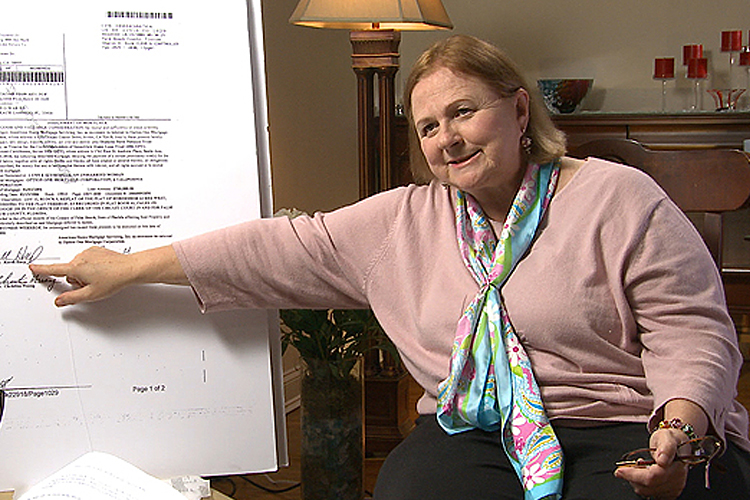
Your mortgage documents are fake!

Your mortgage documents are fake!Lynn Szymoniak (Credit: CBS News/60 MInutes)
If you know about foreclosure fraud, the mass fabrication of mortgage documents in state courts by banks attempting to foreclose on homeowners, you may have one nagging question: Why did banks have to resort to this illegal scheme? Was it just cheaper to mock up the documents than to provide the real ones? Did banks figure they simply had enough power over regulators, politicians and the courts to get away with it? (They were probably right about that one.)
A newly unsealed lawsuit, which banks settled in 2012 for $95 million, actually offers a different reason, providing a key answer to one of the persistent riddles of the financial crisis and its aftermath. The lawsuit states that banks resorted to fake documents because they could not legally establish true ownership of the loans when trying to foreclose.
This reality, which banks did not contest but instead settled out of court, means that tens of millions of mortgages in America still lack a legitimate chain of ownership, with implications far into the future. And if Congress, supported by the Obama administration, goes back to the same housing finance system, with the same corrupt private entities who broke the nation’s private property system back in business packaging mortgages, then shame on all of us.
The 2011 lawsuit was filed in U.S. District Court in both North and South Carolina, by a white-collar fraud specialist named Lynn Szymoniak, on behalf of the federal government, 17 states and three cities. Twenty-eight banks, mortgage servicers and document processing companies are named in the lawsuit, including mega-banks like JPMorgan Chase, Wells Fargo, Citi and Bank of America.
Szymoniak, who fell into foreclosure herself in 2009, researched her own mortgage documents and found massive fraud (for example, one document claimed that Deutsche Bank, listed as the owner of her mortgage, acquired ownership in October 2008, four months after they first filed for foreclosure). She eventually examined tens of thousands of documents, enough to piece together the entire scheme.
A mortgage has two parts: the promissory note (the IOU from the borrower to the lender) and the mortgage, which creates the lien on the home in case of default. During the housing bubble, banks bought loans from originators, and then (in a process known as securitization) enacted a series of transactions that would eventually pool thousands of mortgages into bonds, sold all over the world to public pension funds, state and municipal governments and other investors. A trustee would pool the loans and sell the securities to investors, and the investors would get an annual percentage yield on their money.

advertisement

In order for the securitization to work, banks purchasing the mortgages had to physically convey the promissory note and the mortgage into the trust. The note had to be endorsed (the way an individual would endorse a check), and handed over to a document custodian for the trust, with a “mortgage assignment” confirming the transfer of ownership. And this had to be done before a 90-day cutoff date, with no grace period beyond that.
Georgetown Law professor Adam Levitin spelled this out in testimony before Congress in 2010: “If mortgages were not properly transferred in the securitization process, then mortgage-backed securities would in fact not be backed by any mortgages whatsoever.”
The lawsuit alleges that these notes, as well as the mortgage assignments, were “never delivered to the mortgage-backed securities trusts,” and that the trustees lied to the SEC and investors about this. As a result, the trusts could not establish ownership of the loan when they went to foreclose, forcing the production of a stream of false documents, signed by “robo-signers,” employees using a bevy of corporate titles for companies that never employed them, to sign documents about which they had little or no knowledge.
Many documents were forged (the suit provides evidence of the signature of one robo-signer, Linda Green, written eight different ways), some were signed by “officers” of companies that went bankrupt years earlier, and dozens of assignments listed as the owner of the loan “Bogus Assignee for Intervening Assignments,” clearly a template that was never changed. One defendant in the case, Lender Processing Services, created masses of false documents on behalf of the banks, often using fake corporate officer titles and forged signatures. This was all done to establish standing to foreclose in courts, which the banks otherwise could not.
Szymoniak stated in her lawsuit that, “Defendants used fraudulent mortgage assignments to conceal that over 1400 MBS trusts, each with mortgages valued at over $1 billion, are missing critical documents,” meaning that at least $1.4 trillion in mortgage-backed securities are, in fact, non-mortgage-backed securities. Because of the strict laws governing of these kinds of securitizations, there’s no way to make the assignments after the fact. Activists have a name for this: “securitization FAIL.”
One smoking gun piece of evidence in the lawsuit concerns a mortgage assignment dated Feb. 9, 2009, after the foreclosure of the mortgage in question was completed. According to the suit, “A typewritten note on the right hand side of the document states:  ‘This Assignment of Mortgage was inadvertently not recorded prior to the Final Judgment of Foreclosure… but is now being recorded to clear title.’”
This admission confirms that the mortgage assignment was not made before the closing date of the trust, invalidating ownership. The suit further argued that “the act of fabricating the assignments is evidence that the MBS Trust did not own the notes and/or the mortgage liens for some assets claimed to be in the pool.”
The federal government, states and cities joined the lawsuit under 25 counts of the federal False Claims Act and state-based versions of the law. All of them bought mortgage-backed securities from banks that never conveyed the mortgages or notes to the trusts. The plaintiffs argued that, considering that trustees and servicers had to spend lots of money forging and fabricating documents to establish ownership, they were materially harmed by the subsequent impaired value of the securities. Also, these investors (which includes the Treasury Department and the Federal Reserve) paid for the transfer of mortgages to the trusts, yet they were never actually transferred.
Finally, the lawsuit argues that the federal government was harmed by “payments made on mortgage guarantees to Defendants lacking valid notes and assignments of mortgages who were not entitled to demand or receive said payments.”
Despite Szymoniak seeking a trial by jury, the government intervened in the case, and settled part of it at the beginning of 2012, extracting $95 million from the five biggest banks in the suit (Wells Fargo, Bank of America, JPMorgan Chase, Citi and GMAC/Ally Bank). Szymoniak herself was awarded $18 million. But the underlying evidence was never revealed until the case was unsealed last Thursday.
Now that it’s unsealed, Szymoniak, as the named plaintiff, can go forward and prove the case. Along with her legal team (which includes the law firm of Grant & Eisenhoffer, which has recovered more money under the False Claims Act than any firm in the country), Szymoniak can pursue discovery and go to trial against the rest of the named defendants, including HSBC, the Bank of New York Mellon, Deutsche Bank and US Bank.
The expenses of the case, previously borne by the government, now are borne by Szymoniak and her team, but the percentages of recovery funds are also higher. “I’m really glad I was part of collecting this money for the government, and I’m looking forward to going through discovery and collecting the rest of it,” Szymoniak told Salon.
It’s good that the case remains active, because the $95 million settlement was a pittance compared to the enormity of the crime. By the end of 2009, private mortgage-backed securities trusts held one-third of all residential mortgages in the U.S. That means that tens of millions of home mortgages worth trillions of dollars have no legitimate underlying owner that can establish the right to foreclose. This hasn’t stopped banks from foreclosing anyway with false documents, and they are often successful, a testament to the breakdown of law in the judicial system. But to this day, the resulting chaos in disentangling ownership harms homeowners trying to sell these properties, as well as those trying to purchase them. And it renders some properties impossible to sell.
To this day, banks foreclose on borrowers using fraudulent mortgage assignments, a legacy of failing to prosecute this conduct and instead letting banks pay a fine to settle it. This disappoints Szymoniak, who told Salon the owner of these loans is now essentially “whoever lies the most convincingly and whoever gets the benefit of doubt from the judge.” Szymoniak used her share of the settlement to start the Housing Justice Foundation, a non-profit that attempts to raise awareness of the continuing corruption of the nation’s courts and land title system.
Most of official Washington, including President Obama, wants to wind down mortgage giants Fannie Mae and Freddie Mac, and return to a system where private lenders create securitization trusts, packaging pools of loans and selling them to investors. Government would provide a limited guarantee to investors against catastrophic losses, but the private banks would make the securities, to generate more capital for home loans and expand homeownership.
That’s despite the evidence we now have that, the last time banks tried this, they ignored the law, failed to convey the mortgages and notes to the trusts, and ripped off investors trying to cover their tracks, to say nothing of how they violated the due process rights of homeowners and stole their homes with fake documents.
The very same banks that created this criminal enterprise and legal quagmire would be in control again. Why should we view this in any way as a sound public policy, instead of a ticking time bomb that could once again throw the private property system, a bulwark of capitalism and indeed civilization itself, into utter disarray? As Lynn Szymoniak puts it, “The President’s calling for private equity to return. Why would we return to this?”
Update: This story previously suggested that banks settled this lawsuit with the federal government for $1 billion. That number is actually the total for a number of whistle-blower lawsuits that were folded into a larger National Mortgage Settlement. This specific lawsuit settled for $95 million. The post above has been changed to reflect this fact.

Wednesday, August 14, 2013

Break-up-the-big-banks fever hits the states


Its time to wake up our State Legislatures, and demand that they stand with others to bring down to big to fail! We also need to tell them private hedge funds trying to pass the fraudulent mortgage notes these banks had, are also fraud!!

A JPMorgan Chase Bank is pictured. | AP Photo
So far, only Maine and South Dakota have approved a Glass-Steagall resolution. | AP Photo
Elizabeth Warren’s effort to break up Wall Street banks through a return to Depression-era laws may not have a lot of support in Congress, but it has a sympathetic audience in state capitals across the country.
Lawmakers in at least 18 states have introduced resolutions this year calling on Congress to split up banking giants by putting back in place a wall between commercial banking, taking deposits and making loans, and investment banking, the world of traders and deal-makers.


Five years after the 2008 financial crisis and three years after enactment of the 2010 Dodd-Frank law, these symbolic resolutions show there is still a significant amount of public anger toward big banks.
And if these proposals gain enough traction in state legislatures, a growing number of members of Congress could feel pressure to get behind this effort to reinstate the 1933 Glass-Steagall Act — a cause Warren championed as a candidate and has reinvigorated as a freshman Massachusetts senator.

“We on the state level have been looking for an Elizabeth Warren — someone to carry this banner for us,” said Illinois state Rep. Mary Flowers, a Democrat who is the lead sponsor on a resolution introduced in May that urges Congress to reinstate Glass-Steagall, which was repealed in 1999.
Maryland Democratic state Del. Aisha Braveboy, who co-sponsored a resolution in her state, said: “She is the inspiration.”
So far, only Maine and South Dakota have approved a Glass-Steagall resolution. The states where lawmakers are pressing the issue include Mississippi, Pennsylvania, Alabama and California.
This week, the National Conference of State Legislatures will vote on a Glass-Steagall resolution introduced by Delaware Republican state Sen. Catherine Cloutier at its legislative summit in Atlanta.

Large banks aren’t taking the issue lightly.
Take Delaware — corporate home to the credit card operations of several banks.
When a group of bipartisan state senators introduced a resolution in June calling for a return to Glass-Steagall, four lobbyists — including those working on behalf of JPMorgan Chase and Bank of America — showed up at a hearing to denounce the idea. The resolution was shelved.
“I can’t say I was really surprised by the pushback,” said state Sen. Bruce Ennis, a Democrat who is one of the resolution’s co-sponsors. “They don’t want to rock the boat.”
Delaware state Sen. Robert Venables, a Democrat and another co-sponsor, added: “I’m 80 years old and I remember the aftermath of the Great Depression — this was why it was put in. And then the Clinton administration repealed it.”
Not all state lawmakers pushing for a breakup of big banks cite Warren, a liberal who came to prominence because of her calls to get tough on Wall Street, as an inspiration. Several are conservatives with a tea partier’s dislike of Wall Street and the taxpayer bailouts that resulted from the financial crisis.
In South Dakota, state Rep. Stace Nelson — a self-described tea partier with a “mean libertarian” streak — and other state lawmakers urged Senate Banking Committee Chairman Tim Johnson (D-S.D.) last month to support Glass-Steagall after the state Legislature adopted the measure earlier this year.
“People are gravely concerned about what has happened on Wall Street with the bailouts and the government getting involved,” said Nelson, who has formed a 2014 Senate exploratory committee.

Read more: http://www.politico.com/story/2013/08/break-up-the-big-banks-fever-hits-the-states-95481.html#ixzz2byMu8N8o

Friday, August 9, 2013

After BofA, DOJ Sets MetLife and Chase in its Crosshairs

After BofA, DOJ Sets MetLife and Chase in its Crosshairs

153974932 (1).jpg
Not long after Bank of America (BofA) came under fire from three separate entities, one of which being the Department of Justice (DOJ), both MetLife and JPMorgan Chase are finding themselves in the DOJ’s crosshairs. There’s no historical record indicating that the DOJ has gone after three large entities all at once, however; in the case of BofA, the case was built over the course of a few years. Whether or not the cases against JPMorgan Chase and MetLife are similar remains to be seen.
In an SEC filing, it was revealed that MetLife received a subpoena back in May, which reads “requiring production of documents relating to MetLife Bank’s payment of certain foreclosure-related expenses to law firms and business entities affiliated with law firms and relating to MetLife Bank’s supervision of such payments, including expenses submitted to the Federal National Mortgage Association, the Federal Home Loan Mortgage Corp. and the U.S. Department of Housing & Urban Development (HUD) for reimbursement. It is possible that various state or federal regulatory and law enforcement authorities may seek monetary penalties from MetLife Bank relating to foreclosure practices.”
MetLife may face substantial fines should the governmental probe find anything. “It is possible that various state or federal regulatory and law enforcement authorities may seek monetary penalties from MetLife Bank relating to foreclosure practices,” the insurer said in the filing.
JPMorgan Chase is the third bank under investigation by the DOJ, for charges of criminal practices related to sales of mortgage-backed bonds. “It is unprecedented that the Department of Justice has seriously considered criminal indictment of a major bank and I question whether it truly is,” said Professor John Coffee, of Columbia Law School to Bloomberg. “You can often bring dual investigations, civil and criminal, in order to maximize pressure for a global civil resolution.”
The indication is that the probes into JPMorgan Chase’s loans and mortgage-backed securities are product of JPMorgan, not the ones purchased from Bear Stearns Cos. and Washington Mutual back in 2008. “The Department of Justice is likely to be extremely cautious” in the criminal probe, Coffee said. “If they did anything, they might indict a subsidiary” or individual executives, he added.
With JPMorgan Chase, Bank of America and MetLife under fire from the Department of Justice and other government entities, one wonders what big bank is next?

DON'T LEAVE OUT CHASE AND WAMU LOANS AND LONG BEACH LOANS AS WELL. 

Wednesday, August 7, 2013

Subprime Execs From 2008 Are Alive and Well

Well here's news, the crooks who destroyed America, are alive and well and working on walls street, for none other than the KINGS of thieves -JPMorgan Chase, Goldman Sachs, Bank of America,and Deutsche Bank.


Subprime Execs From 2008 Are Alive and Well at Wall Street's Big Banks

Friday, 02 Aug 2013 07:54 AM
By John Morgan
Share:
Some of the subprime mortgage executives from Bear Stearns, the now-extinct investment bank that was among the first dominos to fall in the U.S. financial meltdown, have parleyed their expertise into top jobs at the most powerful banks on Wall Street, according to The Center for Public Integrity.

Bears Stearns failed in 2008 under the weight of billions of dollars in mortgage-backed securities that its customers and creditors concluded were not worth what the bank maintained.

Today those executives hold senior roles at JPMorgan Chase, Goldman Sachs, Bank of America and Deutsche Bank.


"The fact they were able to emerge unscathed from a financial crisis that wiped out $19.2 trillion of household wealth in the U.S. and as many as 8.8 million jobs has become part of the legacy of the financial meltdown," The Center for Public Integrity stated.

Four of the executives — Thomas Marano, Jeffrey Verschleiser, Michael Neirenberg and Jeffrey Mayer — have been accused of making false statements to federal regulators in a lawsuit by the Federal Housing Finance Agency (FHFA), the news organization said. All four denied the allegations in their response.

Two other of Bear Stearns' mortgage division leaders, Mary Haggery and Baron Silverstein, were not named in the FHFA lawsuit.

Separately, AMBAC Assurance Corp., which went bankrupt after guaranteeing some of Bear Stearns' mortgage bonds, accused the firm of fraud in a lawsuit that described alleged actions by all six executives.

"How is it that we could say that we learned something from the last crisis when we still have the same people running our companies for the future?" asked Jordan Thomas, a former attorney for the Securities and Exchange Commission who now runs the whistleblower practice at a private New York law firm.

Marano has earned more than $29 million in the past four years as head of Residential Capital LLC, the mortgage subsidiary of the former General Motors Acceptance Corp., which obtained a huge federal bailout, The Center reported. Residential Capital itself filed for bankruptcy last year.

Verschleiser jumped to Goldman Sachs in 2008 as a managing director and was promoted to global head of mortgage trading last year, according to the news agency.

Nierenberg and Silverstein now work together at Bank of America's divisions that issue mortgage-backed securities and collateralized debt obligations — two instruments that figured prominently in the financial crisis.

Meanwhile, Haggerty works in an executive role at JPMorgan and Mayer has a senior role at Deutsche Bank.

The news service concluded that as of today, there have been "few meaningful prosecutions or regulatory actions against any individuals who were in positions of power during the financial crisis."

On Wednesday, a federal jury in New York found former Goldman Sachs trader Fabrice Tourre liable for misleading investors in a crisis-era deal that cost them $1 billion, The Wall Street Journal reported.

Tourre was a mid-level figure at Goldman, and not regarded one of Wall Street leaders who helped play a prominent role in the 2008 meltdown.


Bank of America Sued for Alleged RMBS Fraud

Bank of America Sued for Alleged RMBS Fraud


The Justice Department and the Securities and Exchange Commission have both filed civil lawsuits against Bank of America alleging that the financial institution and certain affiliates defrauded investors about the riskiness of $850 million in residential mortgage-backed securities.
According to the complaint, around January 2008, the Charlotte-based lender sold Bank of America Mortgage Securities 2008-A certificates to investors by knowingly making materially false and misleading statements by failing to disclose important facts about the mortgages collateralizing the RMBS.
This included the bank’s failure to conduct loan level due diligence in the offering documents filed with the SEC, the complaint stated, as well as concerns about how the mortgages originated and the likelihood that the prime loans would perform as expected.
The DOJ said in the complaint that more than 40% of the 1,191 mortgages in the BOAMS 2008-A collateral pool failed to adhere to Bank of America’s underwriting standards.
Additionally, the nation’s second largest bank supposedly kept bad loans in the deal that had several origination problems, such as overstated income, fake employment, inflated appraisals, wrong loan-to-value ratios, undisclosed debt, occupancy misrepresentation, and mortgage fraud.
Because of these alleged errors in the pool, the DOJ says that Bank of America had no basis to make representations it made when offering the RMBS.
Lastly, the complaint alleges that Bank of America concealed important risks in the mortgages backing the BOAMS 2008-A securitization pool. For example, the bank originated more than 70% of the loans through third-party mortgage brokers, which were riskier than similar mortgages initiated by the financial institution.
Meanwhile, as this deal was being completed, Bank of America purportedly received internal reports that showed a significant decrease in the quality and performance of these securitized mortgages. Despite knowing this, the lawsuit said the bank never disclosed the information or possible risks to investors.
It is estimated that investors who acquired BOAMS 2008-A certificates will sustain total losses of more than $100 million.
“Bank of America’s reckless and fraudulent origination and securitization practices in the lead-up to the financial crisis caused significant losses to investors,” said Anne M. Tompkins, U.S. attorney for the Western District of North Carolina. “Now, Bank of America will have to face consequences of its actions.”
However, Bank of America plans on fighting the charges made by both the DOJ and SEC.
“These were prime mortgages sold to sophisticated investors who had ample access to the underlying data and we will demonstrate that,” said Lawrence Grayson, spokesperson for Bank of America. “The loans in this pool performed better than loans with similar characteristics originated and securitized at the same time by other financial institutions. Moreover, at the time this deal was securitized, and even now, wholesale channel loans have performed at least as well as loans originated in corporate channels.”