Showing posts with label Us Bank. Show all posts

Tuesday, December 17, 2013

US Bank.. well I called this one awhile back :(

US Bank is popping up all over the place as the Plaintiff in judicial actions and the initiator of foreclosures in non- judicial states. It is one of the leading parties in the shell game that is mistaken for securitization of loans. But on its own website it admits against the interests that it has advanced in courts across the country, that it has NO POWER TO FORECLOSE or to pursue any other remedies.
US Bank pops up as the foreclosing party as trustee for some supposedly securitized asset pool masquerading as a REMIC trust ( which we all know now was breached in virtually every way, which is why the IRS granted a one year amnesty for the trusts to get their acts together --- an action of dubious legality).
Both US Bank and the the Pooling and Servicing Agreement will usually state flat out that the servicer makes all decisions and takes all actions relating to the borrower and the borrower's payments. There are several reasons for this one of which is the obvious conflict that could occur if the the servicer and the trustee were both bringing foreclosure actions.
But the other reason, the hidden one, is that the banks want to keep the court's attention on the borrower's contract and keep it away from the lender's contract which is quite different than the borrower's contract. And THAT will invite inquiry as to how or even if the two contracts are related or connected such that the mortgage encumbrance gives rights to the trust beneficiaries such that the collection and foreclosure efforts will inure to the benefit of the trust beneficiaries in the REMIC trust.
So why is US Bank violating both the content and intent of the PSA and its own website? In my own law firm I have two entirely different foreclosure cases --- one in which US Bank is the foreclosing party and the other where the servicer started the foreclosure action. Both loans are claimed to be in the same trust although one is in California and the other is in Florida. Why would Chase bank as servicer started an action? Even worse, why did Chase bank start the action as though it was the creditor and claim that there was no securitization?
I am not sure about the answers to these questions but I have some conjectures.
In the Florida case, US Bank is bringing the case because the servicer can't --- it knows and its records show non-stop servicer advances to the trust beneficiaries of the REMIC trust that supposedly was funded and who purchased or originated the loans in the trust. In the California case, even though the servicer advances are still present it is non-judicial so it is easier for Chase to slip by without even pausing because unless the homeowner brings a legal action to stop the foreclosure sale it just happens. And then it is over. But Chase is treading on thin ice here which is why it is now transferring the servicing rights ---- and therefore the rights to litigate --- to SPS who did not make the servicer advances.
Both Chase and US Bank are going into bankruptcy courts in Chapter 11 proceedings and demanding adequate protection payments while the bankruptcy is proceeding, knowing and withholding the fact that the creditor is being paid every month and there is no default from the creditor's point of view. This would be important information for the debtor in possession and the his attorney and the Judge to know. But it is withheld in the hope that the borrower/debtor will never discover the truth --- and in most cases they don't, unless they get a loan level account report based upon a solid securitization report which is based upon a good title report.
Both US Bank and Chase are wiling to endure awards of sanctions for misleading the court as a cost of doing business because the volume of complaints about their illegal and fraudulent activities is nearly zero when compared with the total of all state court, federal court and bankruptcy actions. But now they are treading on even thinner ice --- they are seeking to get turnover of rents with people who own multiple properties. Their arrogance apparently overcame their judgment. The owners of multiple properties frequently have substantial resources to litigate against the US Bank and Chase and now SPS. The truth is coming out in those cases.
Other Banks who say they are trustees simply direct the borrower or other inquirers to the servicer. But where US Bank is involved it is seeking profit at the expense of the trust beneficiaries and the owners of the real property involved. It seems to me that US Bank has gotten too cute by half and is now exposed to multiple actions for fraud. And I question whether the current revelations about US Bank BUYING the position of trustee has any legal support. I don't think it does --- not in the PSA, not in the statutes nor under common law.

Tuesday, November 19, 2013

Watch Out For Those Prepared Orders!!!

What amazes me most here, is how fast this came to the forefront. I warned you all about this new scam, the banks were doing, called RENTALS.. and here we go. Lets not forget, we once again, have the TBTF in the headers ... and worst yet, Judges again, not prepared for this new fraud.  I warned all of you and investors too, now here we go.


Watch Out For Those Prepared Orders!!!

by Neil Garfield
I was in court yesterday battling out an attempt by U.S. Bank to have all rent turned over to them from several investment properties. The Florida Statute, like many others, allows for a summary procedure and allows the Judge to grant the Motion even if the owner if the properties has defenses. I had many problems both with the statute and the facts. U.S. bank had appeared out of nowhere as successor to Bank of America. How did it become the successor? We don't know because it was done with an ex orate notice of substitution of Trustee that reminds me of the way they do that in non-judicial states. There, the "new beneficiary" of the deed of the trust pops up put of nowhere and substitutes the trustee on the deed of trust by naming its own controlled entity as the trustee. So the new mortgagee/beneficiary names itself as the mortgagee and then names itself as trustee.
Here in Florida we have much the same thing as the pretender lenders continue their shell game. In the case I was arguing, the Judge was ready to rule in favor of US Bank despite numerous defenses regarding the money, the loan, the standing of the parties, etc. until I asked how the ex lenses of running the properties would be paid. The first interesting thing is that there was no requirement of a factual affidavit, testimony or evidence. I think that is an incorrect application of the words "summary proceeding."
So the "take no prisoners " attorney in Miami whips out an order already nicely printed and the Judge tells us to go over it and if there are any disagreements to let him know. This is where the rubber meets the road, where attorneys for the banks are steam rolling over foreclosure defense attorneys and pro se litigants with orders that do not resemble anything the Judge ordered, which was net rents. In similar situations you should have the information rom a securitization report that shows how much the alleged creditors have already received in non stop non refundable advance payments of interest from the Servicer. So far in the case I am handling, those payments total more than $70,000 for each property. how many times does the creditor need to be paid.
So the provision requiring an accounting of course was acceptable, but then nearly everything else in the order amounted to a summary final judgment and the case would be effectively over upon entry of the order, including going back to 2009 for all the rent received since the original notice of default was sent. The proposed pre-printed order contained some pretty bizarre stuff. The Judge had heard the entire proceeding in 10 minutes despite the fact that even the bank had noticed it for 30 minutes and we had said at last 2 hours would be required.
The principal problem that I had and with which the judge agreed was that in a summary proceeding like this it is not the so-called lender that decides what are proper expenses, like the proposed order said, it is the Judge. "Trust me" the bank's attorney had said to me out in the hallway. I didn't and neither did the judge.
So we go back into the courtroom with the Order that I found nearly completely unacceptable because I did one thing that most people don't --- I knew I was dealing with a lawyer that would try anything. So I read every word of the proposed order and sat there processing it. This of course was wholly unacceptable to the bank lawyer who was expecting me to skip over the parts where we gave up the litigation and the bank simply won the entire case based upon a summary proceeding that had no evidence.
Upon return to the harried judge, we explained our differences and it became apparent to everyone that the bank lawyer was not really all that clear about what he was asking for and I kept asking clarifying questions, like "are you going to become the landlord?" No he said he didn't want that. In fact his own client who did not appear, told my client that they didn't want the rent --- which bring up a whole bunch of other problems. So beware of this rents gimmick.
It looks to me that the so-called new trustee doesn't want and won't take the rents, and that the whole rent turnover thing is simply a profit center for the attorneys who represent the banks. By asking for authority to represent and taking discovery as to whether the Bank wants the rents, you will probably uncover a conflict, and an opportunity to apply sanctions against the law firm representing the Bank.
In the end, the Judge who was irritated at me for arguing my client's case, turned to lean more and more against the bank. He said he was close to denying the motion. And then the bank attorney took it one step over the line with the judge and the Judge said he would not sign the order and that the hearing should be rescheduled allowing us to fight another day. The point is that without carefully going over the proposed order, whether you have won or lost, you are leaving yourself wide open to abuse.

Thursday, September 12, 2013

U.S. Bancorp's

U.S. Bank Sued Over Peregrine Role


WASHINGTON—U.S. regulators on Wednesday sued a unit of U.S. Bancorp USB -0.08% for allegedly facilitating the embezzlement of customer funds by the jailed founder of Peregrine Financial Group Inc., the collapsed futures brokerage.
The civil charges filed Wednesday by the Commodity Futures Trading Commission against U.S. Bancorp's U.S. Bank unit revolve around the bank's oversight of accounts used by Peregrine founder and Chief Executive Russell Wasendorf Sr. to siphon client funds from the firm over a period of almost 20 years.
The CFTC alleged that U.S. Bank "knowingly allowed and facilitated" Mr. Wasendorf's transfers of millions of dollars of customer funds out of the account to pay for his private jet, his restaurant and divorce settlement, according to the complaint filed in U.S. District Court for the Northern District of Iowa. Customer funds also were used as collateral on loans to fund Peregrine's $20 million headquarters building in Cedar Falls, Iowa, according to the complaint.
Associated Press
U.S. Bank parent U.S. Bancorp said it was duped by Mr. Wasendorf.  NOW THIS MIGHT BE SWALLOWABLE IF US BANK CORP, DIDN'T COMMIT SO MUCH FRAUDULENT ABUSE ON FORECLOSURES AND OTHER TRUSTEE HANDLING'S, THE ONE CASE I AM SURE MOST OF YOU ARE AWARE OF IS THIS :

Breaking News: U.S. Bank v. Ibanez Foreclosure Ruling Upheld

SO AS FAR AS USBANK CLAIMING ITSELF AS A VICTIM, TELL IT TO THE CHOIR.


U.S. Bank said in a statement that the charges were "without merit" and that it was a "victim of the same fraud—one that the CFTC failed to detect." LIAR
Mr. Wasendorf in February began serving a 50-year federal prison sentence after pleading guilty to charges that he stole $215 million from clients.
The complaint doesn't accuse U.S. Bank of direct knowledge of the fraud, but alleges the bank indirectly aided Mr. Wasendorf's misuse of funds by failing to protect customer money.
"The CFTC is saying here that if you hold customer accounts and you see money going to third parties or individuals, you better ask some questions because it very likely is indicating that those customer funds are being misused," said Gary DeWaal, principal of his own consulting firm and a former CFTC enforcement attorney.
The CFTC has stepped up its pursuit of cases involving customer funds amid criticism that it failed to adequately oversee protection of such money in cases such as MF Global Holdings Ltd., whose 2011 failure unveiled a roughly $1.6 billion shortfall in customer funds.
In April 2012, J.P. Morgan Chase JPM -0.76% & Co. agreed to pay $20 million, the largest settlement in a customer-fund protection case, to settle CFTC charges that it counted money that belonged to customers of Lehman Brothers Holdings Inc. as though it belonged to the firm. J.P. Morgan didn't admit or deny wrongdoing.
The CFTC complaint details a long and close relationship between U.S. Bank and Mr. Wasendorf, one that the CFTC says enabled him to hide movements of millions of dollars of customer funds and model his forgeries on documents prepared by a local banker in the Cedar Falls branch to create fraudulent bank statements. The agency alleges U.S. Bank treated the accounts as Peregrine's commercial checking account, and knew that Mr. Wasendorf was misusing the funds, according to the complaint.
At Mr. Wasendorf's request, any information or account inquiries had to be directed to the local banker, referred to in the complaint as "Banker A." The CFTC said U.S. Bank "knew that Wasendorf's mandates" concerning the account "were highly unusual" and alleges that bank personnel, including Banker A, "believed it was important to maintain Wasendorf's and Peregrine's goodwill in order to protect the bank's relationship with them," the complaint states.
Hope Timmerman, a banker in the Cedar Falls branch, has been identified in earlier court documents as the person who handled the Peregrine accounts. Ms. Timmerman still works for the bank and a spokesman said that an internal investigation found no employee misconduct.
Ms. Timmerman didn't respond to requests for comment.
The agency is seeking monetary penalties, among other relief. The trustee liquidating the firm also is weighing potential claims against U.S. Bancorp and J.P. Morgan. Both banks held customer accounts, the complaint said. J.P. Morgan declined to comment.
Mr. Wasendorf said in a confession found after his suicide attempt last July that he used basic computer software to make "very convincing forgeries" of statements on its account at U.S. Bank, and earlier bank accounts, as well as forgeries of official correspondence from the bank.
imageJarrad Cole/The Wall Street Journal
P.O. Box 706 at the Cedar Falls post office, which Russell Wasendorf Sr. said he used to thwart auditors.
Auditors routinely attempt to verify bank balances by sending confirmation forms directly to the banks. To thwart the auditors, Mr. Wasendorf supplied them with a false address for sending the forms to the bank—P.O. Box 706 in a Cedar Falls post office, which Mr. Wasendorf controlled, he said in his confession.
Mr. Wasendorf said in his confession he kept others inside Peregrine from learning about the real bank balances by insisting on being the only one authorized to open mail from the bank.
U.S. Bancorp said it was duped by Mr. Wasendorf, who intercepted regulatory communications that were intended for the bank. "As he has admitted, Wasendorf actively deceived the bank," the bank said in a statement. "Banks are not responsible for losses generated by customers who are fraudsters."
"Wasendorf stole vast sums of customer money, but his crimes do not excuse U.S. Bank from its own independent responsibilities," David Meister, the CFTC's director of enforcement, said in a statement.
—Matthias Rieker contributed to this article.

Saturday, August 17, 2013

Got some good reading herefor everyone

The enforcement actions were based on interagency examinations conducted in the fourth quarter of 2010. A summary of the findings of the interagency reviews is available in the Interagency Review of Foreclosure Policies and Practices, which was produced by the OCC, the Board of Governors of the Federal Reserve System, and the OTS.

Links to the OCC and former OTS Enforcement Actions (Issued April 2011):

Links to Enforcement Action Amendments for Servicers Entering the Independent Foreclosure Review Payment Agreement (Issued February 2013):

Just hit link in the blue 

Monday, August 5, 2013

Why you should change banks

 Lets not leave out US BANK corp.. they have had there hands in full swing on foreclosures , and supplying private hedge funds with cash to buy your homes, most illegally.


9 Reasons To Change Banks – Switch From Wall Street

Reason #1: People Who Change Banks Like It

change banks satisfaction
People who bank with local lenders are far more satisfied than those who bank on Wall Street. (source)


Reason #2: The Wall Street Banks Are Still Too Big to Fail

if the biggest banks were too big to fail aligned


Reason #3: The Wall Street Banks Are Still Too Big to Jail

HSBC drug laundering


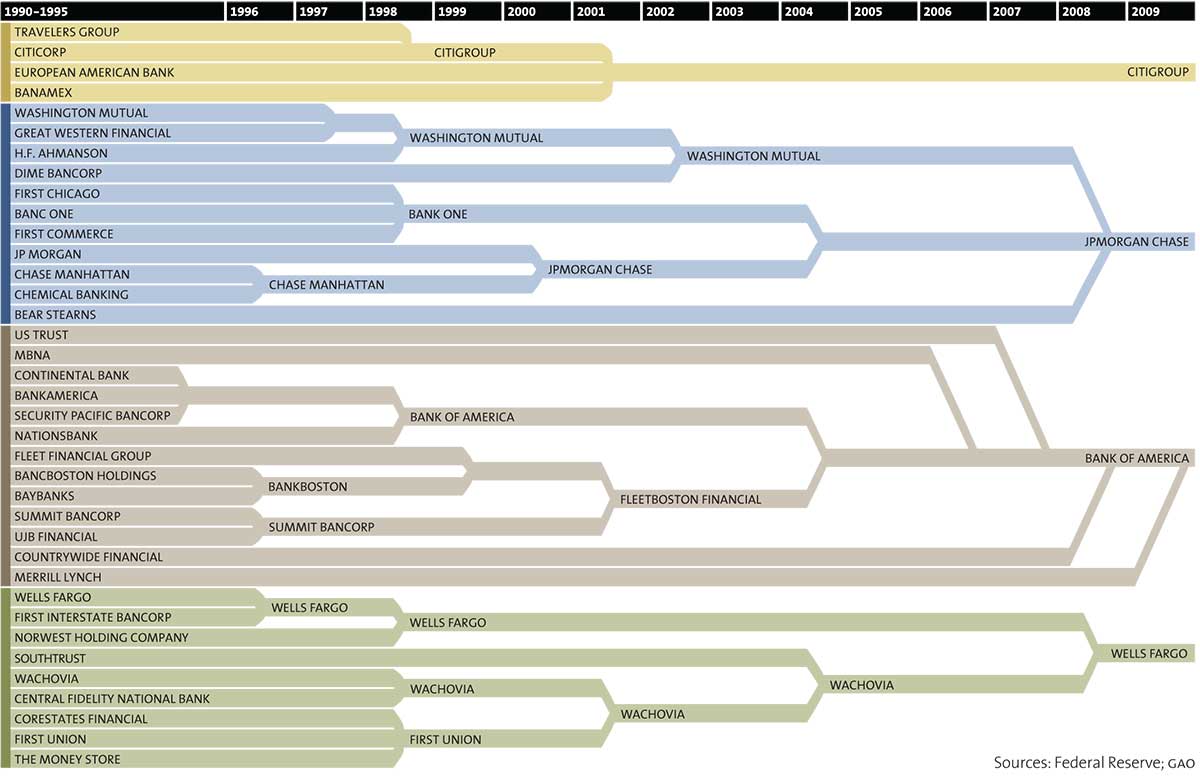
Reason #4: The Wall Street Banks Are Too Big to Manage

sheila bair bull by the horns too big to manage
The megabanks have grown tremendously over the past two decades, making it harder for them to properly manage all their various international pieces.
bank concentration timeline
SOURCE


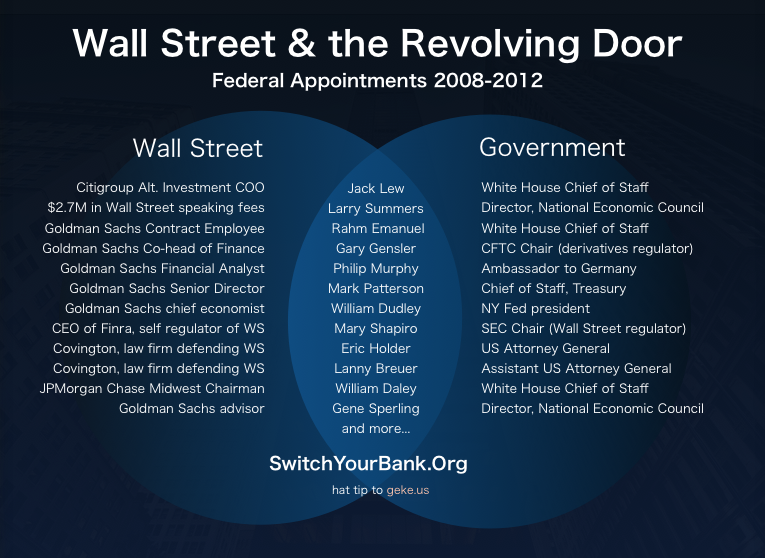
Reason #5: Wall Street Has Captured Washington

Wall Street revolving door


Reason #6: Wall Street Continues To Gamble With the Economy

Gambling on Wall Street lies behind boring, impenetrable names like credit default swaps, synthetic credit derivatives, and mortgage-back securities. All of these bets are types of derivatives. The financial crisis of 2008 occurred largely because these particular derivatives bets went bad. And yet the worldwide derivatives market continues to explode, from under $100 trillion in notional value in 2000 to over $700 trillion in 2011.
Worldwide Derivatives
SOURCE
What’s more, nearly half of the worldwide derivatives exposure is centered in the United States, and 95% of the total U.S. derivatives exposure comes from 5 megabanks.
wall street derivatives
SOURCE


Reason #7: Small Lenders Charge Less in Fees

wall street fees
Smaller lenders charge less in account fees, overdraft fees, and off-us ATM fees, as shown in a study from the PIRG Education Fund. According to the study, a substantive portion of small lenders belong to ATM networks that don’t charge anything if you use an ATM which doesn’t belong to your financial institution. That’s better than some megabanks offer.


Reason #8: Small Lenders Are Far More Likely to Offer Totally Free Checking

lower checking
Small financial institutions are more likely to offer totally free checking accounts. No loopholes or snags. Chart from the Institute of Local Self-Reliance.


Reason #9: Small Lenders Are Far Better For Your Community

If you want to support local job creation, one way to do it is to support local lenders.
bank local
Local lenders also make nearly 40% of small business loans, even though they only have 10% of total bank assets. (source)
bank local

Conclusion – Why Change Banks?

The problem with the megabanks is that they’re locked in a destructive cycle of being too big to manage, too big to fail, and too big to jail. They continue to have unpredictable, catastrophic losses. The losses lead inevitably to declarations of “too big to fail” (and bailouts). Being “too big to fail” means that the megabanks can’t be prosecuted without endangering the entire economy (or so they say), which makes the megabanks even bigger—and, again (back to the start!), too big to manage.
Therefore:
If you want to help end “too big to fail,” if you opposed the megabank bailouts, if you’re tired of megabanks getting away with crime, if you recognize that these institutions have become too big to manage, if you want to ensure that we never repeat the vast injustice at play in the 2008 crisis, then switch your bank.
You might be thinking, “Yes, okay, Wall Street makes the economy dangerous. But there are plenty of things that make the economy dangerous—more than I could ever effectively boycott.”
That’s why, even if you don’t think changing banks will make much difference for the fiscal health of the nation, you should still change banks for many of the personal advantages listed above. Either, way changing banks to a local lender is a good idea.

Global Destruction

Be the first to watch

http://www.toobighasfailed.org/2013/08/05/video-first-showing/