Showing posts with label OCC. Show all posts

Thursday, November 14, 2013

ALERT: COMMUNITY BANKS AND CREDIT UNIONS AT GRAVE RISK

Well this warning didn't take long.. When are you people gonna learn. ANYTHING that has Deutsche Bank attached to it , is a loss before it starts. Call your banks and Credit Unions and tell them no deals with Black Rock  IE: Deutsche Bank!!

Investors, hear my warning, you will lose in the end. Last warning.


BlackRock with ETF push to smaller banks


  • The roughly 7K regional and community banks in the U.S. have securities portfolios totaling $1.5T, the majority of which is in MBS, putting them at a particularly high interest rate risk, and on the screens of regulators who would like to see banks diversify their holdings.
  • "This is going to be a multiple-year trend and dialogue," says BlackRock's (BLK) Jared Murphy who is overseeing the iSharesBonds ETFs campaign.
  • The funds come with an expense ratio of 0.1% and the holdings are designed to limit interest rate risk. BlackRock scored its first big sale in Q3 when a west coast regional invested $100M in one of the funds.
  • At issue are years of bank habits - when they want to reduce mortgage exposure, they typically turn to Treasurys. For more credit exposure, they habitually turn to municipal bonds. "Community bankers feel like they're going to be the last in the food chain to know if there are any problems with a corporate issuer," says a community bank consultant.


ALERT: COMMUNITY BANKS AND CREDIT UNIONS AT GRAVE RISK HOLDING $1.5 TRILLION IN MBS

by Neil Garfield
I've talked about this before. It is why we offer a Risk Analysis Report to Community Banks and Credit Unions. The report analyzes the potential risk of holding MBS instruments in lieu of Treasury Bonds. And it provides guidance to the bank on making new loans on property where there is a history of assignments, transfers and other indicia of claims of securitization.
The risks include but are not limited to
  1. MBS Instrument issued by New York common law trust that was never funded, and has no assets or expectation of same.
  2. MBS Instrument was issued by NY common law trust on a tranche that appeared safe but was tied by CDS to the most toxic tranche.
  3. Insurance paid to investment bank instead of investors
  4. Credit default swap proceeds paid to investment banks instead of investors
  5. Guarantees paid to investment banks after they have drained all value through excessive fees charged against the investor and the borrowers on loans.
  6. Tier 2 Yield Spread Premiums of as much as 50% of the investment amount.
  7. Intentional low underwriting standards to produce high nominal interest to justify the Tier 2 yield spread premium.
  8. Funding direct from investor funds while creating notes and mortgages that named other parties than the investors or the "trust."
  9. Forcing foreclosure as the only option on people who could pay far more than the proceeds of foreclosure.
  10. Turning down modifications or settlements on the basis that the investor rejected it when in fact the investor knew nothing about it. This could result in actions against an investor that is charged with violations of federal law.
  11. Making loans on property with a history of "securitization" and realizing later that the intended mortgage lien was junior to other off record transactions in which previous satisfactions of mortgage or even foreclosure sales could be invalidated.
The problem, as these small financial institutions are just beginning to realize, is that the MBS instruments that were supposedly so safe, are not safe and may not be worth anything at all --- especially if the trust that issued them was never funded by the investment bank who did the underwriting and sales of the MBS to relatively unsophisticated community banks and credit unions. In a word, these small institutions were sitting ducks and probably, knowing Wall Street the way I do, were lured into the most toxic of the "bonds."
Unless these small banks get ahead of the curve they face intervention by the FDIC or other regulatory agencies because some part of their assets and required reserves might vanish. These small institutions, unlike the big ones that caused the problem, don't have agreements with the Federal government to prop them up regardless of whether the bonds were real or worthless.
Most of the small banks and credit unions are carrying these assets at cost, which is to say 100 cents on the dollar when in fact it is doubtful they are worth even half that amount. The question is whether the bank or credit union is at risk and what they can do about it. There are several claims mechanisms that can employed for the the bank that funds itself facing a write-off of catastrophic or damaging proportions.
The plain fact is that nearly everyone in government and law enforcement considers what happens to small banks to be "collateral damage," unworthy of any effort to assist these institutions even though the government was complicit in the fraud that has resulted in jury verdicts, settlements, fines and sanctions totaling into the hundreds of billions of dollars.
This is a ticking time bomb for many institutions that put their money into higher yielding MBS instruments believing they were about as safe as US Treasury bonds. They were wrong but because of any fault of anyone at the bank. They were lied to by experts who covered their lies with false promises of insurance, hedges and guarantees.
Those small institutions who have opted to take the bank public, may face even worse problems with the SEC and shareholders if they don't report properly on the balance sheet as it is effected by the downgrade of MBS securities. The problem is that most auditing firms are not familiar with the actual facts behind these securities and are likely a this point to disclaim any responsibility for the accounting that produces the financial statements of the bank.
I have seen this play out before. The big investment banks are going to throw the small institutions under the bus and call it unavoidable damage that isn't their problem. despite the hard-headed insistence on autonomy and devotion to customer service at each bank, considerable thought should be given to banding together into associations that are not controlled by regional banks are are part of the problem and will most likely block any solution. Traditional community bank associations and traditional credit unions might not be the best place to go if you are looking to a real solution.
Community Banks and Credit Unions MUST protect themselves and make claims as fast as possible to stay ahead of the curve. They must be proactive in getting a credible report that will stand up in court, if necessary, and make claims for the balance. Current suits by investors are producing large returns for the lawyers and poor returns to the investors. Our entire team stands ready to assist small institutions achieve parity and restitution.
FOR MORE INFORMATION OR TO SCHEDULE CONSULTATIONS BETWEEN NEIL GARFIELD AND THE BANK OFFICERS (WITH THE BANK'S LAWYER) ON THE LINE, EXECUTIVES FOR SMALL COMMUNITY BANKS AND CREDIT UNIONS SHOULD CALL OUR TALLAHASSEE NUMBER 850-765-1236 or OUR WEST COAST NUMBER AT 520-405-1688.
BLK | Thu, Nov 14
BlackRock with ETF push to smaller banks • The roughly 7K regional and community banks in the U.S. have securities portfolios totaling $1.5T, the majority of which is in MBS, putting them at a particularly high interest rate risk, and on the screens of regulators who would like to see banks diversify their holdings. • "This is going to be a multiple-year trend and dialogue," says BlackRock's (BLK) Jared Murphy who is overseeing the iSharesBonds ETFs campaign. • The funds come with an expense ratio of 0.1% and the holdings are designed to limit interest rate risk. BlackRock scored its first big sale in Q3 when a west coast regional invested $100M in one of the funds. • At issue are years of bank habits - when they want to reduce mortgage exposure, they typically turn to Treasurys. For more credit exposure, they habitually turn to municipal bonds. "Community bankers feel like they're going to be the last in the food chain to know if there are any problems with a corporate issuer," says a community bank consultant.


Wednesday, October 30, 2013

Put Big Bank CEOs in Jail

Elizabeth Warren to Wall Street Regulators: Put Big Bank CEOs in Jail

| Wed Oct. 23, 2013 12:33 PM PDT
 
This past weekend, the Department of Justice slapped a record fine on JPMorgan Chase for packaging and selling the mortgage-backed financial products that helped cause the financial meltdown. But Sen. Elizabeth Warren (D-Mass.) wants the administration to know that fines are not enough. On Wednesday, she called on Wall Street regulators to hold all those responsible for the 2008 crisis accountable.
In a letter to the Federal Reserve, the Securities and Exchange Commission (SEC) and the Officer of the Comptroller of the Currency (OCC), Warren lauded the overseer of the TARP bailout program for cracking down on financial industry players who wasted, stole, or abused the federal emergency funds doled out to banks during the financial crisis, and implied that the three banking regulators should also punish individuals who helped cause the financial meltdown.
Although the budget for TARP's inspector general was "a small fraction of the size of the budgets and staffs at your agencies," Warren pointed out, the program's watchdog has brought criminal charges against nearly 100 senior executives; obtained criminal convictions on 107 defendants, including 51 jail sentences; and suspended or banned 37 people from working in the banking industry.
How about you guys, Warren asked. She called on the Fed, the SEC, and the OCC to provide records on the number of people the agencies have charged criminally and civilly, the number of convictions and prison sentences they have obtained, the number of people banned or suspended from working in the industry, and the total amount of fines leveled against Wall Street ne'er-do-wells.
Warren knows the answer to most of these questions, but wants to shame the agencies into action. Yes, big banks have been forking over billions of dollars in civil settlements for bad behavior in the lead up to the crisis. There have been prosecutions of various smaller mortgage brokers, and some civil charges and settlements against executives who helped cause the crisis. But zero Wall Street CEOs are in jail for bringing down the economy, and no CEOs have faced criminal charges.
Earlier this year, U.S. Attorney General Eric Holder seemed to concede that some banks are "too big to jail." But Warren doesn't buy it. "There have been some landmark settlements in recent weeks for which your agencies and others deserve substantial credit," Warren said in the letter. "However, a great deal of work remains to be done to hold institutions and individuals accountable for breaking the rules and to protect consumers and taxpayers from future violations."

Thursday, September 12, 2013

OCC – Correcting Foreclosure Practices

Correcting Foreclosure Practices - Updated August 28, 2013
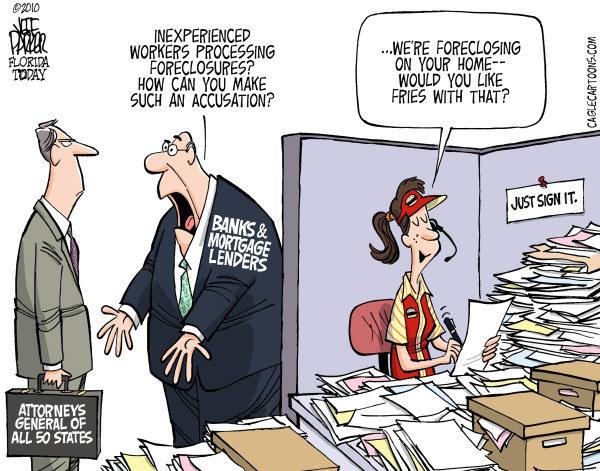
foreclosure_review_cartoon1While cruising the Internet looking for the status of a particular bank, the Office of the Comptroller of the Currency (OCC) Independent Foreclosure Review website jumped into view. The OCC website is worth an examination even though the Submission Window is closed (way too early IMHO) as there are numerous CONSENT ORDERS made available for viewing. 

Of course the accused financial and/or financial related companies never admit or deny the the “Findings” from the examination by the:
  •  (1) Comptroller of the Currency of the United States of America, through his national bank examiners and other staff of (2) the Office of the Comptroller of the Currency (“OCC”);
  • (3) the Board of Governors of the Federal Reserve System, Washington, D.C.,
  • (4) the Federal Deposit Insurance Corporation (“FDIC”); 
  • (5) the Office of Thrift Supervision (“OTS”); and
  • (6) the Federal Housing Finance Agency (“FHFA”) …
1-6 above (Collectively the “Agencies”…even though this was part of an interagency horizontal review (who apparently all 6 sections agreed to the results of the examination) of the major residential mortgage servicers and mortgage service providers.
OCC title 
??????
Six (6) frickin’ sectors of the Federal Government find that these companies to be in violation of several consumer protection related statutes, deceptive practices and pretty much scumbags and no one forces them to admit to their wrongdoings! 
The CONSENT ORDER “Findings” are still worth reading and we don’t see why the same “Findings” can’t find their way onto complaints and oppositions. Maybe you’ll find a decent, reputable judge, like Judge Rakoff, who will demand an admission along with a settlement. BTW - The Independent Foreclosure Review Process continues for the following servicers at this time: Everbank and OneWest (IndyMac). That means the claims have not been processed yet. To review the OCC website Click HERE.
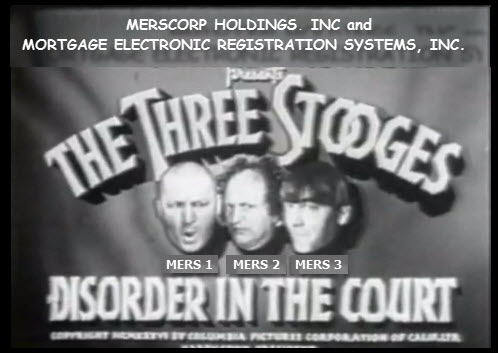
MERS 3-STOOGES 
Did you wonder why MERS was no longer foreclosing?
A particularly interesting “Consent Order” belonged to Mortgage Electronic Registration Systems, Inc. and MERSCORP, Inc. Click HERE for the MERS and MERSCORP, Inc. Consent Order.
“… as part of an interagency horizontal review of major residential mortgage servicers and mortgage service providers, have conducted an examination of MERSCORP, Inc. (“MERSCORP”), and of its wholly-owned subsidiary corporation, Mortgage Electronic Registration Systems, Inc., (“MERS”), both of which provide various services to financial institutions related to tracking and registering residential mortgage ownership and servicing, acting as mortgagee of record in the capacity of nominee for lenders, and initiating foreclosure actions.
The Agencies have identified certain deficiencies and unsafe or unsound practices by MERS and MERSCORP that present financial, operational, compliance, legal and reputational risks to MERSCORP and MERS, and to the participating Members. …
…By this Stipulation and Consent, which is incorporated by reference, MERS and MERSCORP have consented to the issuance of this Consent Cease and Desist Order (“Order”), pursuant to 12 U.S.C. §§ 1818(b), 1867(c)-(d), and 4631, by the Agencies, consistent with the Stipulation and Consent. …
There are currently approximately 31 million active residential mortgage loans registered on the MERS System.” [Read more]
What happened to the other 40 million? DON'T I WISH THAT WAS TRUE. :(
truth always winsThe verbiage in the Consent Order verifies DeadlyClear’s posts indicating separate and distinct “MERS” corporations substantiating that Mortgage Electronic Registration Systems, Inc. and MERSCORP, Inc. are NOT the same company!
Related MERS posts:

Saturday, August 17, 2013

Got some good reading herefor everyone

The enforcement actions were based on interagency examinations conducted in the fourth quarter of 2010. A summary of the findings of the interagency reviews is available in the Interagency Review of Foreclosure Policies and Practices, which was produced by the OCC, the Board of Governors of the Federal Reserve System, and the OTS.

Links to the OCC and former OTS Enforcement Actions (Issued April 2011):

Links to Enforcement Action Amendments for Servicers Entering the Independent Foreclosure Review Payment Agreement (Issued February 2013):

Just hit link in the blue 

Saturday, June 29, 2013

Lost is America

Last week, I detailed bombshell revelations from Bank of America whistle-blowers, in which former employees of the bank detailed systematic fraud and deceptive practices inside their loan modification department — including bonuses and Target gift cards for staff who racked up foreclosures.
Now, another new lawsuit, featuring a separate whistle-blower, contains additional remarkable revelations – and may shed light on Bank of America’s strategy in getting out from under the mountain of legal exposure and costs in which it now finds itself. Simply put, the bank seeks to pocket quick cash and evade practices set forth in major settlements – by cashing out of the subprime mortgage servicing business. The result would be to leave struggling homeowners back at square one, with even fewer protections to avoid foreclosure.
First, some background. Over the past year, non-bank servicers like Nationstar and Ocwen have been buying up servicing rights to millions of mortgages, gradually positioning themselves to become the biggest companies in the space. These non-bank servicers, which process monthly payments and deal with foreclosures but do not originate loans, have an asset not available to their big bank colleagues: They haven’t yet been officially caught scamming customers. Therefore, they are not a party to the various servicer settlements brought by state and federal regulators, and they need not submit to those settlement guidelines. This includes rules like establishing a single point of contact for borrowers, stopping foreclosure operations when a modification is in process (ending what is known as “dual track”) and facilitating proper payment processing.
All of this has come to a head in a class-action lawsuit filed by Leonard Law Office in Massachusetts against Green Tree Servicing, a non-bank servicer based in St. Paul, Minn. As detailed by an insider at Bank of America in a packet of documents, in January 2013, BofA sold servicing rights to 650,000 mortgages (worth $93 billion) to the parent company for Green Tree.
Like Nationstar and Ocwen, Green Tree is not part of any servicing settlements, nor do they have to abide by any guidelines set by those agreements, even though the loans they purchased were subject to those guidelines when they were in the hands of BofA. Moreover, as a non-bank servicer, Green Tree has traditionally had less stringent oversight from federal regulators, though the Consumer Financial Protection Bureau is fixing to change that.
Of course, servicers like Green Tree, Nationstar and Ocwen have terrible reputations as among the worst servicers in the country (worse than Bank of America, if you can imagine that). Among the charges Leonard Law Office made against Green Tree were claims that the servicer imposed illegal fees to process any kind of payment; failed to process mailed payments on time; harassed borrowers by calling them at all hours of the night and using abusive language to try to collect on debts; and delayed or denied timely modifications. These practices violate such federal laws as the Fair Debt Collection Practices Act, the Telephone Consumer Protections Act, and others. Complaints about Green Tree’s practices litter theInternet.
And some complaints have gone to court, like the case of a Florida widow who claimed that Green Tree debt collectors called her husband, as well as his co-workers and relatives, nine times a day about a mortgage debt. Nationstar and Ocwen have seen their share of complaints as well. One innovative Ocwen scam involves sending homeowners a check for $3.50, and claiming that cashing the check automatically enrolls the customer in an appliance insurance plan, which costs $54.95 a month.
Here’s where Bank of America comes in. According to a bank insider, this is part of a deliberate effort to flip the servicing rights for a quick buck and get out from under the scrutiny of the various settlements. “Brian Moynihan, Ron Sturzenegger and Tony Meola are well aware of the reputations of these servicers,” says the insider, referring to Bank of America’s CEO and two high-level executives. “Ron is a dealmaker, not an operations guy. He was brought in to sell the stuff.”
Sturzenegger runs Bank of America’s Legacy Asset Servicing Division, $1 trillion or so of the shakiest loans at the bank.  By selling off servicing rights, suddenly the bank doesn’t have to comply with settlement practices, nor do they have to increase staff for compliance purposes. So not only do they get some ready cash, they lower their labor costs.
Sturzenegger worked with Meola, the executive of Fulfillment Operations, to put together the “Bulk Transfer Program,” selling off these mostly delinquent loans to disreputable servicers like Green Tree and Nationstar (the more reputable ones didn’t want any part of them). But they only sold the “subservicing” rights. Non-bank servicers like Green Tree service the loans, but Bank of America held onto the so-called master servicing rights. This means that the bank still gets some of the profits from servicing the loans, and none of the responsibility to comply with settlements. Bank of America added a million-plus current loans to the mix of shakier loans to sweeten the pot for the subservicers.
In the most damning charge, the insider noted that, “It may mean that any modification currently in process with BAC (Bank of America) will not be recognized and the borrower will proceed into foreclosure.” This is almost certainly true, and it’s a very common practice. Servicers who purchase servicing rights are not obligated to follow through on prior agreements with homeowners on loan modifications that have not yet been made permanent. So the homeowner, who thought they were well on their way to saving their home, instead has to start all over with a new servicer.
Here’s one example from a former Bank of America customer in Puget Sound, Wash., whose switch to Green Tree voided his short sale and put him back in modification hell. Even if the borrower was getting special treatment because of a natural disaster like Hurricane Sandy, that treatment would be voided once the new subservicer entered the picture. The Fitch rating agency has recognized the danger of selling off distressed servicing rights to these non-bank operations, saying in a research note that “the growth and outsized scale of larger nonbank servicers may pose challenges to a potential orderly transfer of servicing.” Struggling homeowners will bear the brunt of these challenges.
Once Charles Giannotti, a friend of Bank of America CEO Brian Moynihan, found out that his servicing transferred to Nationstar, he emailed in a fit of rage. “Are you aware of the fact that your bank is turning its customers over to a processor that based on the complaints posted appears to not only lack basic competency but also poor customer service?” Giannotti fumed. This set off a flood of CYA emails within the bank from senior executives, responding to Moynihan’s queries about the scheme.
Regardless of how Bank of America resolves this situation, the damage to homeowners has already been done. Homeowners don’t get to choose their servicer – they just get passed around at the whim of big mortgage companies. And every time the servicing rights get transferred, they have to deal with a whole new set of practices. If they were fighting foreclosure at the time of the switch, then they have to start over, under typically disadvantageous circumstances. And that’s especially true when their new servicer sits outside the glare of strict oversight.
Bank of America’s reputation is already unsalvageable. But avoiding requirements they were forced to make to homeowners to compensate for an initial round of illegal practices, by selling the servicing rights off to fly-by-night organizations that specialize in abusing customers, just about takes the cake. And they’re profiting from it, too.

Lost is America  -- The banks found a way to hide and steal our homes and the SEC, FDIC, CFPB, US AG, OCC, are all hiding their heads in the sand..but wait for it......Wall Street will soon go belly up and where does that leave everyone than?