Forget the huge boost in trading income. Set aside (for now) the legion of questions about new capital requirements.
The real news in JPMorgan Chase's
second-quarter report
was the weak outlook that it provided for traditional banking. Rising
rates could cut the mortgage business by at least a third the rest of
the year, and commercial loan growth was anemic. Credit cards offered a
bright spot.
Above all, its results cast doubt on predictions that
industrywide mortgage volume was going to fall by 20% this year
compared with 2012, says Christopher Whalen, managing director and head
of investment banking at Carrington Investment Services in Greenwich,
Conn.
"JPMorgan numbers suggest that interest rates could account
for an additional 10% to 20% drop in volumes," on top of the expected
decline in refinance volumes, Whalen says.
The headline numbers for JPMorgan were strong, as they often are.
Much
of the 31% increase in JPMorgan's quarterly earnings, to $6.5 billion,
came from investment banking. Net income from corporate and investment
banking rose 19% to $2.8 billion, from a year earlier. That included a
38% rise in investment banking fees, a 50% rise in debt underwriting
fees and an 83% increase in equity underwriting fees.
"Their
capital markets business continues to do so well during a period of
unprecedented volatility," says Nancy Bush, a banking industry analyst
with NAB Research. "Clients continue to come to them for their trading
ability."
Meanwhile, analysts incessantly questioned Jamie Dimon,
chairman and chief executive, about the potential effect on the
company's capital position from proposed Basel III rules. Dimon
responded that JPMorgan "intends to be in compliance" when required to
do so but internal details are still being worked out.
However, it all came back to mortgages.
For the second quarter, net income from mortgage banking at JPMorgan fell 15% to $1.1 billion, from $1.3 billion a year earlier.
The
effect of rising rates on its mortgage business could be huge, Marianne
Lake, chief financial officer, said. JPMorgan's mortgage production,
both refinancings and new purchase mortgages, "could be reduced by an
estimated 30% to 40%" in the second half of 2013, Lake said.
JPMorgan
is looking at a potential "dramatic reduction in profits," Dimon said.
"This would be a significant event if mortgage rates stay where they
are."
Ten-year Treasury yields rose from 1.63% on May 2 to 2.74%
on July 5, the highest yield since August 2011. The 10-year Treasury
yield stood at 2.58% in late Friday morning trading.
Dimon said
that it's difficult to make broad comments about the impact of interest
rates on the bank overall. Higher rates were one contributing factor to
market volatility, and heightened volatility helped trading results.
"Higher
rates hurt mortgages but, again, they can help other areas, so it's a
whole potpourri," Dimon said. "It's impossible to separate it out."
Commercial
lending fell 8% to $621 million, from $673 million a year earlier, with
Lake characterizing the drop as a result of continued pessimism among
borrowers.
"Corporate America is very liquid right now and has
access to the capital markets, and that obviously affects demand," Lake
said. "Our customers are still very cautious and also still very liquid.
We need confidence to pick up."
Average loans in credit cards
fell 2% to $122.9 billion, from a year earlier. But Lake predicted an
increase in card business later this year.
"We saw a
stabilization…at the end of the second quarter after 15 quarters of net
run-off," Lake said during the call. "We feel we've reached an
inflection point and expect some modest growth from here."
JPMorgan's
second-quarter results also included $600 million in new expenses for
litigation, although Dimon declined to provide details on the source of
the litigation cost.
Federal regulators
signed off this week on Basel III rules on capital ratios,
which include new risk-based capital requirements. JPMorgan executives
were asked numerous questions by analysts about the proposed rules;
including one question from Whalen whether the U.S. should withdraw from
the Basel process.
Dimon said the company has "always believed in
high capital, high liquidity, good regulation and things like that and
finishing it." But he did express frustration with the process.
"One
of the things that Basel" was supposed to do was "harmonize global
rules," Dimon said. "This is clearly no longer harmonization. I don't
think there's any industry out there to be comfortable with something
like that in the long run, because in the long run that has a lot of
effects that you can determine, quarter by quarter."
Some analysts
and investors are also becoming frustrated with the lack of clarity on
the Basel III rules, as well as new proposals to
break up JPMorgan and other large banks.
"Everything
is so squarely aimed at Chase," Bush says. "If you had to look at what
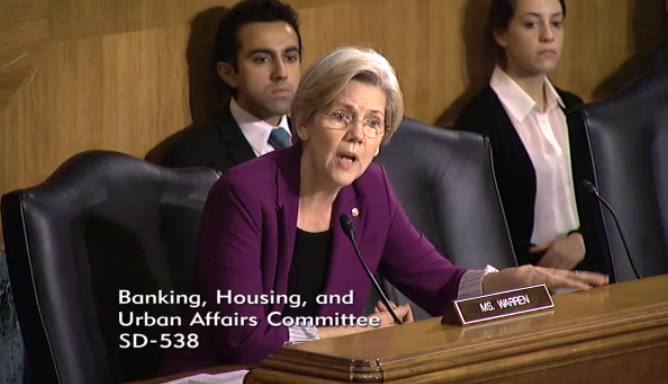
[Sen. Elizabeth] Warren did yesterday with Glass-Steagall, I
characterize that as the 'Get Jamie Dimon Act.'"