Showing posts with label Too Big To Fail. Show all posts

Monday, September 9, 2013

Ex-Citi CEO John Reed: We Need To Break Up The Big Banks

Ex-Citi CEO John Reed: We Need To Break Up The Big Banks


Sen. Elizabeth Warren (D-Mass.) has a friend in former Wall Street CEO John Reed.
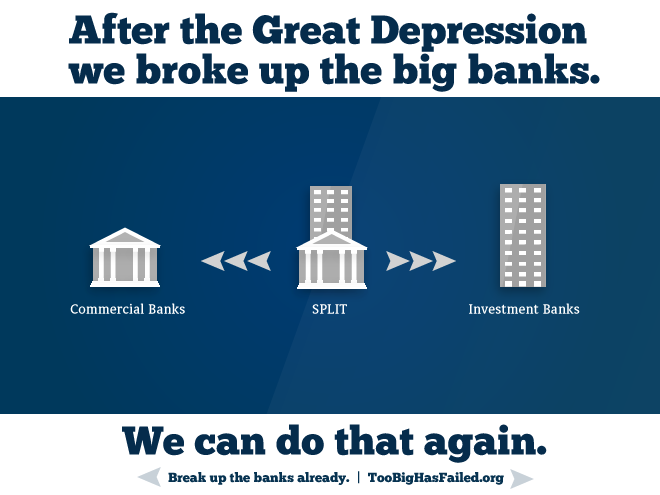
The former CEO of Citicorp, which merged with Travelers Insurance in 1998 to create the mega-bank Citigroup, told the Financial Times in an interview published Sunday that it's time to reinstate the Glass-Steagall Act. The act largely separated investment banking from commercial banking until its controversial repeal in 1999.
Reed, who played a critical role in the creation of Citigroup, now the nation's third biggest bank by assets, told the Senate Banking Committee in 2010 that he helped create "a monster" by combining Travelers and Citi.
Still today, he told the FT, bankers are being pushed to become more like high-risk traders and take bigger risks to get bigger payouts.
“These cultures [investment from commercial banking] don’t mix well and one tends to push out the other," Reed said. "It does result in institutions whose behavior isn’t necessarily productive for the economy."
Warren has Glass-Steagall on her radar as well, and proposed a bill earlier this year with Sen. John McCain (R-Ariz.) and others that aims to reinstate the division between investment and commercial banks. Some say the act's repeal helped create the conditions for banks to become "too big to fail" and require taxpayer bailouts.
Reed also argued his point in a 2009 letter to The New York Times, saying that separating commercial and investment banking activities “makes sense."

Tuesday, July 16, 2013

7 Reasons To Support Glass-Steagall, and a List of Those Who Do

It's a proposition that has plenty of critics, many of whom say that Glass-Steagall wouldn't have prevented the last crisis .( namely people like banks who don't want here , heres why)  In response, we've listed three reasons (numbers 4, 5, and 6 below) showing that the repeal of Glass-Steagall did in fact play a role in the crisis and that people should therefore support restoring it. Here's the list:

1. It Will Break Up Chase, Bank of America, and Citi

By international accounting standards, these three banks are the biggest in world. They are also the prime examples of banks that have enormous combined commercial and investment enterprises. What this means is that these banks are increasingly unwieldy, and in the words of former FDIC chair Sheila Bair they're simply "too big to manage."

2. It Will Fracture Wall Street's Lobbying Power


photo from flickr
In a Bloomberg video and in an article in the Financial Times, University of Chicago economist Luigi Zingales argues that restoring Glass-Steagall will fracture Wall Street's lobbying power. He says, "Under the old regime, commercial banks, investment banks and insurance companies had different agendas, so their lobbying efforts tended to offset one another. But after the restrictions ended, the interests of all the major players were aligned." It's no wonder, then, that Wall Street's power in Washington has increased in recent years.

3. Glass-Steagall Is Simple

Separating commercial banking activity from investment banking activity is a simple way to keep banks smaller. This simplicity is reflected in the bill itself: The original Glass-Steagall Act was 37 pages, for instance, while the 2010 Dodd-Frank Act will potentially reach 30,000 pages of rules.
Of course, simplicity in itself isn't reason enough to support a bill, but it's a reason that shouldn't be overlooked. After all, the global economy gets exponentially more complex each year, and so it's imperative to compensate that complexity with simple regulations—not lots of red tape and loopholes. “The simpler a rule is," Luigi Zingales says, "the fewer provisions there are and the less it costs to enforce them. The simpler it is, the easier it is for voters to understand and voice their opinions accordingly. Finally, the simpler it is, the more difficult it is for someone with vested interests to get away with distorting some obscure facet.”
We need a few simple laws on Wall Street. Glass-Steagall is one such law.

4. It Would Have Prevented AIG's Major Role In the Financial Crisis


photo from flickr
In his testimony to the Financial Crisis Inquiry Commission, Former Superintendent Eric Dinallo argued that AIG wouldn't have been so laden with risk if they hadn't been able to function like a hedge fund. He says that the repeal of Glass-Steagall, "permitted AIG to operate an effectively unregulated hedge fund with grossly insufficient reserves to back up its promises. Had AIG Financial Products been a stand alone company, it is unlikely that its counterparties would have been willing to do business with it because its commitments would never have carried a triple-A credit rating."
Since AIG was at the heart of the bailouts, the repeal of Glass-Steagall played a major role in the financial crisis.

5. Citi Wouldn't Have Been Run By Someone Who Didn't Understand Commercial Banking

Vikram Pandit (pictured above) hadn't ever worked as a commercial banker before becoming CEO of Citi in 2007. As Sheila Bair once said, Pandit “wouldn’t have known how to underwrite a loan if his life depended on it.” His lack of experience with commercial banking was problematic during the crisis because Citi was the sickest of all banks that received bailout money—requiring $472.6 billion in cash and guarantees. Pandit would have never been in charge of such a large commercial banking enterprise if Glass-Steagall hadn't been repealed. Instead, he would have stuck with what he knew: investment banking.

6. Investment Banks Wouldn't Have Faced as Much Competitive Pressure During the 2000s


Lehman Brothers CEO Dick Fuld, saying he wanted to rip out the heart of people betting against him.
The man in the picture above is Dick Fuld, the CEO of Lehman Brothers, an investment bank that went bankrupt in the crisis. Fuld was insanely competitive, as we saw in A Colossal Failure of Common Sense as well as this internal video, where Fuld shows his disdain for people betting against Lehman by saying, "I want to reach in, rip out their heart, and eat it before they die." (Yikes.) Fuld desperately wanted to be a top dog on Wall Street, and the repeal of Glass-Steagall made that much, much more difficult because it created the sudden influx of big competition from commercial banks. Fuld's blindly competitive spirit led him to overextend Lehman and eventually go bankrupt.
Of course, the repeal of Glass-Steagall didn't in itself cause Fuld to overextend, but it's clear that Lehman and other investment banks like Bear Stearns wouldn't have faced nearly so much competitive pressure if commercial banks like Citi hadn't suddenly entered the investment banking scene after 1999.
This report from Public Citizen (pdf) reveals more about why "The absence of Glass-Steagall ... was intrinsic to Lehman’s collapse," showing that Lehman itself admitted they were feeling intense pressure in 2005 from the repeal of Glass-Steagall.

7. Plenty of Smart People Support Restoring Glass-Steagall

Here's a list of people in the video above who support Glass-Steagall:
0:07 -- Bill Moyers (PBS) and Matt Taibbi (Rolling Stone discuss how little has changed since 2008).
0:27 -- Robert Reich (fmr Labor Sec) explains why we need to break up the biggest banks
0:47 -- Sandy Weil (founder, Citi Bank) explains why he wants the banks to be broken up
1:04 -- Byron Dorgan gives the successful history of breaking up the banks.
1:32 -- James Rickards lists the folks who allowed the banks to get big again.
1:41 -- James Komansky (fmr CEO, Merril Lynch) regrets his decision to allow banks to get big again.
1:57 -- Luigi Zingales (economist, Univ. of Chicago) on the danger of consolidated banks.
2:13 -- Sheila Bair (fmr FDIC Chair) on why she would like to see the banks broken back up.
2:30 -- Joseph Stiglitz (Nobel laureate, Columbia economist) on why we don't have ordinary capitalism when banks are so big.
2:40 -- Nouriel Roubini (NYU economist) "if institutions are too big to fail, they are too big."
2:54 -- Simon Johnson (MIT economist)
3:18 -- Neil Barofsky (TARP inspector) explains exactly what needs to happen.
3:41 -- Elizabeth Warren
4:00 -- Bernie Sanders
4:17 -- Ted Kaufman
*You can see more from MIT economist Simon Johnson in his articles "Five Facts About the New Glass-Steagall," where he says that Glass-Steagall would be good for small banks, and in "Remember Citigroup," where he says that the repeal of Glass-Steagall was directly responsible for Citi's problems in the crisis. You can also see more from University of Chicago economist Luigi Zingales in his article "Why I Was Won Over By Glass-Steagall," where he explains why he was initially resistant to the law, and why he now supports it.
In addition to the sixteen people shown in the video above, here are some more quotes from others who want to restore the law:
Barry Ritholtz, chief executive of FusionIQ, an asset management and research firm: “For about 70 years, Glass-Steagall managed to keep the riskier, more damaging part of Wall Street away from what should be the boring, straightforward side of finance. It was the height of stupidity repealing Glass-Steagall.”
Arthur Levitt, former Wall Street regulator: “Clearly, I regret my support of doing away with Glass Steagall.”
John Reed, former Citi CEO: "As another older banker and one who has experienced both the pre- and post-Glass Steagall world, I would agree with Paul A. Volcker (and also Mervyn King, governor of the Bank of England) that some kind of separation between institutions that deal primarily in the capital markets and those involved in more traditional deposit-taking and working-capital finance makes sense. This, in conjunction with more demanding capital requirements, would go a long way toward building a more robust financial sector."
Thomas Hoenig, FDIC director: “When you mix commercial banking and high-risk broker-dealer activities, you increase the risk overall and as a result you invite new problems.”
Dean Baker, economist for the Center for Economic Policy and Research: "I think there are a lot of ways to make [the big banks] less powerful, less politically powerful, less economically powerful. Glass-Steagall, again I'd like to see that sort of separation."
Andrew Haldane, Executive director of the Bank of England, calls Glass-Steagall "perhaps the single most important piece of financial legislation of the 20th century."

Conclusion

Restoring Glass-Steagall won't guarantee prevention of future financial crises, just as it (alone) wouldn't have prevented the last one. However, restoring Glass-Steagall is a simple way to reduce the size of Wall Street banks, and its repeal certainly did play a part in the last crisis. Its for those reasons, as well as the others listed above, that the law should be restored.
We'll conclude with this passage from Simon Johnson's article "Remember Citigroup," which argues that the New Glass-Steagall law should be a complement to other propositions to fix banking. We strongly agree with this notion:
The point of the New Glass-Steagall Act is to complement other measures in place or under consideration, including much higher capital requirements (both in the Brown-Vitter proposed legislation and in the new regulatory cap on leverage now under consideration), the Volcker Rule, and efforts to bring greater transparency to derivatives.
These measures are not substitutes for each other – they are complements.  Each would be more effective if the others are also implemented properly.
Nothing can completely remove the risk of future financial crisis.  Anyone who promises this is offering up illusions and deception.
But, like it or not, public policy shapes incentives in the financial system.  We can have a safer financial system that works better for the broader economy – as we had after the reforms of the 1930s.  Or we can have a system in which a few relatively large firms are encouraged to follow the model of Citigroup and to become ever more careless and on a grander scale.
Also see our last post on the new Glass-Steagall Act.

Friday, July 12, 2013

ELIZABETH WARREN AND JOHN MCCAIN TEAM UP TO REIGN IN BANKS

MSNBC had a segment today in which they interviewed Elizabeth Warren about a new set of laws reinstating the old style of Chinese walls. There are probably similar interviews on other channels with Senator Warren or Senator McCain and others. Just go to your favorite news channel and look it up. Their approach has bi partisan support because of its simplicity and its history. Historically it is merely a tune-up of the old laws to include definitions of new financial products that did not exist and were not adequately considered in the 1930's when EVERYONE AGREED THE RESTRICTIONS WERE NEEDED.
Bottom Line: RETURN TO THE BORING BANK SAFETY WITHOUT BOOMS AND BUSTS FROM 1930's into the 1990's: leading republicans and democrats are stepping out of gridlock into agreement. They want to stop Wall Street from access to checking and savings accounts for use in high risk investment banking because that is what brought us to the brink and some say brought us Into the abyss. And it would stop commercial banks that are depository institutions for your checking and savings accounts from using your money on deposit in ways where there is a substantial risk of loss that would require FDIC ((taxpayer) intervention.
Banking should be boring. In the years when restrictions were in place we only had one serious breach of banking practices --- the S&L Scandal in the 1980's. But it didn't threaten the viability of our entire economy and more than 800 people were serving prison terms when the dust cleared. Of course Bankers saw prison terms as an invasion of their business practices and regulation as unnecessary.
But the simple reason for bipartisan support is that the public is enraged that the mega banks (too big to fail) have GROWN 30% SINCE THE 2007-2008 while the people on Main Street are losing jobs, homes, businesses, families (divorce), thus stifling an already grievously injured economy because credit and cash are now scarce --- unless you are a mega bank that made hundreds of billions or even trillions of dollars because they were able to create an illusion (securitization) and at the same time, knowing it was an illusion, they bet heavily using extreme leverage on the illusion being popped.
They made it so complex as to be intimidating to even bank regulators. So no wonder borrowers could not realize or even contemplate that their mortgage was not a perfected lien, so they admitted it. Foreclosure defense attorneys made the same mistake and added to it by admitting the default without knowing who had paid what money that should have been allocated to the loan receivable account of the borrower that was supposedly converted for a note receivable from the borrower to a bond receivable from an asset pool that supposedly owned the note receivable account.
The complexity made it challenging to enforce regulations and laws. The complexity was hidden behind curtains for reasons of "privacy". The real reason is that as long as bankers know they are acting behind a curtain, they are subject to moral hazard. In this case it erupted into the largest PONZI scheme in human history.
And the proof of that just beginning to come out in the courts as judges are confronted with an absurd position --- where the banks "foreclosing" on homes and businesses want delays and the borrower wants to move the case alone; and where those same banks want a resolution (FORECLOSURE OR BUST) that ALWAYS yields the least possible mitigation damages, the least coverage for the alleged loss on the note because they would be liable for all the money they made on the bond. Just yesterday I was in Court asking for expedited discovery and the Judge's demeanor changed visibly when the Plaintiff seeking Foreclosure refused to agree to such terms. The Judge wanted to know why the defendant borrower wanted to speed the case up while the Plaintiff bank wanted to slow it down.
And because of all the multiple sales, the insurance funds, the proceeds of credit default swaps, because the initial money funding mortgages came from depositors ("investors"), and all the money from the Federal Reserve who is still paying off these bond receivables 100 cents to the dollar --- all that money amounting to far more than the loans to borrowers --- because it related to the bond receivable, the banks think they can withhold allocation of that money to the receivable until after foreclosure and avoid refunding all the excess payments to the borrower the investor and everyone else who paid money in this scheme. And the system is letting them because it is difficult to distinguish between the note receivable and the bond receivable and the asset pool that issued the bond to the actual lender/depositor.
Senators Warren and McCain and others want to put an end to even the illusion that such an argument would even be entertained. Support them now if not for yourselves then for your children and grandchildren.

Wednesday, July 10, 2013

A couple stories

 Unflipping real.


Tim Geithner's Kickbacks
The Financial Times has the news:  Tim Geithner has made $400,000 in speaking fees since he left his role as Treasury Secretary—$200,000 of which came from a single speech he gave at Deutsche Bank.
In 2009, Deutsche Bank received nearly $12 billion from AIG after AIG was bailed out by the US taxpayer, with Geithner adamantly insisting that AIG receive 100 cents on the dollar (i.e. no haircut). So $200,000 was the least Deutsche Bank could do for Geithner, right?
It seems to us that Wall Street uses speaking fees as a loophole to pay public servants back for their "service" when they leave office. We see the same thing happening with Alan Greenspan and Larry Summers, and it's a horrible precedent. If public servants know they become part of the 1% simply by giving a speech or two after they leave office, then they're bound to privilege certain citizens (the ones with the money) more than others.
It's not public service if the public isn't served.
Bank of America's Twitter Bot
In a hilarious post from blogger Eksith Rodrigo you can see Bank of America's Twitter bot responding with automated responses to protestors complaining about the bank. The conversation was initiated when Twitter user @darthmarkh posted a picture of his chalk protest outside the bank. After that, @BofA_Help unwittingly (we mean literally: no wits) starts joining the conversation. See the interchange at Eksith's blog, or below:

Bank of America's Foreclosure Fiasco
The last story we want to share is about the Mata family, who lived in the same home for 10 years before they were hit by the Great Recession. Since then they applied for loan modifications from Bank of America repeatedly, but were given the run around. The article talks about Gisele Mata's experience (who is the mother in the family):
Every time Gisele would reapply for a loan, she would get a new single point of contact (SPOC). She would receive letters from different people inside the bank with contradictory information, some from an old SPOC saying she was denied a modification (without explanation), others from a new SPOC saying that her paperwork was in the underwriting process. This matches what Bank of America whistle-blowers have stated, that customer service representatives would facilitate delay by claiming that applications were “under review,” when they weren’t.
Gisele talks about how these events led her to protest Wall Street banks. Hopefully they lead more people like her to do the same. Otherwise these banks will continue to treat customers like cogs in a system and give preference to people like Tim Geithner.

Tuesday, June 25, 2013

On Too Big to Fail, All the Warning Lights Are Flashing Red

"Too Big to Fail" banks played a key role in causing the last financial crisis. Since then they've grown even bigger, without much discouragement from the government (and in some cases with government support). Not a single executive has been prosecuted, despite their rampant lawbreaking, which means that there's been no effective deterrent against reckless and illegal behavior.
And, with millions still unemployed and hundreds of millions still suffering the economic after-effects of the last crisis, we're just about due for the next one.  That's why we convened a panel at last weekend's Netroots Nation conference titled "Stopping the Next Depression: Ending Too Big to Fail."  And that's why our first question was, "What would happen if the 40 million people who live in underwater American homes went on a mortgage strike?"
The panelists included Sen. Jeff Merkley, D-OR; Phil Angelides, former California State Treasurer, gubernatorial candidate, and Chair of the Financial Crisis Inquiry Commission; author Robert Kuttner (Debtors' Prison); and professor/author Anat Admati (The Bankers' New Clothes).
Here are some of the key points we addressed:
The jobs crisis created by the 2008 crisis is much deeper and long-lasting than that caused by any recession since the Great Depression of the 1980s. (See Figure 1, below.)
The total economic loss from 2008 crisis is roughly the same as that we experienced during the Great Depression, but stretched out over a longer period of time. (See "The Long Depression.")
Without proper regulatory protections, we're  likely to see recessions re-occurring every five to seven, or seven to ten, years. JPMorgan Chase CEO Jamie Dimon even bragged about it, saying in 2010:
"It's not a surprise that we know we have crises every five or 10 years. My daughter came home from school one day and said, 'Daddy, what's a financial crisis?' And without trying to be funny, I said, 'it's the type of thing that happens every five, 10, seven, years.' And she said: 'Why is everybody so surprised?'"
Dimon later said, "This bank is anti-fragile. We actually benefit from downturns." In other words, misery is their business model.
Recessionary cycles have more or less tended to follow the "Dimon's daughter" pattern during periods of regulatory underenforcement, which is what we have now.  That means the next recession could come along at any time. With mega-banks even bigger than they were before, and with so much economic damage and fragility left over from the last crisis, the next recession could lead to a major worldwide depression.
The financial sector had exploded in size before the last crisis, sucking all the oxygen out of the economy by diverting profits into nonproductive financial speculation.  (See Figure 2, below.) After the 2008 crisis it promptly began expanding again.  And Too Big to Fail became an even bigger problem: Assets at the top five U.S. banks now exceed half the Gross Domestic Product of the entire country, up from 42 percent. (See Figure 3.) That growth was spurred in part by mergers conducted with the government's approval -- or even at its insistence.
There is still an enormous amount of outstanding derivatives risk, and markets for several over-the-counter (OTC) securities are even more concentrated than they were before the 2008 crisis. (Slides that cover those last two points, and several of those which follow, are included in the PowerPoint presentation embedded at the bottom of this post.)
The bankers who inflated the real estate market in the run-up to the crisis are up to their old tricks, using their old tools.  Dead economic ideas have risen from the grave to threaten us again, thanks in large part to the systemically corrupt relationship between money and political power.
What's Washington doing about it? Republicans are working feverishly to neutralize the already-weak Dodd/Frank reform act, while the Obama Justice Department's shameful lack of prosecutions has given bankers free rein to continue defrauding customers (see David Dayen's piece on Bank of America) and laying the groundwork for future economic disasters.
We ran out of time for questions during the panel, in part because we on the panel talked for a long time. It was exacerbated by a couple longish questions, including one which I thought haranguing Sen. Merkley a little unfairly.
(As an aside, "Q&A time" at these events is always heavier on the "A" than the "Q."  Occasionally a questioner may act as if they were on some inverted version of Jeopardy!, where "your questions must be phrased in the form of an answer" rather than vice versa. You know what I mean...)
Here are the questions I would've liked to ask the panel, if we had found the time:
Why are bankers treated as economic experts? Reporters and politicians are still asking their opinions, which encourages them to engage in self-serving political stunts like "Fix the Debt." It's like going to the captain of the Exxon Valdez for advice on navigation. They shouldn't even be treated as banking experts, much less as economic ones.
How do we explain to the public that top bankers are actually quite unimpressive and have underperformed both managerially and economically?
How do we educate decision-makers and influence leaders? Anat Admati and her co-author wrote in The Bankers' New Clothes: "In trying to engage with policymakers and others on the issues, we discovered that many of them had no interest in engaging in the issues - not because of what they knew or did not know but because of what they wanted to know."
Or, I would assume, what they wanted not to know.  How do we address this problem among a) economists, b) politicians, and c) journalists and pundits?
Can the Fed do more? Should it step outside its traditional role to do so?
If you could tell the average American one thing she or he doesn't know about America's big banks, what would it be?
What is one government response to the financial crisis which you simply -- and naively -- assumed would be done and hasn't been done?
How great a danger does shadow banking pose?  How can it be controlled?
What's the right amount of allowable leverage?
How can we generate a shift in general or cultural perception, so that people understand we don't have to submit to unjust banking behavior or tolerate too-big-to-fail banks? And, in a related question:
How can we implement a "culture of shame" against bankers behaving badly?
I'm sure you'll have some questions of your own after watching the video. Here are some figures, pulled from my slide presentation (which is at the bottom of this page).
Figure 1: Jobs lost since onset of recession
2013-06-25-jobschart1.jpg

Figure 2: Growth in financial sector
2013-06-25-totfinsectorassets.jpg

Figure 3: Bank size as percent of GDP


Its coming and no one is watching again2013-06-25-assets.JPG