Showing posts with label Business News. Show all posts

Tuesday, November 26, 2013

Really? Can banks go any lower to cheat customers.

It seems the banks stop at nothing to rob people. I think its time we go back to the old ways. Get yourselves a bank safe and start saving it at home. Cash your checks at walmart for a 3.00 fee and put your money where you know its safe in a wall safe!!!!! So fed up with these crooks I could puke. Maybe its time for a bank run on the TBTF guys to put them back in order.. remember if it wasn't for you, they have nothing:. Citizens Bank already charges customers 3.00 to check your own damn bank accounts. How low is that! Think about this.. your savings will no longer be savings, the charges will out do the saving percentage so you will lose more than you gain. Priceless!


In an effort to protect their record profits, banks might soon charge you for the privilege of having a savings account.
I know what you're thinking: Banks already charge customers outrageous fees for the privilege of having bank accounts. But if the Federal Reserve dares to try and help the economy by cutting a special interest rate it pays banks, fees could get even more outrageous, the Financial Times reports (subscription only). Such a move by the Fed would lose banks some easy money, and they could take the difference out of their customers' hides.
The Fed is desperately trying to find ways to dial back on its $85 billion per month in bond purchases, an extreme stimulus program known as "quantitative easing," while still supporting the economy. One possible approach would be to stop paying banks a tiny interest rate for money they store at the Fed for safekeeping. The idea being that banks would be more inclined to put money to work with lending and other stuff that helps the economy.
But according to banks, that tiny Fed interest payment is the only thing that helps banks break even on savings accounts and other deposit services they provide. In order to protect their multi-billion-dollar bonuses and bank profits -- which have bounced to record highs since that financial crisis the banks helped create, a crisis from which the Fed and the American taxpayer bailed them out -- banks will sadly have no choice but to punish their customers.
That's not all: The banks say that, without that interest payment, they might also be pushed to take ever-crazier risks with money that was once safely parked at the Fed, the FT reports. Stop us before we kill the economy again, the banks are saying. And by "stop us," they mean, "give us all of your money."
There is hope, the FT writes: In order to dissuade banks from screwing their customers, the Fed might offer another way for banks to earn cash from Fed deposits. But that would seem to defeat the entire purpose of cutting rates on the first Fed program.
Anyway, as always, the banks are money-grubbing and horrible. But at the same time, from the Fed's perspective, it might not be the end of the world if people stopped saving so much money. The Fed wants money burning holes in people's pockets, in order to goose the economy out of its semi-permanent state of misery. Through their own greed, the banks could help with that.

Friday, October 11, 2013

Where does all the money go , you ask.


Big bank fines aren’t working

The penalties are greater than ever, but financial firms keep turning profits -- while the rest of us pay

Big bank fines aren't working 
Jamie Dimon, CEO of JPMorgan Chase & Co.(Credit: AP/Paul Sakuma)
This article originally appeared on Alternet.
AlterNet If somebody broke into your home and stole your belongings, you’d expect to see some serious consequences if they got caught. But when banks and financial firms rob, defraud and mismanage the money of Americans—and even cast them out of their own homes illegally—the worst that usually happens is a fine.
Since the recent financial crisis and housing collapse, some of Wall Street’s biggest banks have faced fines from regulators reaching into billion-dollar territory. In the latest news, JPMorgan Chase is looking at $11 billion in fines for pushing crap mortgage securities on unwary investors.
That sounds like a hefty amount of cash—it’s about the gross domestic product of Kenya, and tops that of Iceland and Bahrain. As journalist Pat Garafalo has noted, $11 billion is equal to what all the major banks paid together in 2012. The sum would be the largest single financial fine in history, if in fact it ever is paid (JPMorgan Chase is reported to be in negotiations that might reduce it).
So what happens to all that dough? Will it really change anything?
Let’s follow the money trail.
Who gets fined, and for what?
Investigators from the SEC, the U.S. Justice Department, a smorgasbord of state governments, and other regulatory agencies have been fining financial institutions for everything from concealing risky products, to illegally kicking soldiers out of their homes, to trying to scam bailout money.
The SEC has a list of firms whose activity “led to or arose from” the financial crisis on its website. It tells you what they have been charged with, what fines have been sought and what has been paid. The list is pretty long. Here’s just a small sample of the 161 entities and individuals charged for a grand total of $2.73 billion collected so far in settlements:
  • Goldman Sachs: Charged with conning investors on a financial product tied to subprime mortgages as the U.S. housing market started tanking. Goldman agreed to pay a record penalty in $550 million settlement and reform its business practices. A jury found former Goldman Sachs vice-president Fabrice Tourre liable for fraud.


  • Citigroup: The SEC charged the company and two executives with misleading investors about exposure to subprime mortgage assets. Citigroup paid a $75 million penalty to settle charges, and the executives also paid penalties.
  • Bank of America: Charged with misleading investors about billions of dollars in bonuses being paid to Merrill Lynch executives at the time of its acquisition of the firm, and failing to disclose ginormous losses that Merrill sustained. BofA paid $150 million to settle charges.
Now, keep in mind that so far we’re only talking about the SEC, which deals with various kinds of market scammers like inside traders, accounting fraudsters, and crooks who dupe investors.
If you start going through all the various agencies and the frauds they deal with, you may feel as if you’ve plunged into the 9 Circles of Financial Hell.
The U.S. Commodity Futures Trading Commission has its own list of enforcement actions, which covers hustlers who screw around with futures and option markets. Then there’s the Consumer Financial Protection Bureau, which deals with jerks who rip off consumers with products like credit cards and criminals who take kickbacks that raise prices on things like mortgage payments.  Over at the Department of Justice, they watch out for your price-fixers, your rate-riggers, and your money launderers. The Office of the Comptroller of the Currency handles swindlers of the sort who steal your financial info and make up phony investment programs, along with debt collectors. And so on.
There’s a good bit of overlap between regulators, and when there’s a big scam afoot, several agencies will often file suit against the same company.
Where does the money go?
That’s the billion-dollar question. Regulators love to brag about all the money they extract from financial transgressors, which comes in the form of various fines and “disgorgements” (returns of wrongful profits) to settle charges.
But does the money go to victims? Does it end up in the Treasury? Do regulators use it to fund more investigations? Buy snazzy new furniture for the office? The answers are not always easy to come by.
Let’s take a look at JPMorgan. This year alone, the megabank has paid $3.68 billion to settle various criminal probes into stuff ranging from manipulating electricity markets to ripping off credit card customers. A big fish was the “London Whale” debacle in which over $7 billion vanished due to risky derivatives bets.For its failed risk management and unsafe practices related to that Moby Dick of a f*ck up, JPMorgan is settling for $920 million. Out of that particular amount, $200 million will go to the SEC, and another $200 million to the Federal Reserve Board. The Office of the Comptroller of the Currency will receive $300 million, while the British regulator will get $220 million.
And we still haven’t gotten to the $11 billion whopper JPMorgan may have to pay out to end mortgage-bond investigations by federal and state authorities. That lump sum would presumably take care of all of the charges and would reportedly include $4 billion for relief for people who lost their houses and so on. The rest would go to pay various penalties. Where that $7 billion or so ultimately goes depends on what agency you’re talking about, and the particulars of the case.
I contacted the Department of Justice to find out how it handled fines, and no one returned my messages. (Perhaps during the shutdown, justice has been put on hold—or maybe that already happened when Attorney General Eric Holder admitted that banks had gotten too big to jail.) In any case, a former DOJ officer, Billy Jacobson, has gone on record as saying that the fines don’t pay for coffee and donuts for investigators. Instead, the money has to go the U.S. Treasury. Restitution for victims is rare, and constitutes a trivial amount of what the DOJ brings in. In 2011 the DOJ took in $2 billion in judgments and settlements, and only $116 million went to restitution.
At the SEC, I got hold of a spokesperson who tersely informed me that money collected from fines does not ever come back to the agency, but rather goes into the Treasury’s general fund. Anything else would violate the agencies’ statutes.
The Sarbanes-Oxley Act of 2002 also directed the SEC to create something called the Fair Fund, which in some cases, distributes monies collected from fines and disgorgements to investors. So if you invested in a company like, say, Enron, you might end up seeing some of your money returned, though rarely all of it, and the process can take years. If you happen to own stock in a company or owned a mutual fund that has been charged by the SEC, you can check the SEC website to see if there’s a settlement fund. Only a small portion of what’s in the Fair Fund has been returned to investors, so don’t hold your breath.
Some have complained that money from fines goes back to the regulatory agencies to launch further investigations, which creates a parasitic relationship between regulators and those they pursue. Barry Ritholtz of the Big Picture was recently quoted in Yahoo Finance on this point: “Only a portion of the settlements collected go to the actual victims,” stated Ritholtz. “For the most part the money is used to fund more investigations.” When I asked him for particulars, Ritholtz first told me to “Google it” but when I pressed him, he sent me the SEC’s 156-page financial report from 2012. When I read over this bloated document, it seemed to contradict Ritholtz’s statement. Perhaps he sees something in 156 pages that I don’t —alas, he did not respond to further inquiries.
I continued my quest to follow the money by calling up the Consumer Financial Protection Bureau. The folks at the CFPB were the most helpful so far, and explained that when the bureau collects civil penalties, it drops them into something called the Civil Penalty Fund, which was established by the Dodd Frank legislation in 2010. The bureau will use the money in the Civil Penalty Fund to provide some compensation to victims, an amount which depends on various factors such as how much the victim has gotten from other sources.  When the CFPB can’t find the victim or determines, for whatever reason, that it’s not “practicable” to pay them, the money goes to “consumer education” and “financial literacy programs.” That last bit is a little vague.
In the end, we seem to have a large chunk of money from fines and penalties going to the U.S. Treasury, which, if you’re a deficit hawk, ought to cheer you. But the amount going to victims, though on the rise, still appears to be inadequate.
Case in point: 10 megabanks, including Citi, JPMorgan Chase, and Bank of America, will have to fork over $3.3 billion in direct payments to customers who were in foreclosure during 2009 and 2010. That adds up to about $125,000 for each person who was foreclosed on even though they were up to date with their mortgage payments. Does that amount really cover the horrific cost of being kicked out of your home, losing equity, and all the other costs and inconveniences that go along with such a cataclysmic disruption? Some victims are saying no, it doesn’t, by a long shot.
Who pays the fines?
Technically, the banks or financial entities charged pay the fines. Much has been made of an aspect of corporate tax law that allows companies to write off disgorgements when they pay Uncle Sam. The Washington Post reports that the law lets the companies off the hook for millions of dollars in tax payments. Some bloggers have leapt to the idea that a big bank can write off fines, but that is not true at all, because fines are not the same thing as disgorgements.
Here’s how disgorgement works: If you’re a crook and you get your money from illegal activity you then pay taxes on, what you’ve really done is inflated your income and assets to the government because that money actually didn’t belong to you in the first place. If disgorgement happens, then you have to hand over the money you made from your shady activity. From a technical accounting perspective, you shouldn’t be taxed on the money because it was never yours, and the taxes you paid must be returned. This obviously doesn’t sit well in the gut for many folks, but instead of arguing this particular point, perhaps what we should really be doing is insisting that the fines should be much bigger—because right now, they aren’t big enough to hurt.
The banks are very clever about things like fines, and in some cases, they actually have ways of making you pay for them. When HSBC got hit with a giant money-laundering fine, customers got letters soon after noting certain “changes.” HSBC, for no reason it cared to explain, would be taking longer to deposit monies into accounts. What the bank was really doing was increasing the “float,” or soaking up interest on the money in between the time you deposit a check into your account and the moment it shows up there. Was there any link between the money-laundering fine and what happened to your account? Makes you wonder. It did not make the Federal Reserve wonder, though.
What if you decided to go after a bank yourself for harmful activity? Alexander Eichler at the Huffington Post has pointed out that there’s some very interesting fine print on fines buried way down in the terms-and-conditions agreements you have to sign when you open a bank account with big names like HSBC, TD Bank, and PNC Bank. Basically, if there’s any legal disputes over your account, and the bank has to fork over any fees, like attorney fees and so on, you get to pay them. In other words, if you sue your bank over a credit card dispute, you may have to pay for the bank’s losses, even if you win.
Here’s HSBC’s clause: “You agree to be liable to the bank for any losses, costs or expenses the bank incurs as a result of any dispute involving your account. You authorize the bank to deduct any such losses, costs or expenses from your account without prior notice to you.” The LA Times reports that though the practice is on shaky legal ground, what it’s really intended to do is scare consumers out of taking a bank to court.
Such is the peculiar reality in our banks-gone-wild universe.
In fact, taxpayers are paying for big banks to make all those heady profits and enabling their bad behavior through our subsidies. The megabanks can borrow money at a lower rate because creditors assume the government, on behalf of taxpayers, will come to the rescue in an emergency. Ironically, this subsidy only encourages them to engage in more risky behavior, for which we all end up paying.
What’s the goal of the fines, anyway?
Good question. Nobody really seems to know. In theory, disgorgements are a remedy for misdeeds, whereas fines are a punishment. But the punishment in many cases does not fit the crimes, which have wreaked havoc on the entire economy and caused job losses, vanished savings and pensions, and lost homes for millions of blameless people. Fines may sometimes force a company out of business, but most of time, those paying the big bucks barely bat an eye.
In case you hadn’t noticed, bank profits are up.
Despite JPMorgan’s potential $11 billion hit, the company stock has barely registered the fine. Maybe that’s because the fine, though large, would only amount to about two quarters worth of profits. Or because no one really believes a sum like that will ever be paid.
In any event, banks like settlements because they save a lot of hassle. Settling matters outside of the court system means that they usually don’t have to admit wrongdoing, they save money on legal fees, and they avoid juries, which may be in the mood to get a lot tougher on them than your friendly neighborhood regulator. This is true not just for banks, but all across the corporate sector. Big Pharma has gotten hit with big fines, too, for things like fraudulent marketing practicies. Hasn’t slowed them down a bit.
I spoke to banking expert Walker Todd of the American Institute for Economic Research, and he noted that though there has been a movement to get banks to at least admit wrongdoing when they settle, these admissions typically fall short of owning up to criminal guilt. When firms admit to criminal guilt, then they are open to lawsuits, and if they end up in court, they can’t deny what they’ve already admitted as facts.
Until they are truly forced to admit their crimes, or have to pay penalties that exceed their profits, banks have little to fear.
Are fines just the cost of doing business?
The Obama administration has not been very eager to pursue full-blown court cases with corporations or send executives to jail. When criminal charges ensue, they often involve lower-level employees who take the hit while the company and the big honchos go unscathed. The fines are paid and everybody goes back to business as usual.
The New York Times noted in an editorial that in the case of UBS, which was involved in the LIBOR rate-rigging scandal, a subsidiary got hit with a $100 million fine and two former traders of various criminal acts could wind up in jail. Sounds good—until you realize, as the Times observes, that a “subsidiary’s plea on a single criminal charge appears to shield the parent company and the prosecution of two traders appears to shield their managers.”
In other words, crush the small fry and let the big fish go.
What is clear is that fines, even the biggest ones, do little to deter criminal activity. Big banks appear to be simply calculating fines into their business models: fines, after all, don’t exceed profits, and in this scenario, what do you think the incentive is for banks to cease their fraudulent and criminal activity? If you answered, “none whatsoever,” you are likely correct.
Bank fines are simply baked into financial business. Until fines are much, much bigger and perpetrators at the top face the possibility of prosecution, the crime spree will go on.

Monday, September 30, 2013

JPMorgan Audit Director Laban Jackson: 'We Actually Are Guilty'

Sorry just isn't enough.

jpmorgan guilty


CHICAGO (Reuters) - The head of JPMorgan Chase & Co's audit committee acknowledged on Thursday that the bank had made mistakes and said it has tried to learn from them.
"We've got these things that we actually are guilty of and we've got to fix them," said Laban Jackson, the head of the audit committee of JPMorgan's board of directors.
"It's embarrassing for the board," he added. Jackson spoke at a conference at a downtown Chicago hotel on Thursday.
The remarks could underscore the bank's eagerness to resolve the raft of regulatory investigations it now faces. Earlier on Thursday, JPMorgan Chief Executive Jamie Dimon met with U.S. Attorney General Eric Holder in Washington to discuss a settlement to end investigations into its sales of shoddy mortgage securities leading up to the financial crisis.
In Chicago, Jackson spoke publicly with Anne Sheehan, chair of the Council of Institutional Investors, which sponsored the event.
Jackson did not discuss in detail the bank's settlement talks with regulators.
But he did offer a picture of some board decision making and vowed that it would try to become more open with investors. When Sheehan, as moderator, suggested that many directors would not share the same goal, Jackson replied, "That's got to change, and you guys have to drive it."
Asked what he learned from JPMorgan's troubles, Jackson said that while few boards or managers could stop malfeasance, JPMorgan made sure its response to problems like the so-called "London whale" trading losses were correct, such as by bringing in law firms to investigate its actions.
Jackson quoted JPMorgan's top director, former Exxon Mobil CEO Lee Raymond, as saying: "our job is to get the respect back in the market."
Jackson received a polite reception from attendees at the conference, which included hundreds of officials from state pension funds, endowments and other institutions.
Several said, however, they wished the directors had taken a harder line. "I think he was very light on the board's self-evaluation," said Dieter Waizenegger, executive director of CtW Investment Group, an adviser to union pension funds. CtW previously had opposed Jackson's re-election to the board.
Jackson noted that after problems emerged, JPMorgan had clawed back millions of dollars from executives, demoted some and fired others to send a strong message the bank's rules and culture had to be respected.
"I don't know what else we could have done because we're not allowed to shoot people," Jackson said. "That's what happened. I'm sorry to all you shareholders."

Wednesday, September 18, 2013

So what has changed?

Two years ago today, demonstrators descended on Zuccotti Park in New York City's financial district. Their focus, economic injustice, was clear in the name the movement would take: Occupy Wall Street.
Since then, nearly 8,000 Occupy protesters have been arrested fighting to fix a series of problems they feel are plaguing the nation. Have their efforts been for naught?
1. The gap between the rich and poor is still growing.
occupy los angeles
The U.S. continues to be plagued by the worst income inequality in the developed world. In fact, according to one measure, income inequality grew faster under President Obama than under President George W. Bush.
2. The Robin Hood Tax has yet to be implemented.
occupy protest
The Occupy Movement called for a tax on all Wall Street transactions. While the European Commission has proposed a similar tax on its financial institutions, it has yet to be pushed forward in the U.S. Supporters plan to continue rallying for it Tuesday during demonstrations in New York.
3. The student loan debt problem is only getting worse.
occupy protest
Obama recently signed a measure to lower interest rates for student loans. Still, total outstanding student loan debt has surpassed $1 trillion while the average borrower is more than $26,000 in debt. Over the course of a lifetime, average student loan debt could cost a household $208,000.
4. The Volcker Rule has still not passed.
occupy protest
The rule, named after former Federal Reserve Chairman Paul Volcker, was written as part of the Dodd-Frank financial reform bill to protect customers from risky bank behavior. Despite support from Obama and Treasury Secretary Jacob Lew, the rule remains unfinished.
5. The housing market has begun posting signs of recovery.
occupy protest
The number of homes entering foreclosure is down sharply, and prices are on the rise. This has led to a fear (unimaginable until recently) that prices are going up too fast.
6. Politicians continue to prioritize the wealthy.
occupy new york
Occupiers decried the influence of the 1 percent on politics. Unfortunately, not much has changed. The issues politicians care about are more likely to match up with the issues their wealthy constituents are concerned about as well. One prominent example: Rich Americans are much more likely to be concerned about the budget deficit than their average counterparts, a March study found. Another unfortunate result of the wealthy's outsized influence on politics is that democracy has done little to counterbalance income inequality, a study published in the most recent issue of the Journal of Economic Perspectives found.
7. Corporations are still allowed to spend an unlimited amount on political campaigns.
occupy new york
Despite protests from Occupiers and even some state governments, the Supreme Court's Citizens United decision, which allowed for unlimited political spending by corporations, unions and other entities, has yet to be overturned. A full 62 percent of Americans oppose this unlimited flow of corporate money into politics.

Friday, September 13, 2013

See how our Judicial really works - Not for you and me.

Not One Top Wall Street Executive Has Been Convicted Of Criminal Charges Related To 2008 Crisis

  Posted:


By Sarah White

LONDON, Sept 13 (Reuters) - Will top bankers' behaviour ever land them in jail? Or are bad business decisions even a crime at all?

Five years on from the bankruptcy of Lehman Brothers, the debate over how to hold senior bank bosses to account for failures is far from over, but legal sanctions for top executives remain a largely remote threat.

Even as laws evolve - in Britain, the government wants to criminalise recklessness in banking - a repeat of the global financial crisis and near-collapses of 2008 would not necessarily result in many more prosecutions today, lawyers say.

At issue is the difficulty in pinning the blame on any one person for risks and decisions taken throughout a firm - one of the main obstacles to building such cases so far.

"It's a case of the confused lines of responsibility and accountability," said Judith Seddon, director in law firm Clifford Chance's business crime and regulatory enforcement unit in London. "When you're pursuing an individual, if they've delegated responsibilities ... it's much more difficult in a big organisation."

Regulators the world over stepped up their scrutiny of banks and cracked down on financial crime in the wake of public anger over costly bailouts and subsequent scandals. But that has so far translated into relatively few attempts to bring charges against those in the highest echelons of banking.

In the United States, home to Lehman Brothers, no top executives at large Wall Street or commercial banks have been convicted of criminal charges relating to the 2008 crisis.

Across Europe, the implosion of Iceland's financial sector five years ago has resulted in some of the most prominent convictions so far, with the former chief executive of failed lender Glitnir among those sentenced to jail time.

In Germany and the Netherlands there have also been isolated high-level convictions, and some landmark cases could yet materialise. The entire former executive board of German lender HSH Nordbank is being put on trial over actions taken in the run-up to the crisis.

But in Britain, where Royal Bank of Scotland and Lloyds were bailed out to the tune of 66 billion pounds ($104.37 billion), no senior bankers faced criminal charges.

Three executives at Ireland's failed Anglo Irish Bank face trial in 2014, five years after the probe into the lender began, while in Spain, around 100 people are being investigated by courts over failings at banks devastated by a property market crash, though none have gone on trial.

RECKLESS BANKERS?

The low rate of convictions partly stems from the fact that in some countries laws which could have addressed the way that banks were run simply did not exist.

Britain's Finance Minister George Osborne said in July he would adopt recommendations made by an influential body of lawmakers that bankers should face jail for a new offence of "reckless misconduct in the management of a bank".

"The regulator has got to be holding people personally accountable for their actions. They need to be frightened of the regulator, which certainly wasn't true in the past," said Mark Garnier, a Conservative member of the Parliamentary Commission on Banking Standards.

In the United States, federal prosecutors are still exploring new strategies for criminally charging Wall Street bankers who packaged and sold the bad mortgage loans behind the financial crisis, including using an old law intended to punish individuals for scamming commercial banks.

Britain's push to create a "recklessness" offence could in theory make it possible to punish senior executives for taking misguided decisions. But proving that such decisions were made recklessly at the time could still be tough.

"Board level meetings are carefully minuted and you might therefore have detailed evidence, but however reckless someone appears with the benefit of hindsight, will it stand up in court?" said Gregg Beechey, a London-based partner at law firm SJ Berwin. "You wouldn't get the whole board to vote for an acquisition if the case wasn't reasonably convincing at the time."

U.S. regulators' approach since the crisis has reflected some of these challenges. Although the Securities and Exchange Commission has charged over 150 firms and individuals in relation to the financial crisis, critics have still said it has not done enough to go after high-level bank executives.

"We go where the evidence leads," former SEC enforcement director Robert Khuzami has said in the past, noting that cases could not be brought against people merely for "bad judgment".

A perceived lack of political will in some countries to pursue senior bankers and firms could also cloud future cases.

Despite costly state rescues in Spain for example, mainstream politicians have shied away from calling for investigations into various failures in the same way as British ones, after the UK government came under pressure from an intense public backlash in the wake of the crisis.

"(In Spain) it's more an absence of any willingness to pursue the cases than because of a lack of tools, as some cases could be proved without much difficulty," said Juan Torres, an economics professor at the University of Seville, adding that some related to clear instances of fraud.

Claims from customers and activist groups have instead led Spain's High Court to investigate several high-profile failures, including that of Bankia, which was bailed out in 2012 less than a year after listing on the stock market.

Frustrations over the slow progress of legal probes in Spain is even leading some activist groups to consider lobbying the United Nations to list economic crimes as a crime against humanity, even though they admit it is unlikely to happen.

If the scope for legal prosecutions of senior bankers has not broadened drastically in the past five years, however, some argue that life at the top is much harder than it used to be, in part as countries pursue other lines of action.

"Regulatory tools can be more powerful than criminal law, although whether or not it's what the public want to see is another question," Beechey at SJ Berwin said.

"There's more of a sense with regulators that they can do things without fulfilling the burden of proof, and they are definitely working to try and pursue senior management more and more."

Tuesday, September 10, 2013

While we pay, they play

To bad the victims of their crimes didn't come out with something , other than handouts. 
wall street executives
Bank of America Corp.'s CEO Ken Lewis arrives at the building that houses the New York Attorney General Andrew Cuomo's office, Thursday, Feb. 26, 2009 in New York. (AP Photo/Mary Altaffer)
Five years after the near-collapse of the nation’s financial system, the economy continues a slow recovery marred by high unemployment, hesitant consumers and sluggish business investment.
Many of the top Wall Street bankers who were largely responsible for the disaster — and whose companies either collapsed or accepted billions in government bailouts — are also unemployed. But since they walked away from the disaster with millions, they’re juggling their ample free time between mansions and golf, skiing and tennis.
Meantime, the major banks that survived the crisis, largely because they were saved with taxpayer money after being deemed “too big to fail,” are now bigger and more powerful than ever.
The Center for Public Integrity looked at what happened to five former Wall Street kingpins to see what they are up to these days. None are in jail, nor are any criminal charges expected to be filed.
Certainly none are hurting for money.
Take Richard Fuld. Five years after Lehman Brothers Holdings Inc., the 158-year-old company he ran, collapsed under the weight of bad investments and sent a tidal wave of panic through the global financial system, Fuld is living comfortably.
He has a mansion in Greenwich, Conn., a 40-plus-acre ranch in Sun Valley, Idaho, as well as a five-bedroom home in Jupiter Island, Fla. He no longer has a place in Manhattan, since he sold his Park Avenue apartment in 2009 for $25.87 million.
The other four bankers the Center caught up with — Jimmy Cayne (Bear Stearns), Stanley O’Neal (Merrill Lynch), Chuck Prince (Citigroup) and Ken Lewis (Bank of America) are also living in quiet luxury.
Meltdown primer
A quick crisis refresher: During the early years of the last decade, U.S. home values were soaring, fueled by ultra-low interest rates.
Wall Street investors, eager to get in on the party, developed an enormous appetite for bonds backed by the mortgages of everyday homeowners. Firms like Lehman would buy up thousands of mortgages, pool them together into a security, and sell the cash flow from the mortgage payments to investors, including pension funds and hedge funds.
The bonds were thought to be almost as safe as U.S. Treasuries, but they carried a higher interest rate.
The demand was so great that eventually mortgage lenders loosened their underwriting standards and made loans to people who couldn’t afford them, just to satisfy hungry investors.
-------------------------
Don’t miss a single Center for Public Integrity investigation on the financial industry.
Sign up now to receive special newsletters relevant to your interest.
-------------------------

When the housing market turned down in 2007 and homeowners began to default on their loans, the whole system began to crumble.
In March 2008, Bear Stearns almost collapsed and was sold. Six months later, Lehman failed, setting off a chain reaction that killed dozens more banks and mortgage lenders. Weeks later, Congress approved a $700 billion bailout of the financial system and soon nearly every major financial institution was on the dole.
The ensuing recession destroyed as much as $34 trillion in wealth and sent the unemployment rate soaring above 10 percent for the first time in 25 years.
“Every single one of these companies was insolvent,” said Neil Barofsky, the former special inspector general overseeing the bailout, which was called the Trouble Asset Relief Program.
“Clearly there was a large underpinning of fraud,” said Barofsky, a former federal prosecutor, who argues the government didn’t adequately pursue criminal charges against those who caused the crisis. “There was never really a comprehensive investigation. The Justice Department largely outsourced this to the Securities and Exchange Commission.”
Five years after the meltdown, the potential for a criminal prosecution of any of those involved in the events leading up to the collapse has faded as the statute of limitations for financial fraud ran out.
The five ultra-rich former Wall Street chieftains have simultaneously faded into luxurious obscurity while the survivors — Jamie Dimon of JPMorgan Chase & Co. and Lloyd Blankfein of Goldman Sachs — have only consolidated their power as they alternate between being seen as great villains or near statesmen depending on the changing fortunes of their companies.
Fuld checks in
Five years after Lehman Brothers declared bankruptcy, Fuld is keeping a low profile. He’s not giving interviews or lectures, and he’s not done an apology tour.
At times he picks up the phone and calls up former Lehman co-workers — those whom he considers friends — to check in.
Kevin White, a former managing director at Lehman, says he hears from Fuld about once a month. The former CEO asks about White’s family, checks on how business is at the hedge fund White founded after Lehman, offers to help, and perhaps introduce him to someone.
“Dick’s a family man and he’s someone who takes this whole Lehman bankruptcy very personally,” White says. He admits that some of his former colleagues hate Fuld and don’t understand why White stays in touch.
Fuld has been widely criticized, by former Lehman workers and in official investigations, for allowing the firm to drown itself in too much debt. When it went bankrupt, for every dollar of capital Lehman held, it was borrowing at least $30. Some reports say the rate was higher than 40 to 1.
That gave it no cushion to absorb losses when the market began to decline.
The myriad investigations into the causes of the crisis revealed that under Fuld’s watch, Lehman executives toyed with the company’s finances to make that leverage look better than it really was using what some Lehman employees called an “accounting gimmick” called Repo 105, according to the official bankruptcy report by Anton Valukas of the law firm Jenner & Block.
The tactic allowed the company to characterize a short-term loan as an asset sale and then use the money from that false sale to cut debt. By doing so, Lehman appeared to have less debt and more cash. Lehman used Repo 105 transactions to cut the debt on its books by as much as $50 billion just before it announced quarterly earnings, giving investors a false impression of the bank’s financial health.
In a legal filing in an investor lawsuit, Fuld and other Lehman executives said investors were informed that Lehman’s leverage was often higher than it was at the end of each quarter.
"Lehman specifically disclosed that its balance sheet ‘will fluctuate from time to time’ and could be and at times was larger than its balance sheet reported at quarter- or year-end,’ the filing said.
Fuld, in testimony before the Financial Crisis Inquiry Commission, blamed Lehman’s failure on the government’s decision not to give it a bailout.
“Lehman was forced into bankruptcy not because it neglected to act responsibly or seek solutions to the crisis, but because of a decision, based on flawed information, not to provide Lehman with the support given to each of its competitors,” he testified.
“There is sufficient evidence … that Fuld was at least grossly negligent,” Valukas wrote in his report.
Negligence isn’t necessarily a crime, however, so Fuld has faced no punishment for the wreckage caused by his company’s collapse, save perhaps banishment to irrelevance.
Last year a federal judge approved a $90 million settlement of a class action suit brought by Lehman investors against Fuld and several other company executives and directors. The judge, Lewis Kaplan, questioned whether the settlement, which will be paid entirely by Lehman’s insurers, was fair given that none of the individuals would pay out of pocket. He agreed to the deal, however, because litigation expenses for a trial were likely to deplete the funds available for compensating the investors.
Fuld quietly opened his own advisory firm called Matrix Advisors in a Third Avenue office building in Manhattan, across the street from the headquarters of Avon, the cosmetics company. He’s landed a few clients, according to news reports, SEC filings and court records. Matrix advised AT&T Inc. on its failed bid to purchase T-Mobile. And it has consulted with GlyEco, a company that recycles the chemical glycol, and Ecologic Transportation Corp., a company that rents out environmentally friendly cars.
He was recently spotted at Doubles, the private dining club in the Sherry-Netherland Hotel in Manhattan, according to a former Lehman employee.
Still, companies haven’t been eager to have their names associated with Fuld, so landing clients hasn’t been easy, according to two people familiar with the business.
Fuld, through his lawyer, declined several interview requests for this story. He wasn’t in his office when a reporter paid a visit in July. His assistant, through a security guard, declined to say where he was.
Even if business is slow, it may not matter much to Fuld. Unlike many of his former employees, and unlike the millions of people still out of work after the 2008 financial collapse, Fuld has money.
When Lehman Brothers filed for bankruptcy on Sept. 15, there was a sense that if Fuld had mismanaged Lehman to death, at least he had lost a load of cash in the process as the value of his company stock dropped to nothing.
And he did lose plenty.
Fuld’s 10.8 million shares of the company that may have once been worth more than $900 million, according to a study by Harvard University Professor Lucian Bebchuk, became worthless.
However, he wasn’t exactly on his way to the poor house. From 2000 through 2007, Fuld took home as much as $529 million from his Lehman job. That includes his salary and cash bonuses, as well as the Lehman shares granted him by the company that he sold before the bankruptcy in September 2008.
That total comes from an analysis by Oliver Budde, a former Lehman associate general counsel who left the firm in 2006 because, he says, Lehman was underreporting its executive compensation to shareholders.
That income allowed Fuld to buy some very high-end real estate.
In Greenwich, he has an $8 million, nine-bedroom home with a guest house. He and his wife, Kathleen, bought the house in 2004 after they sold their previous Greenwich home to Robert Steel, a Goldman Sachs executive who became undersecretary of the Treasury in 2006 under Henry Paulson. Steel then became CEO of Wachovia, which nearly collapsed 11 days after Lehman and was sold to Wells Fargo at the direction of federal regulators.
When he’s looking to get out of Greenwich, Fuld can head south to Jupiter Island, Fla., a ritzy barrier island that’s home to Tiger Woods and Greg Norman. He transferred ownership of the $10.6 million beachfront home, with a pool and tennis court, to his wife in November 2008, a common strategy for protecting assets from legal judgments.
He also spends a lot of time at his 40-plus-acre ranch in Ketchum, Idaho, in the center of the Sun Valley resort area. The spot offers “ultimate privacy,” according to Daryl Fauth, CEO of Blaine County Title in Ketchum.
The ranch is located just five minutes from downtown Ketchum, east of the Baldy Mountain ski resort and west of the Reinheimer Ranch, a 110-acre spread that’s owned by the Idaho Foundation for Parks and Lands and can’t be developed. The house is situated on a bend in a river that runs through the property.
Fuld even managed to make a killing in real estate during the depths of the collapse. A Park Avenue apartment that he and his wife bought in 2007 for $21 million was sold in 2009 for a $4.8 million gross profit.
What he hasn’t done is make any public statement or gesture or obvious effort to rehabilitate his image. He hasn’t made any public overtures to major charities.
He appears to have wound down his family foundation after Lehman went bankrupt, distributing the last $10,948 in 2009, according to tax filings. And last summer Fuld sued his estranged son-in-law seeking to recover money he had lent the younger man to buy a home with Fuld’s daughter.
Fuld was looking to be paid in cash and stock by those he advised, according to a person familiar with the company. That’s the type of agreement he struck with Ecologic, which paid him a $10,000-per-month retainer and granted him options to buy 2.29 million shares of its stock at 25 cents per share.
Jimmy’s playing bridge
While Fuld has tried to stay in the business, Jimmy Cayne of Bear Stearns has withdrawn completely.
Cayne, who lives in a $25 million apartment in New York’s Plaza Hotel, can be found almost every day in cyberspace hosting an online bridge game.
Last month in the Hyatt Regency hotel in Atlanta, Cayne sat for hours in a crowded ballroom with orange, brown and yellow swirled carpet competing for the coveted Spingold Cup.
Cayne sat in a crisply pressed shirt with his team — two Italians and two Israelis — chomping a cigar and talking in hushed tones over one of the dozens of folding tables. He likely pays his players more than $100,000 a year each to help him remain atop the world rankings, according to two people who have played in tournaments against him.
He’s ranked 22nd in the world, according to the American Contract Bridge League. Last month he lost in the round of 16 of the Spingold knockout match.
That he’s opted for bridge over finance is telling, as Cayne was much criticized for spending more time on golf and bridge than on dealing with the crises that were crushing his firm.
While at Bear, Cayne would leave every Thursday and take a helicopter to his New Jersey beach house for long weekends of golf at the Hollywood Golf Club. He’d emerge from the chopper behind sunglasses and chomping the trademark cigar, according to people who saw him there.
Cayne had survived the bankruptcy of two Bear Stearns hedge funds the summer before but succumbed to the inevitable when, in the fourth quarter of 2007, the company had to write down $1. 9 billion in bad home loan bets, leading to its first quarterly loss ever.
He retired as CEO in January 2008, two months before the firm collapsed under the weight of its subprime mortgage investments, but remained as board chairman. As the market became doubtful that the mortgage bonds on Bear’s books were worth what the company claimed, companies pulled their business, suddenly and en masse.
Bear Stearns was sold on March 16, 2008, in a late night deal to JPMorgan Chase & Co., which eventually paid $1.2 billion, about what it would have cost to buy the company’s Madison Avenue headquarters.
The company’s leverage ratio was 38 to 1 or higher, according to Phil Angelides, the chairman of the Financial Crisis Inquiry Commission. Cayne acknowledged in his testimony before the commission that it was too high.
“That was the business,” he said. “That was really industry practice.”
He told Angelides that he believed in Bear so strongly that he almost never sold its stock. “I rarely sold any of the firm’s stock except as needed to pay taxes,” he testified on May 5, 2010.
Like Fuld, Cayne lost about $900 million on paper when Bear’s stock plunged, but he took home plenty before the crash. He earned $87.5 million in cash bonuses from 2000 to 2007 and sold stock worth about $289.1 million in those years, according to Bebchuk’s study.
In addition to the Plaza Hotel condo, he and his wife have a second apartment on Park Avenue. They put that home on the market last month for $14.95 million. When they want to get out of the city, they can head to their $8.2 million mansion on the Jersey Shore, about a mile from the Hollywood Golf Club, or their $2.75 million condo at the Boca Beach Club in Boca Raton, Fla.
Cayne, like many of his fellow CEOs, has apparently worked to shield his assets from potential liability.
In November and December 2009, he transferred ownership of four pieces of real estate to four separate limited liability companies, called Legion Holdings I, II, III and IV, for a total of $21. Some of the LLCs share Cayne’s Plaza Hotel mailing address in public tax records.
“I take responsibility for what happened. I’m not going to walk away from the responsibility,” Cayne told the FCIC.
He hasn’t had to take any for the demise of Bear, however. He’s paid no judgments or settlements from any lawsuits, according to his lawyer, David Frankel.
Chuck Prince is helping his friends
While Fuld went down with his ship and Cayne remained until close to the end, two of their CEO brethren were pushed aside earlier — when the subprime collapse began taking its toll on profits — only to watch their companies falter from a distance.
Charles O. Prince III resigned as CEO of Citigroup on Nov. 5, 2007, when the company announced it had lost between $8 billion and $11 billion on subprime mortgage bets.
“Given the size of the recent losses in our mortgage-backed securities business, the only honorable course for me to take as Chief Executive Officer is to step down,” he said in a statement. Prince walked away with a golden parachute worth about $33.6 million.
From 2000 through his resignation, Prince took home $65.2 million in cash salary and bonuses, according to an analysis by the Center. There are no SEC reports showing that he sold any shares from 2000 through 2008. It’s unclear whether he’s sold any since he resigned. Citigroup shares were priced at more than $300 the week Prince resigned and today hover at about $50 after a 1-for-10 reverse stock split.
His downfall came only months after he famously justified Citi’s continued involvement in subprime:
“When the music stops, in terms of liquidity, things will be complicated. But as long as the music is playing, you’ve got to get up and dance. We’re still dancing,” he told The Financial Times in July 2007.
Prince was succeeded by Vikram Pandit, a former hedge fund manager whose firm was acquired by Citi just months earlier for $800 million. While Pandit was trying to right the listing ship, the company continued to provide Prince with an office, an administrative assistant and a car and driver for up to five years, a package worth $1.5 million a year, according to SEC filings.
By the end of 2008, Citigroup had received $45 billion in bailout money from the U.S. Treasury and the Federal Reserve had guaranteed hundreds of millions of dollars of its debt.
Prince apologized for the disaster that the financial crisis caused in testimony to the FCIC in 2010. "I'm sorry the financial crisis has had such a devastating impact for our country," he testified. "I'm sorry about the millions of people, average Americans, who lost their homes. And I'm sorry that our management team, starting with me, like so many others, could not see the unprecedented market collapse that lay before us."
After Citigroup, Prince joined the global consulting firm Stonebridge International, which was founded by former National Security Advisor Sandy Berger. The company merged in 2009 with the Albright Group, founded by former Secretary of State Madeleine Albright to form Albright Stonebridge Group.
Prince described his move to Albright Stonebridge as “helping my friends with their activities,” in a 2009 interview. When pressed about what his exact job was he said, “I’m just a friend.”
He’s no longer listed as an executive on the company’s website and a spokeswoman for the company did not respond to an email and phone call seeking an update on his status.
He serves on the boards of directors of Xerox Corp. and Johnson & Johnson Inc. He’s represented by the Harry Walker Agency as a speaker for hire on topics including “Corporate Governance: A Five-Point Plan to the Best Business Practices,” and “Inside the Current Financial Crisis.”
Last year Prince, along with Citigroup and several members of the company’s pre-2008 board, settled a class action lawsuit for $590 million that accused them of misleading investors about the amount of subprime-related securities the company held on its books and underreporting losses related to those investments. Prince and the other defendants didn’t admit any wrongdoing in the settlement.
It’s unclear how often Prince went to the office held for him at Citi, but what is clear is that Prince had plenty of other places to spend his time.
He has a $3.6 million Nantucket getaway and a $2.7 million house in a Jack Nicklaus golf community in North Palm Beach, Fla., called Lost Tree Village.
Stan O’Neal goes to the Vineyard
Prince’s ouster from Citigroup was prefaced just days earlier by the departure of Stanley O’Neal from Merrill Lynch.
O’Neal had taken over Merrill when it was mostly a retail brokerage firm and turned it into a major manufacturer of collateralized debt obligations, a type of security, backed by home mortgages.
By 2006, it was the biggest underwriter of CDOs on Wall Street and a year later the company had $55 billion worth of subprime loans on its own books that no one wanted to buy.
As the losses mounted, O’Neal made overtures, first to Bank of America, then to Wachovia, about buying Merrill Lynch — without the approval of the board, according to a 2010 interview O’Neal gave to Fortune Magazine. When in October 2007 Merrill announced it was writing off $8 billion of its mortgage-backed securities, and then news broke that O’Neal was thinking of selling the firm, it was over. He was fired.
O’Neal floated out of Merrill comfortably, however, buoyed by a golden parachute worth $161.5 million. In the eight years leading up to his ouster, O’Neal earned $68.4 million in cash salary and bonuses, and he sold Merrill stock at a profit of at least $18.7 million, according to a Center review of annual reports and SEC filings.
He was succeeded by John Thain, a former CEO of the New York Stock Exchange, who convinced Bank of America to buy Merrill Lynch for $50 billion just as Lehman was imploding and taking much of the financial system with it.
(Thain himself was eventually fired after it became public that he spent more than $1 million renovating his Merrill office — including $87,700 for a pair of guest chairs — as the company was on the verge of bankruptcy.)
O’Neal, however, is flush. On top of his $161.5 million, he and his wife have a Park Avenue apartment. NBC anchor Tom Brokaw sold his apartment in the building for $10.75 million in 2011. O’Neal transferred full ownership to his wife in November 2008, a common strategy to protect the home from any legal judgments.
The couple also owns a $12.4 million vacation home in Martha’s Vineyard through an LLC called KZ Vineyard Land.
Today he sits on the board of Alcoa Inc., the world’s top producer of aluminum and is on the audit and corporate governance committees.
Ken Lewis moves to Florida
Kenneth Lewis survived the September 2008 bloodbath and even came out looking like a hero to some when he arranged Bank of America’s hasty purchase of Merrill Lynch — O’Neal’s former employer — for $50 billion on the same weekend that Lehman failed, possibly saving it from the same fate as Lehman.
It soon became clear that Merrill was no bargain. That, combined with Lewis’ ill-advised purchase of subprime giant Countrywide Financial just as the housing market went into free fall, led Bank of America to start hemorrhaging cash.
It eventually got $45 billion in bailout money from the federal government to stanch the bleeding.
Lewis knew of Merrill’s excess losses before shareholders approved the final deal, according to his 2009 testimony to then-New York Attorney General Andrew Cuomo. He said he kept the losses hidden under pressure from Treasury Secretary Henry Paulson who worried that, if the deal fell through, it would hurt the already wounded market and overall economy.
Bank of America last month was accused by the Justice Department in a civil lawsuit of understating the risks that the loans included in $850 million of mortgage-backed securities would default. The Justice Department said the company was so hungry for loans to securitize that it let its quality controls slide and didn’t adequately verify borrowers’ incomes or ability to repay. The suit did not name Lewis as a defendant.
The company already settled a civil fraud suit with the SEC for $150 million and another lawsuit brought by pension fund investors for $62.5 million.
Lewis retired in September 2009 with a going-away package worth $83 million, even though the company was largely dependent on the federal government for its survival. He had already banked at least $86.4 million from Bank of America stock sales between 2000 and 2008, according to SEC filings. He also brought in $52.4 million in salary and bonuses in that time.
He and his wife Donna sold their house in Charlotte, N.C., in January for $3.15 million and their mountainside mansion in Aspen for $13.5 million, $3.35 million less than what they paid for it in 2006.
They appear now to have only one home, a $4.1 million condo in a beachfront high-rise in Naples, Fla.
The winners
While Lewis and several of the CEOs that led their companies into the thicket of mortgage-backed securities have ended up rich but unemployed, two have seen their fortunes soar.
Jamie Dimon and Lloyd Blankfein, the leaders of JPMorgan Chase & Co. and Goldman Sachs Group Inc., today stand atop the global financial system, their banks bigger and more powerful than ever and their personal fortunes growing.
Blankfein was a magnet for scorn and envy before the crisis when Goldman awarded him a $68 million bonus in 2007, just as the economy was going bad. He then became the target for much of the public wrath that followed the collapse of the economy when he flippantly declared that Goldman was doing “God’s work” by lending money to businesses.
His reputation plummeted to its lowest point in 2010 after revelations that Goldman Sachs packaged and sold mortgage securities that appeared designed to fail, and then shorted the bonds, making a killing for the firm while customers lost money.
The company was sued by the SEC over one such deal, called Abacus, and Goldman settled the case for $550 million without admitting any wrongdoing.
While Blankfein was the villain, Dimon was treated as a rock-star statesman.
He was welcome at the White House and lauded as one of the only bankers who didn’t need a bailout — even though he took one, allegedly at the direction of Paulson.
Obama sang his praises in February 2009, just weeks after entering the Oval Office.
“There are a lot of banks that are actually pretty well managed, JPMorgan being a good example,” Obama said. “Jamie Dimon, the CEO there, I don't think should be punished for doing a pretty good job managing an enormous portfolio.”
Dimon’s popularity in the White House began to fade because he was a vocal opponent of many of the financial reforms being advocated in response to the crisis. Then in 2012, JPMorgan announced it had lost billions because of bad bets by a rogue derivatives trader in London.
Dimon came under investigation for minimizing the issue to investors — he called the problem “a tempest in a teapot.” The company was sued by the SEC, and Dimon had to testify before Congress. Last spring he barely survived a shareholder vote that would have separated his two jobs, chairman of the board and chief executive.
Last month the company said it was under civil and criminal investigation by the Justice Department over its subprime mortgage-backed securities.
When he hit the nadir of his troubles, Dimon reportedly sought advice from Blankfein on how to weather the storm and maintain his and his company’s reputation.
Earlier this summer, Blankfein held forth before a roomful of journalists and lobbyists at Washington’s swank Mayflower Hotel where, like an elder statesman, he was asked about everything from immigration reform to his first job selling hot dogs at Yankee Stadium. BusinessWeek Magazine wrote a story about the fashion impact of his new beard.
Through the ups and downs, neither CEO has suffered financially.
Blankfein was paid $21 million last year and he was the highest-paid chief executive of the 20 biggest financial companies, according to Bloomberg. Dimon earned about half that, or $11.5 million, as a result of the derivatives loss that became known as the “London whale.” Blankfein owns about $256 million of Goldman shares, according to Forbes magazine.
Dimon bought a Park Avenue apartment in 2004 for $4.9 million and bought a second unit in the same building this year for $2 million. He also owns a $17 million estate in Mt. Kisko, N.Y. Blankfein’s Central Park West penthouse is valued at $26.5 million, according to New York property records. Late last year, he and his wife also bought a 7.5-acre estate in the Hamptons with a pool and tennis court for $32.5 million. Forbes estimates Dimon owns $223 million of JPMorgan stock.
While Dimon and Blankfein held on to their power, the banks they lead, and other U.S. megabanks, have grown larger and more powerful.
JPMorgan’s assets — one common measure of bank size — have grown to $2.44 trillion from $1.78 trillion shortly before Lehman failed in 2008. Bank of America’s assets have ballooned to $2.13 trillion from $1.72 trillion, while Wells Fargo more than doubled to $1.44 trillion from $609 billion five years ago. Goldman Sachs, which wasn’t on the list of top 50 bank holding companies in 2008 because it was a pure investment bank at the time, is now the nation’s fifth largest with $939 billion in assets.
Citigroup, beset by financial problems, is the only one of the top five banks whose balance sheet has shrunk in those years.
Total assets don’t even adequately measure the full size of these institutions because the measure does not take into account derivatives contracts or off-balance-sheet items that could still put the banks at risk. If those assets were counted, JPMorgan’s size would rise to $3.95 trillion, according to a worksheet prepared by FDIC Vice Chairman Thomas Hoenig.
‘Bad guys everywhere’
Since that epic month in 2008 that began with the bankruptcy of Lehman early Monday, Sept. 15, and ended with the $80 billion bailout of insurance giant American International Group and the sales of Merrill Lynch to Bank of America, Wachovia to Wells Fargo and Washington Mutual to JPMorgan, thousands of hours and millions of pages have been filled trying to determine what happened.
The most comprehensive, the Financial Crisis Inquiry Report, said the financial collapse was avoidable.
“The captains of finance and the public stewards of our financial system ignored warnings and failed to question, understand, and manage evolving risks within a system essential to the well-being of the American public. Theirs was a big miss, not a stumble,” the report said.
That those “captains of finance” have suffered few consequences of that “big miss” is now part of the legacy of the crisis, and has cast a shadow over the U.S. justice system, which prosecutes small-time offenders but appears to turn away from what many see as crimes of the wealthy.
“This is the greatest white-collar fraud and most destructive white-collar fraud in history and we have found ourselves unable to prosecute any elite bankers,” said Bill Black, an economics and law professor at the University of Missouri and author of The Best Way to Rob a Bank is to Own One. “That’s outrageous.”
U.S. Attorney General Eric Holder appeared to confirm that view earlier this year when he said he’s hesitant to criminally prosecute big banks because he’s afraid of the damage such a move could do to the economy.
“When we are hit with indications that if you do prosecute, if you do bring a criminal charge, it will have a negative impact on the national economy, perhaps even the world economy, … that is a function of the fact that some of these institutions have become too large,” he said during a Senate Judiciary Committee hearing in March.
Since that time, the Justice Department has walked back those statements and assured lawmakers and the public that they have aggressively investigated and pursued any criminal acts related to the financial crisis.
The hurdle, officials say, is that to prove a crime, they must prove intent. That means if the government wanted to bring charges against any of the CEOs of the companies that led the nation to financial disaster, prosecutors would have to prove to a jury beyond a reasonable doubt that these individuals intended to commit fraud.
“They tend to have to work in a much more black and white misconduct universe,” said Jordan Thomas, a former lawyer for the SEC who worked with Justice on many financial fraud cases. Proving criminal misconduct is such a high hurdle that the government has resorted mostly to civil charges, where the burden of proof is lower. That doesn’t mean, Thomas says, that nobody did anything wrong.
“The financial crisis had bad guys everywhere,” he said.

Friday, August 23, 2013

Elizabeth Warren’s secret: The Salon interview


The senator tells Salon how one senator can wield tremendous power -- and (kind of) addresses those '16 rumors

Elizabeth Warren's secret: The Salon interviewMassachusetts Sen. Elizabeth Warren (Credit: Reuters/Eric Thayer)
It’s been well-documented that the 113th Congress specializes in getting nothing consequential done. While the nation’s supply of named post offices is apparently well-stocked, anything more critical has generally stalled out, with little hope to break the gridlock.
So let’s say you’re a high-profile freshman senator walking into this den of inertia, and you want to make your large following proud and advance your agenda, but you’re in no position to do that legislatively? How do you, Elizabeth Warren, find your way through this minefield, and even chalk up successes?
“It’s all about learning to use the new tools,” Warren told Salon in an interview this week. “In the Senate, there are more tools in the toolbox than are obvious.” Warren, now the senior senator from Massachusetts (Ed Markey, with a 37-year congressional career, is the junior member), has employed those more unconventional tools effectively, doing her part to both change the conversation around the financial industry inside and outside Washington, and change the sharpness of the regulatory response to financial misdeeds.
Warren sits on the Senate Banking Committee, which has marked up all of two bills so far this year (she played a role in both, passing an amendment to a national insurance licensing bill and working closely with the committee leadership on reforming the Federal Housing Administration). But she has really shone in oversight hearings, where she has gained a reputation for offering uncomfortable questions to regulatory officials about their lack of prosecuting criminal activity on Wall Street.  “Too big to fail has become too big for trial,” she said at a hearing in February. “How big do the biggest banks have to get before we consider breaking them up?” she asked Treasury Secretary Jack Lew in May. And she’s used the bully pulpit outside the hearing room, too, schooling CNBC anchors so badly on the history of financial regulation that the network forced the clip to be removed from YouTube.

advertisement

This creates a consequence for the regulators for lax enforcement. Nobody wants to end up on the business end of an Elizabeth Warren viral video, and the hope is that the prodding will spur the regulators into action, or at least keep them alert. “There’s a lot that banking regulators can do to make the system safer without Congress passing any new laws,” Warren told Salon. “But only if they do their jobs. It’s about accountability in both directions. The largest financial institutions should be held accountable, and so should the regulators.”
She added, “They are not there to serve the banks, they are there to serve the public. I’m reminded of that when we have public hearings. I try to ask questions that the public wants to hear.”
This extends beyond the occasional badgering of witnesses (“I beg your pardon,” said Warren when I termed it that way, though she misunderstood, as I have a great affection for badgering). In one of her first major actions, Warren opened an investigation into the Independent Foreclosure Review, which was supposed to review every foreclosure from 2009-2010 for errors, but ended up so botched (the banks picked their own reviewers) that regulators shut it down and gave wronged homeowners a seemingly random amount of cash compensation, typically around $300. Warren demanded information on how the aborted reviews were conducted, what they found and how regulators arrived at the final penalties. After a series of embarrassing hearings on the subject, last month Federal Reserve chairman Ben Bernanke promised the release of some details, though none have yet come out.
Other agencies have come to expect Warren’s queries. Just yesterday, she asked the Justice Department about why it settled with five large banks who submitted fraudulent mortgage insurance claims to the FHA for $225 million, when based on the number of claims made public in a government report, the damages could have been as high as $37 billion. That comes out to a settlement for 0.6 percent of potential damages.
Warren has had more luck with the Securities and Exchange Commission, which she previously criticized for generating settlements with giant financial institutions on securities fraud and other violations without making the guilty party admit wrongdoing. Corporations can’t stand this because they expose themselves to future litigation, could suffer reputational risk and even lose their banking licenses. But putting this price on misconduct could have a tremendous deterrent effect (in addition, fines in cases where the defendant admits wrongdoing are not tax deductible).
The Massachusetts senator used both hearings and a series of letters to new SEC chairwoman Mary Jo White to question the policy. This has borne fruit: White announced a new settlement policy that will require admissions of guilt in more cases. “I’m very optimistic about the direction Mary Jo White is taking the SEC,” Warren said. “She didn’t make a generalized ‘we’re going to get tough’ statement, she identified a class of cases in which the agency would take a different position, with harsher consequences for companies that don’t cooperate.”
“Commissioner White is showing some real spirit,” Warren added. “She has come in and made it clear that it’s a new day in town.”
Just this week, hedge fund manager Philip Falcone admitted wrongdoing in a settlement over improper use of funds at Harbinger Capital, the first individual to do so since White announced the new policy. While Falcone didn’t admit to liability on specific violations of law, Warren called it a “step in the right direction,” and an indication that “the SEC is a watchdog that’s starting to show some teeth.”
So while critics call Warren’s verbal jabs mere showboating, combined with her persistence they have had a tangible impact, both exposing some bank-friendly regulators and spurring others to better alternatives. “Those who criticize her for being all talk and no achievements don’t understand the Senate,” said Jeff Connaughton, a former chief of staff to Sen. Ted Kaufman who wrote an appreciation of Warren earlier this year. “I think she and others have made regulators think twice about how kid glove treatment of the banks will look in a harsh Senate spotlight.”
Warren has also done plenty of unsung work in her freshman year. She actually has the highest attendance at Banking Committee proceedings so far this year, making 27 out of 35 hearings and executive sessions, more than chairman Tim Johnson or ranking member Mike Crapo. And in hearings, she almost always stays from start to finish, learning from her fellow members’ questioning and often tailoring hers to cover a different subject area. “I learn a lot from those hearings,” Warren said. “Not everyone is engaged, but there’s a core of people really interested in the issues and really driving them.”
The freshman senator named her Banking Committee colleagues Sherrod Brown and Jeff Merkley as part of this core group. (She even had nice words to say for Republican Bob Corker, whom she has worked with on the future of Fannie Mae and Freddie Mac “since before I was a senator.”) Another reformer, Carl Levin, has made a habit of using his Permanent Subcommittee on Investigations to delve into issues of financial crimes, most recently with the “London Whale” trade by JPMorgan Chase. Levin’s report was instrumental in the criminal indictments of two ex-traders at the bank for hiding losses and lying to regulators and investors. “Progress on the London Whale and admit or deny has come because of three or four determined senators and despite two captured committees,” argued Jeff Connaughton.
The increased scrutiny has a cumulative effect. When one regulatory agency like the SEC changes its policy, it provokes other agencies to consider toughening theirs. When one senator points the way toward more provocative questioning of the broken regulatory response to a tsunami of financial crimes, other senators want in on the act. “She has elevated ‘the game’ of other senators,” said Bartlett Naylor of Public Citizen. “No longer can her peers survive a committee hearing on a one-minute staff briefing before asking a question written for them, if it might be at odds with one of her positions.”
Warren is hoping such momentum-building will play out in her first banking legislation, which would reinstate the Depression-era “Glass-Steagall” protections separating commercial banking (like taking deposits and making loans) from investment banking (like trading derivatives and other Wall Street casino gambling pursuits). Critics allege that the Glass-Steagall repeal had nothing to do with the financial crisis. But in a system where those duties are separated, Warren believes, regulators would have an easier time at their jobs. “They wouldn’t have to develop expertise in multiple lines of business,” she said. “The SEC can oversee the non-bank institutions, and bank regulators could focus on the safety of banks.” While all big legislation faces a long road in a divided Washington, Warren partnered with Republican John McCain, Democrat Maria Cantwell and Independent Angus King on the Glass-Steagall bill to raise its profile, using an outside-inside approach. “We’re two freshmen and two members not on the Banking Committee,” Warren said, “and we got together to make this a more urgent issue.”
Regardless of the eventual outcome of that bill, Warren has learned that a senator has power if he or she knows how to wield it. As for how else she can make an impact, Jeff Connaughton has a suggestion. “Run for president.”
I asked if she had any reaction to that kind of buzz. The senator had a pat response. “No!”
Read the full transcript of our conversation here.

Thursday, August 15, 2013

Your mortgage documents are fake!

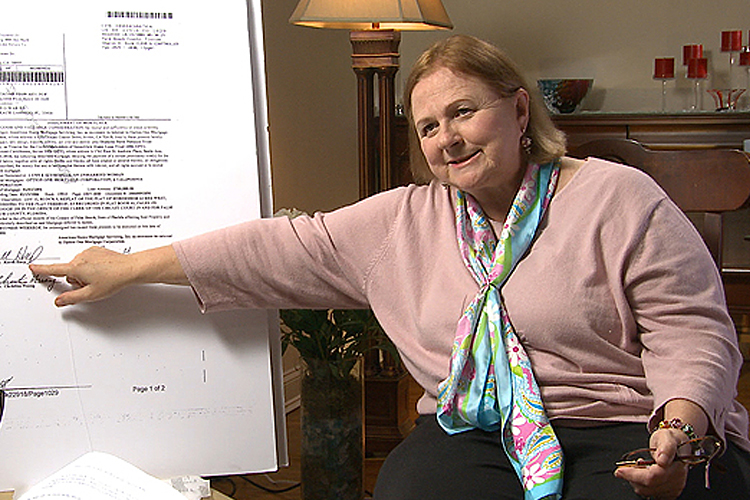
Your mortgage documents are fake!Lynn Szymoniak (Credit: CBS News/60 MInutes)
If you know about foreclosure fraud, the mass fabrication of mortgage documents in state courts by banks attempting to foreclose on homeowners, you may have one nagging question: Why did banks have to resort to this illegal scheme? Was it just cheaper to mock up the documents than to provide the real ones? Did banks figure they simply had enough power over regulators, politicians and the courts to get away with it? (They were probably right about that one.)
A newly unsealed lawsuit, which banks settled in 2012 for $95 million, actually offers a different reason, providing a key answer to one of the persistent riddles of the financial crisis and its aftermath. The lawsuit states that banks resorted to fake documents because they could not legally establish true ownership of the loans when trying to foreclose.
This reality, which banks did not contest but instead settled out of court, means that tens of millions of mortgages in America still lack a legitimate chain of ownership, with implications far into the future. And if Congress, supported by the Obama administration, goes back to the same housing finance system, with the same corrupt private entities who broke the nation’s private property system back in business packaging mortgages, then shame on all of us.
The 2011 lawsuit was filed in U.S. District Court in both North and South Carolina, by a white-collar fraud specialist named Lynn Szymoniak, on behalf of the federal government, 17 states and three cities. Twenty-eight banks, mortgage servicers and document processing companies are named in the lawsuit, including mega-banks like JPMorgan Chase, Wells Fargo, Citi and Bank of America.
Szymoniak, who fell into foreclosure herself in 2009, researched her own mortgage documents and found massive fraud (for example, one document claimed that Deutsche Bank, listed as the owner of her mortgage, acquired ownership in October 2008, four months after they first filed for foreclosure). She eventually examined tens of thousands of documents, enough to piece together the entire scheme.
A mortgage has two parts: the promissory note (the IOU from the borrower to the lender) and the mortgage, which creates the lien on the home in case of default. During the housing bubble, banks bought loans from originators, and then (in a process known as securitization) enacted a series of transactions that would eventually pool thousands of mortgages into bonds, sold all over the world to public pension funds, state and municipal governments and other investors. A trustee would pool the loans and sell the securities to investors, and the investors would get an annual percentage yield on their money.

advertisement

In order for the securitization to work, banks purchasing the mortgages had to physically convey the promissory note and the mortgage into the trust. The note had to be endorsed (the way an individual would endorse a check), and handed over to a document custodian for the trust, with a “mortgage assignment” confirming the transfer of ownership. And this had to be done before a 90-day cutoff date, with no grace period beyond that.
Georgetown Law professor Adam Levitin spelled this out in testimony before Congress in 2010: “If mortgages were not properly transferred in the securitization process, then mortgage-backed securities would in fact not be backed by any mortgages whatsoever.”
The lawsuit alleges that these notes, as well as the mortgage assignments, were “never delivered to the mortgage-backed securities trusts,” and that the trustees lied to the SEC and investors about this. As a result, the trusts could not establish ownership of the loan when they went to foreclose, forcing the production of a stream of false documents, signed by “robo-signers,” employees using a bevy of corporate titles for companies that never employed them, to sign documents about which they had little or no knowledge.
Many documents were forged (the suit provides evidence of the signature of one robo-signer, Linda Green, written eight different ways), some were signed by “officers” of companies that went bankrupt years earlier, and dozens of assignments listed as the owner of the loan “Bogus Assignee for Intervening Assignments,” clearly a template that was never changed. One defendant in the case, Lender Processing Services, created masses of false documents on behalf of the banks, often using fake corporate officer titles and forged signatures. This was all done to establish standing to foreclose in courts, which the banks otherwise could not.
Szymoniak stated in her lawsuit that, “Defendants used fraudulent mortgage assignments to conceal that over 1400 MBS trusts, each with mortgages valued at over $1 billion, are missing critical documents,” meaning that at least $1.4 trillion in mortgage-backed securities are, in fact, non-mortgage-backed securities. Because of the strict laws governing of these kinds of securitizations, there’s no way to make the assignments after the fact. Activists have a name for this: “securitization FAIL.”
One smoking gun piece of evidence in the lawsuit concerns a mortgage assignment dated Feb. 9, 2009, after the foreclosure of the mortgage in question was completed. According to the suit, “A typewritten note on the right hand side of the document states:  ‘This Assignment of Mortgage was inadvertently not recorded prior to the Final Judgment of Foreclosure… but is now being recorded to clear title.’”
This admission confirms that the mortgage assignment was not made before the closing date of the trust, invalidating ownership. The suit further argued that “the act of fabricating the assignments is evidence that the MBS Trust did not own the notes and/or the mortgage liens for some assets claimed to be in the pool.”
The federal government, states and cities joined the lawsuit under 25 counts of the federal False Claims Act and state-based versions of the law. All of them bought mortgage-backed securities from banks that never conveyed the mortgages or notes to the trusts. The plaintiffs argued that, considering that trustees and servicers had to spend lots of money forging and fabricating documents to establish ownership, they were materially harmed by the subsequent impaired value of the securities. Also, these investors (which includes the Treasury Department and the Federal Reserve) paid for the transfer of mortgages to the trusts, yet they were never actually transferred.
Finally, the lawsuit argues that the federal government was harmed by “payments made on mortgage guarantees to Defendants lacking valid notes and assignments of mortgages who were not entitled to demand or receive said payments.”
Despite Szymoniak seeking a trial by jury, the government intervened in the case, and settled part of it at the beginning of 2012, extracting $95 million from the five biggest banks in the suit (Wells Fargo, Bank of America, JPMorgan Chase, Citi and GMAC/Ally Bank). Szymoniak herself was awarded $18 million. But the underlying evidence was never revealed until the case was unsealed last Thursday.
Now that it’s unsealed, Szymoniak, as the named plaintiff, can go forward and prove the case. Along with her legal team (which includes the law firm of Grant & Eisenhoffer, which has recovered more money under the False Claims Act than any firm in the country), Szymoniak can pursue discovery and go to trial against the rest of the named defendants, including HSBC, the Bank of New York Mellon, Deutsche Bank and US Bank.
The expenses of the case, previously borne by the government, now are borne by Szymoniak and her team, but the percentages of recovery funds are also higher. “I’m really glad I was part of collecting this money for the government, and I’m looking forward to going through discovery and collecting the rest of it,” Szymoniak told Salon.
It’s good that the case remains active, because the $95 million settlement was a pittance compared to the enormity of the crime. By the end of 2009, private mortgage-backed securities trusts held one-third of all residential mortgages in the U.S. That means that tens of millions of home mortgages worth trillions of dollars have no legitimate underlying owner that can establish the right to foreclose. This hasn’t stopped banks from foreclosing anyway with false documents, and they are often successful, a testament to the breakdown of law in the judicial system. But to this day, the resulting chaos in disentangling ownership harms homeowners trying to sell these properties, as well as those trying to purchase them. And it renders some properties impossible to sell.
To this day, banks foreclose on borrowers using fraudulent mortgage assignments, a legacy of failing to prosecute this conduct and instead letting banks pay a fine to settle it. This disappoints Szymoniak, who told Salon the owner of these loans is now essentially “whoever lies the most convincingly and whoever gets the benefit of doubt from the judge.” Szymoniak used her share of the settlement to start the Housing Justice Foundation, a non-profit that attempts to raise awareness of the continuing corruption of the nation’s courts and land title system.
Most of official Washington, including President Obama, wants to wind down mortgage giants Fannie Mae and Freddie Mac, and return to a system where private lenders create securitization trusts, packaging pools of loans and selling them to investors. Government would provide a limited guarantee to investors against catastrophic losses, but the private banks would make the securities, to generate more capital for home loans and expand homeownership.
That’s despite the evidence we now have that, the last time banks tried this, they ignored the law, failed to convey the mortgages and notes to the trusts, and ripped off investors trying to cover their tracks, to say nothing of how they violated the due process rights of homeowners and stole their homes with fake documents.
The very same banks that created this criminal enterprise and legal quagmire would be in control again. Why should we view this in any way as a sound public policy, instead of a ticking time bomb that could once again throw the private property system, a bulwark of capitalism and indeed civilization itself, into utter disarray? As Lynn Szymoniak puts it, “The President’s calling for private equity to return. Why would we return to this?”
Update: This story previously suggested that banks settled this lawsuit with the federal government for $1 billion. That number is actually the total for a number of whistle-blower lawsuits that were folded into a larger National Mortgage Settlement. This specific lawsuit settled for $95 million. The post above has been changed to reflect this fact.