If
you know about foreclosure fraud, the mass fabrication of mortgage
documents in state courts by banks attempting to foreclose on
homeowners, you may have one nagging question: Why did banks have to
resort to this illegal scheme? Was it just cheaper to mock up the
documents than to provide the real ones? Did banks figure they simply
had enough power over regulators, politicians and the courts to get away
with it? (They were probably right about that one.)
A newly
unsealed lawsuit, which banks settled in 2012 for $95 million, actually
offers a different reason, providing a key answer to one of the
persistent riddles of the financial crisis and its aftermath. The
lawsuit states that banks resorted to fake documents because they could
not legally establish true ownership of the loans when trying to
foreclose.
This reality, which banks did not contest but instead settled out of court, means that tens of millions of mortgages in America
still
lack a legitimate chain of ownership, with implications far into the
future. And if Congress, supported by the Obama administration, goes
back to the same housing finance system, with the same corrupt private
entities who broke the nation’s private property system back in business
packaging mortgages, then shame on all of us.
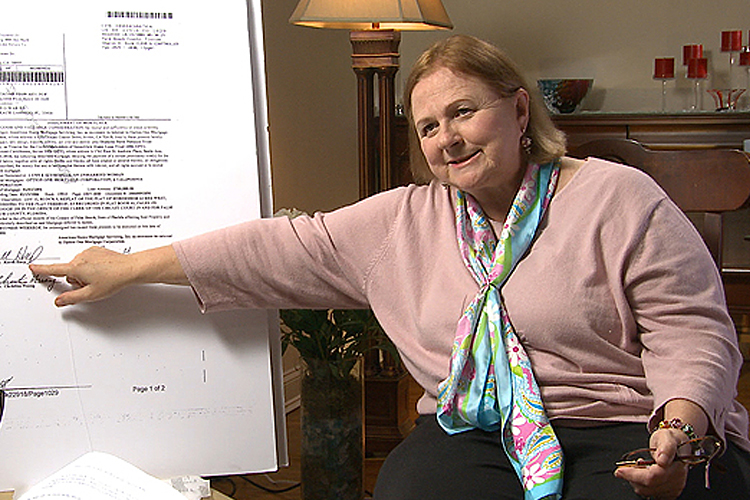
The 2011 lawsuit
was filed in U.S. District Court in both North and South Carolina, by a
white-collar fraud specialist named Lynn Szymoniak, on behalf of the
federal government, 17 states and three cities. Twenty-eight banks,
mortgage servicers and document processing companies are named in the
lawsuit, including mega-banks like JPMorgan Chase, Wells Fargo, Citi and
Bank of America.
Szymoniak, who fell into foreclosure herself in
2009, researched her own mortgage documents and found massive fraud (for
example, one document claimed that Deutsche Bank, listed as the owner
of her mortgage, acquired ownership in October 2008, four months
after
they first filed for foreclosure). She eventually examined tens of
thousands of documents, enough to piece together the entire scheme.
A
mortgage has two parts: the promissory note (the IOU from the borrower
to the lender) and the mortgage, which creates the lien on the home in
case of default. During the housing bubble, banks bought loans from
originators, and then (in a process known as securitization) enacted a
series of transactions that would eventually pool thousands of mortgages
into bonds, sold all over the world to public pension funds, state and
municipal governments and other investors. A trustee would pool the
loans and sell the securities to investors, and the investors would get
an annual percentage yield on their money.
advertisement
In
order for the securitization to work, banks purchasing the mortgages
had to physically convey the promissory note and the mortgage into the
trust. The note had to be endorsed (the way an individual would endorse a
check), and handed over to a document custodian for the trust, with a
“mortgage assignment” confirming the transfer of ownership. And this had
to be done before a 90-day cutoff date, with no grace period beyond
that.
Georgetown Law professor Adam Levitin spelled this out in
testimony before Congress in 2010: “If mortgages were not properly
transferred in the securitization process, then mortgage-backed
securities would in fact not be backed by any mortgages whatsoever.”
The
lawsuit alleges that these notes, as well as the mortgage assignments,
were “never delivered to the mortgage-backed securities trusts,” and
that the trustees lied to the SEC and investors about this. As a result,
the trusts could not establish ownership of the loan when they went to
foreclose, forcing the production of a stream of false documents, signed
by “robo-signers,” employees using a bevy of corporate titles for
companies that never employed them, to sign documents about which they
had little or no knowledge.
Many documents were forged (the suit
provides evidence of the signature of one robo-signer, Linda Green,
written eight different ways), some were signed by “officers” of
companies that went bankrupt years earlier, and dozens of assignments
listed as the owner of the loan “Bogus Assignee for Intervening
Assignments,” clearly a template that was never changed. One defendant
in the case, Lender Processing Services, created masses of false
documents on behalf of the banks, often using fake corporate officer
titles and forged signatures. This was all done to establish standing to
foreclose in courts, which the banks otherwise could not.
Szymoniak
stated in her lawsuit that, “Defendants used fraudulent mortgage
assignments to conceal that over 1400 MBS trusts, each with mortgages
valued at over $1 billion, are missing critical documents,” meaning that
at least $1.4 trillion in mortgage-backed securities are, in fact,
non-mortgage-backed securities. Because of the strict laws governing of
these kinds of securitizations, there’s no way to make the assignments
after the fact. Activists have a name for this: “securitization FAIL.”
One
smoking gun piece of evidence in the lawsuit concerns a mortgage
assignment dated Feb. 9, 2009, after the foreclosure of the mortgage in
question was completed. According to the suit, “A typewritten note on
the right hand side of the document states: ‘This Assignment of
Mortgage was inadvertently not recorded prior to the Final Judgment of
Foreclosure… but is now being recorded to clear title.’”
This
admission confirms that the mortgage assignment was not made before the
closing date of the trust, invalidating ownership. The suit further
argued that “the act of fabricating the assignments is evidence that the
MBS Trust did not own the notes and/or the mortgage liens for some
assets claimed to be in the pool.”
The federal government, states
and cities joined the lawsuit under 25 counts of the federal False
Claims Act and state-based versions of the law. All of them bought
mortgage-backed securities from banks that never conveyed the mortgages
or notes to the trusts. The plaintiffs argued that, considering that
trustees and servicers had to spend lots of money forging and
fabricating documents to establish ownership, they were materially
harmed by the subsequent impaired value of the securities. Also, these
investors (which includes the Treasury Department and the Federal
Reserve) paid for the transfer of mortgages to the trusts, yet they were
never actually transferred.
Finally, the lawsuit argues that the
federal government was harmed by “payments made on mortgage guarantees
to Defendants lacking valid notes and assignments of mortgages who were
not entitled to demand or receive said payments.”
Despite
Szymoniak seeking a trial by jury, the government intervened in the
case, and settled part of it at the beginning of 2012, extracting $95
million from the five biggest banks in the suit (Wells Fargo, Bank of
America, JPMorgan Chase, Citi and GMAC/Ally Bank). Szymoniak herself was
awarded $18 million. But the underlying evidence was never revealed
until the case was unsealed last Thursday.
Now that it’s unsealed,
Szymoniak, as the named plaintiff, can go forward and prove the case.
Along with her legal team (which includes the law firm of Grant &
Eisenhoffer, which has recovered more money under the False Claims Act
than any firm in the country), Szymoniak can pursue discovery and go to
trial against the rest of the named defendants, including HSBC, the Bank
of New York Mellon, Deutsche Bank and US Bank.
The expenses of
the case, previously borne by the government, now are borne by Szymoniak
and her team, but the percentages of recovery funds are also higher.
“I’m really glad I was part of collecting this money for the government,
and I’m looking forward to going through discovery and collecting the
rest of it,” Szymoniak told Salon.
It’s good that the case remains
active, because the $95 million settlement was a pittance compared to
the enormity of the crime. By the end of 2009, private mortgage-backed
securities trusts held one-third of all residential mortgages in the
U.S. That means that tens of millions of home mortgages worth trillions
of dollars have no legitimate underlying owner that can establish the
right to foreclose. This hasn’t stopped banks from foreclosing anyway
with false documents, and they are often successful, a testament to the
breakdown of law in the judicial system. But to this day, the resulting
chaos in disentangling ownership harms homeowners trying to sell these
properties, as well as those trying to purchase them. And it renders
some properties impossible to sell.
To this day, banks foreclose
on borrowers using fraudulent mortgage assignments, a legacy of failing
to prosecute this conduct and instead letting banks pay a fine to settle
it. This disappoints Szymoniak, who told Salon the owner of these loans
is now essentially “whoever lies the most convincingly and whoever gets
the benefit of doubt from the judge.” Szymoniak used her share of the
settlement to start the Housing Justice Foundation, a non-profit that
attempts to raise awareness of the continuing corruption of the nation’s
courts and land title system.
Most of official Washington,
including President Obama, wants to wind down mortgage giants Fannie Mae
and Freddie Mac, and return to a system where private lenders create
securitization trusts, packaging pools of loans and selling them to
investors. Government would provide a limited guarantee to investors
against catastrophic losses, but the private banks would make the
securities, to generate more capital for home loans and expand
homeownership.
That’s despite the evidence we now have that, the
last time banks tried this, they ignored the law, failed to convey the
mortgages and notes to the trusts, and ripped off investors trying to
cover their tracks, to say nothing of how they violated the due process
rights of homeowners and stole their homes with fake documents.
The
very same banks that created this criminal enterprise and legal
quagmire would be in control again. Why should we view this in any way
as a sound public policy, instead of a ticking time bomb that could once
again throw the private property system, a bulwark of capitalism and
indeed civilization itself, into utter disarray? As Lynn Szymoniak puts
it, “The President’s calling for private equity to return. Why would we
return to this?”
Update: This story previously
suggested that banks settled this lawsuit with the federal government
for $1 billion. That number is actually the total for a number of
whistle-blower lawsuits that were folded into a larger National Mortgage
Settlement. This specific lawsuit settled for $95 million. The post
above has been changed to reflect this fact.
 Lynn Szymoniak (Credit: CBS News/60 MInutes)