Showing posts with label mortgage fraud. Show all posts

Thursday, August 15, 2013

Your mortgage documents are fake!

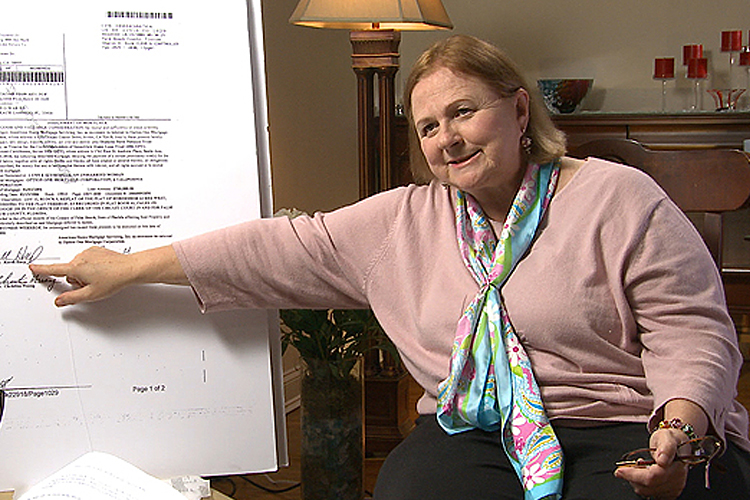
Your mortgage documents are fake!Lynn Szymoniak (Credit: CBS News/60 MInutes)
If you know about foreclosure fraud, the mass fabrication of mortgage documents in state courts by banks attempting to foreclose on homeowners, you may have one nagging question: Why did banks have to resort to this illegal scheme? Was it just cheaper to mock up the documents than to provide the real ones? Did banks figure they simply had enough power over regulators, politicians and the courts to get away with it? (They were probably right about that one.)
A newly unsealed lawsuit, which banks settled in 2012 for $95 million, actually offers a different reason, providing a key answer to one of the persistent riddles of the financial crisis and its aftermath. The lawsuit states that banks resorted to fake documents because they could not legally establish true ownership of the loans when trying to foreclose.
This reality, which banks did not contest but instead settled out of court, means that tens of millions of mortgages in America still lack a legitimate chain of ownership, with implications far into the future. And if Congress, supported by the Obama administration, goes back to the same housing finance system, with the same corrupt private entities who broke the nation’s private property system back in business packaging mortgages, then shame on all of us.
The 2011 lawsuit was filed in U.S. District Court in both North and South Carolina, by a white-collar fraud specialist named Lynn Szymoniak, on behalf of the federal government, 17 states and three cities. Twenty-eight banks, mortgage servicers and document processing companies are named in the lawsuit, including mega-banks like JPMorgan Chase, Wells Fargo, Citi and Bank of America.
Szymoniak, who fell into foreclosure herself in 2009, researched her own mortgage documents and found massive fraud (for example, one document claimed that Deutsche Bank, listed as the owner of her mortgage, acquired ownership in October 2008, four months after they first filed for foreclosure). She eventually examined tens of thousands of documents, enough to piece together the entire scheme.
A mortgage has two parts: the promissory note (the IOU from the borrower to the lender) and the mortgage, which creates the lien on the home in case of default. During the housing bubble, banks bought loans from originators, and then (in a process known as securitization) enacted a series of transactions that would eventually pool thousands of mortgages into bonds, sold all over the world to public pension funds, state and municipal governments and other investors. A trustee would pool the loans and sell the securities to investors, and the investors would get an annual percentage yield on their money.

advertisement

In order for the securitization to work, banks purchasing the mortgages had to physically convey the promissory note and the mortgage into the trust. The note had to be endorsed (the way an individual would endorse a check), and handed over to a document custodian for the trust, with a “mortgage assignment” confirming the transfer of ownership. And this had to be done before a 90-day cutoff date, with no grace period beyond that.
Georgetown Law professor Adam Levitin spelled this out in testimony before Congress in 2010: “If mortgages were not properly transferred in the securitization process, then mortgage-backed securities would in fact not be backed by any mortgages whatsoever.”
The lawsuit alleges that these notes, as well as the mortgage assignments, were “never delivered to the mortgage-backed securities trusts,” and that the trustees lied to the SEC and investors about this. As a result, the trusts could not establish ownership of the loan when they went to foreclose, forcing the production of a stream of false documents, signed by “robo-signers,” employees using a bevy of corporate titles for companies that never employed them, to sign documents about which they had little or no knowledge.
Many documents were forged (the suit provides evidence of the signature of one robo-signer, Linda Green, written eight different ways), some were signed by “officers” of companies that went bankrupt years earlier, and dozens of assignments listed as the owner of the loan “Bogus Assignee for Intervening Assignments,” clearly a template that was never changed. One defendant in the case, Lender Processing Services, created masses of false documents on behalf of the banks, often using fake corporate officer titles and forged signatures. This was all done to establish standing to foreclose in courts, which the banks otherwise could not.
Szymoniak stated in her lawsuit that, “Defendants used fraudulent mortgage assignments to conceal that over 1400 MBS trusts, each with mortgages valued at over $1 billion, are missing critical documents,” meaning that at least $1.4 trillion in mortgage-backed securities are, in fact, non-mortgage-backed securities. Because of the strict laws governing of these kinds of securitizations, there’s no way to make the assignments after the fact. Activists have a name for this: “securitization FAIL.”
One smoking gun piece of evidence in the lawsuit concerns a mortgage assignment dated Feb. 9, 2009, after the foreclosure of the mortgage in question was completed. According to the suit, “A typewritten note on the right hand side of the document states:  ‘This Assignment of Mortgage was inadvertently not recorded prior to the Final Judgment of Foreclosure… but is now being recorded to clear title.’”
This admission confirms that the mortgage assignment was not made before the closing date of the trust, invalidating ownership. The suit further argued that “the act of fabricating the assignments is evidence that the MBS Trust did not own the notes and/or the mortgage liens for some assets claimed to be in the pool.”
The federal government, states and cities joined the lawsuit under 25 counts of the federal False Claims Act and state-based versions of the law. All of them bought mortgage-backed securities from banks that never conveyed the mortgages or notes to the trusts. The plaintiffs argued that, considering that trustees and servicers had to spend lots of money forging and fabricating documents to establish ownership, they were materially harmed by the subsequent impaired value of the securities. Also, these investors (which includes the Treasury Department and the Federal Reserve) paid for the transfer of mortgages to the trusts, yet they were never actually transferred.
Finally, the lawsuit argues that the federal government was harmed by “payments made on mortgage guarantees to Defendants lacking valid notes and assignments of mortgages who were not entitled to demand or receive said payments.”
Despite Szymoniak seeking a trial by jury, the government intervened in the case, and settled part of it at the beginning of 2012, extracting $95 million from the five biggest banks in the suit (Wells Fargo, Bank of America, JPMorgan Chase, Citi and GMAC/Ally Bank). Szymoniak herself was awarded $18 million. But the underlying evidence was never revealed until the case was unsealed last Thursday.
Now that it’s unsealed, Szymoniak, as the named plaintiff, can go forward and prove the case. Along with her legal team (which includes the law firm of Grant & Eisenhoffer, which has recovered more money under the False Claims Act than any firm in the country), Szymoniak can pursue discovery and go to trial against the rest of the named defendants, including HSBC, the Bank of New York Mellon, Deutsche Bank and US Bank.
The expenses of the case, previously borne by the government, now are borne by Szymoniak and her team, but the percentages of recovery funds are also higher. “I’m really glad I was part of collecting this money for the government, and I’m looking forward to going through discovery and collecting the rest of it,” Szymoniak told Salon.
It’s good that the case remains active, because the $95 million settlement was a pittance compared to the enormity of the crime. By the end of 2009, private mortgage-backed securities trusts held one-third of all residential mortgages in the U.S. That means that tens of millions of home mortgages worth trillions of dollars have no legitimate underlying owner that can establish the right to foreclose. This hasn’t stopped banks from foreclosing anyway with false documents, and they are often successful, a testament to the breakdown of law in the judicial system. But to this day, the resulting chaos in disentangling ownership harms homeowners trying to sell these properties, as well as those trying to purchase them. And it renders some properties impossible to sell.
To this day, banks foreclose on borrowers using fraudulent mortgage assignments, a legacy of failing to prosecute this conduct and instead letting banks pay a fine to settle it. This disappoints Szymoniak, who told Salon the owner of these loans is now essentially “whoever lies the most convincingly and whoever gets the benefit of doubt from the judge.” Szymoniak used her share of the settlement to start the Housing Justice Foundation, a non-profit that attempts to raise awareness of the continuing corruption of the nation’s courts and land title system.
Most of official Washington, including President Obama, wants to wind down mortgage giants Fannie Mae and Freddie Mac, and return to a system where private lenders create securitization trusts, packaging pools of loans and selling them to investors. Government would provide a limited guarantee to investors against catastrophic losses, but the private banks would make the securities, to generate more capital for home loans and expand homeownership.
That’s despite the evidence we now have that, the last time banks tried this, they ignored the law, failed to convey the mortgages and notes to the trusts, and ripped off investors trying to cover their tracks, to say nothing of how they violated the due process rights of homeowners and stole their homes with fake documents.
The very same banks that created this criminal enterprise and legal quagmire would be in control again. Why should we view this in any way as a sound public policy, instead of a ticking time bomb that could once again throw the private property system, a bulwark of capitalism and indeed civilization itself, into utter disarray? As Lynn Szymoniak puts it, “The President’s calling for private equity to return. Why would we return to this?”
Update: This story previously suggested that banks settled this lawsuit with the federal government for $1 billion. That number is actually the total for a number of whistle-blower lawsuits that were folded into a larger National Mortgage Settlement. This specific lawsuit settled for $95 million. The post above has been changed to reflect this fact.

Wednesday, August 7, 2013

Mortgage fraud set to surge in 2013 in the UK, what about United States?

Attempted mortgage fraud is expected to increase dramatically in the UK next year, bringing the number of people fraudulently trying to obtain home loans to the highest level since records began.
Over the last few years we have just witnessed an unprecedented “meltdown” of our industry, where many “systems” broke down that were designed to keep companies and our industry healthy. One of those systems that broke down was the quality control system in many mortgage companies.
Fraud often starts small. A fudged figure here, an incomplete loan application there, an over-generous appraisal, but little do employees know that these “little lies” are actually fraudulent information and, in fact, possibly criminal.
Are lenders performing the level of quality control and pre-funding audits needed, if done right and done often, they can prevent the reason for the mortgage investigation in the first place.
A new era started in 2012, for the first time, the Financial Crimes Enforcement Network (FinCEN) require nonbank mortgage lenders and originators to implement an Anti-Money Laundering program (AML Program) and file Suspicious Activity Reports (SARs) for certain loan transactions.
Residential mortgage lenders and originators, the RMLOs, are considered to be the primary providers of mortgage finance, and have a unique position with respect to direct contact with the consumer. Thus, they are presumably able to assess and identify money laundering risks and fraud.
As part of the AML program, non-bank residential mortgage lenders must also implement programs to report potential money laundering, fraud, and other criminal activity to the government in the form of a SAR (suspicious activity report). The penalties for non-compliance are severe, ranging from cease-and-desist orders, civil money penalties, stiff fines and other criminal penalties.
Residential mortgage lenders and originators, the RMLOs, are required to establish an AML Program that includes, at a minimum:
1. Development of internal policies, procedures, and controls.
2. Designation of a compliance officer.
3. Ongoing employee training program.
4. Independent audit function to test for compliance.
The AML Program, also includes a form that must be filed with FinCEN and is called the Suspicious Activity Report, known as a SAR. Completing the SAR correctly is essential to compliance with the FinCEN’s rule, the SAR form’s preparation and filing, it can be conducted by the RMLO’s employees, although requires independent auditors to determine and report on the enforcement of the AML Program and the accuracy, completeness, and timeliness of the SAR filings.
Remember:
-It is too late to prevent fraud after closing: The damage is already done and you can’t go back and implement them after the fact;
-The civil and criminal penalties… for non-compliance of not reporting fraud could come back to haunt you if you don’t take proper steps to prevent, report and stop fraud;
-The internal cost of a fraudulent mortgage: this is an area that most lenders have trouble calculating but consider that the rehiring cost, reputation cost, lost loans from HUD cost, etc., are much more devastating than insignificant costs of reproducing materials for audits and reviews;
-The external cost of a fraudulent mortgage… is directly related to the actual money lost associated with a fraudulent loan, such as repurchase, foreclosure, etc.
The following mortgage and real estate fraud investigations, including money laundering charges which are written from public record documents on file in the court records in the judicial district in which the cases were prosecuted in 2012.
Former Attorney Sentenced for Mortgage Fraud
On December 20, 2012, in Boston, Mass., Marc D. Foley, a former attorney who operated a real estate practice in Needham, was sentenced to 72 months in prison and three years of supervised release. In September 2012, Foley was convicted by a jury of 33 counts of wire fraud and five counts of money laundering.
According to evidence presented at trial, in December 2006 and January 2007, Foley participated in a scheme to defraud six mortgage lenders in connection with $4.9 million in real estate loans for the purchases of 24 condominium units in Dorchester.
When Foley and an associate, acting under his direction, closed the loans, documents sent to the mortgage lenders falsely represented that funds ranging from $9,300 to $39,000 had been collected at the closings from the borrowers, when in fact the borrowers made no down payments and paid no funds at the closings. Furthermore,
Foley entered into an undisclosed agreement with the seller to subtract from the seller’s proceeds all the funds that were reported to the lenders as coming from the borrowers. Foley also used various other means to conceal from the lenders that the borrowers had not provided funds for the purchases.
Kansas Man Sentenced for Mortgage Fraud
On December 17, 2012, in Kansas City, Kan., Brian D. Jaimes, of Overland, Kan., was sentenced to 24 months in prison for mortgage fraud. Jaimes pleaded guilty to one count of conspiracy to commit wire fraud and money laundering.
According to his plea agreement, Jaimes conspired with co-defendant Paul Hartfield to fraudulently obtain more than $1 million worth of mortgage loans. Hartfield owned Hart Investments, Inc., a company that purchased depressed properties in order to rehabilitate them and sell them at a profit.
Hartfield also owned Diamond Mortgage, a company that acted as a mortgage broker for individuals. Jaimes was president of Diamond Mortgage from 2003 to 2006. According to court documents, Hartfield recruited friends and family to purchase some properties. In most cases, the borrowers would not have qualified for a loan to purchase the properties.
Hartfield used Diamond Mortgage as the mortgage broker with Brian Jaimes falsifying loan applications and other supporting documents by inflating the borrower’s income and assets to secure loan approval. Jaimes was the loan officer on 11 fraudulently obtained mortgages for properties. The loans totaled more than $1 million.
Florida Defendants Sentenced in Multi-Million Mortgage Fraud Scheme
On December 7, 2012, in Miami, Fla., Lilia Casal-Diaz, the sixth defendant in a multi-million dollar mortgage fraud scheme, was sentenced to 12 months and one day in prison, one year of home confinement and three years of supervised release.
Casal-Diaz, a real estate attorney, also was ordered to pay $509,543 in restitution to the IRS. According to court documents, the defendant engaged in a multi-million dollar mortgage fraud scheme using straw buyers to purchase residential properties at an apartment complex in Miami.
The scheme resulted in more than $5.6 million in mortgage proceeds that were fraudulently obtained from various lending institutions, as well as tax-related offenses involving willful failure to declare to the IRS proceeds from such transactions. The other defendants sentenced in connection with this scheme include:
• Andres Mendez, Sr., aka Andy Mendez, Sr. - 60 months in prison, five years of supervised release and ordered to pay $4,232,542 in restitution,
• Andy Mendez, Jr. - 12 months and one day in prison,18 months home confinement, five years of supervised release and ordered to pay $4,232,542 in restitution,
• Josephine Santana - 21 months in prison, five years of supervised release and ordered to pay $1,202,861 in restitution,
• Jose Rafael Martinez - 18 months in prison, five years of supervised release and ordered to pay $1,202,861 in restitution,
• Basilio Gomez - 15 months in prison, five years of supervised release and ordered to pay $1,202,861 in restitution.
Ohio Woman Sentenced for Mortgage Fraud
On November 29, 2012, in Cleveland, Ohio, Antoinette Payne was sentenced to 27 months in prison and ordered to pay more than $1.3 million in restitution. Payne pleaded guilty to one count each of conspiracy to commit wire fraud and conspiracy to commit money laundering.
According to court documents, Payne worked as a mortgage broker and loan officer for Supreme Funding, a mortgage broker in Euclid, Ohio. She was also the owner of TLC Properties and Designer Loan Properties, which were simply sham companies which she used to receive kickbacks and reimbursements for undisclosed down payment assistance she was providing to purchasers from the various loans’ closings she was handling.
These funds were in addition to the fees paid to Payne as a mortgage broker and loan officer in handling these transactions. Payne recruited purchasers for properties and promised to pay them money for filling out the paperwork for mortgage loans where the price of the properties had been greatly inflated. She also provided any down payments as necessary.
Payne also falsified the income and asset on the loan documents of the purchasers she recruited to ensure their approval. She provided phony lists of improvements to the lender to support the inflated price of the real estate. Once the purchasers stopped making payments on the mortgage loans, the properties went into default, resulting in a loss to lenders in the amount of approximately $1 million.
Former Mortgage Broker Sentenced Role in Mortgage Fraud Scheme
On November 26, 2012, in Phoenix, Ariz., Michele Marie Mitchell, was sentenced to 30 months in prison, three years of supervised release, and ordered to pay $110,490 in restitution. Mitchell pleaded guilty in April 2012 to conspiracy to commit wire fraud.
According to court records, Mitchell held herself out to be a mortgage broker, loan officer and real estate investor. Mitchell and an associate, Jeremy West Pratt, recruited people with good credit scores to act as straw buyers to purchase one or more properties as investments. Mitchell and Pratt enticed the straw buyers by offering to pay a kickback of up to $15,000 per property or to make the mortgage payments until the property could be resold for a profit, or both.
The defendants submitted false loan applications and supporting documents to induce lenders to fund loans. At the close of escrow they enriched themselves by directing a portion of the loan proceeds, or “cash back,” to a company which one of them controlled. Between October 2005 and February 2007, Mitchell obtained mortgage financing for 17 properties and induced lenders to fund approximately $17 million dollars in loans.
Pratt aided Mitchell’s efforts in eight of the 17 properties. The defendants failed to make the mortgage payments as promised and each of the 17 properties went into foreclosure. Pratt was sentenced on July 30, 2012 to six months in prison and three years of supervised release.
Texas Couple Sentenced on Wire Fraud and Money Laundering Charges
On November 26, 2012, in Houston, Texas, Derwin Frazier and his wife, Veronica, both of Pearland, Texas, were sentenced for their roles in the sham sales of condominiums.
Derwin pleaded guilty to money laundering and was sentenced to 85 months in prison and ordered to pay $16,316,102 in restitution. Veronica pleaded guilty to wire fraud and was sentenced to 12 months and one day in prison and ordered to pay $321,742 in restitution.
According to court documents, from December 2004 to October 2006, the Frazier’s defrauded residential lenders using straw borrowers. Co-conspirator, Brenda East, assisted these straw borrowers by providing false information and documents, including bogus tax letters and false verifications of bank balances and employment. The Frazier’s submitted invoices for payment from loan proceeds and used the money to pay themselves and the straw borrowers.
East pleaded guilty to conspiracy to commit wire fraud and was sentenced to 57 months in prison. A fifth defendant, Duane Wardell, of Palestine, also pleaded guilty to conspiracy to commit wire fraud and is awaiting sentencing.
New Jersey Woman Sentenced in Mortgage Loan Fraud Scheme
On November 9, 2012, in Trenton, N.J., Crystal Paling, of Sussex, N.J., was sentenced to 37 months in prison, three years of supervised release, and ordered to pay $532,497 in restitution. Paling was convicted by a jury in March 2012 on conspiracy to commit wire fraud and conspiracy to commit money laundering.
According to documents and trial evidence, Paling acted as the closing agent for fraudulent mortgage loans orchestrated by her co-conspirators, Daniel Verdia, of Mahwah, N.J., Jaye Miller, of Pocono Lake, Pa., and Sandra Mainardi, of Wayne, N.J. The co-conspirators put together buyers and sellers in real estate transactions that they could control, and then filed false and fraudulent loan applications containing inflated income figures for the borrowers.
Specifically, Paling wired loan proceeds due to the sellers from a trust account that she controlled to an account in the name of Capital Investment Strategies, a shell company owned by Verdia and Miller. She concealed illicit payments to Capital Investment Strategies by failing to disclose them on the settlement statements. She collected a portion of the disclosed closing fees that appeared on the settlement statements.
She also received undisclosed kickbacks paid from Capital Investment Strategies to her own shell company, XL Partnership. Verdia and Miller were sentenced to 30 months and six months in prison, respectively. Mainardi was sentenced to 46 months in prison. Two additional defendants were sentenced in this scheme: Donald Apolito, of Elmwood Park, N.J., received five years of probation and Robert Gorman, of Long Valley, N.J., received two years of probation.
Couple Sentenced for Orchestrating Million Dollar Mortgage Fraud Scheme
On November 8, 2012, in Minneapolis, Minn., James Warren Hoffman was sentenced to 78 months in prison and ordered to pay $344,409 in restitution. Teresa Gay Hoffman was sentenced to 12 months and one day in prison.
The Hoffman’s pleaded guilty on February 3, 2012 to one count of tax evasion. In addition, James Hoffman pleaded guilty to one count of engaging in a monetary transaction in criminally derived property.
According to court documents, the Hoffman’s recruited straw buyers to purchase real estate in both Minnesota and Wisconsin with the proceeds of fraudulent mortgage loans.
From August 2001 through 2008, the couple lived in a Hastings home without ever owning it.
James Hoffman arranged for a series of straw purchasers to buy the property entirely with the proceeds of fraudulent loans. From June 2001 through 2008, the couple used a Spicer Lake property as their vacation home without ever owning it by also arranging fraudulent mortgage loans for a series of straw buyers. Starting in June 2006, the couple, through three businesses, purchased apartment buildings in Rochester, Sauk Rapids, and Spicer.
They converted the apartments into condominiums and sold them to straw buyers, who paid for them with proceeds of fraudulent mortgage loans arranged by the defendants. In total, the estimated loss to mortgage lenders is approximately $5 million.
Arizona Man Sentenced for Role in Fraud Scheme
On November 7, 2012, in Phoenix, Ariz., Shannon Robert Kato was sentenced to 24 months in prison, three years of supervised release and ordered to pay $225,000 in restitution. Kato pleaded guilty on October 11, 2012 to conspiracy.
According to his plea agreement, from February 2006 through May 2007, Kato and others submitted mortgage loan applications and related documents to banks and lending institutions containing false information. They also induced those institutions to fund residential real estate purchases. In addition, they created a "straw man" double escrow transaction to obtain "cash back" from the financing for the benefit of the purchasers and concealed from the lending institutions the methods and means by which "cash back" flowed to the ultimate purchasers instead of the "straw" buyer/seller.
To accomplish this, Kato and others submitted simultaneous loan applications for multiple real estate purchases without fully disclosing other pending applications, provided false information on the loan applications to obtain mortgage loans, inflated the sales price, and directed portions of the lending proceeds to some of the defendants through the use of entities.
At least 15 homes were purchased through this process and $2.5 million in "cash back" was obtained. Kato's role was to act as the "straw buyer" using his own name, his company's name, or a fictitious family trust, so that it would appear that he had purchased the property from the seller. Kato then turned around and sold it at a higher price to one of the other defendants. The lending institutions would fund at the higher price and the profit would be diverted to a controlled entity of one of the other defendants.
Florida Man Sentenced for Participating in Mortgage Fraud Scheme
On October 17, 2012, in Miami, Fla., Juan Carlos Rodriguez, a real estate agent and mortgage broker from Weston, Florida, was sentenced to 42 months in prison and three years of supervised release. On May 11, 2012,
Rodriguez pleaded guilty to conspiracy to commit mail fraud, wire fraud, financial institution fraud, and
conspiracy to commit money laundering. According to court documents, Rodriguez and others used “straw buyers” to submit false documentation to various mortgage lenders substantially inflating the purchase price of the properties.
The fraudulent loan proceeds were laundered through multiple accounts to conceal the source and distribution of the money and were ultimately used for the benefit of the co-conspirators. Other individuals sentenced in mortgage fraud schemes include:
• David Lam was sentenced to 42 months in prison, two years of supervised release, and ordered to pay $7,117,000 in restitution.
• Pamela Higgins was sentenced to 36 months in prison, two years of supervised release, and ordered to pay $2,141,536 in restitution.
• Carl Alexander was sentenced to 48 months in prison, three years of supervised release, and ordered to pay $3,576,724 in restitution.
• Carol Asbury was sentenced to 30 months in prison, three years of supervised release, and ordered to pay $6,510,291 in restitution.
• Patrick Brinson was sentenced to 78 months in prison, three years of supervised release, and ordered to pay $1,602,250 in restitution.
One of the most difficult aspects of dealing with mortgage fraud is that it’s hard to know the scope of the problem. The human element that’s involved makes would-be fraudsters hard to spot, and those already committing fraud even harder to identify.
Because these people are white-collar criminals, they look, dress, act, and talk just like the rest of us. They won’t look like criminals; they’ll look like loan officers, real estate agents, members of management and loan processors or closers.
Management also share in some of these responsibilities for their employees, preferred partners, and borrowers, and need to set up pre-funding audit procedures to establish that they want to both protect the innocent and scrutinize a random percentage of the mortgage loans prior to the closing and funding to prevent fraud.
A quick buck here, a few grand there, and soon you and your company are committing fraud, the company in most cases are unknowingly participating. It’s blunt, but it’s true. Changing information yourself, or even letting someone knowingly change information; is fraud. If you’re doing it’ it’s fraud. If you’re letting someone do it; it’s fraud. If you even suspect someone’s doing it; it’s fraud.
You must resist.
You must identify.
You must prevent.
You must report.
IT’S JUST THAT SIMPLE…
By Michael S. Richardson
SEC Halts Ex-Marine’s Hedge Fund Fraud Targeting Fellow Military

SEC Halts Ex-Marine’s Hedge Fund Fraud Targeting Fellow Military

 
FOR IMMEDIATE RELEASE
2013-149
Washington D.C., Aug. 6, 2013 — The Securities and Exchange Commission today obtained an emergency court order to halt a hedge fund investment scheme by a former Marine living in the Chicago area who has been masquerading as a successful trader to defraud fellow veterans, current military, and other investors.
The SEC alleges that Clayton A. Cohn and his hedge fund management firm Market Action Advisors raised nearly $1.8 million from investors through a hedge fund he managed.  Cohn lied to investors about his success as a trader, the performance of the hedge fund, his use of investor proceeds, and his personal stake in the hedge fund.  Cohn only invested less than half of the money raised from investors and instead used more than $400,000 for such personal expenses as a Hollywood mansion, luxury automobile, and extravagant tabs at high-end nightclubs.  He used his lavish lifestyle to carefully contrive the image of a successful trader and investor, when in reality he lost nearly all of the money invested through the hedge fund.  In order to cover up his fraud and continue raising money from investors, Cohn generated phony hedge fund account statements showing annual returns exceeding 200 percent.
“Cohn lured fellow military and other investors into his hedge fund by portraying himself as a successful trader who generated massive returns for his investors,” said Timothy L. Warren, Acting Director of the Chicago Regional Office.  “But Cohn’s hedge fund investors didn’t have a chance to make a profit since he never invested most of their money and promptly lost the portion he did invest.”
According to the SEC’s complaint filed in federal court in Chicago, Cohn targets mostly unsophisticated investors and has solicited friends, family members, and fellow veterans to invest in his hedge fund.  Cohn controls a so-called charity called the Veterans Financial Education Network (VFEN) that purports to teach veterans how to understand and manage their money.  Cohn has touted his Marine Corps pedigree in VFEN press releases and encourages veterans to find “a money-manager who is both trustworthy and knows what he is doing.” VFEN’s website identifies Cohn as a money manager who “manages millions of dollars.”
According to the SEC’s complaint, Cohn managed his hedge fund Market Action Capital Management through his investment advisory firm Market Action Advisors, which is registered with the state of Illinois.  Cohn solicited investments by falsely claiming that he had major success as a personal trader and invested $1.5 million of his own money in the hedge fund.  He also misrepresented that an accounting firm would audit the hedge fund’s financial statements.
The SEC alleges that Cohn had a record of trading losses, invested no more than $4,000 of his own money, and absconded with far more money for his personal expenses.  The audit firm named by Cohn never agreed to audit the fund’s financial statements.  Cohn continued to deceive investors after their initial investment by issuing account statements that showed annual returns of more than 200 percent for 2012 when the hedge fund actually lost money. 
The SEC’s complaint charges Cohn and Market Action Advisors with violating the antifraud provisions of the federal securities laws.  The court granted the SEC’s request for emergency relief including a temporary restraining order and asset freeze.  The SEC further seeks permanent injunctions, disgorgement of ill-gotten gains, and financial penalties from Cohn and Market Action Advisors.
The SEC’s investigation was conducted by John J. Sikora, Jr. and Jason A. Howard, and the litigation will be led by Jonathan S. Polish.

Wednesday, July 17, 2013

Now this is BULLSHIT

First they lie and cheat and steal homes illegally and now , they want a free pass to do it all again? BULLSHIT! This needs to end, bankers need jail time, and maybe its time that ALL the people who were foreclosed on by these banks, get their homes free. Its time the people  start fighting back. No more free rides for bankers !!!!! JAIL THEM!This congress must be changed in 2014- or nothing will ever change.


New House Bill Wipes Mortgage Fraud Clean For Banksters

susanne_posel_news_ Foreclosure-Image-10.4.10Susanne Posel
Occupy Corporatism
July 17, 2013


The House Financial Services Committee (HFSC), headed by chair Jeb Hensarling, has approved proposed bill entitled, “Protecting American Taxpayers and Homeowners Act” (PATH) that is being sold to the American public as a way “to create a sustainable housing finance system.”
Hensarling explained : “Our plan helps taxpayers and homeowners. It gives power and control back to consumers. Under the current broken system, unaccountable Washington elites have more of a say over who gets a mortgage than your local bank. The current system is a government monopoly run by the same types of Washington bureaucrats who run the IRS. America can do better. Americans deserve better.”
Buried in PATH is the creation of the National Mortgage Data Repository (NMDR) which is the brainchild of the Federal Housing Finance Agency (FHFA) and the Consumer Financial Protection Bureau (CFPB).
The NMDR would be “the first comprehensive repository of detailed mortgage loan information. The database will primarily be used to support the agencies’ policymaking and research efforts and to help regulators better understand emerging mortgage and housing market trends.”
Richard Corday, director of the CFPB asserts that “in order to understand what is going on in the mortgage marketplace and develop appropriate consumer protections, we must have the best facts and data. This database will be a valuable tool for regulators and researchers and we look forward to partnering with FHFA on this important work.”
The NMDB would be utilized in conjunction with agencies to:
• Monitor the relative health of mortgage markets and consumers.
• Provide new insight on consumer decision making.
• Monitor new and emerging products in the mortgage market.
• View both first and second lien mortgages for a given borrower.
• Understand the impact of consumers’ debt burden.
The problem that justifies the NMDB is the Mortgage Electronic Registration Systems (MERS) that is a database that was incorporated in 1995 and privately held.
MERS board of directors is filled with vested interest from technocrats such as:
• Freddie Mac
• Wells Fargo
• Citigroup
• JP Morgan & Chase Co
• Fannie Mae
• Bank of America
Those financially invested in MERS include:
• Bank of America
• Citigroup
• HSBC
• Sun Trust
• Wells Fargo
• Fannie Mae
• Freddie Mac
Hensarling took a ski-trip last April and met with powerful members of the financial Elite who have also made campaign contributions to him through the SuperPAC Jobs, Economy and Budget (JEB) Fund just before PATH was announced by the HFSC.
The “weekend getaway” was attended by:
• A representative from the American Securitization Forum (ASF)
• Len Wolfson, lobbyist for the Mortgage Bankers Association (MBA)
• VISA
• And other members of the retail industry and finance corporations
Those who have contributed to the JEB Fund around the time of the ski-trip weekend are:
• Capital One
• Credit Suisse
• PricewaterhouseCoopers
• MasterCard
• UBS
• US Bank
• National Association of Federal Credit Unions
• Koch Industries
• Cash America International
• CheckSmart Financial
• Regions Financial
• JP Morgan & Chase Co
Considering the implications of PATH for the banksters, it may be that those technocrats who contributed to the JEB Fund would be the first to take advantage of the bill should it pass through to become a law.
Supporting PATH, the American Bankers Association (ABA) released a statement saying: “We commend Chairman Hensarling for this thoughtful measure to begin the essential work of reforming our nation’s housing finance system and protecting taxpayers, which includes reforming Fannie Mae and Freddie Mac and refocusing the Federal Housing Administration.”
The ABA went on to say: “We strongly support provisions of the Chairman’s bill that would delay implementation of pending mortgage rules, including Qualified Mortgage, and provide some important and needed changes to that rule. More time is needed to ensure that banks can comply with these complex new rules to avoid unintended effects on credit availability. Clarifications to the rules are also necessary, both those still to be proposed by regulators and others included in this legislation.”
The NMDR would wipe the slate clean with regard to the mortgage fraud that has become apparent with cases being filed in courts all across the nation. Homeowners and attorneys have realized that with the use of MERS, the banks have been able to robosign their way into mortgage debt that was foreclosable.
However, MERS has proven to be a bit of a thorn for the banksters when it comes to proving they hold title to the property they are in the process of seizing. In fact, it appears that the financial Elite did not consider the clogging of the courts and losing their right to foreclose on home based on the lack of evidence that they hold title of the property because of MERS.
Instead, the technocrats have devised a way to take the homes from ALL homeowners regardless of whether or not they have previously won during foreclosure litigation, are in the process of litigation and would file a complaint with the courts at a future date.
One of the outcomes of PATH would be the right of the technocrats to stop current legal standing of the homeowners in court with regard to foreclosure litigation.
Without this provision, the homeowner cannot sue to stop the foreclosure, nor can new complaints be filed with the courts.
But one of the biggest advantages of PATH would be for the technocrats to reopen foreclosure litigation that was ruled on in favor of the homeowner.
Just as with criminal law, the right of protection from being retried for a “crime” is protected under Jeopardy clause.
The civil version of the Jeopardy clause works much the same of the criminal counterpart. Jeopardy can terminate “in four instances: after acquittal; after dismissal; after a mistrial; and on appeal after conviction.”
What this means for PATH and the NMDR is that a homeowner who previously won a suit against the bank and kept their home, would now be under threat of having the case reopened under the new evidence argument.
The bank could simply open a new case in light of PATH that would empower them bring this law in as evidence (should the law be passed). This would also allow the banks to circumvent the Ex Post Facto clause .
By using PATH as the reason to bring old litigation to new light, this scheme would serve to give the banks a way to acquire those properties anyway.
It is a three-fold win for the technocrats thanks to Henserling and the HFSC.
• Future foreclosure litigation is halted because of lack of legal standing for the homeowner
• Current foreclosure litigation would be halted because of lack of legal standing for the homeowner
• Past litigation could be reopened and tried in court for the purpose of taking the property from the homeowner and possibly suing for damages and interests incurred by the original suit

Thursday, June 20, 2013

Remember Penny Mac is also know as Country Wide

Remember Penny Mac is also know as Countrywide, the same creeps and thieves, who took homes and bet against them and defrauded the country is at it still, except now their a private hedge fund, which makes them even more dangerous. Why would the SEC and the FDIC, and the US Government allow these thieves to keep going? Anybody got answers? If you ask the government, all you will get is a run around.. same with the SEC.


HUSTLE: A PLAN TO DESTROY HOMEOWNERS AND DEFRAUD INVESTORS: The U.S. Government in its complaint filed against Bank of America details the specific ways in which Countrywide was operating when loans were originated.
"Countrywide rolled out a new streamlined loan origination model is called the "hustle."
In order to increase the speed at which it originated and sold loans to the GSES,  countrywide eliminated every significant checkpoint on loan quality and compensated its employees solely based on the volume of loans originated, leading to rampant instances of fraud and other serious lung defects all while countrywide was informing the GSES that it had tightened its underwriting guidelines."
Countrywide eliminated underwriter review even from many high risk loans. In lieu of underwriter review, countrywide assigned critical underwriting tasks to loan processors who were previously considered unqualified even to answer borrower questions. At the same time, countrywide or eliminated previously mandatory checklists that provided instructions on how to perform these underwriting tasks. Under the Hustle, such instructions on proper underwriting were considered nothing more than unnecessary forms that would slow the swim lane down.
Countrywide also eliminated the position of compliance specialist, an individual previously responsible for conducting a final, independent check on alone to ensure that all conditions on the loans approval were satisfied prior to funding.
The Hustle began in full force in approximately August 2007.
Countrywide also concealed the quality control reports on Hustle loans demonstrating that instances of fraud and other material defects (i.e. defects making the loans in eligible for investors sell) were legion. Countrywide's own quality control reports identified material defect rate of nearly 40% in certain months, rates that were nearly 10 times the industry-standard defect rate of approximately 4%.

  The complaint above is from the United States Atty. for the Southern District of New York gives us a clear picture of the processing of loans without any underwriting standards at Countrywide and other aggregators across the country. The complaint is not authority, but it is a guide for what you can allege and what you can ask about in discovery.
It is time to ask the nuclear question, to wit: in light of the revelations that are already in the public domain with dozens of whistleblowers, is it not reasonable to assume that the aggregators not only knew about fabricated, forged and inaccurate loan applications, but actually intended that result. I ask that question because of the number of attempted prosecutions of people for mortgage fraud, when mortgage fraud was exactly what Countrywide wanted.  They clearly wanted the highest possible volume of loans approved under circumstances where it can only be assumed that they wanted those loans to fail, in order to be paid by insurers, counterparties on credit default swaps, the federal government in bailouts and now the Federal Reserve which appears to be  buying $85 billion in worthless mortgage bonds from the financial industry every month.
  Thus Wall Street collected money from the investors (and took a share of that and put it in their pocket), collected money from borrowers (and took a share of that and put it in their pocket), collected money from insurers which went only into their pockets, collected money from the proceeds of credit default swaps which went only into their pockets,  collected money from the government in the bank bailouts, collected money from the government sponsored entities who guarantee the loans, and are collecting money from the Federal Reserve who are buying worthless mortgage bonds which have little or no interest in any secured loan, residential or otherwise. On top of all of that Wall Street has taken the homes of more than 5 million families and is expected to take the homes of another 5 million families ---  supposedly to cover the "loss"  on mortgage bonds they never owned and mortgage loans they never owned.
And then you have the real question, to wit: why would banks create a scheme that originated loans, most of which were destined to fail in one fashion or another? And the answer is unavoidable and incontestable: they did it because that was the way they could make the most money.
And then the second real question, to wit: why would banks want foreclosures but not want the property?  And the related question is why would they want a foreclosure under circumstances where a modification would produce far greater proceeds to mitigate the loss on a loan that a foreclosure? And the related question to that is why would the largest bank in the world adopt a policy of fraud in order to guide people into foreclosure deceiving them into thinking that they were getting a modification? And the final question related to all of that is why with the modification not become permanent after the borrower has done everything correctly during the trial period?  The answer is extremely simple: the foreclosure process is the largest cover-up in history for the largest economic crime in history; it provides cover for all of the defects, multiple payments that were already received and never disclosed, and the diversion of money and property from investors and homeowners.


 So why are these investors trusting them again is my question.. they don't like money??