Showing posts with label to big to fail. Show all posts

Sunday, September 15, 2013

What you don't know may shock you


Five years ago today, Lehman Brothers went bankrupt.

Instantly and inevitably, the house of cards otherwise known as Wall Street collapsed.

But after getting bailed out by the American taxpayers, Wall Street is doing just fine.

The people of Main Street? Not so much.

Here are some numbers to think about this Sunday morning.

  • Amount the crash cost the U.S. economy: $22 trillion
  • How much everyone would get if that $22 trillion were divided equally among the U.S. populace: $69,478.88
  • Assets of the four biggest banks in America — JPMorgan Chase, Bank of America, Citigroup and Wachovia/Wells Fargo — when they were “too big to fail” in 2008: $6.4 trillion
  • Assets of those four banks today: $7.8 trillion
  • Of the 63 former Lehman Brothers employees identified by a bankruptcy examiner as being aware of an accounting scheme Lehman used to mask its true finances, number who are employed in senior financial services positions today: 47
  • Number of the 25 banks responsible for the bulk of risky subprime loans leading up to the crash that are back in the mortgage business: 25
  • Chances that an American voter thinks that regulating financial products and services is “important” or “very important”: 9 in 10
  • Chances that an American knows the Earth orbits the sun: 8 in 10
  • Amount spent in 2012 by Wall Street and other finance industry behemoths on lobbying to roll back, water down and weasel out of the Dodd-Frank Wall Street Reform and Consumer Protection Act: $487 million
  • Number of registered financial industry lobbyists in 2012: 2,429
  • Number of lawsuits filed as of April of this year by Eugene Scalia, son of U.S. Supreme Court Justice Antonin Scalia, to hold up implementation of Dodd-Frank rules on legal technicalities: 7
  • Rank of finance industry among all corporate election spending by sector in 2011 and 2012: 1
  • Amount the industry gave to political candidates in 2011 and 2012: $664 million
  • In 2012, rate at which revenues of JPMorgan Chase, the largest bank in the U.S., matched Public Citizen’s operating expenses for the entire year: Every 80 minutes
Undeniably, these numbers are shocking, infuriating, damning.

Monday, September 9, 2013

Chase Settles Suit Alleging Kickbacks on Force-Placed Insurance

Chase Settles Suit Alleging Kickbacks on Force-Placed Insurance


JPMorgan Chase has agreed to stop accepting commissions from the nation's top provider of force-placed insurance in an agreement that could loom large for other big banks alleged to have overbilled homeowners on insurance premiums.
Under a settlement filed Friday in U.S. District Court in Miami, Chase and insurance company Assurant would also make payments to up to 1.3 million mortgage holders nationwide who were allegedly overcharged during the last five years. The agreement would resolve a suit filed on behalf of homeowners that hold Chase mortgages.
The payments—equal to 12.5% of the insurance premium each affected homeowner was charged—could total as much as $300 million, according to a document filed by the plaintiffs' lawyers. In addition, plaintiffs' lawyers could get up to $20 million.
Potentially more important, though, are the changes Chase and Assurant agreed to make to their business arrangements, which could affect future settlements involving other big banks. Under the deal, Chase agreed not to take commissions—widely characterized as kickbacks—or to engage in certain reinsurance arrangements with Assurant for six years.
Force-placed insurance is a type of property insurance—intended to protect the mortgage investors' stake—that banks purchase when homeowners' policies lapse. Though banks buy the insurance, they typically pass along the cost to homeowners or to investors, including Fannie Mae and Freddie Mac.
For years, banks have been able to pad their profits by aligning with insurers that set insurance premiums extremely high and then used various methods to funnel much of the money back to the bank.
Chase spokeswoman Amy Bonitatibus said in an email Monday that the New York bank discontinued its reinsurance agreement earlier this year. "The settlement will have no expected impact on our financials," she stated.
The proposed settlement is subject to approval from a judge. An Assurant spokesman said in an email that the company is unable to comment on the agreement while the case is still pending.
A lawyer for the plaintiffs, Adam Moskowitz of Kozyak, Tropin & Throckmorton in Coral Gables, Fla., said that a confidentiality agreement prevents him from commenting on the settlement.
His firm has also filed suits involving force-placed insurance against Citigroup, Bank of America and HSBC. Moskowitz said that other defendants have contacted his firm about starting mediation talks similar to those involving Chase and Assurant.
"We are looking forward to working with all of the defendants to resolve all of these cases," Moskowitz said.
In May, Wells Fargo and the other giant in the force-placed insurance industry, QBE, agreed to settle a related suit. That settlement featured larger potential payouts to homeowners than the Chase-Assurant settlement does, but it did not include the same restrictions on future business arrangements.
Still, the reforms agreed to by Chase and Assurant do not go as far as an agreement that Assurant reached in May with New York authorities. For example, the settlement filed Friday does not set a permissible loss ratio as a way to reduce homeowners' premiums.
New York officials found that Assurant subsidiaries paid no more than 24.7% of its premiums in claims between 2006 and 2011, and its March settlement with the company established a 62% permissible loss ratio.
When the New York settlement was announced, Empire State officials stated that Chase had made approximately $600 million over the previous seven years by taking 75% of the profits from the business it sent to Assurant.
Unlike the New York settlement, the agreement filed Friday would be binding across the country, assuming the court approves it.

Wednesday, August 14, 2013

Break-up-the-big-banks fever hits the states


Its time to wake up our State Legislatures, and demand that they stand with others to bring down to big to fail! We also need to tell them private hedge funds trying to pass the fraudulent mortgage notes these banks had, are also fraud!!

A JPMorgan Chase Bank is pictured. | AP Photo
So far, only Maine and South Dakota have approved a Glass-Steagall resolution. | AP Photo
Elizabeth Warren’s effort to break up Wall Street banks through a return to Depression-era laws may not have a lot of support in Congress, but it has a sympathetic audience in state capitals across the country.
Lawmakers in at least 18 states have introduced resolutions this year calling on Congress to split up banking giants by putting back in place a wall between commercial banking, taking deposits and making loans, and investment banking, the world of traders and deal-makers.


Five years after the 2008 financial crisis and three years after enactment of the 2010 Dodd-Frank law, these symbolic resolutions show there is still a significant amount of public anger toward big banks.
And if these proposals gain enough traction in state legislatures, a growing number of members of Congress could feel pressure to get behind this effort to reinstate the 1933 Glass-Steagall Act — a cause Warren championed as a candidate and has reinvigorated as a freshman Massachusetts senator.

“We on the state level have been looking for an Elizabeth Warren — someone to carry this banner for us,” said Illinois state Rep. Mary Flowers, a Democrat who is the lead sponsor on a resolution introduced in May that urges Congress to reinstate Glass-Steagall, which was repealed in 1999.
Maryland Democratic state Del. Aisha Braveboy, who co-sponsored a resolution in her state, said: “She is the inspiration.”
So far, only Maine and South Dakota have approved a Glass-Steagall resolution. The states where lawmakers are pressing the issue include Mississippi, Pennsylvania, Alabama and California.
This week, the National Conference of State Legislatures will vote on a Glass-Steagall resolution introduced by Delaware Republican state Sen. Catherine Cloutier at its legislative summit in Atlanta.

Large banks aren’t taking the issue lightly.
Take Delaware — corporate home to the credit card operations of several banks.
When a group of bipartisan state senators introduced a resolution in June calling for a return to Glass-Steagall, four lobbyists — including those working on behalf of JPMorgan Chase and Bank of America — showed up at a hearing to denounce the idea. The resolution was shelved.
“I can’t say I was really surprised by the pushback,” said state Sen. Bruce Ennis, a Democrat who is one of the resolution’s co-sponsors. “They don’t want to rock the boat.”
Delaware state Sen. Robert Venables, a Democrat and another co-sponsor, added: “I’m 80 years old and I remember the aftermath of the Great Depression — this was why it was put in. And then the Clinton administration repealed it.”
Not all state lawmakers pushing for a breakup of big banks cite Warren, a liberal who came to prominence because of her calls to get tough on Wall Street, as an inspiration. Several are conservatives with a tea partier’s dislike of Wall Street and the taxpayer bailouts that resulted from the financial crisis.
In South Dakota, state Rep. Stace Nelson — a self-described tea partier with a “mean libertarian” streak — and other state lawmakers urged Senate Banking Committee Chairman Tim Johnson (D-S.D.) last month to support Glass-Steagall after the state Legislature adopted the measure earlier this year.
“People are gravely concerned about what has happened on Wall Street with the bailouts and the government getting involved,” said Nelson, who has formed a 2014 Senate exploratory committee.

Read more: http://www.politico.com/story/2013/08/break-up-the-big-banks-fever-hits-the-states-95481.html#ixzz2byMu8N8o

Thursday, July 11, 2013

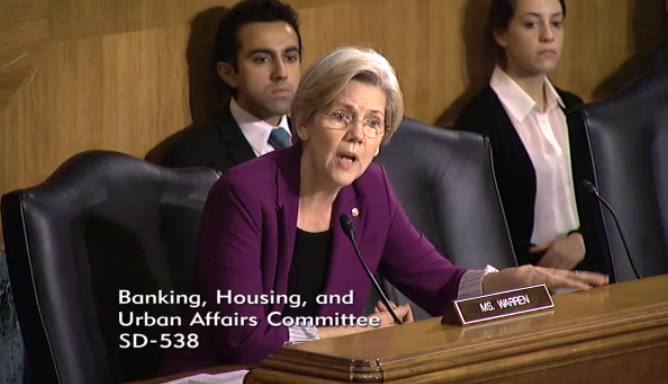
Elizabeth Warren Introduces 21st Century Glass-Steagall Act

At today's Senate Banking Committee hearing, Elizabeth Warren introduced the 21st Century Glass-Steagall Act of 2013, co-sponsored by Senators McCain, Cantwell, and King. The bill mirrors the heart of the original 1933 law, which separated traditional banking activity (like checking and lending) from the riskier activity investment banking (like derivatives).
The original law was repealed in 1999 toward the end of the Clinton administration, though the law had been eroding for years leading up to 1999. This repeal was one of several laws passed during that era which allowed the big banks to transform into megabanks, in part creating our current "too big to fail" policy.
To illustrate, the chart below shows that from 1935 to 1990 the three biggest banks averaged around 10% of total bank assets, but by 2009 they suddenly had over 40%.
This new bill from Senator Warren aims to play a part in reversing this trend so the banks will be smaller. After all, the three biggest banks (Chase, Bank of America, and Citi) are all bloated conglomerate banks that have enormous traditional and investment subsidiaries, so these banks wouldn't be able to continue as they're currently instituted. They would be broken up into much smaller firms.
What's more, the 21st Century Glass-Steagall Act of 2013 will make it so banks cannot gamble with derivatives using depositor's money like they do today. Currently, anyone who has money at banks like Chase, Bank of America, or Citi is implicitly using that money to help these banks make amplified bets that have the potential to cause another global meltdown. Reintroducing Glass-Steagall will make it so depositor's money cannot be used for the derivatives market. This would be a major step toward restoring sanity to Wall Street.
For more on why it's important to restore Glass-Steagall, see this compilation video that shows expert after expert calling to restore it:
Perhaps one of the best quotes from the video is from University of Chicago economist Luigi Zingales who says the strength of Glass-Steagall was its simplicity. The new bill from Warren shares that strength. It's a mere 30 pages (compare that to the 30,000 pages of rules that will come out of Dodd-Frank).

 You can read the full text of the bill here, or glance at the fact sheet