Showing posts with label Citi Bank. Show all posts

Thursday, September 12, 2013

Regulators Warn Banks Not to Flout $25B Foreclosure Deal


SEP 12, 2013 12:50pm ET

Regulators Warn Banks Not to Flout $25B Foreclosure Deal


When the largest U.S. banks agreed to pay $25 billion last year to settle claims of abusive foreclosure practices, they promised to stop seizing homes from borrowers who had completed applications for mortgage help.
Now regulators say lenders may be flouting the spirit of the deal by repeatedly asking for additional paperwork from borrowers seeking loan modifications and then foreclosing while treating the applications as incomplete.
The Consumer Financial Protection Bureau and the court-appointed monitor of the 2012 foreclosure settlement are among those moving to tighten oversight of the process known as dual-tracking, when borrowers facing the loss of their homes are simultaneously negotiating changes in their loans. Mortgage servicers who violate the rules or the terms of the deal could face sanctions including fines of $1 million per infraction.
“It is an important outstanding issue of unfinished business,” Joseph A. Smith Jr., the monitor, said in an interview.
Smith, who is responsible for ensuring Bank of America Corp., JPMorgan Chase & Co., Wells Fargo & Co., Ally Financial Inc. and Citigroup Inc. live up to their promises, said he is preparing to start measuring how well banks are communicating with borrowers about loan-workout applications. That could determine whether the servicers or homeowners are at fault for incomplete files.
Separately, the consumer bureau this week plans to complete proposed changes to pending mortgage-servicing rules aimed at tightening restrictions on dual-tracking, according to a person briefed on its work. The rules, to take effect in January, would cover all lenders, including those who aren’t parties to the settlement such as Ocwen Financial Corp. and Nationstar Mortgage Holdings.
Richard Cordray, director of the consumer bureau, said in an interview that he has personally met with the heads of the top 25 mortgage servicers, banks and non-banks alike, “to tell them face to face that this is a major priority for the bureau and that it’s something they need to focus on.”
Other U.S. and state agencies also have vowed to pursue banks that violate the settlement terms. U.S. Housing and Urban Development secretary Shaun Donovan has said that authorities would fine banks or “haul them back into court” if they failed to improve treatment of borrowers. New York attorney general Eric Schneiderman said he is preparing to sue Bank of America and Wells Fargo for breaching the terms of the settlement.
Paul Leonard, a senior vice president at the Housing Policy Council, a group representing mortgage servicers, said complaints about dual-tracking partly reflect a “misunderstanding” of what the settlement requires.
“Some people think that if there is any contact from the servicer to the borrower that any part of the foreclosure process stops,” Leonard said in an interview. “That is not the case.”
Bank of America “is in compliance with all standards related to dual-tracking,” spokesman Rick Simon said in an emailed statement.
Even as foreclosures decline and the housing market turns around, nearly 2.9 million borrowers have missed at least three mortgage payments and remain in danger of losing their homes, according to data compiled by the housing department. Loan modifications, which reduce monthly payments, are meant to help delinquent borrowers become current again.
Lenders have completed nearly five million mortgage workouts since 2009, about 1.2 million of them through the Home Affordable Modification Program, in which the U.S. Treasury offers incentive payments to lenders for each loan modified for a delinquent borrower. The median HAMP workout reduced borrowers’ monthly mortgage payments by nearly 40%, or $547, according to Treasury data.
During the same time period, servicers repossessed about 3.7 million homes, according to data compiled by RealtyTrac Inc.
While no national data has been published that measures the scope of dual-tracking, housing lawyers and advocates said that they continue to see homeowners who were wronged in the workout process.
“We’re hearing complaints from customers of every major servicer,” said Gary Klein, a Massachusetts attorney whose clients have sued Bank of America for failing to modify their mortgages.
U.S. District Judge Rya Zobel in Boston last week denied the request of homeowners in 26 states, including Klein’s clients, to be considered for class-action status because their claims were not similar enough. Still, Zobel said that Bank of America had a “Kafkaesque bureaucracy” that determined which documents homeowners had to submit and said the borrowers’ claims “may well be meritorious.”
John Bartholomew, an attorney with the Atlanta Legal Aid Society, said an example of the pattern is how Citigroup dealt with one of his clients, Gwendolyn Green, a drugstore employee in Loganville, Ga.
Green said in an interview that she fell behind on her mortgage payments after her former husband’s truck-parts business went bankrupt and they divorced. She first applied to Citigroup for a loan modification in October 2012. On July 1, the bank notified her she’d have one. Then came the bad news: Her monthly payment would be reduced by only $1.01, to $984.49.
Even though she began making the payments under the program, Green said, Citigroup notified her it still plans to seize the ranch home, which has an assessed value of $115,000, on Oct. 2.
Green said Citigroup repeatedly demanded paperwork she had already faxed multiple times, notably a document confirming her sole ownership of the home. She said she kept records to prove it.
“They keep asking for the same things over and over and over again,” Green said. “They change people who handle the case, and each time a new person comes on, they ask for the same things.”
Citigroup spokesman Mark Rodgers declined to discuss Green’s case other than to say that the bank “correctly followed strict guidelines set forth by governmental agencies” when dealing with her loan modification.
The HAMP program, under which Green applied for help, also bars dual-tracking. Still, the HAMP rulebook “does not say that foreclosure sales cannot be scheduled and postponed,” Rodgers said.
“There is no universe where Citi is allowed to schedule homeowners like Ms. Green for three consecutive foreclosures after they’ve accepted and are current on a trial modification,” Bartholomew said.
Like the national settlement, the consumer bureau’s rules, which were first published in January, will bar foreclosure when a homeowner has submitted a complete application for a loan modification. The new language to be inserted this week could also bar foreclosure if a servicer has told a borrower that an application is complete and subsequently discovers that more documentation is required.
The agency also has been soliciting public feedback about whether it needs to be even more prescriptive in defining what constitutes a finished application so that isn’t left up to the banks. Commenters including Massachusetts Attorney General Martha Coakley responded that there should be a more uniform definition of when the paperwork is complete.
Cordray said the regulations will be “very specific” about the requirements.
“I would have been glad to be able to think that we could oversee the industry with looser rules, but I just don’t think we can,” Cordray said.
Katherine Porter, who monitors the mortgage settlement on behalf of California attorney general Kamala Harris, identified the lack of a concrete definition of a complete loan-assistance application as a “serious problem” in a June report.
Porter said she has received more than 3,300 complaints from homeowners that banks aren’t following the rules. The breakdowns usually involve communication failures between departments of the same bank or the incompatibility of computer systems containing different pieces of information about a loan file, she said in an interview.
The banks “do make calls. They do send letters,” Porter said. “And I think many of the consumers are really desperately trying to get their documents in. There’s a mismatch in the way that they’re communicating with each other.”
Porter said that if she had one wish, “I would wish for deep investment in better technology.”
Technology woes were at the root of Smith’s findings in a June report that monitored the settlement banks’ servicing practices. The report showed that Citigroup, Bank of America and Wells Fargo had failed to meet deadlines for notifying borrowers that their workout applications were incomplete.
“Areas in which our performance has temporarily fallen outside of the allowable thresholds did not result in inaccurate foreclosures or improper loan-modification denials, and corrective action plans for those areas are being submitted to the monitor and implemented,” Simon, the Bank of America spokesman, said.

Saturday, August 17, 2013

Got some good reading herefor everyone

The enforcement actions were based on interagency examinations conducted in the fourth quarter of 2010. A summary of the findings of the interagency reviews is available in the Interagency Review of Foreclosure Policies and Practices, which was produced by the OCC, the Board of Governors of the Federal Reserve System, and the OTS.

Links to the OCC and former OTS Enforcement Actions (Issued April 2011):

Links to Enforcement Action Amendments for Servicers Entering the Independent Foreclosure Review Payment Agreement (Issued February 2013):

Just hit link in the blue 

Wednesday, August 14, 2013

Break-up-the-big-banks fever hits the states


Its time to wake up our State Legislatures, and demand that they stand with others to bring down to big to fail! We also need to tell them private hedge funds trying to pass the fraudulent mortgage notes these banks had, are also fraud!!

A JPMorgan Chase Bank is pictured. | AP Photo
So far, only Maine and South Dakota have approved a Glass-Steagall resolution. | AP Photo
Elizabeth Warren’s effort to break up Wall Street banks through a return to Depression-era laws may not have a lot of support in Congress, but it has a sympathetic audience in state capitals across the country.
Lawmakers in at least 18 states have introduced resolutions this year calling on Congress to split up banking giants by putting back in place a wall between commercial banking, taking deposits and making loans, and investment banking, the world of traders and deal-makers.


Five years after the 2008 financial crisis and three years after enactment of the 2010 Dodd-Frank law, these symbolic resolutions show there is still a significant amount of public anger toward big banks.
And if these proposals gain enough traction in state legislatures, a growing number of members of Congress could feel pressure to get behind this effort to reinstate the 1933 Glass-Steagall Act — a cause Warren championed as a candidate and has reinvigorated as a freshman Massachusetts senator.

“We on the state level have been looking for an Elizabeth Warren — someone to carry this banner for us,” said Illinois state Rep. Mary Flowers, a Democrat who is the lead sponsor on a resolution introduced in May that urges Congress to reinstate Glass-Steagall, which was repealed in 1999.
Maryland Democratic state Del. Aisha Braveboy, who co-sponsored a resolution in her state, said: “She is the inspiration.”
So far, only Maine and South Dakota have approved a Glass-Steagall resolution. The states where lawmakers are pressing the issue include Mississippi, Pennsylvania, Alabama and California.
This week, the National Conference of State Legislatures will vote on a Glass-Steagall resolution introduced by Delaware Republican state Sen. Catherine Cloutier at its legislative summit in Atlanta.

Large banks aren’t taking the issue lightly.
Take Delaware — corporate home to the credit card operations of several banks.
When a group of bipartisan state senators introduced a resolution in June calling for a return to Glass-Steagall, four lobbyists — including those working on behalf of JPMorgan Chase and Bank of America — showed up at a hearing to denounce the idea. The resolution was shelved.
“I can’t say I was really surprised by the pushback,” said state Sen. Bruce Ennis, a Democrat who is one of the resolution’s co-sponsors. “They don’t want to rock the boat.”
Delaware state Sen. Robert Venables, a Democrat and another co-sponsor, added: “I’m 80 years old and I remember the aftermath of the Great Depression — this was why it was put in. And then the Clinton administration repealed it.”
Not all state lawmakers pushing for a breakup of big banks cite Warren, a liberal who came to prominence because of her calls to get tough on Wall Street, as an inspiration. Several are conservatives with a tea partier’s dislike of Wall Street and the taxpayer bailouts that resulted from the financial crisis.
In South Dakota, state Rep. Stace Nelson — a self-described tea partier with a “mean libertarian” streak — and other state lawmakers urged Senate Banking Committee Chairman Tim Johnson (D-S.D.) last month to support Glass-Steagall after the state Legislature adopted the measure earlier this year.
“People are gravely concerned about what has happened on Wall Street with the bailouts and the government getting involved,” said Nelson, who has formed a 2014 Senate exploratory committee.

Read more: http://www.politico.com/story/2013/08/break-up-the-big-banks-fever-hits-the-states-95481.html#ixzz2byMu8N8o

Monday, August 5, 2013

Why you should change banks

 Lets not leave out US BANK corp.. they have had there hands in full swing on foreclosures , and supplying private hedge funds with cash to buy your homes, most illegally.


9 Reasons To Change Banks – Switch From Wall Street

Reason #1: People Who Change Banks Like It

change banks satisfaction
People who bank with local lenders are far more satisfied than those who bank on Wall Street. (source)


Reason #2: The Wall Street Banks Are Still Too Big to Fail

if the biggest banks were too big to fail aligned


Reason #3: The Wall Street Banks Are Still Too Big to Jail

HSBC drug laundering


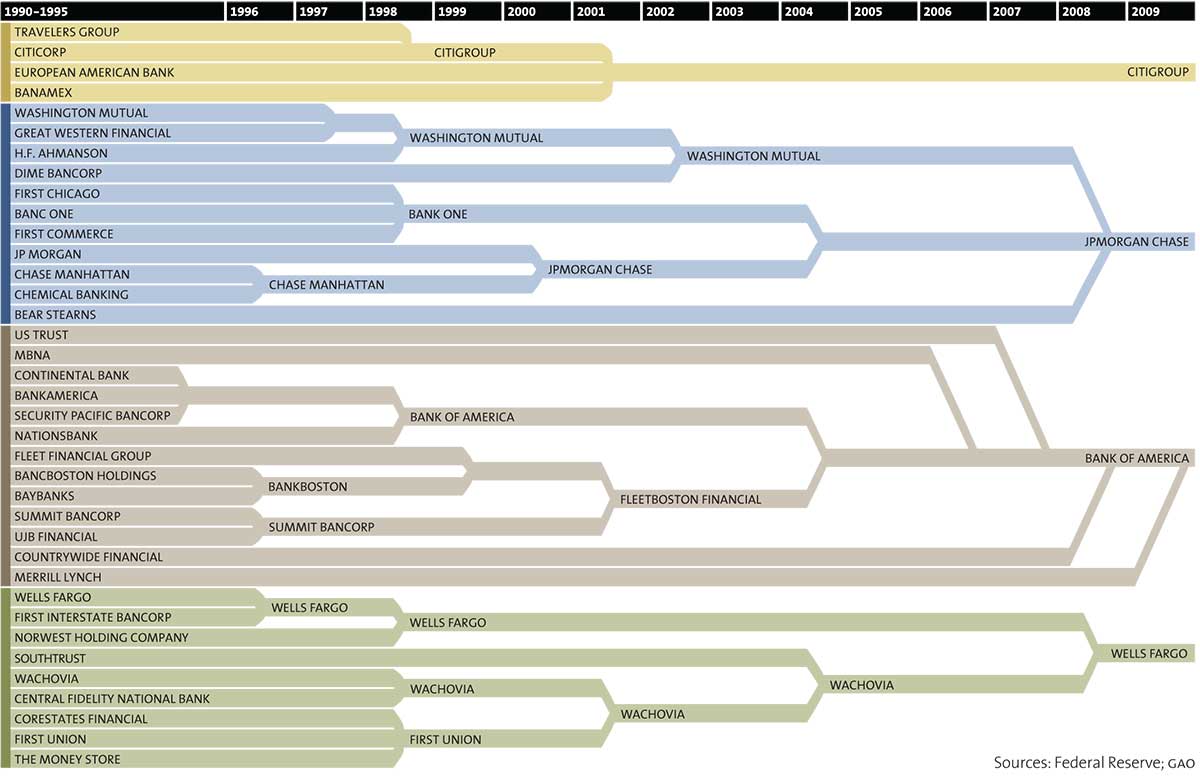
Reason #4: The Wall Street Banks Are Too Big to Manage

sheila bair bull by the horns too big to manage
The megabanks have grown tremendously over the past two decades, making it harder for them to properly manage all their various international pieces.
bank concentration timeline
SOURCE


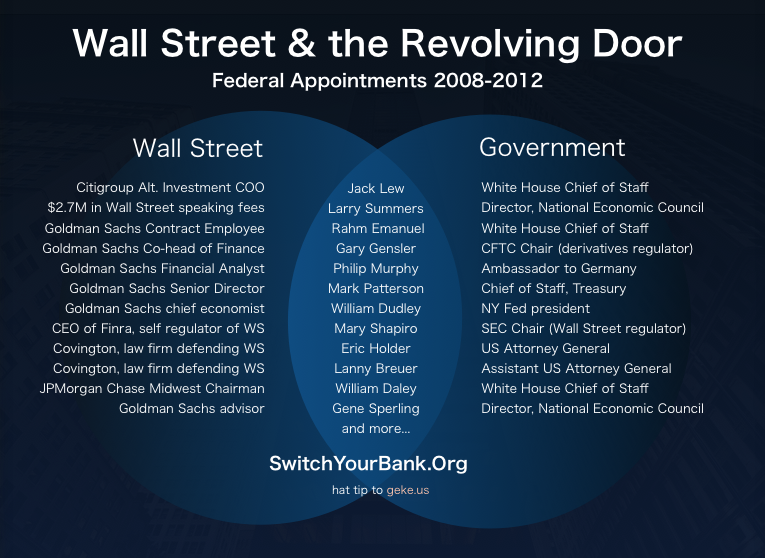
Reason #5: Wall Street Has Captured Washington

Wall Street revolving door


Reason #6: Wall Street Continues To Gamble With the Economy

Gambling on Wall Street lies behind boring, impenetrable names like credit default swaps, synthetic credit derivatives, and mortgage-back securities. All of these bets are types of derivatives. The financial crisis of 2008 occurred largely because these particular derivatives bets went bad. And yet the worldwide derivatives market continues to explode, from under $100 trillion in notional value in 2000 to over $700 trillion in 2011.
Worldwide Derivatives
SOURCE
What’s more, nearly half of the worldwide derivatives exposure is centered in the United States, and 95% of the total U.S. derivatives exposure comes from 5 megabanks.
wall street derivatives
SOURCE


Reason #7: Small Lenders Charge Less in Fees

wall street fees
Smaller lenders charge less in account fees, overdraft fees, and off-us ATM fees, as shown in a study from the PIRG Education Fund. According to the study, a substantive portion of small lenders belong to ATM networks that don’t charge anything if you use an ATM which doesn’t belong to your financial institution. That’s better than some megabanks offer.


Reason #8: Small Lenders Are Far More Likely to Offer Totally Free Checking

lower checking
Small financial institutions are more likely to offer totally free checking accounts. No loopholes or snags. Chart from the Institute of Local Self-Reliance.


Reason #9: Small Lenders Are Far Better For Your Community

If you want to support local job creation, one way to do it is to support local lenders.
bank local
Local lenders also make nearly 40% of small business loans, even though they only have 10% of total bank assets. (source)
bank local

Conclusion – Why Change Banks?

The problem with the megabanks is that they’re locked in a destructive cycle of being too big to manage, too big to fail, and too big to jail. They continue to have unpredictable, catastrophic losses. The losses lead inevitably to declarations of “too big to fail” (and bailouts). Being “too big to fail” means that the megabanks can’t be prosecuted without endangering the entire economy (or so they say), which makes the megabanks even bigger—and, again (back to the start!), too big to manage.
Therefore:
If you want to help end “too big to fail,” if you opposed the megabank bailouts, if you’re tired of megabanks getting away with crime, if you recognize that these institutions have become too big to manage, if you want to ensure that we never repeat the vast injustice at play in the 2008 crisis, then switch your bank.
You might be thinking, “Yes, okay, Wall Street makes the economy dangerous. But there are plenty of things that make the economy dangerous—more than I could ever effectively boycott.”
That’s why, even if you don’t think changing banks will make much difference for the fiscal health of the nation, you should still change banks for many of the personal advantages listed above. Either, way changing banks to a local lender is a good idea.

Global Destruction

Be the first to watch

http://www.toobighasfailed.org/2013/08/05/video-first-showing/

Monday, July 8, 2013

If Citi Bank has your mortgage

 If Citi bank has your mortgage - demand they not sell it to  Penny Mac- they are the Country Wide employees who got us into this mess. Call CITI and demand they keep your Mortgage. These people will lie, cheat and steal your homes, and their will be no work outs , and the ones that are will fail. Like the past they won't have the actual paperwork and watch out for Orion Financial Group, Iron Mountain on them papers.


PennyMac Mortgage Investment Trust has inked a deal to buy $140 million of nonperforming mortgages and residential “real property” from Citigroup for a sum to be determined in the future.
Citigroup, which runs an active NPL trading desk, acquired the assets from an unnamed “large money-center bank,” according to a new filing with the SEC.
The NPL purchase was the second deal announced by PennyMac in the past 30 days. The other involved the purchase of $257 million of mortgages in mid June.
PennyMac and Citigroup have done business in the NPL space before. Citigroup also has been a repo lender to PennyMac.