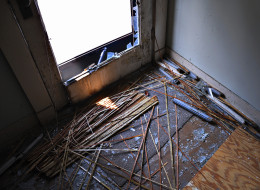
They are independent contractors working indirectly for banks, including Wells Fargo, JPMorgan Chase and Bank of America.
Mortgage agreements give these banks the right to enter abandoned properties, even those that are locked up, to secure them against the ravages of weather and to perform other simple repairs. But the contractors they hire to do this work sometimes force their way into houses and condominiums that are still occupied by their owners, changing out locks and removing what they find inside, including family heirlooms and other valuables.
"These companies don't ask the homeowner, don't go to a court to get permission to go inside," said Matthew Weidner, a consumer lawyer in St. Petersburg, Fla., who has handled several such cases. "They just send unlicensed, unregulated people who break down doors and do whatever they want."
Fed up with what they claim is a serious violation of their property rights -- and sometimes outright theft -- homeowners are fighting back.
In the past five years, people in 31 states have filed more than 250 lawsuits against the six largest national companies that contract directly with banks to inspect and repair homes in some stage of default or foreclosure, a Huffington Post review of court records found. The majority of these cases have come in the past 18 months.
The most-sued contractor is Safeguard Properties, based in Valley View, Ohio. The company, the subject of a previous HuffPost investigation and a new NBC News report, has been named in at least 135 lawsuits filed by homeowners alleging unwarranted break-ins.
Lawyers and other industry experts say growing awareness of the national scope of the problem has pushed more consumer complaints into courts. On Facebook and in online forums, homeowners swap tales of unauthorized break-ins and theft and solicit advice for how best to respond. Some attorneys who brought early cases against the industry are now sought for their expertise.
"I get these calls all the time," Weidner said.
One of his clients, Deanna Tedone, returned to her Tampa, Fla., home last year to discover that a contractor working for U.S. Bank had ripped huge holes in her walls, purportedly on a search for hazardous Chinese-made drywall.
The bank claims it was simply trying to protect its investment in the property, where Tedone and her husband had quit making monthly mortgage payments. But neither the bank nor the contractor, who worked for Five Brothers, based in Warren, Mich., had bothered to inform Tedone, who still owned the house, that such a radical procedure was in store, she claims in a lawsuit. Moreover, the contractor made a mess of it -- ripping out walls, leaving huge piles of possibly contaminated rubble strewn about, all without obtaining the proper permits from the city, she said.
The bank's action essentially killed any chance that she could sell her home at a short sale, and thus avoid the huge hit to her credit that a foreclosure deals, Tedone said.
"When you sell you have to disclose everything," she said. "And I don't know what was done."
Conflicts between contractors and homeowners are an outgrowth of a housing crisis that fueled rapid expansion in a previously little-noticed corner of the mortgage industry. In the past decade, the largest banks have increasingly outsourced their responsibilities to look after distressed real estate to a growing cadre of companies that do what is called property preservation, or field-services work.
Even now, with the housing market booming again in some areas, more than 3 million homes in some stage of default or foreclosure are subject to a monthly bank inspection, according to RealtyTrac, an online real estate company.
Disputes most often arise in instances where a borrower has missed a few payments, or is in the early stages of the foreclosure process. Sometimes owners just walk away from their homes, leaving it to the bank to mow lawns, fix broken windows or patch roofs.
Bank inspectors are sent each month to look for evidence of abandonment, but too often, say homeowners and even some of the contract workers themselves, they don't even get out of the car.
This is a result of lax supervision and regulation, critics say. Inspectors have little financial incentive to be cautious, often earning just a few dollars to inspect a property, after various other subcontractors have taken a cut of what the bank pays for inspections. On Craigslist, contractors solicit workers to inspect homes for as little as $1 or $2 each.
Bad inspections lead to work orders issued to clean out or lock up homes that are still inhabited by their rightful owners. Dozens of complaints allege that a resident was at work or on vacation when a contractor break-in occurred.
Adam Reynolds, a Naples, Fla., contractor who owned his own preservation company until last year, said he was routinely dispatched on such missions. "Countless times," he said, he would punch out a door lock and go inside a residence only to discover personal photos on the shelves and fresh food in the refrigerator.
Reynolds said he would immediately leave the property in such situations, as the contracting companies require in written guidelines. But others go ahead with these work orders, regardless of what they discover inside, homeowners and other contractors maintain. Indeed, some appear to see a fully stocked home as an opportunity to loot valuables.
In Chicago, Majorie Principe claims she returned home to find that a Safeguard contractor had taken her furniture, books, savings bonds and electronics.
In Cleveland, Bruce Brown claims a Safeguard contractor stole all of his clothes.
In Atlanta, Woldeab Medhin was arrested after he forced his way back into his home after a Safeguard contractor locked him out. The worker, as it turned out, had the address mixed up and was at the wrong house.
All have sued, seeking unspecified monetary compensation.
Safeguard is also the target of a fraud lawsuit filed earlier this month by Illinois Attorney General Lisa Madigan. Her office has received more than 300 complaints against the company in Illinois alone, she says.
More state actions could be coming. A spokeswoman for the Florida attorney general said her office was "reviewing" complaints regarding Safeguard.
In addition, plaintiffs' lawyers have named Safeguard in two class-action lawsuits: one filed in Chicago federal district court and another in Ohio, in Cuyahoga County state court.
In at least two instances, homeowners have alleged that the worker Safeguard hired to fix up or clean out a property had a lengthy criminal background.
For its part, Safeguard maintains that it strictly oversees and screens its subcontractors, performing background checks, auditing their work and requiring that they carry insurance. The company says the number of complaints against it is partly a function of its size: Safeguard completed 1.5 million work orders last year, the company said, making it far and away the biggest player in the industry.
A Safeguard spokeswoman declined to comment further on the Illinois investigation, or the homeowner lawsuits.
So far, there isn't much case history to suggest how this litigation will turn out. Some previous lawsuits have been dismissed, others have settled for undisclosed sums.
But Safeguard has shown it's willing to fight back. The company recently sued Kevin Kubovcik, a former employee who ran its complaint department until 2010. In April, Kubovcik provided HuffPost with records that showed he was logging about 85 incidents a month involving an alleged theft or break-in. The company claims that disclosure violated a confidentiality agreement and is seeking "in excess" of $25,000 from Kubovic.
It's also unclear how much legal liability the banks that hire companies like Safeguard have for such alleged abuses. In the past, banks have tried to shunt liability onto the contracting companies. But the $25 billion settlement struck with state attorney generals last year requires that five of the largest banks "perform appropriate due diligence" in examining any third-party contractors' "expertise, complaints and qualifications." Failure to do so could hypothetically lead to fines or other penalties. No public actions have been taken yet.
Sonia Wisniewska, a California homeowner, said she hopes heightened scrutiny of the property preservation industry will help yield a favorable result in her lawsuit against Wells Fargo and another large contracting company, Lender Processing Services, which she filed last month.
Wisniewska's case is one of the most unusual of those reviewed by HuffPost. She lives alone in a remote corner of Santa Barbara County, on a ranch miles from the nearest neighbor. One afternoon last year, Wisniewska angrily confronted a contract worker who snuck through the security gate guarding her long driveway.
When the contractor refused to leave, Wisniewska retrieved her shotgun and fired a warning shot into the sky. She was arrested on grounds that she had recklessly discharged a firearm.
Although the charges were eventually dismissed, Wisniewska claims the turmoil scared off a friend who was prepared to assume the ranch's deed and thus allow her to avoid foreclosure on a property she could no longer afford to keep.
The experience, Wisniewska said, was devastating. "I couldn’t get a job with the felony hanging over me. I lost weight. I had insomnia and depression," she said. "I don't want anyone else to have to go through this."
